
I teach online correspondence courses every month in philosophy and history, and I highly recommend you check them out. It’s a great way to get in some guided self-learning, with a whole month of being able to pick my brain about the subject for a very affordable price. But I also promote self-learning through reading. My standard recommendations lists include philosophy (contemporary naturalism) and history (the origins of Christianity and ancient science), and I cycle through all three subjects every month. These represent the books I think one needs to dive into first to build an expert understanding of each subject. And I have been running a series reviewing them all, which this entry continues.
As always, I get a commission on anything you buy on Amazon after clicking any link on my website, here or elsewhere. In fact, I get a commission on everything in your cart when you check out within 24 hours after following a link from my site, even if you don’t buy the item you clicked on but instead wander around Amazon and buy, say, a giant box of quality rice pilaf or a gift set of prestige olive oils and vinegars instead (those links might not convert outside the US; but follow a link that does—books usually do—and then find whatever products yourself in Amazon, and my commission on it all applies when you check out).
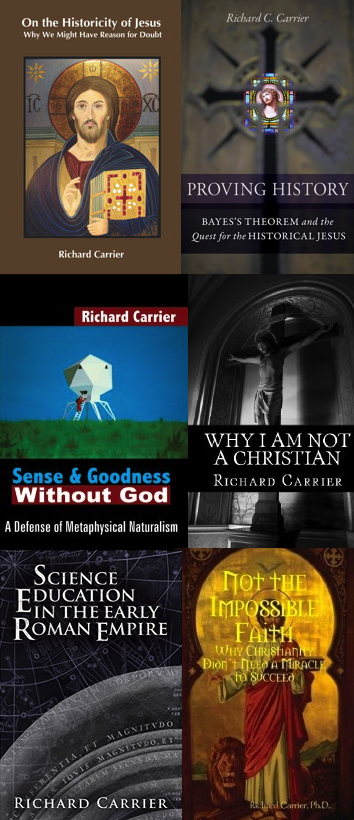
The books I’ll be discussing today are about the philosophy of history, including my own peer-reviewed study on that, Proving History: Bayes’s Theorem and the Quest for the Historical Jesus (Prometheus Books, an imprint now of Rowman & Littlefield, 2012). Amazon keeps claiming it’s “ring bound” or “loose leaf” but there is no such thing. They can’t correct their own database for some reason. It’s actually a lovely casebound hardback. So whatever they say there is “ring bound” or “loose leaf,” just know, they “mean” a standard hardcover book. The other works I recommend just as highly for mastering this subject—indeed, they are essential reading for all historians, and philosophers who want to tackle the philosophy of history—are: David Hackett Fischer, Historians’ Fallacies: Toward a Logic of Historical Thought (Harper & Row 1970) and Aviezer Tucker, Our Knowledge of the Past: A Philosophy of Historiography (Cambridge University Press 2004).


-:-
Proving History
In Proving History I outline how all historical methodologies reduce to Bayes’ Theorem, that being the engine underneath driving and justifying correct uses of every method. I continue that case, and in the simplest terms I can, in The Obsolete Paradigm of a Historical Jesus, which may be the best place for someone to start, but if you want to dive into the philosophical and mathematical details of why this is, why it matters, and what that tells us about the epistemology and ontology of history, Proving History is where then to go. Although it uses Jesus studies as the working example (because it was written as the methodology section of my historicity of Jesus postdoc research program), it universally applies to all historical fields.
Proving History is also not a book that ever argues against the historicity of Jesus—so anyone who claims it does has obviously not read it, or not paid attention when they did. The first study I ever published arguing against historicity was On the Historicity of Jesus two years later. Rather, Proving History analyzes (in chapter four) all the general methods used in all fields of history, like the argument from evidence, the argument to the best explanation, the argument from silence, and Ockham’s Razor, and then spends only one chapter (chapter five) on the methods uniquely employed in Jesus studies. It does find them all defunct, and shows why they don’t work and can’t accomplish what Jesus historians claim of them. But that only means those arguments don’t work. That does not entail Jesus did not exist or that there aren’t arguments to that conclusion that do work. And it isn’t even a fringe position. It is in fact the mainstream consensus of all specialists examining the merits of those methods: as I cite in Proving History, every study (literally every single study) of whether those methods work found that they do not (e.g., I show there are ways to get some of them to work, but they then don’t get the results anyone wants). Jesus historians just keep using them anyway, ignoring their own field’s literature (which is genuinely a common problem in that field).
The rest builds out the underlying architecture, explaining the problem (chapter one); the basic required assumptions (“axioms”) of history as a knowledge-field (chapter two); and what Bayes’ Theorem is and how it works (chapter three). Chapters four and five then apply those findings to the methods of history (generally, in four; and specifically regarding Jesus, in five). Chapter six then covers all the deep meta-mathematical and meta-epistemological questions this all creates. That chapter is of help to historians (e.g. in resolving complex questions of choosing a valid reference class for any hypothesis they test) and to philosophers (e.g. in resolving common arguments between so-called Bayesian “subjectivists” and statistical “frequentists” in defining and developing probabilities).
Because of this, I contractually mandated its publisher only release the book if it passes peer review with a professor of mathematics and a professor of Biblical studies. So it meets the bar of academic quality. Which is why all the one-star reviews of it on Amazon are self-evidently specious or desperate, while the five-star reviews, six times more numerous, tend to give you a good idea of what the book’s value is. If there was anything I would change, it would be to flip the degree to which I emphasize the Odds Form over the Long Form of Bayes’ Theorem. I cover both, but assume the Long Form is standard and teach from that. In the decade since I have found that the subject is easier to teach the other way around, because humans more intuitively grasp frequency-based reasoning than percentage-based reasoning. Not everyone (some find the latter easier). But a lot. And so all my subsequent work has emphasized the Odds Form. But it is still important to understand both if you want to be well grounded in the philosophy of history. I would also meet the request to add more fully-explored examples (which I now do in Obsolete Paradigm).
Our Knowledge of the Past
Almost a decade before I published, the same conclusion was reached and defended by an actual specialist in the philosophy of history, Aviezer Tucker, in Our Knowledge of the Past. He has since published the Cambridge Element on the philosophy of history, Historiographic Reasoning (2025) and edited The Bloomsbury Handbook of the Philosophy of the Historical Sciences and Big History (2025). This is essential reading because it independently corroborates the central thesis of Proving History, justifies it on a broader field-wide analysis of history as a whole (it is not about Jesus studies), and focuses on how it all ties into the philosophy and logic of the history of the philosophy of history. For a good take on it (which you may find productive agreement or disagreement with) see Notre Dame Philosophical Reviews. Whether you agree with Tucker or not, on all or any of it, his book is still essential for setting the stage of what there is to agree or disagree with. And that’s what makes it the fundamental starter kit to any philosopher of history who wants to expand beyond just my treatment of the subject.
Historians’ Fallacies
Which leaves Fischer’s Historians’ Fallacies. This is a work in the philosophy of history that comes from an actual working historian. And though he is a renowned specialist in early American history, Fischer does not limit his survey to his own field but finds countless examples across all fields of history. Fischer’s overall thesis is that historians need to identify the underlying logic that makes any conclusion in history “true,” and that they have not done this, and this has resulted in a plethora of continuing failures, where fallacious reasoning ends up being promoted as mainstream when it isn’t even correct. Fischer’s declared aim is to try and fix this by “finding” the real logical formula by which conclusions in history are justifiable, but in the end he admits he could not discern it, and thus has to resort to the next best thing: cataloguing and critiquing failures of logic by even renowned historians, in the hopes of furthering the quest for what all those failures have in common that can lead to what all avoidances of those failures would then have in common—which would then be “the thing” that he is looking for, the logical foundation of all historical methodologies.
As Tucker and myself have found (with which now many other historians concur: see my bibliography in Obsolete Paradigm, pp. 155–58; cf. 145), what Fischer was looking for was, indeed, Bayes’ Theorem. That is the formula underlying all sound historical reasoning, and with which all fallacies of history can be spotted and corrected. But to fully understand that one needs to read Fischer’s survey. Because besides being witty and a fun read throughout, his book documents numerous cases of bad reasoning being treated as good reasoning across all fields of history. And (like me) as a working historian he understands the demands and standards of history “on the ground” (as-it-were). His book thus provides an invaluable and expertly curated database of examples of actual historical reasoning, with which one can start formulating theories in the philosophy of history, both epistemological (how exactly do we know things about our collective past) and ontological (what does it mean for the past to exist and have causal powers on the present).
Conclusion
Of these, Fischer is the most enjoyable to read. It will get you chuckling more than once. He’s a good writer. And a good historian. While Tucker is the most important in raw philosophical grounding, a crucial bridgework between Fischer’s study and mine, and really should be the centerpiece of any dive you do into the philosophy of history. And then my contribution is the most up to date and direct, solving problems and matters of practice that Tucker does not delve into, with many sections that will be gripping and rewarding reading for those interested more specifically in counter-apoologetics and how Christians distort and abuse historical reasoning and methodologies, practices that have bled over even into secular scholars in biblical studies, who were all trained by apologists (or by mentors so trained) and emulate a literature that is also predominately apologetical in motive or training, and thus like fish unaware of the water they swim through they tend to be unaware of how invalid or wrong so many of their standard methods and practices are.
All three books remain essential reading in the philosophy of history because they complete the needed coverage to understand it. Fischer’s database of examples educates you in the breadth and depth of historical reasoning from a deliberate perspective of philosophy and logic, in a way you won’t get anywhere else (not even from Tucker or me). And though I became aware of Tucker after I published, I had independently discovered everything he did (a strong argument for our being right). And thus my treatment effectively dives you into applying the results and findings of Tucker into actual practice, and to resolving debates he focused less on, thereby combining Tucker with Fischer: drilling down on a specific example (the specialist field of Jesus studies, and specific examples of practices and results in that field) more deeply than Fischer (which can then be adapted to any other subfield) using the philosophical framework described and defended from a philosopher’s point of view by Tucker, thus resolving the open question left by Fischer.
Discover more from Richard Carrier Blogs
Subscribe to get the latest posts sent to your email.






Not a comment, Richard, but just calling your attention to the latest issue of Free Inquiry, the publication of the Center for Inquiry. At https://secularhumanism.org/2026/01/the-five-challenges-unanswered/ it focuses on the mythicist case with several essays. Not high-level stuff, but illuminating of the difficulties of overcoming ingrained cultural biases.
Interesting to me was a comment by Bill Cooke that mythicism reads in antisemitism. As a mythicist coming out of Judaism, I can tell him–he’s full of it. To the contrary, it makes absolute sense. It’s the thought that a man can be God that is antithetical to Judaism, not that there are agents of God in the world.
Good grief. That Cooke fella is a bit full of himself. Doesn’t appear to have kept up with yesterday in Biblical Criticism never mind today. We are at the ‘Why we have reason to doubt the historicity of Paul’ point now from numerous accredited scholars; nevermind that of JC! Who, if Marcion has priority as an overlapping slew of scholars are arguing, wasn’t Jewish whether or not he was historical. He might have been from Palestine, but Marcion’s JC wasn’t peddling Jehovah but the antithesis. I’m increasingly of the view that whether or not Jesus and Paul were real people we can’t reach back that far: all we can be sure of is already mythology and legend when stylus first put to wax, several competing literary versions of each that can’t be said to overlap terribly much. Arguments to historicity are pretty moot when myth and legend is all that can be recovered.
But but but what if they get to the bottom of Oxyrhyncus before Thermonuclear War ‘Game’?
😉
Thank you. I was aware. Cooke (and Lindsay, same issue) don’t say anything new. I already refuted all this when they published essentially all the same arguments a year ago:
See That Phenomenally Stupid Article by Bill Cooke.
Note the Update at the bottom there, which covers the issue you are talking about.
Also, general advice: it’s worth bookmarking my article List of Responses to Defenders of the Historicity of Jesus because I update that continually. You’ll notice there is an entry for Cooke there (and Lindsay, though they point to the same place because theirs was a tag-team propaganda move).
Proving History is listed in hardback as well as ring-bound, audiobook, & Kindle on Amazon UK. It has doubled in price in hardback since I bought it 13 years ago this month; AND they think my order was for the mythical ring-bound edition! Is there not a paperback edition? The Tucker tomes are probably best picked as good second-hand paperbacks if we want a physical copy. $68 for 78 pages has to be the silliest price I’ve seen in a good long year for an academic title.
Sadly, when I click your links, they are still going to the US site for me. Very weird how it works for some and not others.
Proving History is a fantastic work. It makes learning Bayesian reasoning accessible and learnable for those less mathematically inclined. I credit this book for sharpening my own critical thinking skills.
Thank you. That’s helpful to hear.
There is a YouTube channel about philosophy of history and historiography that includes talks and interviews with Aviezer Tucker:
https://youtube.com/@cpshoulu?si=V63qcMkwiyKKP2hJ
Maybe tangential to your blogpost, but let me ask you this: How scientific (or pseudoscientific) do you think the field of ‘historical linguistics’ is?
It’s a real science. There is some pseudoscience that tries to steal its glory. But once you treat it like an actual science (only accepting conclusions that maintain consensus status on a foundation of multiple independent corroboration) the other stuff dissolves (which is often old stuff long since refuted and abandoned, or failed theories of the past no longer held in the field, or speculative proposals not yet proved).
Thanks for replying. In this aspect, what do you of Angela Marcantonio’s research over the years? One of her books is ‘The Uralic Language Family: Facts, Myths and Statistics’.
I am not familiar with that or its quality or reception in the field.
You should ask someone actually in the field of Indo-European historical linguistics.
P.S. I took historical linguistics courses in grad school (ancient Greek linguistics, which operated on a foundation of proto-Indo-European linguistics). But I find most of what people think the field says isn’t true. There’s a lot of crankery and mythology circulating that people mistake as actually still the status of the real science.