
As always, I get a commission on anything you buy on Amazon after clicking any link on my website, here or elsewhere. Heck, I get a commission on everything in your cart when you check out within 24 hours after following a link from my site, even if you don’t buy the item you clicked on but instead wander around Amazon and buy, say, an illuminated world globe or real chainmail armor instead (those links might not convert outside the US; but follow a link that does—books usually do—and then find whatever products yourself in Amazon, and my commission on it all applies when you check out).
I rotate among three subjects in writing these reviews as I rebuild my Recommendations Pages three books at a time; and this time, it’s philosophy. I have three unusual picks that I now list as essential readings to master philosophy on your own, and they’re weird, so you’ll wonder why the hell I do that: The Oxford Handbook of Contextual Political Analysis, edited by Robert Goodin and Charles Tilly (OUP 2006); Vision Science: Photons to Phenomenology, by Stephen Palmer (MIT 1999); and The Atheist’s Primer, by Malcolm Murray (Broadview 2010). Today I will explain.


-:-
Why Murray’s Primer?
“Who is Malcolm Murray?” That’s what I usually get asked when I recommend this little volume as the best book philosophically establishing atheism ever written. It’s not the best because it’s the most thorough (it’s not) or the most current (it’s not), but precisely because it is the best possible opposite of those things: it hits all the essentials, with perfectly concise and philosophically serious dispatch; and if you master all it has for you, you can turn the same engines onto any hip new argument for God anyone tries to throw at you (because there’s always going to be some new stupid argument for God). This is the ultimate baseline toolkit for refuting all that. I’ve written up my few disagreements with Murray elsewhere, and they are minor.
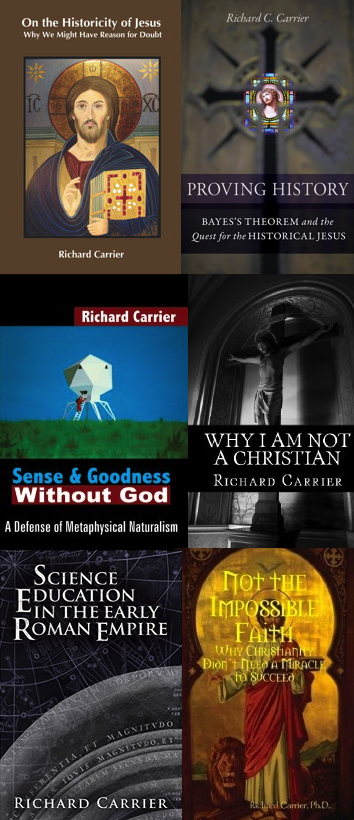
I actually don’t have any other books on god shit anywhere on my philosophy recommendation list except my own Sense and Goodness without God, and that’s only there because it is mostly a defense of positive philosophy—what atheists should believe in; more than what they shouldn’t. The rest of my list is all to the same point: we should not have to be wasting time arguing about gods; we should be spending all that time building a productive, reality-based philosophy of life and the world. Theism shouldn’t even exist to waste our time, any more than flat earthism or lizard theory. But. Yeah. It’s there. So we have to fight it. But we shouldn’t let theists suck all the oxygen out of the room, to heckler’s veto real progress in philosophy or in perfecting your own understanding of yourself and the world, by constantly distracting us with their tinfoil hattery.
So, yes. My recommendations in philosophy are for learning actual, productive philosophy. It’s for you to understand yourself and the world, and to better yourself and the world. But, we do need to know how to turn the resulting skills and knowledge of philosophy against all the crazy—whether it’s gods or crystal powers or lizards from outer space. And so I chose the one best toolkit for that, the one book that gives you all the skills and insights you need for the mission. And that’s The Atheist’s Primer.
For example, Murray covers questions of method, existence, definitions, in ways that you can adapt to tackle any supernatural or paranormal claim. His treatment of design arguments approaches the whole question in that way, whereby you can see that every whackadoo wooism is some form of Argument from Design, merely switching out who or what is running the “conspiracy” to subvert the blindly running physics of an ordinary nature. He has chapters on every subject, from moral arguments to fideism, even religious error theory, mysticism, and the meaning of life. And yes, even liberal and postmodern theism. All adaptable to any kind of woo.
And in the process of all that you will learn a great deal of philosophy itself, as Murray teaches countless basic concepts in philosophy, and then uses those to dismantle woo and godist nonsense from the ground up. Which makes it a good teaching tool in philosophy even apart from its specific target. And he does all that while wasting no words. And yet he is somehow also consistently, entertainingly witty throughout. Indeed you’ll wonder at how he can do all of that, across 25 chapters, in just 275 pages. Seeing how he accomplishes that feat alone educates. It’s almost the perfect book. Highly recommended.
Why Palmer’s Vision Science?
There is to this day no substitute for Palmer’s study of vision. Nor is there any comparable volume for any of the other senses—but there should be, because this one is phenomenal (pun not intended), and one for each sense is much needed. I have found that it is not possible to understand anything about theory of mind without a thorough understanding of how the brain produces perception, from the ground up. This covers that account for vision, detailing everything we know from physics (the photons that hit the eye and their behavior in the world), to biochemistry (how the receptor cells react to photons to general electrical signals), to neurophysics (how the brain processes those signals), including all the preprocessing (e.g. the color yellow is generated here, not at the eye) and post-processing (how visual structures are formed and integrated with other senses to produce a perceptual field), all the way to the end-point of “phenomenology” (the production of qualia, on which Palmer is a computational functionalist).
It’s 800 pages of priceless understanding, divided into three sections, Foundations, Spatial Vision, and Visual Dynamics, which last for example breaks into four chapters: Perceiving Motion and Events; Visual Selection: Eye Movements and Attention; Visual Memory and Imagery; and Visual Awareness. The text has never been updated to a new edition so it’s over 25 years old now, yet it still holds up as a seminal and complete study of the visual system. All the progress made since has been to build on the state of science in Palmer rather than overthrow it. For example, we have increased the detail with which we have mapped all the cellular structures involved, eye to brain; we have increased the number of things we know about motion and boundary processing; and advances have proceeded in the philosophy of phenomenology (that question of “qualia”). So once you absorb the basics from this book, you can investigate and better understand all subsequent advances in the decades since.
I’ll just give a couple of examples of revelations I received studying this volume (among hundreds of examples I could describe). First, I discovered that there is a special specific place in the brain where the color yellow is invented (and another where orange is, by comparing the strength of the primary red and secondary yellow signals). Red, green, and blue of course are signaled directly by corresponding cone cells in the eye. But there is no sensor in the eye for yellow. So why does that show up in prismatic spectra? Well, there’s a place in the brain, in the primary visual cortex, where signals from the red and green sensors are combined to “guess” at the presence of mid-frequency photons that are then experienced as “yellow.” This opens your mind to the reality of how much of human vision is fake—but not completely divorced from reality. It’s all a moderately reliable guess at what’s actually going on in the world, using computation on incoming signals. But colors themselves are “stand ins” for other properties (such as the vibrational frequency of photons). They don’t exist in the world itself.
Second, before reading this volume, I had naively toyed with theories of qualia whereby the colors are brightness levels of a single color, based on the observation that the prismatic spectrum goes from bright (red, yellow) to dark (green, blue). But alas, Palmer presents data and diagrams showing that in fact this is a processing artifact: our brains’ color wheel is tipped at an angle, representing baseline colors as brighter to darker along the spectrum. A neutral (flat) spectrum would in fact have tans and browns come out of a prism where we see yellow and orange—because brown is just dark orange; or more correctly, orange is just light brown. It’s the same color. Not a different color as we are taught growing up. In fact, computationally, it’s actually a mixture of yellow and red, and thus a post-post-processing outcome, where orange is computed after yellow is computed and compared to the incoming signal for red. Yellow is more primary and as such orange is really a product of yellow and red. Likewise, a neutral (flat) brightness spectrum would show red as closer to blood red (a very dark shade of red), not what we see coming out of a prism, which is really “light” red. And understanding things like this helps hone what you think is going on when the brain produces phenomenal experience.
So I find this tome invaluable for understanding philosophy of mind. It would be enhanced by companion volumes for every other sense (by 1999 we had made more advances in vision science, but by now have made comparable advances in other domains) but it contains crucial starter-kit information for understanding how our brains generate perception and experience from basic physics, and hence realizes a major element of the human mind. So I highly recommend Vision Science to anyone who really wants to get a good handle on any theory of consciousness.
Purchase advice: When you click on Palmer’s book you’ll find it sells new for over a hundred dollars (these days, a typical price-gouge for academic monographs and college textbooks; I think objectively it’s only worth half that, or a quarter considering that it’s last-century material). Here’s an alternative. Amazon sometimes offers a “used” option, which differs from the Amazon Marketplace option. I might still get commission on Amazon Prime used book sales (the option is usually below the “Buy Now” button, where you can tick the circle to change the selection to an available used copy). But even if you go to the “Other used” link under the top price listing and buy a used copy on Amazon Marketplace: those are third party sales I do not get a commission on, but you can still add things to your cart before checkout to get me a commission on if you want. As long as those are Amazon items and not Marketplace (third party sellers), I get a commission on all the rest, just not the used book.
Why Goodin and Tilly’s Handbook?
You might think this is a really weird thing to list as a top recommendation. A handbook of Contextual Political Analysis? What the hell even is “contextual” political analysis? Or even political analysis? Isn’t this too obscure or next-level to qualify for a starter kit in getting to be a good philosopher? From just the title that’s what I would have thought. But I encountered it while researching subjects in its chapter list, and the unexpected and totally baller usefulness of the chapter I consulted led me check out the rest of the book and it was so useful I bought the whole damn thing and now consult it often. It’s a must-read. Yes. I’m not kidding. I think every philosopher, actual or prospective, should read this entire book.
Like Primer and Vision Science, which are unexpected or unusual things to list as top recommendations yet in completely different aspects of philosophy, so is this Handbook. It jumps to a third wholly distinct area of philosophy: politics. I have often noted that all philosophy ultimately serves and converges in political philosophy, such that, really, it’s the centerpoint of all philosophy. Because the only real end-function of all other philosophy is to be able to use it all to sort out political philosophy; and conversely, no good political philosophy is really possible without sorting out the rest of philosophy. Because it all depends on what you find in science, epistemology, aesthetics, and morality. And every aspect of your life depends on politics. It is literally the most important thing fucking you over or making anything you do possible. You have water to drink and breathable air because of politics. You can date and marry people solely because of some political system in place making that possible and informing how it goes. Pick any thing you do, from taking a shit to sleeping, and politics sits underneath, in the system that made everything involved—from giving you even just the time to shit or sleep, to manufacturing, delivering, and installing the bed you sleep in and the toilet you sit on. If you even have a bed or toilet is an outcome of the political system you live in.
So, politics is a crucial and indispensable branch of philosophy. But it requires understanding everything else, from epistemology and science, to beauty or blight, and morality and justice. Bad foundations in any of those will percolate up to give you bad results in political philosophy—and thence to real-world political outcomes. Like Vision Science, Goodin and Tilly’s Handbook is over 800 pages, encompassing 42 chapters across 10 sections (hat-tip to Douglas Adams fans), all scientifically informed with good notes or bibliographies. I really can’t communicate the value of this book better than having you do the usually tedious thing of reading the entire table of contents, but it’s actually eye-opening to see the range of subjects they cover and how applicable they are across all philosophy, not just politics. And I can vouch for the fact that every chapteris good. You will come away with some great insights and understanding from every one. So, please do read on down the line, and think about how much your curiosity is peaked by every single chapter title:
Part I. Introduction
1. It Depends, Charles Tilly and Robert Goodin
Part II. Philosophy Matters
2. Why and How Philosophy Matters, Philip Pettit
3. The Socialization of Epistemology, Louise Antony
4. Political Ontology, Colin Hay
5. Mind, Will, and Choice, James Druckman and Arthur Lupia
6. Theory, Fact, Logic, Rod Aya
Part III. Psychology Matters
7. Why and How Psychology Matters, Kathleen McGraw
8. Motivation and Emotion, James Jasper
9. Social Preferences, Homo Economicus, and Zoon Politikon, Samuel Bowles and Herbert Gintis
10. Frames and Their Consequences, Francesca Polletta and M. Kai Ho
11. Memory, Individual and Collective, Aleida Assmann
Part IV. Ideas Matter
12. Why and How Ideas Matter, Dietrich Rueschemeyer
13. Detecting Ideas and Their Effects, Richard Price
14. How Previous Ideas Affect Later Ideas, Neta Crawford
15. How Ideas Affect Actions, Jennifer Hochschild
16. Mistaken Ideas and Their Effects, Lee Clarke
Part V. Culture Matters
17. Why And How Culture Matters, Michael Thompson, Marco Verweij, and Richard Ellis
18. How to Detect Culture and its Effects, Pamela Ballinger
19. Race, Ethnicity, Religion, Courtney Jung
20. Language, Its Stakes and Its Effects, Susan Gal
21. The Idea of Political Culture, Paul Lichterman and Daniel Cefaï
Part VI. History Matters
22. Why and How History Matters, Charles Tilly
23. Historical Knowledge and Evidence, Roberto Franzosi
24. Historical Context and Path Dependence, James Mahoney and Daniel Schensul
25. Does History Repeat?, Ruth Collier and Sebastián Mazzuca
26. The Present as History, Patrick Jackson
Part VII. Place Matters
27. Why and How Place Matters, Göran Therborn
28. Detecting the Significance of Place, R. Bin Wong
29. Space, Place, and Time, Nigel Thrift
30. Spaces and Places as Sites and Objects of Politics, Javier Auyero
31. Uses of Local Knowledge, Don Kalb
Part VIII. Population Matters
32. Why and How Population Matters, David Levine
33. The Politics of Demography, Bruce Curtis
34. Politics and Mass Immigration, Gary Freeman
35. Population Change, Urbanization, and Political Consolidation, Jeffrey Herbst
36. Population Composition as an Object of Political Struggle, David Kertzer and Dominique Arel
Part IX. Technology Matters
37. Why and How Technology Matters, Wiebe Bijker
38. The Gendered Politics of Technology, Judy Wacjman
39. Military Technologies and Politics, Wim Smit
40. Technology as a Site and Object of Politics, Sheila Jasanoff
Part X. Old and New
41. Duchamp’s Urinal: Who Says What’s Rational When Things Get Tough?, David Apter
42. The Behavioral Revolution and the Remaking of Comparative Politics, Lucian Pye
The objective of briefing across this marvelous diversity of philosophical subjects is to make political thinkers better at political thought and thinking about politics, by squaring them across a whole range of subjects they do need to understand well to think well about anything political. Hence the title: contextual political analysis. Everyone who isn’t an apathetic loser betraying their neighbors and societies, and even their own interests, with wilful indifference and ignorance in matters of politics, is always engaging in analysis of political questions and realities. And to do that well, you need to do it in context, informed by all the system-wide factors that play into every line of thought, from philosophy itself, to history, geography, demography, technology, and everything else. Each chapter here is an ideal “first-stop shop” on one of dozens of subjects we should have some quality grounding in philosophically. And all together, they will make you a competent political thinker.
So, yes, I highly recommend this volume as essential reading in philosophy—indeed, as essential reading for a citizen. As with any work in philosophy it does not require you to agree with every thing every author here says—rather, its value comes from knowing what they say, and engaging with it and thinking about it. These are primers for any philosophical engine of thought. Even if that engine drives ultimately in a different direction, it won’t have done so uninformed or unconsidered. I also have the same advice regarding the price of this volume as before, although seventy dollars is actually a reasonable and realistic price to ask for the extraordinary amount of high quality content you will get out of this.
Discover more from Richard Carrier Blogs
Subscribe to get the latest posts sent to your email.






Hello, does this include links from here to Amazon.co.uk
Yes.
If you click a book link here and it automatically converts to an amazon.uk page for the same book or product, it’s tracking that and will automatically apply to my account as if it were the original link.
If you click a book link here and it does not convert (if it sends you to the American Amazon page), then you may need to start from scratch, using one of my book links on my Global Sales Page, and then once in the appropriate nation’s Amazon, search for the book you actually wanted to buy and put it in your cart that way. It will track that you came from my site even if you don’t opt to buy the book you clicked through to get there.
We must not neglect, as a primer, The Hitchhiker’s Guide to the Galaxy, by Douglas Adams.
All good recommendations, if I can find the time I might read them and I do like reading about political science and political philosophy.
One great book I recommend is an economics layman´s book, 21 Things they don´t tell you about Capitalism, by Ha Joon Chang. It´s a great book because it dispels a lot of myths about capitalism, particularly neoliberal ones (but Chang also makes the point that any economic/political theory is bound to have limitations, it´s impossible to have a general theory that works well for every aspect of human society).
There´s also a fair bit about political economy in the book, which isn´t surprising as lots of economic schools of thought integrate it into their models, i.e institutional economics, Marxist economics, Austrian economics and early classical economics did too (i.e Adam Smith). Chang is kind of quite an eclectic economist, he thinks all these schools of thought have strengths and weaknesses, but if you follow any of their prescriptions dogmatically you will have an economic disaster. He considers himself to be a reluctant capitalist, but who supports things like a strong welfare state and strong worker´s rights.
The book is mostly about economic history from the 18th to the 21st century, when you first start having modern industrialised societies and it´s about what factors are likely to lead to successful development and which ones are not. In particular, none of the countries that industrialised, i.e the UK, France, Germany or the US followed the neoliberal recipe to the letter, they often had quite high tarrifs (which he thinks can be useful for developing nations but not advanced ones), a fair amount of government intervention in industry and quite often didn´t protect foreign IP. He talks a lot too about the Asian models, i.e Japan, Korea, China, which defy neoliberal economics in many ways.
I think he has some interesting views too on when countries can become successful liberal democracies. There are various writers who have argued that countries tend to become successful liberal democracies first and then have decent economic development. Chang argues that it´s often the other way round, that you often have to have decent economic institutions, economic growth etc before you can get democracy to survive, but he does think that democracy is a very useful thing to have, it encourages plurality, it reduces confirmation bias, not to mention that it´s the best guarantee of civil rights.
Anyway, it´s a book that I definitely recommend for your readers and I also definitely recommend checking out any of his talks on youtube, he´s a very good speaker and you always learn something interesting.
Thank you for that. I haven’t read it, but 23 Things They Don’t Tell You about Capitalism has bonafides (the author has cred and the publisher is real), and at a skim looks decent and worthy of at least considering its arguments.
Good catch, it´s 23 Things They Don’t Tell You About Capitalism.
He has another good book that´s a fun read called “Edible Economics”.
It tells various economic stories from different countries with anecdotes or puns about food.
One irony he notices is that he arrived in the UK in the 80s, and the food wasn´t very diverse, but over the next 30 years, the diversity (and quality) grew incredibly to the point where pretty much every small town has a Chinese, an Indian and an Italian restaurant.
On the other hand, diversity of economic thought has decreased since the 80s (Thatcher-Reagan era of course, the dawn of neoliberalism) and neoclassical and monetarist theories tend to be quite dominant in the institutions now, in both the Labour and Tory parties. It´s strange to think that there were Tories who opposed Thatcherism and Bush senior coined the term “voodoo economics” when he challenged Reagan in the 1980 primary.
For people interested in how both of the controlling parties in the US and UK are basically the same conservative party arguing only over process rather than outcome, Shaun provides a very good explanation through the lens of J.K. Rowling’s politics in the Harry Potter series.
Yes, #NotAllPoliticians. There are anti-corporate progressives in the U.S. Congress. But they are a powerless minority always at odds (and often in open combat) with their peers and party bosses. I imagine there are some outliers in Parliament too. But the controlling machines of both parties remain aligned with each other in economic goals, and even the culture-war stuff is just the smoke and mirrors of Oz to get votes without telling voters what their actual policies will do to them.
The UK is in on the verge of entering of a new era politically, like much of the EU is.
Labour and the Tories (the Conservative party´s nickname for people who don´t know UK politics) have lost tonnes of support recently. Labour won the 2024 election, but only really because the Tories were super unpopular and Starmer, the current PM has really tried to purge the left and appeal to the kind of voters who are not likely to vote for them anyway.
Now Starmer is in a similar situation to the Tories, and he has lost a lot of votes to the Green party, who won a by-election in Manchester in what was a super safe seat (Labour came third). Unlike Tony Blair and Bill Clinton, Starmer is pretty incompetent at electoral politics, i.e he just insults his own voters and they´re beginning to desert him. Basically, he´s lost every single part of the Labour coalition (organised Labour, ethnic minorities, public employees, students, the working classes, cultural liberals). In opinion polls Labour are now equal with the Greens (both about 20% on average), a party that just a decade ago would be lucky to make 5%. In terms of outlook, the Greens are similar to the Berniecrats in the US.
On the right, the Tories have been utterly disgraced, but their voters instead of thinking “well, maybe the ideology is nonsense” are going to a far right party, which is a lot like the modern GOP, called “Reform”. Their policies can be summed up as “dismantle the welfare state, ban all immigration, repeal anti-racist laws” and they´re now consistently on about 24-29% in the polls and have won by-elections (special elections) and control some local govt areas. Predictably, a party of lunatics has turned out to be terrible. Their leader is Nigel Farage, one of the big campaigners in the Brexit referendum for the leave vote, and a friend of Trump.
Like the US, we use First Past the Post for our parliamentary elections, which of course will give Reform a lot of seats as they´re quite popular in our rust belt (like Trump was) and in rural areas of the country, which are overrepresented.
I hope it wakes people up for the need for electoral reform, but I somehow doubt it, Starmer is kind of like a James Buchanan in terms of political ability.
Lol! That has been my position on arguments for God lately. When I hear apologists bringing the Kalam or fine-tuning again, I can’t help but think “Oh God no.. Please, stop.” And they even have the courage to act as if their pet arguments haven’t been refuted (several times already).
But I suppose they will never stop using these ridiculous arguments.
Vision Science sounds interesting. From the summary I think I’m familiar with most of that, but my focus has been primarily on its language equivalents.
(A somewhat useless comment to test the whitelist.)
Given that the human eye is frequently cited by creationists as a “gee whiz a god must have done that because I don’t know how vision works or evolved” argument from ignorance, this book can serve multiple purposes. As someone who considered a career in neuroscience, I find the science of perception fascinating. So I will look for a copy, thanks!
Also, this is a test comment for the whitelist.
Hi Dr. Carrier, this posted immediately so you seem to have fixed the whitelist issue.
Yay!
Let’s hope it remains stable.
This really should be a native feature of WordPress. I shouldn’t have to hack it like this. But alas. So far so good.
Wow, Richard! You’ve convinced me to buy every book on this list when I get home today. Admittedly, that’s partly in fear of shipping costs rising further, but mostly I’m just excited to get my hands on these bad boys and start reading as soon as possible
Report back here your own thoughts as you finish each.
Richard, I have a logistical question: If I drop a few items into my Amazon shopping cart from time to time over the course of a week or two, but without finalizing their purchase, then at some point I log in through a link on your website, add a couple of items and then check out purchasing everything in my shopping cart, do you receive a commission on everything I just purchased including the items that have been parked there for any indeterminate length of time, or only on the items I just now added to the shopping cart?
Good question. The FAQs are fuzzy on this (but you can read what they say).
I think the answer is no. I only get commission on items added in the 24-hour window after following my link (while the other items already in your cart are exempted). But if you do that and then wait up to 90 days before closing the cart, I get the commission on what you added in that original 24 hour window (but not later items added, or earlier, unless those were also added within 24 hours after following one of my affiliate links).
That’s kind of what I thought. To try and stay on the safe side what I’ve been doing, when I’m actually ready to make a purchase, is to make note of what’s in my shopping cart, delete it all then log back in through your website. Then I add everything back into the shopping cart including any new additions and make the purchase. I think that would work, but I was hoping I might be able to eliminate the “delete and add back” steps.
According to their FAQ, that does work. They even mention the re-adding items again move as a use-case.