Amazon Prime Day deals end tonight. These aren’t in that deal. And you need to already be (or become) a Prime subscriber to get the deals there are today. But as always, I get a commission on anything you buy on Amazon after clicking any link anywhere on my website. And that means everything in your cart when you check out within 24 hours (or before 2am EST for today’s deal) after following a link from my site—even if you don’t buy the item you clicked on but instead wander around Amazon and buy Amazon Day Deals instead like a YETI Hopper M Series Backpack Soft Sided Coolers with MagShield Access (whatever that is) or a great deal on Basics of Biblical Hebrew Grammar. I’m unsure how any of this works outside the U.S. today. So you’d have to check in each case. But Amazon’s front page has more “today only” deals like those at least on the U.S. side.
I rotate among three subjects in writing these reviews as I rebuild my Recommendations Pages three books at a time; and this time, it’s philosophy. And these are all essential reading for anyone who wants to take philosophy seriously as a thing they do, and not just claim to know about. Today I will explain.


-:-
Why Is Philosophy in Crisis?
Mario Bunge’s Philosophy in Crisis closes with a really important chapter that aptly critiques academic philosophy, pointing out how it is failing and could be making more substantive progress and be of greater use to more people. Bunge is a renowned Argentinian philosopher and scientist (only recently deceased), one of the most important yet neglected philosophers of naturalism in particular, and worldview-building in general. I don’t always agree with him, but I always benefit even from our disagreements.
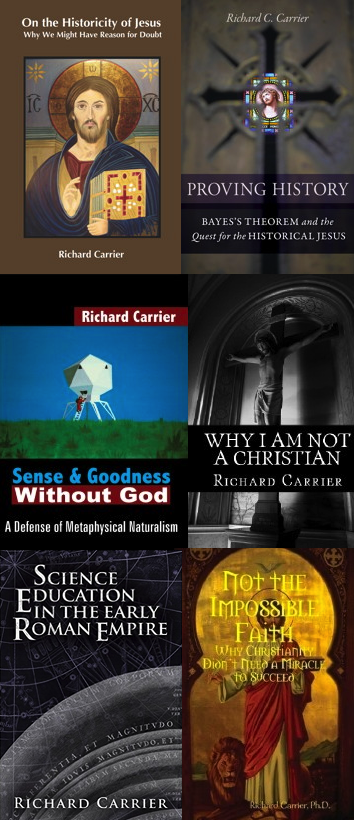
Philosophy in Crisis is Bunge’s most succinct and crucial study. It has no real parallel. Philosophers almost never turn around and criticize their own field, or frame their survey of its progress in terms of picking winners and losers and calling balls. And none but Bunge have developed an entire well-organized monograph doing this. It is the closest thing to a single-volume worldview defense that exists—my book Sense and Goodness without God is the only other there is, and it remains the only thorough example. Bunge’s is more like a sketch or an outline, with a selection of brief arguments for each pillar. Bunge did produce a more thorough one, closer to what mine sought to do, but in an eight-volume series almost impossible to get ahold of now (his Treatise on Basic Philosophy). This single-volume summary is more accessible, and more immediately useful as an example of what you, as a philosophy, must match or beat, to have built a complete, coherent, evidence-based worldview—better known as “a philosophy of life,” a belief system guiding all others.
By the close of his final chapter you’ll have learned the difference between what is often wheelspinning or bullshit flooding the field (and nothing has changed about this in the decades since he wrote this, so all his points remain current) and what philosophers (including you) should be doing instead, or at least allocating far more time and attention to. You will come away from reading his short study with a clearer understanding of what makes the difference between philosophy that matters, and philosophy that doesn’t—and what has happened that caused academic philosophy to fail at this metric. It’s an important window into what a philosopher should be doing, as a philosopher, and at the most abstract level. On the way you’ll get views of failed philosophy and successful philosophy, and how to follow the latter to its most logical conclusion. It has chapters on epistemology, semantics, ontology, morality, politics, economics, the philosophy of social systems, worldview theory, and on the difference between productive and excess skepticism, science and pseudoscience, and productive and stagnating philosophy generally, and apathetic and substantive humanism in particular.
I don’t recommend Philosophy in Crisis because everything it says is perfected or correct. It probably isn’t. I recommend it as essential because this is what every philosopher needs to be doing (and warns against everything they need to avoid doing). So if you think you can do it better, this is your starting platform for measuring what “it” is and what counts as “better.”
What Is A Rulebook for Arguments for?
Anthony Weston’s A Rulebook for Arguments is widely considered a classic. It’s been in print for decades. It’s sixth edition even has a chapter on dealing with AI. This provides something better and more important a textbook in logic: an actual comprehensive guide to arguing. Which means something more than just logic. Logic can always be gamed to produce any result you want, if you are willing to play fast and loose with fuzzy fallacies and dubious facts. Which everyone is who wants a particular result or wants to believe they are “good at this” and thus can’t have something to learn about it. Weston’s point is that arguing has to be sincere and genuinely effective, not an exercise in browbeating or rhetoric. For him argument is not a tool of persuasion but a means of getting at the truth. And too many people (especially “intellectuals”) have forgotten (or don’t want to admit) that those are different tasks with different skills.
Argument does not mean just arguing with other people. It also means arguing with yourself. And all good philosophy is the end product of exactly that: a philosopher arguing with themselves. You argue to a conclusion; then you try to argue against that conclusion to burn test it (the only honest way to think critically); and if you find problems, you rethink your conclusion, and start the cycle again. A good philosopher thus needs this book (and needs to recommend it to anyone they would argue with) because that is what it is about. It’s not enough to know logics or maths. You need to know how to deploy them in arguments that are genuine and successful, and not pretending to be or only appearing or feeling that way. And, conversely, you need to know how to call out opponents when they break these rules.
That said, still about half of this is about how to present arguments to the public or opponents, and in a way that doesn’t distract or trigger, but cuts right to the chase of why you are right and what it would take to prove you wrong. And all of it is useful to that end. But it is also half or more crucial to skilling up in arguing with yourself and thus in changing your mind to be ever more correct, developing a credible worldview, a belief system and philosophy of life that you can actually defend to yourself and anyone challenging it. Which is what philosophy is. And thus a book like this is essential to being a philosopher, rather than pretending to.
The table of contents (minus the introduction etc.) gives you a fuller picture of what you’ll get here:
I. Short Arguments: Some General Rules
1. Resolve premises and conclusion
2. Unfold your ideas in a natural order
3. Start from reliable premises
4. Be concrete and concise
5. Build on substance, not overtone
6. Use consistent terms
II. Arguments by Example
7. Use more than one example
8. Use representative examples
9. Background rates are often crucial
10. Statistics need a critical eye
11. Reckon with counterexamples
III. Arguments by Analogy
12. Work from a relevantly similar case
IV. Arguments Using Sources
13. Cite your sources
14. Seek informed sources
15. Seek reliable sources
16. Cross-check sources
17. Build your web savvy
V. Arguments about Causes
18. Causal arguments start with correlations
19. Consider a variety of explanations
20. Work toward the most likely explanation
21. Expect complexity
VI. Deductive Arguments
22. Modus ponens
23. Modus tollens
24. Hypothetical syllogism
25. Disjunctive syllogism
26. Dilemma
27. Reductio ad absurdum
28. Deduction as a method of inquiry
VII. Extended Arguments
29. Explore the issue
30. Spell out basic ideas as arguments
31. Defend basic premises with arguments of their own
32. Reckon with objections
33. Explore alternatives
VIII. Argumentative Essays
34. Jump right in
35. Make a definite claim or proposal
36. Your argument is your outline
37. Detail objections and meet them
38. Seek feedback and use it
• special section on AI assisted writing
IX. Oral Arguments
39. Ask for a hearing
40. Be fully present
41. Signpost energetically
42. Hew your visuals to your argument
43. End in style
X. Reclaiming Public Argument Today
44. Follow firm facts
45. Diversify your sources
46. Theories verses “theories”
47. Listen, learn, leverage
48. Work from common ground
49. Offer something positive
50. Do argument proud
Appendix I: Some Common Fallacies
Appendix II: Definitions
D1.When terms are unclear, get specific
D2. When terms are contested, work from the clear cases
D3. Definitions don’t replace arguments
I would also say that Weston’s Rulebook follows its own advice. It always gives specific examples—usually real world examples (and already not doing either is a common route to folly in argument)—to teach each rule or principle or practice by. It recognizes complexity and nuance and is even about how to handle them in every case. It has a very useful appendix on how to use and understand definitions in the context of arguments (messing up or manipulating which is one of the most common forms of argument failure). For example, he makes key generalizable points explaining the difference between “assisted suicide” and “involuntary euthanasia” and why those differences matter.
And you do not have to agree with him at every turn in his Rulebook for Arguments. But you do have to consider his “arguments” (pun intended). Because even where you disagree, if you can’t argue why, you haven’t learned anything. It’s using his advised techniques even to figure out why you don’t agree or maybe even shouldn’t that will teach you something and advance your philosophy, making it better. Which means: more accurate, more useful, more understandable, and more defensible. So, for example, you can certainly make a case against his focus on accuracy and simplicity over persuasive rhetoric: we need both. Your arguments need to be good and emotionally effective. Sometimes that means breaking his rules—as long as you are still fulfilling their intention. Which is just not to trick or deceive or play games.
How Can Philosophy Save Your Life?
If Bunge sets the stage for what a philosopher needs to beat, and Weston sets the rules for how to honestly argue your way there, Marietta McCarty explains why you are doing any of this. In How Philosophy Can Save Your Life she doesn’t just survey (as the subtitle suggests) “10 Ideas That Matter Most” but actually handles every one as praxis—meaning, not just as an exploration of ideas, but how to benefit from being a philosopher, to do philosophy as an action, a lifestyle, an occupation rather than a profession. Every chapter details what it means to practice philosophy, not just think it or have it. So you can start with what you should have sorted out by now, using honest rules of argument, and end with how to live the resulting philosophy—not just as a finished product, but even in the process of building it, experimenting with it, changing it up and improving it over time.
McCarty’s book opens with explaining its purpose, and an idea of using salons of friends discussing philosophy as a tool for building and making progress in philosophy. She then offers a chapter on ten “practical” outcomes of philosophy that (in my own opinion) philosophers have wasted their lives not having used their philosophy to sort out already: Simplicity, Communication, Perspective, Flexibility, Empathy, Individuality, Belonging, Serenity, Possibility, and Joy. It uses examples from thinkers as diverse as Socrates to Simone de Beauvoir, and includes guided discussion questions and artistic inserts for reflection.
I find this essential reading because too many philosophers get lost in the intellectual game and exploration and forget that philosophy is supposed to be lived. Its primary actual purpose is supposed to be to help you live a more fulfilling and grounded life, and to be a better person, for yourself and your society. It guides not only your votes but your life choices and everyday behavior. And it should be doing that informedly and well—and not in result of a monstrous construct of false and toxic beliefs. So how you do philosophy matters, how you live philosophy matters, and thus how you discover the best philosophy matters.
Reading McCarty will pull you back from a blinding concentration on cosmological arguments and wrangling over free will into more important end products that any philosophy of life should be ready to handle. Simplicity, for example, means asking “What is the simple life and should we want it? Is it better than what we have or are pursuing right now?” Communication means arguing with others with sincerity and empathy so as to gain something, to be changed by it, and learning from others by listening to their stories and narratives, to improve yourself rather than dominate others. Perspective reminds us to see the world from other points of view before coming to conclusions about it. Flexibility means being open to being wrong, learning something causing you to rethink serious things and change your mind—seeing this as a virtue rather than a thing to oppose, yet still telling the difference between being too open and too closed to change. And so on.
This is an example of a continental rather than an analytical style of philosophy, and I am usually not a fan. But there are merits to exploring good examples of it and this is one, indeed one easier to read than most, and most directly on topics of such direct and common concern philosophers often forget about them. For example, throughout McCarty teaches with examples from her own students, college and younger, and has in mind even children being able to follow her book and gain from it. In result, from her examples you’ll notice that children are already philosophers and already doing philosophy every day, with everything they encounter and everyone they argue with. Adults need to recognize this—because it entails the need to teach children how to do this well, so they will do it even better as adults; and to teach them that requires learning to be better at it yourself, to turn the eye on philosophy on the everyday cares and concerns and experiences of ordinary people, successfully.
How Philosophy Can Save Your Life is a very easy read and a good reminder of the kinds of questions philosophy is actually supposed to be able to successfully answer. All the high level stuff is just the scaffolding, the prep work, the infrastructure, that you build ideas on about how to best live your life, and why live is so worth living when lived well.
Discover more from Richard Carrier Blogs
Subscribe to get the latest posts sent to your email.