A Primer on Successful vs. Bogus Methodology: Tim O’Neill Edition
Recently Tim O’Neill once again engaged his usual arrogantly dishonest methods and lied about the evidence in the very act of denouncing an actual expert (me) as incompetent, but in the process proving he was incompetent and I was not. Which is standard...Bayesian Analysis of the Barkasi-Sant’Anna Defense of Naive Memory Realism
Last month I launched my three-part series on analyzing peer-reviewed philosophy papers with my Bayesian Analysis of Faria Costa’s Theory of Group Agency, where I explain my process and how I selected the articles for review. I followed that with my Bayesian...Bayesian Analysis of Shelley Park’s Uncanniness Thesis
Last month I launched my three-part series on analyzing peer-reviewed philosophy papers with my Bayesian Analysis of Faria Costa’s Theory of Group Agency, where I explain my process and how I selected the articles for review. Second up is “Uncomfortably...The Scary Truth about Critical Thinking
The fundamental goal of legitimate critical thinking (as opposed to the fraudulent kind) is to ascertain what is true, about yourself and the world. So the tools that constitute critical thinking must be tools for finding the truth. And that means tools for...The Jesus Chronicles: Three Things People Get Wrong about Probability
Lately I’ve seen a flurry of repeated mistakes in reasoning about probability. I realized a primer is needed to correct some people so they can stop making those mistakes (assuming you care about not making mistakes; an alarming number of people don’t, but...What Exactly Was the Scientific Revolution?
The “Scientific Revolution” is often mentioned and discussed as a crucial development in human civilization that fundamentally changed the entire course of history. World society after and before that event looks consistently yet radically different. For...The Argument from Reason
In 2004 I composed for The Secular Web a detailed Critical Review of Victor Reppert’s Defense of the Argument from Reason. I still reference it whenever the “Argument from Reason” comes up. But anyone who visits it will notice it’s quite long....A Primer on Christian Anti-Intellectualism
I noted this month in my series on Justin Brierley’s book Unbelievable that rather than teaching its faithful how to think reliably, “Christianity teaches against any sound epistemology, even critical thinking.” In fact, “Christianity’s sacred...Justin Brierley and the Folly of Christianity
This is the final entry in my series on Justin Brierley’s book Unbelievable? Why After Ten Years of Talking with Atheists, I’m Still a Christian. You can read my general summary of this book; where also at the bottom is a TOC linking to all the follow-ups, in...Unbelievable: Justin Brierley’s Epistemic Failure
Justin Brierley is an excellent host in Christian broadcasting. I’ve been on his show several times, including in person, when ironically I was an American visiting Brierley’s studio in London discussing the historicity of Jesus on a call with Mark...An Anatomy of Contemporary Right-Wing Delusions
I recently analyzed for a client the crazy rant of Chilean conservative thinktanker Axel Kaiser in “This Could End in Civil War” and realized this is a paradigmatic model of all contemporary right-wing delusionality and I should blog it. I covered a different...More Hosing of Thought Experiments: Pereboom’s Manipulation Argument Against Causal-Chain Free Will
I’ve been asked to discuss what’s wrong with Derk Pereboom’s so-called “Manipulation Argument” (or “Four Case”) argument against Compatibilism, which is of course the view that causal determinism is compatible with free will....Another Failed Thought Experiment: Nozick’s Experience Machine and How It Exemplifies What Bad Philosophy Looks Like
I will be answering in my next article the new questions posed in the 2020 iteration of the PhilPapers survey (a new development I just wrote about). But one of those new questions requires a separate article on its own: the one written, “Experience machine...Three Common Tactics of Cranks, Liars, and Trolls
You might have noticed a shift over the past few years in how I address apologists, propagandists, kooks, and various disinformation scoundrels, toward laying out not just that they are wrong (their facts are bogus; their logic is hosed), but the underlying...The Objective Value Cascade
In the movie Serenity, the crew of a spaceship far in humanity’s future discover the lost planet Miranda, where they discover a dark secret: that a government drug used on its population to make them docile and compliant, actually removed all desires of any...Get Dr. Carrier’s Latest!

About the Author

Richard Carrier is the author of many books and numerous articles online and in print. His avid readers span the world from Hong Kong to Poland. With a Ph.D. in ancient history from Columbia University, he specializes in the modern philosophy of naturalism and humanism, and the origins of Christianity and the intellectual history of Greece and Rome, with particular expertise in ancient philosophy, science and technology. He is also a noted defender of scientific and moral realism, Bayesian reasoning, and historical methods.
Support Dr. Carrier


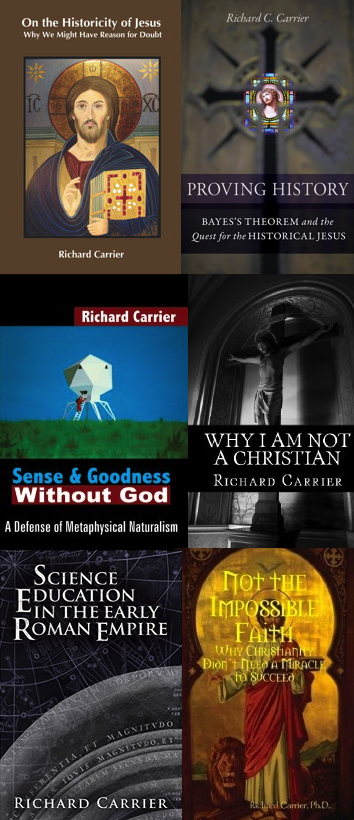
Books by Dr. Carrier
Explore C.H.R.E.S.T.U.S.