Do the ‘We’ Passages in Acts Indicate an Eyewitness Wrote It?
As I write an article on why historians no longer trust Acts, and now categorize it as mythography rather than history (though it emulates a history), I realize one question needs to be settled separately, because otherwise it’s just too tedious a digression:...On the Historicity of Jesus and the Rhetoric of Justin’s Dialogue with Trypho
It’s often claimed “we have no evidence of any skeptic of Christianity ever doubting Jesus existed.” I’ve long noted this isn’t true; and that it’s moot, because the very texts where we would expect to find this don’t survive...New Video Course on New Testament Studies for Everyone!
I am gradually transitioning my online courses to a high-quality video-and-syllabus format through MythVision. The first to launch is my course on New Testament Studies for Everyone. You can check out a five-minute video describing that course and how it works. And...A Primer on Successful vs. Bogus Methodology: Tim O’Neill Edition
Recently Tim O’Neill once again engaged his usual arrogantly dishonest methods and lied about the evidence in the very act of denouncing an actual expert (me) as incompetent, but in the process proving he was incompetent and I was not. Which is standard...Robyn Faith Walsh and the Gospels as Literature
Robyn Faith Walsh, a professor of New Testament studies at the University of Miami with a Ph.D. in religious studies from Brown University, has recently hit the circuit promoting her “controversial” thesis (building on her dissertation at Brown) that the...How We Can Know 1 Clement Was Actually Written in the 60s AD
The Epistle of 1 Clement, a diplomatic letter from elders in Rome to the Christian community in Corinth seeking to persuade them to return to a more orderly appointment of leadership after a recent internal rebellion of sorts, ultimately didn’t make it into the...The Curious Case of Gnostic Informant: Reaction vs. Research
There was a recent internet storm over Gnostic Informant’s (Neal Sendlak’s) attack video “Refutation of Richard Carrier & the Church of Mythicism,” which is so disjointed and inept (and until its subsequent editing, slanderous and...M. David Litwa, the Ascension of Isaiah, and the Problem of Incompetent Scholarship
I recently did a show with Godless Engineer on M. David Litwa’s bizarrely ignorant declarations about the obscure apocryphon The Ascension of Isaiah. You can watch that instead if you prefer video conversation as a medium. But I will expand the essential points...The Backwards and Unempirical Logic of Q Apologetics
I’ve explained before what “Q” theory is and why it is implausible and should have been abandoned by the Biblical Studies field decades ago (see Why Do We Still Believe in Q?). In short, we can prove conclusively that Luke used Matthew as a source (the...Reading Josephus on James: On Valliant Flunking Literary Theory
History as a field is primarily dependent on literary theory (at least the kind following historical models rather than aesthetic), because most evidence relevant to reconstructing history is textual, and the most crucial category of textual evidence is works of...How to Correctly Employ Bayesian Probabilities to Describe Historical Reasoning (Jesus Edition)
I recently did a quick forty minute debate on the historicity of Jesus with Canadian Catholic (with James Is Tired capably moderating), which was remarkably content-rich for such a truncated timeline. The overall takeaway was that Canadian Catholic wasn’t...Mark Goodacre on the Historicity of Jesus’s Execution
In the chapter “Prophecy Historicized or Tradition Scripturalized? Reflections on the Origin of the Passion Narratives” in New Testament and the Church (T&T Clark 2015), Mark Goodacre examines the question still debated in mainstream New Testament...Should We Assume Jesus Was Historical? The Mythvision Carrier-MacDonald Debate
Dennis MacDonald and I have discussed the question of Jesus’s historicity many times over the years. These are among the most important kinds of discussions to have, as MacDonald isn’t a Christian apologist and actually agrees the Gospels are almost...The Original Scriptural Concept of ‘The Lord’ Jesus
I recently realized a minor underlying fact in the background knowledge I laid out in my peer-reviewed book On the Historicity of Jesus has gone unnoticed. It seems trivial to me, but too many things do. I realize this stuff I take for granted is really shocking or...There Is No Logically Sound Case Against Interpolation in 1 Thessalonians 2
In the extant text of 1 Thessalonians 2, Paul is made to say: For you, brothers and sisters, became imitators of God’s churches in Judea, which are in Christ Jesus: you suffered from your own people the same things those churches suffered from the Jews, who killed the...Get Dr. Carrier’s Latest!

About the Author

Richard Carrier is the author of many books and numerous articles online and in print. His avid readers span the world from Hong Kong to Poland. With a Ph.D. in ancient history from Columbia University, he specializes in the modern philosophy of naturalism and humanism, and the origins of Christianity and the intellectual history of Greece and Rome, with particular expertise in ancient philosophy, science and technology. He is also a noted defender of scientific and moral realism, Bayesian reasoning, and historical methods.
Support Dr. Carrier


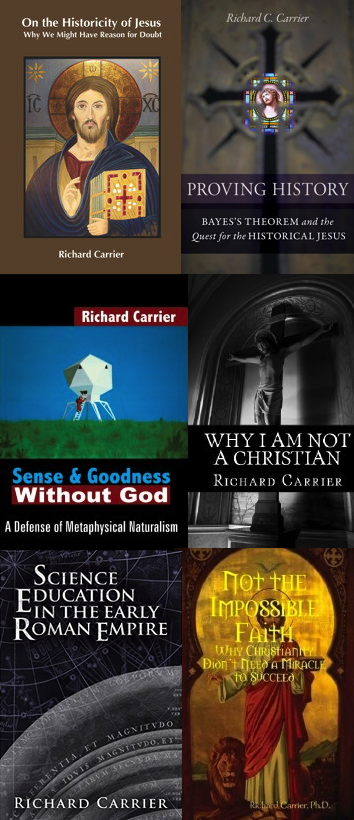
Books by Dr. Carrier
Explore C.H.R.E.S.T.U.S.