Bayesian Statistics vs. Bayesian Epistemology
Bayesian statistics is now routine in almost all knowledge fields. But I often encounter people who confuse “Bayesian statistics” with “Bayesian epistemology” or even just “Bayesian reasoning.” I’ll get critics writing me who...Pascal’s Wager and the Ad Baculum Fallacy
I’m sure you’ve all heard of Pascal’s Wager. The gist of it is that if you bet on there being a God (meaning, to Pascal, the Medieval Catholic God), you have an infinite expected return on investment, because at worst it costs you nothing (or at...Hypothesis: Only Those Who Don’t Really Understand Bayesianism Are Against It
I’ve started to accumulate a lot of evidence that consistently supports a singular hypothesis: only those who don’t really understand Bayesianism are against it. Already I’ve seen this of William Briggs, James McGrath, John Loftus and Richard Miller,...Why Christians Are Terrified of Probability Theory
A few years ago Strange Notions published a strange editorial by statistics professor William Briggs, called Bayes Theorem Proves Jesus Existed (And That He Didn’t). I say strange, because it’s weirdly dishonest, incompetent, and irrational coming from someone...James McGrath Gets Everything Wrong (Again)
Just this month Bible scholar James McGrath, whose incompetence and dishonesty I have documented several times now (example, example, example, example), posted a really foolish attempt to critique Bayesian history on his blog. Titled Jesus Mythicism: Two Truths and a...How Not to Be a Doofus about Bayes’ Theorem
I’ve been dealing with a bunch of doofuses lately. And I can’t tell if they are alone in their quackery, or if their disease is afflicting anyone else. So here’s a primer on how not to be a total doofus about Bayes’ Theorem. I define a doofus...Plantinga’s ‘Two Dozen or So’ Arguments for God: The Onto-Metaphysical Arguments
Famously, Christian apologist Alvin Plantinga once posted a lecture guide online outlining dozens of arguments for the existence of God (which was built-out a little bit in a book, and will evolve soon into an edited volume of its own). I’m often pointed to it...Eight Philosophical Questions We’ll Never Solve?
Years back George Dvorsky wrote a popular article at io9 titled “8 Great Philosophical Questions We’ll Never Solve.” It’s interesting because all eight are triggers for the same cognitive biases sustaining irrational theistic belief. Is it true...How Can Morals Be Both Invented and True?
After my post on Timothy Keller’s bewilderment at how atheists can have and justify morals and civil rights, many Christians struggled to understand the point, that morals and rights are totally made up, just like language and wheels and eyeglasses and laws, and at...All Godless Universes Are Mathematical
At futurism.com, there is a brief article explaining why the universe is mathematical, by saying, essentially just, that’s what we invented math for, to explain the universe. But this isn’t really an answer to the question. Theists have long used the lack...Fishers of Evidence Gets Confused about Math
Someone asked me about a confusing critique of the math in On the Historicity of Jesus by a YouTuber who goes by the moniker Fishers of Evidence. I don’t know his alignment in the debate. But he has posted a short eight minute video entitled The Error of Richard...Critical Thinking as a Function of Math Literacy
What do you get when you combine atheism, mathematics, evolutionary psychology, and the science of cognitive biases? Critical thinking skills! I discuss many aspects of this in my online course on critical thinking. (It’s easy, useful, and affordable, so...Barnes Still Not Listening on the Bayesian Analysis of Fine Tuning Arguments
Last month I caught up on an old thread with On the Bayesian Reversal of the Fine Tuning Argument by Sober, Ikeda, & Jefferys (against Barnes & Lowder). Luke Barnes has now thrown up a bunch of responses that are even more bizarre. One of the things I observed...On the Bayesian Reversal of the Fine Tuning Argument by Sober, Ikeda, & Jefferys (against Barnes & Lowder)
Clearing the dusty shelves of old unanswered things. One such is the Lowder-Barnes critique of my application of Bayesian reasoning to reverse the fine tuning argument into a case against God, rather than an argument for God. Actually this is not my argument. It is...Everything You Need to Know about Coincidences
Here is some handy linkage on coincidences. Thanks to a coincidence. I was reading the The #Skeptic’s Daily News and in it, by coincidence, were two separate papers on the subject of coincidence. Though only one was labeled such; the other, just happened by...Get Dr. Carrier’s Latest!

About the Author

Richard Carrier is the author of many books and numerous articles online and in print. His avid readers span the world from Hong Kong to Poland. With a Ph.D. in ancient history from Columbia University, he specializes in the modern philosophy of naturalism and humanism, and the origins of Christianity and the intellectual history of Greece and Rome, with particular expertise in ancient philosophy, science and technology. He is also a noted defender of scientific and moral realism, Bayesian reasoning, and historical methods.
Support Dr. Carrier


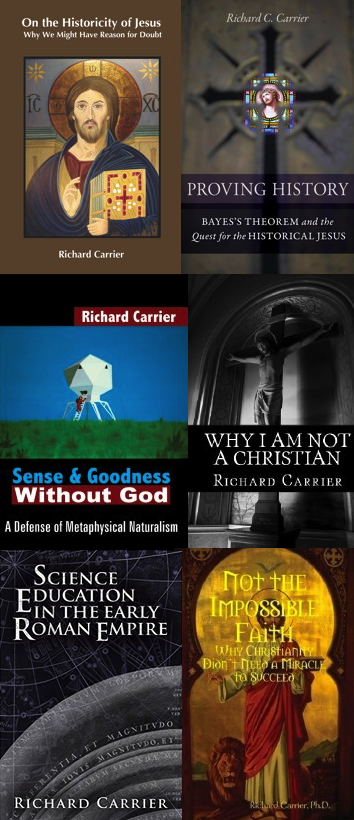
Books by Dr. Carrier
Explore C.H.R.E.S.T.U.S.