The Argument from Reason
In 2004 I composed for The Secular Web a detailed Critical Review of Victor Reppert’s Defense of the Argument from Reason. I still reference it whenever the “Argument from Reason” comes up. But anyone who visits it will notice it’s quite long....The Ontology of Logic
One question atheists tend to be bad at answering, because they rarely give it much competent thought, is the ontology of logic: what, physically, does it mean to say that logically impossible things can’t ever happen or exist? Or as a theist might pose the...Why Google’s LaMDA Chatbot Isn’t Sentient
Claire Hall summarizes the case with beautiful succinctness: “Blake Lemoine, an engineer at Google, was recently suspended after claiming that LaMDA, one of its chatbot systems, was a conscious person with a soul,” because “AI experts have...Why the Fine Tuning Argument Proves God Does Not Exist
In Bayesian Counter-Apologetics I outlined why the Fine Tuning Argument actually disproves the existence of God. And I didn’t make that up. What I outline there was independently corroborated twice by the peer-reviewed research of multiple experts (see On the...Some Ancient Chinese Philosophy on Why We Ought to Be Moral
When looking for “the objectively correct” answer to the question of why we should be moral, we also should look to what the ancient Chinese had to say on the matter. Not because it is any more likely to be correct than Western answers; but because ancient...Koons Cosmology vs. The Problem with Nothing
Recently on The Canadian Catholic Show I debated the cosmological argument with theologian Robert Koons, under the title “Does the Contingency Argument Succeed?” Koons took the position he has formally articulated in two articles, “A New Look at the...A Primer on Christian Anti-Intellectualism
I noted this month in my series on Justin Brierley’s book Unbelievable that rather than teaching its faithful how to think reliably, “Christianity teaches against any sound epistemology, even critical thinking.” In fact, “Christianity’s sacred...The False Trichotomy of Lord, Liar, or Lunatic
C.S. Lewis may have been the worst philosopher of the twentieth century. Worse even than his contemporary Ayn Rand. And that’s saying something; because she was pretty bad at it. Weirdly, he was an even worse historian. As Bart Ehrman put it, “The problem...Appearing in Tampa Tomorrow
Very rare event! Unofficial but actual: I will be hanging out in person at The Pub in Tampa, Florida on Monday, May 23. Strictly 7pm to 9. I will have a limited selection of books, if you want to buy one personally signed. Stop by and say hi! I’ll chat on all...Justin Brierley and the Folly of Christianity
This is the final entry in my series on Justin Brierley’s book Unbelievable? Why After Ten Years of Talking with Atheists, I’m Still a Christian. You can read my general summary of this book; where also at the bottom is a TOC linking to all the follow-ups, in...Justin Brierley on Jesus
Justin Brierley starts his discussion of the historical facts of Jesus by quoting H.G. Wells (p. 94), someone who had no degrees in history, and only remarked upon the historical effect on Well’s era of the literary character of Jesus, and merely presuming the...Justin Brierley on the Science of Existence
Does science prove God? It is painfully ironic that Justin Brierley opens his chapter on this topic with a false quote from a scientist (p. 22). This common Christian failure to do the work to ascertain what scientists have actually said about these subjects explains...Justin Brierley on Moral Knowledge & the Problem of Evil
“But why exactly do we believe that human life should be valued?” Justin Brierley asks (p. 52). Nowhere in his quest for an answer does he ever resort to asking experts in moral psychology or sociology what science has found the answer to this question...Justin Brierley and the Meaning of Life
“These are the reasons,” Justin Brierley says, “that I believe God is the best explanation of human existence, value and purpose” (p. 93). What reasons does he mean? Really, nothing more than a repeated confusion between the obvious natural...Unbelievable: Justin Brierley’s Epistemic Failure
Justin Brierley is an excellent host in Christian broadcasting. I’ve been on his show several times, including in person, when ironically I was an American visiting Brierley’s studio in London discussing the historicity of Jesus on a call with Mark...Get Dr. Carrier’s Latest!

About the Author

Richard Carrier is the author of many books and numerous articles online and in print. His avid readers span the world from Hong Kong to Poland. With a Ph.D. in ancient history from Columbia University, he specializes in the modern philosophy of naturalism and humanism, and the origins of Christianity and the intellectual history of Greece and Rome, with particular expertise in ancient philosophy, science and technology. He is also a noted defender of scientific and moral realism, Bayesian reasoning, and historical methods.
Support Dr. Carrier


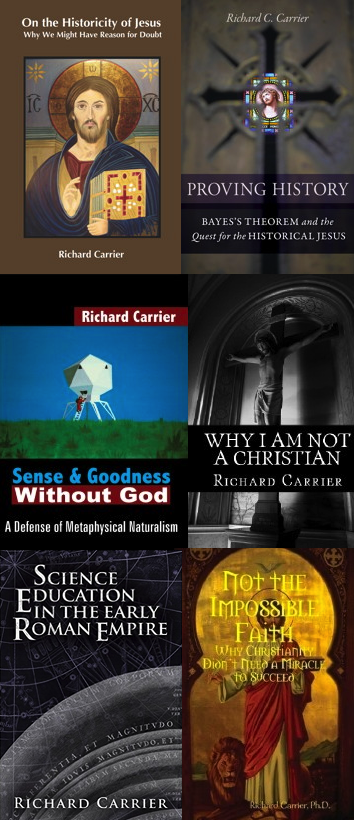
Books by Dr. Carrier
Explore C.H.R.E.S.T.U.S.