

After I published Proving History a reader said I should check out Aviezer Tucker’s book Our Knowledge of the Past: A Philosophy of Historiography, since it appeared to back up the entire core thesis of my book. I am amazed and ashamed that I did not discover this book sooner. It must not have been indexed well in databases, since my searches for Bayesian historiography did not discover it. I just finished reading it, and while I wait for more opportune times to blog on other issues coming up, I thought I’d post a little about this.
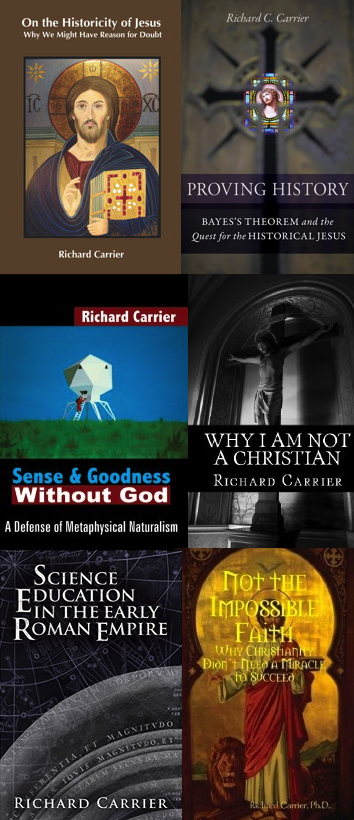
Tucker is a prominent and widely published philosopher (see his bio and cv). We have at least two things in common: we both did graduate work at Columbia University, and we both think historical reasoning is fundamentally Bayesian. As some might know, the subtitle of my book is Bayes’s Theorem and the Quest for the Historical Jesus, and though the study of Jesus is its principle example, the overall thesis is that all history is Bayesian and all historians should learn Bayes’ Theorem and how to apply it to their own thinking to improve their reasoning, research, and argumentation.
Tucker makes the same argument. His approach is deeper and more philosophical, more about making the point that historical reasoning is already Bayesian, and that this explains everything from consensus to disagreement in the historical community. My book makes that argument, too, but is more about the practical application of this conclusion, and providing tools and advice for how historians can make use of Bayesian reasoning to improve what they do. Tucker delves more deeply into philosophy and probability theory and as such his book is essentially an extension of my sixth chapter (which goes into more depth on points made earlier in my book).
That’s why I regret not having known of his book before now. It’s a great shame that Proving History does not cite it, and I am writing this review now to redress that gap. OKP provides solid support for the core thesis of PH, and is the first book I know that makes the case I do (and thought I was alone in making). Others had discussed Bayes’ Theorem in the context of historical reasoning, but always skeptically or inconclusively (e.g. see PH, p. 304, n. 28). Tucker appears to be the first to understand that in fact historical reasoning is Bayesian, and to argue the point explicitly. It thus provides another foundation (and independent corroboration) for my main conclusions. It was also a prestigious peer reviewed academic work, published by Cambridge University Press in 2004 (I had my book peer reviewed as well, but my publisher is less known for that).
Owners of Proving History might want to pen Tucker’s name and book title into the margins somewhere (it should certainly have gotten a nod in note 3 of chapter four, on page 306, and probably in my discussion on page 49 as well, perhaps where I mention the precedents of applying Bayesian reasoning in law and archaeology).
The leading merits of OKP are that Tucker grounds you in the history of historiography and philosophy of history, he treats in greater detail the issues of historical consensus and disagreement (with many erudite examples), he addresses several leading problems in the philosophy of history, and he cites and adapts debates and discussions of Bayesianism in the philosophy of science and applies them to history the same way I do (only he again in more detail): by demonstrating that science and history are fundamentally the same discipline, only applied to data-sets of widely differing reliability.
As Tucker says in his central chapter (ch. 3, “The Theory of Scientific Historiography”), “I argue that the interpretation of Bayesianism that I present here is the best explanation of the actual practices of historians” and that “Bayesian formulae can even predict in most cases the professional practices of historians” (p. 134), and he gives good brief explanations of prior probability and likelihood (what I call consequent probability) in the context of historical thinking, and uses real-world examples to illustrate his point. His chapters 1 and 2 cover the background of the philosophy and epistemology of history, and remaining chapters apply the results of chapter three to address three major debates in that field: explaining disagreement among historians (ch. 4), resolving questions of causal explanation in history (ch. 5), and exploring the limits of historical knowledge and method (ch.6). He then wraps it all up with a conclusion (ch. 7). There is also an extensive bibliography and index. Throughout his book, Tucker aims to refute postmodernist and hyper-skeptical approaches to historical knowledge, and in that regard makes a good supplement to McCullagh (whom I do cite in PH).
For me, the most notable facts are that we did not know of each other, yet we independently came to the same conclusion that all historical reasoning is fundamentally Bayesian, and Tucker is a well-established philosopher and his book is by a major peer reviewed academic press. Both facts add weight and authority to my overall conclusion in Proving History. And that’s always nice to have.
Discover more from Richard Carrier Blogs
Subscribe to get the latest posts sent to your email.






One thing that I’ve always appreciated about reading your work Richard is that you do not exclude supernatural conclusions from the get-go, and believe that we could in principle prove ‘miracles’ occurred. One thing that troubles me about Bart Ehrman and other biblical scholars I’ve read/listened to is that they seem to take a “science is about natural explanations for natural phenomena” approach to history, instead of a “science is about discovering whats true”; “history is about getting the ‘truest’ beliefs about the past”. They seem to think we couldn’t (even in principle) know that Yahweh was behind a given action.
On the topic of Jesus’ resurrection and divinity, Bart often says we simply can’t know. One recent quote from Bart’s blog goes as follows: //I’M NOT SAYING THAT HISTORICALLY WE CAN SHOW THAT IT DID *NOT* HAPPEN; I ARGUE THAT THE HISTORICAL DISCIPLINES SIMPLY DO NOT ALLOW US TO KNOW WHETHER SUCH A MIRACLE OCCURRED OR NOT, DUE TO THE LIMITATIONS INHERENT IN THE STUDY OF HISTORY//
Is this a view that is shared by the consensus of scholars/historians? Or have I just gotten a bad sample? Also, could you recommend any books/essential reading that deal extensively with this topic? Or just any thoughts you have on this issue would be appreciated!
Looking forward to reading OHJC!
Best,
Ben
Well, just keep in mind that most historians don’t really think about this (and honestly, I doubt Ehrman really has, all that much).
I don’t know what’s usual (since most historians never even talk about this), and explicit discussions are scattered and all over the map, but I suspect when you hear what Ehrman said it’s either or both of these things going on:
(1) Like scientists, most historians know the paradigm of naturalism is well established by centuries of solid scientific inquiry, and even if some of them accept that that might change (they might even believe in the supernatural), they also accept that it so far hasn’t. So miracles are just not in the cards. Until we get some scientific support for such things even being possible (note in Proving History I use a transmuting lead to gold analogy [pp. 250-55; with n. 28 p. 330] to avoid the baggage of this, since we scientifically actually can transmute lead to gold, so the question is how one would do that given what we know, and waving a wand over the lead just isn’t one of them…so far).
This intuition then gets garbled when they try to answer questions like Ehrman did, and it comes out as the rationalization that history can’t even in principle discover miracles. But that’s just not thinking the matter through. Obviously all science is history (what science has or has not discovered is a historical question, answered only with historical documents). So such a notion would make it impossible even for science to confirm the existence of the miraculous. And if they understood that, they’d revise the way they phrase this. It’s the difference, perhaps, between a historian and a historian who has philosophical training and thus is aware to think things like this through more before pronouncing, and has some skill in doing that.
I mean, just pick the obvious example: science could have proved by now that the earth and all species began to exist 6000 years ago and we all descend from one woman and one man and that an invincible immortal angel with a sword of fire still won’t let anyone into a garden in central Iraq. I cannot imagine how we could maintain that that isn’t evidence of something miraculous going on (without being unreasonable: see my discussion of the folly of hyper-skepticism in Defining the Supernatural, skip especially to the last section, “Is the Supernatural Knowable?”).
So, not thinking things through, the Ehrmans of the world just think it can’t be done in principle, because it can’t be done in practice (“in practice” meaning, given the facts as they so far happen to be).
(2) There might also be a pandering fallacy involved. If Ehrman says history cannot in principle prove a miracle, that lets the faithful off the hook. They can have their faith and eat it too, since this means history cannot contradict their faith (it just can’t corroborate it; that “non-overlapping magisteria” nonsense). That’s all sweet and nice. But it simply isn’t true. Science (indeed a very much historical science) did not discover that the earth and all species began to exist 6000 years ago and we all descend from one woman and one man and that an invincible immortal angel with a sword of fire still won’t let anyone into a garden in central Iraq. So there could be a kind of attempt here to not offend the religious, while still admitting there is no historical evidence for any real miracle.
Could be one or the other or both.
Off topic, I guess, but do you think the question of the Two Source Hypothesis vs. the Farrer Hypothesis as solutions to the Synoptic Problem is amenable to a Bayesian analysis, or is the evidence already too involved to be easily dealt with?
It could be done. But it would be a data-intensive chore. Something one would need funding for, and a team to work the data with.
There has been something almost like this done, but it was done badly (and got really weird results). I’m talking about the IIGS study. Their first research result appeared as David Barrett Peabody et al., Beyond the Q Impasse: Luke’s Use of Matthew (Trinity Press International, 1996), and then they came out with One Gospel from Two: Mark’s Use of Matthew and Luke: A Demonstration by the Research Team of the International Institute for Renewal of Gospel Studies (Trinity Press International, 2002). Their first book quasi-statistically “proved” that Luke used Matthew and thus there was no Q. Their second book similarly “proved” that in fact Mark was a redaction of Matthew and Luke, not the other way around.
Their mode of argument is unknowingly Bayesian and could have been formalized using Bayesian models. However, they make some basic mistakes in probability theory (which leads them to use certain evidence as borrowing one way but not the other, when in fact it is just as likely either, which is basically screwing up the likelihood ratio) and rely on some inadequately defended assumptions (such as that an author “would never” compose in a certain way, which is basically dinking the priors without foundation). These errors afflict the second book far more than the first (the first therefore remains a good survey of evidence against Q).
That said, I can make a case against Q that is Bayesian right now, and fully articulate it with maybe a week’s labor (not worth the bother for me, but maybe someone someday will have the time for that), but it wouldn’t be “thorough” in the way we should most prefer.
And in the meantime, we have evidence, like that Luke used Matthew for the crucifixion narrative (in at least one place verbatim), that is nearly 0% likely on any traditional Q hypotheses (as Q is not supposed to contain a crucifixion narrative; only on fringe Q theories would it do so), which almost single-handedly refutes the Q hypothesis. I’ve added some of that up and the trend is all against Q and none for (so far as I’ve found). So I can’t really see any sound reason to maintain the Q hypothesis anymore.
Richard, I have a college degree in a science field, but know less than nothing about philosophy. Can you recommend a good beginner’s book on philosophy?
That depends on whether you want to get up to speed on the history of philosophy, or just on philosophical concepts, methods and state of the art. (Philosophers tend to conflate the two way too much.)
There is no ideal catch-all book for either. But as best as it gets in doing both (that I know of) is Classic Philosophical Questions (buy a used copy of the next-to-last edition, which is currently the 13th; the latest edition, right now the 14th, always goes for a highway robbery college textbook price). That treats many aspects of philosophy by using historical readings across the whole history of philosophy, and aims at showing two sides of a debate in each case. The defect is, it’s not thorough, state-of-the-art, or particularly good at teaching you how to do philosophy yourself.
I’ve heard recommended The Philosophy Book for a more thorough ultra-basic intro to history of philosophy (and in result covers all the basic concepts and debates still around or discussed). But I’ve never seen it myself so I don’t know how good it is (though it is very well reviewed on Amazon). But that’s still just a descriptive tour and not a how-to.
For a “how to” book, unfortunately the best intros are college textbooks kept at ridiculous prices. So, limiting to the affordable, you can try Simon Blackburn’s Think: A Compelling Introduction to Philosophy [also kindle]. That’s a good how-to guide, reasonably broad, and almost up-to-date (published in 1999). In fact, as I think most history of philosophy is a waste of time, I recommend this as the first book you read. Get exposed to the history stuff later, if you even care to.
In all honesty, the only actual skill involved in doing philosophy (that would separate “doing philosophy” from “doing science” for example) is logical reasoning. Master that, learn the basics of how to do library research on an issue, and that’s pretty much it. (Often that means researching the science on a subject as much or more than the latest philosophy on it, so your having a science degree gives you a leg up even on most philosophers; and on researching the philosophy on a subject, do know that most philosophy is garbage, but not all of it, and it can be hard figuring out which is which, and the field of philosophy adamantly refuses to develop any standards or guides for helping you do that, so a pox on them).
So, to that end, I recommend (as a good intro to philosophical method) Christopher DiCarlo’s How to Become a Really Good Pain in the Ass [also kindle]. But you can train yourself for free using the ChangingMinds pages on Syllogisms and following up with a study of the Wikipedia List of Fallacies and The Fallacy Files (especially their Interactive Taxonomy of Logical Fallacies). There is also an online version of Bo Bennett’s Catalog of Logical Fallacies, and Bennett’s book Logically Fallacious is the best portable resource for a basic intro to logic and an essentially complete encyclopedia of fallacies aimed at the non-expert [also kindle].
On how to use those skills to study specific branches of philosophy (epistemology, etc.) I usually just recommend my book Sense and Goodness without God [also kindle] in conjunction with free resources online wherever you encounter a word or concept that’s unfamiliar: the Internet Encyclopedia of Philosophy and the Dictionary of Philosophical Terms and Names (Wikipedia also often has descriptions of terms and concepts now). You can use that as a study-by-example (see how I answer questions, and what questions I think need answering and what resources I cite as my guides in the bibliographies to each section, and try to emulate that when you think about these issues on your own, or even follow up with the items in the biblios, although those are now nearly ten years out of date).
For more advanced study once you have your grounding, I have an Amazon store loaded with the books I believe are required reading for any philosopher today (RCR Essentials Philosophy).
So, pick and choose among those options what’s best for you as a starting point.
[Note: see also comment below, where a very good addition to those options is proposed.]
Have you read about bayesian interpretation of quantum mechanics? http://www.scientificamerican.com/article.cfm?id=can-quantum-beyesnism-fix-paradoxes-quantum-mechanics
That’s a new one. For those who can’t afford access to the article, there is a Wikipedia entry on the subject (Quantum Bayesianism) and the original research article is available for free (QBism).
(A) One key problem I detect right away is that it trades on a distinction between degrees of belief and frequentism, when in fact the former logically reduces to the latter (Proving History, pp. 265-80), so the distinction they are trading on doesn’t exist. That’s a problem they would need to resolve, although presumably they could do so with an extension of information theory, which is already their foundation. But doing that will likely lead them right back to where they started: with actual quantum states to explain (the very thing they are trying to remove).
(B) And though they seem to deny it, it appears to just be reformed solipsism (it’s fundamentally anti-realist and assumes our minds generate reality), and lacks any actual explanation of anything (how do our minds generate reality? why do they do it that way instead of some other? whose mind generated our minds? and whose mind generated their mind? did nothing exist ten billion years ago when there were no minds to generate it? yadayada).
Ironically, accepting criticism (A) and criticism (B) leads to my own theory of quantum relativity (see Calling All Physicists) which I’ve had to shelve while I work on other things but do mean to get back to (I have a number of responses from physicists yet to examine). In that model, the agent is (in a sense) causing the phenomena (as QBists suggest), but not in some mystical informational sense but a very real physical sense (the one thing QBists think they have to abandon).
The Philosopher’s Toolkit: A Compendium of Philosophical Concepts and Methods [also kindle], by Julian Baggini and Peter Fosl is also a pretty good introductory text.
I hadn’t heard of that, but I just bought and checked the kindle edition and it is indeed excellent, so I added buy-links to your comment.
To fit that into the scheme of options: it’s a good nuts-and-bolts how-to that works at the level of basic concepts rather than worldview building (so, not much about how to decide what epistemology to adopt, for example, but all the basic skills one might use to do that with). And I am not aware of anything else like it. It fills a niche in the basics department without being too simplistic. I’m even going to add it to my bookstore.
According to Jeff Lowder, this seems to be a good book on Bayesianism, too: “Michael G. Titelbaum, Quitting Certainties: A Bayesian Framework Modelling Degrees of Belief, Oxford University Press, 2013”
You might want to check out this review.
http://ndpr.nd.edu/news/40806-quitting-certainties-a-bayesian-framework-modelling-degrees-of-belief/
It’s a bit pricey (see here), a lot of it looks too advanced for most people (symbolic logic, etc.), and seems mostly specialized (to solving particular philosophical problems in epistemology). I also find suspect its core conceit, that standard Bayesianism does not provide for reducing certainty. I think pretty much every practical Bayesian on earth (e.g. CIA analysis, insurance analysts, etc.) would find that a bizarre claim, as they use BT to reduce certainty all the time (even a single surprising data point, if sufficiently unexpected, can suddenly produce a large drop in certainty). Likewise Titelbaum’s other solutions seem to solve problems that never existed in the first place. At most it looks like he comes up with a more disciplined way to address them; but to suggest they weren’t addressed already (in actual practical applications of BT) is dubious. But maybe the reviews and editorial descriptions mischaracterize what he actually argues.