
There is a classicist named Ammon Hillman (a.k.a. David Hillman) who wrote a decent dissertation on ancient pharmacology and then went on to make absurd claims about the Gospels and early Christianity that verge into pedophilia and an obsession with genitals. And yes, your intuition is working here: all his weird theories about this are just as false as they sound. Yet he’s been pushing this everywhere he can online (for a summary and critique there is a whole channel on this, including treatments at MythVision and History Valley). I happen to know other classicists have been rolling their eyes at this nonsense but don’t want to get entangled in legitimizing “the creepy paedo-porn guy.” So various parties offered to arrange a debate between Hillman and me (because I am immune to university politics). Hillman flat out refused to debate me. Apparently he won’t debate an actual expert. And I’m not the only one who offered: he also refused Luke Gorton; but after I published this article, he relented and their debate on the Danny Jones show did not go well for him and he is now refusing to debate him again. So I think I know why Hillman is so not keen to debate real experts. And so will you before you finish this article.
I must forefront all this with a warning: because I have to assess the value of what Hillman says, and what he says is gross, I’m going to have to quote and discuss some graphic and gratuitous sexual content. If that’s not kosher to you, you can skip this article, and all content ever generated by Ammon (aka David) Hillman, and count yourself lucky. Everyone else, trudge on.
Since Hillman won’t debate me, I will debate his empty chair: his wildly dubious chapter in Toxicology in Antiquity, “Ancient Mystery Initiation: Toxic Priestesses and Vaginal Communion,” which includes his absurd declaration (pp. 383–84) that Jesus was taking drugs and “had to derive his antidote by the performance of a sexual act on a 9–12-year-old boy” because he “needed the semen of a young boy to balance the symptoms brought on by imbibing” hallucinogens that pagans usually snorted from vaginas (none of which is true), plus some false things he has said elsewhere about Mark describing this (he doesn’t). I have no interest in anything else Hillman says, because this alone proves he is catastrophically unreliable and thus cannot be cited even for a sensible claim, much less a controversial one. You should never be listening to or referencing this guy. At all. For anything.
Methodology
The following is not a complete fisk of Hillman’s published nonsense. Cranks never deserve that. What I will give you is a representative dive into how he misstates the facts, and browbeats anyone who can’t check him. And you’ll see it won’t even matter if he’s changed any of his positions since Toxicology, because the “errors” I will document illustrate the same dishonesty or incompetence he is displaying online. Which all entails the same things about his reliability. Hence I will walk you through enough examples for you to know that you cannot trust anything he says.
My procedure here is the same as I recommend in Galatians 1:19, Ancient Grammar, and How to Evaluate Expert Testimony: Hillman’s claims have already been debunked (see links above), but not in as much detail by anyone with a Ph.D. in ancient history and languages. Unlike me. I have studied the Greek language since my Berkeley B.A. in history and minor in classical civilizations, resulting in an honors thesis that won me a full-ride fellowship in the ancient history Ph.D. program at Columbia University, where I studied Roman-era Greek (including linguistics, paleography, and papyrology) under renowned classicists and historians (W.V. Harris, Alan Cameron, Roger Bagnall, Raphaella Cribiore, Gareth Williams, Leonardo Tarán, Nancy Worman, and others), and majored in ancient religion, historiography, and philosophy, and completed a dissertation on ancient science. So I am an expert confirming to you, personally, what Hillman is not telling you. And I am not alone. Other experts have critiqued Hillman in other ways, from Dan McClellan and Kipp Davis to Joel Korytko. As far as I know, no expert backs what he says here.
Danny Jones had Hillman on and later confessed to Joe Rogan that he could not vet his wild claims because Jones doesn’t know ancient Greek and “couldn’t” get an actual expert in Greek to debate him (and didn’t like it when he did). So I am here to tell you what Hillman is saying that isn’t true. And per the method I lay out in Ancient Grammar, I will provide you with the tools (evidence and links) that you need to tell, on your own, which of us (him or me) is snowing you. It is particularly disgusting to me when experts use their degrees to gaslight people whom they know can’t check to see they aren’t telling the truth. It’s abusive, sleazy, and fundamentally unprofessional. So you need to know if this is what Hillman is doing to you.
1. That Vagina Bong Nonsense
Hillman’s postdoc claims about ancient pharmacology generally are untrustworthy (see the Bryn Mawr review by Philippe Charlier for perspective). He practices the tactic of Motte and Bailey, framing himself as just making obviously true claims (e.g. hallucinogens were known and sometimes used in antiquity—they were) but then surrounding those with obviously false claims (e.g. everyone was using them all of the time and everything from Christianity to democracy, even Greek philosophy, was built on them—they weren’t) and then complains that calling out the latter amounts to denying the former (it doesn’t). So you have to be on your guard against that shell game. It’s a game almost every crank plays. And you might catch Hillman (and his fans) doing this a lot. Don’t let them. Always call out this fallacy the moment you see it.
So we should not be surprised that Hillman turns out to be completely unreliable on the claim that people were using women’s vaginas as bongs to take drugs (or vaginal fluids as drugs). There is absolutely no evidence this ever happened anywhere in antiquity. It would be tedious to go through the hundreds of random made-up claims he uses (in his chapter and online) to try and “create” this fact and sell you on it (all of which counting on you not checking anything). What I will do instead is single out some representative examples of how he snows you, which provide you with a framework to follow so you can check any other claim you feel the need to.
Representative of everything I’m talking about is how Hillman abuses you as audience and Apollonius as a source (p. 366):
- Hillman claims Apollonius, in Argonautica 4:1135ff., describes priestesses drugging babies. It does not. It describes the nymph Makris salving the parched lips of the baby Dionysus with honey. It explicitly says “honey” from “bees” and nothing else. Earlier Apollonius mentions she nursed him, which always means nourished, not drugged (4.540). Nowhere in this text is Dionysus or any baby drugged. (Nor in 4.869–872, on which Hillman pulls the same stunts regarding Achilles.)
- Hillman claims this passage “refers to the Mystis (μύστις), the mystery priestess who nursed Dionysus.” There is no one named or called Mystis here. The root μυστ- appears nowhere in the whole of the Argonautica (see screenshot of my search of the TLG below). And there is no reference to mysteries or even priestesses in book four.

- Hillman then claims “Mystis (whose name means “initiator”)” refers to people “credited with the production and administration of a serous vaginal exudate that was mixed with sacramental compound drug concoctions.” None of this is true. While mystis could refer to an initiate or initiator, it actually meant secret rite (from the verb muô, to close, shut). And even when mystis thus referred to initiates in those “mysteries,” it never meant anything to do with drugging vaginas. And no such thing happens in Apollonius, anywhere. And again, no one named or called mystis is in Apollonius anyway. Notice how Hillman has given the impression that this is all in the source he cited. None of it is. Literally none of it.
In fact the Greek passage Hillman quotes here (but doesn’t even attempt to translate for you) says not a single thing he claims. It actually says local “nymphs gathered up in their white folds the many-colored blossoms they had picked,” meaning they were tucking flowers into their white frocks (see below). So how does he get vaginas?
- Hillman insists the word “white” here refers to “the menstrua alba of young girls.” It does not. Even apart from the fact that in no honest, competent way does the context warrant that sense here, Hillman has screwed up the grammar. He cites §5 in the standard Liddell & Scott Lexicon, but “overlooks” the fact that the LSJ indicates that sense only occurs in the neuter plural (ta indicates neuter plural, likewise leuka), not the masculine—and only as a noun, not an adjective. Here it is masculine singular, and an adjective. It modifies kolpos, “fold, lap, bosom,” which can in medical contexts mean vagina but only when paired with the word “womanly” (gynaikeios), hence “womanly fold” not just “fold” (below I screencap an example from the medical author Rufus), or when paired with an explicit reference to birth, hence “born from her lap” not just “lap” (e.g. Callimachus). Neither of which is happening here. This is not a medical book anyway. It’s a poem about nymphs bringing flowers to a sacred site. It is not describing women giving birth or stuffing miscellaneous flowers up their vaginas. Competent translation entails attending to (not ignoring) context. But Hillman chooses crank translation instead.

So, no drugged babies or vaginas in Apollonius. Though paedo points, I guess, for contriving an elaborate excuse to juxtapose drugs, babies, and vaginas; and bonus points for making them the vaginas of “young girls,” when nymphs were actually thousands of years old. But none of this is real. It’s all made-up in Hillman’s mind. So, figmentary points for figmentary ideas, I guess.
Take care to notice all the tricks Hillman is pulling here: his only evidence for his claim about nymph vaginas is this single passage in Apollonius, yet he has misstated which word is in the text; he has misstated what the text says; and he got the grammar wrong; all to convince you that when Apollonius says nymphs carried flowers to a shrine, it means priestesses drugged their vaginas in mystery cults. In fact there are no vaginas, priestesses, drugs, or any references to mystery cults. By playing games of juxtaposition and conflation and stream-of-consciousness make-up-whatever, Hillman has fabricated a passage that does not exist, to con you into believing that a completely outrageous falsehood born of his own pornographic mind is “attested” in ancient sources. This is how he routinely operates. So you need to pay close attention to how he did this, so you know how to catch him doing it every other time.
Hillman does the same thing when he tries to trick you into thinking the word ios means “purple venom” because two different similar-sounding words that aren’t related to each other (ion and ios) mean, separately, violet (as in the flower) and any fast-acting poison (not necessarily venom). None of Hillman’s sources about venom say it is even purple much less connected to violets. None of his sources on violets or even the color purple say they are talking about poisons. It’s all the worse that you will often catch him playing on the ambiguity of the word “purple” to term-switch between “violet” (ion) and “red” in order to claim references to blood are references to ios (poison). Of course spectrally violet is nowhere near the color of blood (literally), and though the ancient Greek word for purple could overlap with red, it can’t for the flower. So there is no logical way to get from “violets” (the flower) to “blood red.” Nor are violets poisonous. Nor are they snakes. Nor is snake venom purple (hence he has to concoct elaborate fantasies about how it must have been mixed with purple dye). Hillman’s train of thought across all of this is poppycock.
And he pulls the same tinfoil hattery with language to get purple vagina bongs. For example:
- Hillman claims “a good example” (note: he says a good example) of his made-up ios-rite “can be found in Euripides’ account of the union of Apollo and Creusa, Ion 887ff.” where, he insists, “Creusa inserts meadow saffron into her vagina” (p. 368).
Really?
No.
Once again, Hillman’s source is just describing a man finding a woman gathering flowers and then leading her to bed (and not a wedding, or any religious rite, as Hillman also falsely claims). The context cannot be tweaked here. “You came to me, your hair gleaming with gold, when I was plucking into the folds of my robe saffron flowers to adorn with gold gleaming” is clear in its meaning. In Greek, this translates ἦλθές μοι χρυσῷ χαίταν μαρμαίρων, εὖτ᾽ ἐς κόλπους κρόκεα πέταλα φάρεσιν ἔδρεπον, ἀνθίζειν χρυσανταυγῆ, where autumn saffron not meadow saffron is referenced (see below), and kolpous this time is in the plural for a single woman. So does she have multiple vaginas?
In the context of giving birth the plural of kolpos can refer to the entire reproductive system (from the womb on down). But that’s not the context here. Here the context is flower-picking. So the sense is dictated by context: she has multiple folds in her gown. Indeed this passage explicitly says “gown” (folds in her pharos, often in poetry plural, meaning a cloak or apron—never vagina). And it is “saffron flowers” (krokea petala) that she is “picking” (drepô)—not a drug or poison, but a condiment (saffron in the vagina wouldn’t do anything pharmacologically more than eating it would). Her many vaginas (or entire reproductive system) stuffed with drugs also can hardly have been “adorning” anything “with gold” either.
Oh, did you not catch the clever poet contrasting the boy’s golden hair gleaming with her golden flowers adorning? Right. The poet is describing visual imagery. She isn’t stuffing flowers out of sight. She is displaying them. Adorning, not drugging.
And then:
- Hillman claims “the vagina (κόλπος) and breasts of priestesses became biological synthesizers of sacred communal substances,” a truly strange assertion, for which he cites only a single source: Horace’s Epodes 17.35, where Hillman insists “the Latin term for the body as a vessel used to prepare drugs was officina and was used by Horace to describe the power of the witch Canidia in her use of Colchian drugs” (p 369).
Not a single thing he says here is true. Remember the word “lap” (kolpos) only means vagina when paired with the word “womanly” or a reference to birth, which isn’t happening in either passage he cites (and not only because his source is in Latin, not Greek). Epode 17 never says any of this. No lap or bosom or vagina is here at all. Line 35 says of Canidia “you’re a workshop aglow with Colchian poisons, till I turn to dry ashes” and am blown away. There is no mention of vaginas or “the body as a vessel.” That Horace, a poet, says “she” is a workshop is a poetic device called personification. Horace is not describing Canidia processing poisons in her body (at all, much less using her vagina). He is just describing her furious activity in producing poisons and magicks until he is burned away by them. So, Hillman has no evidence whatsoever for his wild claim here. He just cited a random unrelated verse and hoped you didn’t go and read it—or don’t know how Latin works, or how poetry works, or that a fantastical poem about a witch tormenting the narrator is not a technical manual on vagina magic.
I won’t tour any more examples. It’s all like this. Nothing he claims is true. None of his sources say what he claims. Indeed, you’ll find Hillman pulls stunts like this all the time, like when in some rambling video or other he tries to argue that any ancient Greek passage about sitting on a throne can be read as “taking drugs” because ta throna can mean drugs (and somehow “sitting” or whatever verb it is can be spun as “taking” or “being on” or whatever). What he doesn’t tell you is that this sense only exists in the neuter plural. When the word means seat or chair (and hence, by metonymy, kingdom or reign) it is masculine singular (or masculine plural when many thrones/domains are meant, like in Colossians 1:16 and Revelation 20:4).
These technical matters of Greek grammar require expertise to spot. So Hillman is counting on his dupes not knowing Greek, or not bothering to check what he is claiming about the Greek. Of course his claim also falls afoul of all the other rules of competent translation (like attending to the grammatical and situational and cultural context of a word—see, again, Colossians 1:16 and Revelation 20:4). For example, Luke 22:30 is obviously just an abbreviation of the twelve-thrones saying of Matthew 19:28 which is obviously an embellishment of a doctrine Paul refers to in 1 Corinthians 6:3, “we will [even] judge angels.” It’s about holding seats of power in judgment (twelve different seats, one for each tribe). It is not about taking drugs. Wrong context. Wrong grammar. So Hillman’s exegesis here would flunk him out of any accredited course in ancient Greek.
When he suspects you are going to catch him pulling these sorts of tricks, he will pull out another more sweeping claim: that he knows a secret language called the Vox Orphica and this allows him to completely change the meaning of any word he wants anywhere to anything. This is a scam. But I’ll get to that last. Let’s move through the rest of his bunk first.
2. That Jesus the Drug Addict Nonsense
I shouldn’t insult your intelligence by wasting time on Hillman’s nonsense case for Jesus taking drugs, in particular a completely illogical mixture of hallucinogens, poisons, and colored dyes (because, reasons). That never happens in the Gospels, and Hillman’s attempts to “get it” to be happening in the Gospels is all linguistic distortion and tinfoil hat that, once again, would get you flunked out of any course in ancient Greek or literature. But alas, he is snowing you, and too many are falling for it, so I have to give you a dose here to inoculate you against this disease.
Hillman claims “the first generation of Christians following Jesus openly acknowledged drinking drug concoctions derived from snakes” in Mark 16:18 (p. 383). Openly? No. Not even covertly. Not even at all. This is all made up. First, of course, that verse is a fake. It was likely inserted into the manuscripts of Mark in the 3rd century, and most likely originated in a commentary on the Gospels from the mid-to-late second century that never intended this to be mistaken as Gospel text (see my chapter on all this in Hitler Homer Bible Christ). It probably was just a rephrase of Luke 10:19 which claims a miraculous immunity to poisons, not their use for anything. But whatever. Likewise, later traditions (e.g. Hippolytus, Apostolic Tradition 36.1, and Papias in Eusebius, History of the Church 3.39.9) only reference a mythical immunity to poisons, not the intentional use of poisons as drugs. But again, whatever. Let’s play the game.
Mark 16:18 is in a list of miraculous powers early Christians would claim to have, including that “they will pick up snakes, and when they drink anything deadly, it will not hurt them at all.” There is no reference here to using poisons as drugs, or using them in any way at all. It just says things won’t hurt or kill them because of their faith. And it “openly” says this of handling snakes (ὄφεις ἀροῦσιν), not processing their venom, and that nothing “deadly” (θανάσιμόν) that they drink will harm them (πίωσιν οὐ μὴ αὐτοὺς βλάψῃ), not “things they drink will do something useful for them” or any other thing that could have buttressed Hillman’s fantasy. In fact Pseudo-Mark chose the opposite sense: to never blapsein someone means not just never cause harm, but to never alter or distort their mind, too. Which rules out any conception of this encompassing hallucinogens.
Hillman ignores all this and claims, instead, that the word “deadly” was a medical term for poisons. That’s not quite true, because he is misrepresenting an adjective as a noun. The word is “deadly,” not necessarily “poison” (the author says “deadly thing,” θανάσιμόν τι). This therefore cannot be the medical term for poisons. As a noun substitute (which it absolutely is not here) it could mean poisons, and hence poisonous “drugs.” And so could the adjective-noun phrase the author actually used. And the context does make that the sense here. But it does not specify snake venom as Hillman mis-implies. It generically encompasses all deadly substances. Moreover, snake venom was already listed, so the author clearly does not mean snake venom with this phrase. He means all other poisons apart from the snake venom he already mentioned by metonymy. And the context plainly establishes that he means these are bad things, things that would cause harm (but for the Christian faith), exactly as Papias and Hippolytus clearly understood (so all Christian witnesses are against Hillman here).
This is all just a bundle of bait-and-switch fallacies: say some trivially true things (like that Pseudo-Mark means “poisons”), then tack on a bunch of false things (like that he means ingesting a processed and carefully-dosed snake venom in conjunction with a hallucinogen), and hope that the truth of those trivial things will rub off onto the false things. It doesn’t. Unless you’re easily duped by shell games. But please don’t be that fool. You know better. What Hillman is doing is exactly the wrong way to translate texts. Ignoring grammar. Ignoring context. Ignoring history. And putting words in an author’s mouth. Just like the Preterist and Israel Only folks do. Hillman is breaking every rule he would have been trained in school to follow. Which would be professional incompetence if it didn’t appear that he knows what he’s doing and thus is doing this on purpose. Which I think the savvy will peg as dishonesty. This is the same shit that Christian apologists do in the other direction, which rightly pisses you off. Same game. Same disinformation. You should be just as pissed off.
Hillman then uses the same Christian-apologetics-style trickery again when he claims that Jesus’s Gethsemane prayer is about him drinking processed snake venom and hallucinating angels—absolutely none of which is happening in the text. There is no angel, no vision—not in Mark’s account, nor Matthew’s revision of it, nor even in Luke’s 2nd century revision of theirs, because Hillman glosses over the fact that the angelic vision now in Luke’s text was most likely a textual corruption of the late second century (a conclusion with a grade of A—the highest confidence—in the most recent text-critical edition, and as defended in Ehrman, Orthodox Corruption of Scripture, pp. 225–26; there is no evidence these verses were in Marcion’s text either). This is important because Hillman spins another ridiculous argument here that (somehow) the fact that Jesus (supposedly) sweated blood confirms his use of a drug—but that’s part of the interpolation. It’s fake. Luke never wrote that. It was inserted half a century or so after Luke composed his edition. But even if he did write it, he clearly invented it a century after the fact. Because both Mark and Matthew, his only known sources, never heard of it (even though some scribes tried to sneak this text into late manuscripts of Matthew: Aland & Aland, The Text of the New Testament, p. 310).
But this is also a non sequitur. Red sweat has no actual correlation with any hallucinogen. And the text does not even mean that anyway. The author’s metaphor is not from the color of blood but how his sweat forms drops and hits the ground the way blood does (this is obvious to anyone with any savvy in literature and metaphor who just reads the text as written). Hillman tries to avoid all this by instead implying the sick idea that Pseudo-Luke might really mean some purple goo was leaking out of Jesus’s ass (“the physical substance that exudes from Jesus in the Garden is also used to describe the exudate of the anus of Dionysus” in the Frogs of Aristophanes—that never happens in the Frogs of Aristophanes). Or perhaps, less intelligibly, leaking out of Jesus’s pores “as if like” Dionysus’s ass. But that would be abject pseudoscience. So I assume Hillman doesn’t mean that.
There is no goo or purple or anus in Luke 22:43–44. Nor in Aristophanes—and notice Hillman does not tell us where in the Frogs this weird thing is supposed to be happening. Not a single relevant word connects between Luke 22:44 and the Frogs, except that “dripping blood” (haimatostagês, a word not in Luke) shows up in Frogs 471–472, but in no connection with anyone’s ass. Nor is there any “ephemera” that Hillman claims Jesus was drinking that is supposed to have caused this. In the Frogs the line is (spoken to Dionysus) “Acheron’s gore-splattered crag is keeping watch on you” (Ἀχερόντιός τε σκόπελος αἱματοσταγὴς φρουροῦσι). Only after this, after Hell’s janitor thus threatened him, does he sick monsters on Dionysus that literally scare the shit out of him, and a humorous discourse follows about his heart dropping into his bowels. But none of that is in connection with the previous mention of blood. So, sorry. No hemorrhoids. No bleeding ass. No “ephemera.” Not a single thing Hillman is claiming is in that text.
There is also no drinking in Gethsemane (or before—and you can check: Jesus is never said to drink anything in any account of the last supper). Hillman is eyerollingly acting like a biblical literalist and just “declaring” that what is in fact a metaphor is supposed to be meant literally. It isn’t. Jesus never drinks anything at Gethsemane. There is no cup (or any physical container to be drinking poisonous concoctions from). There is no drinking (not in Mark, Matthew, or Luke). The mention of a cup is a metaphor, not an actual cup (much less with a hallucinogen in it). This is obvious from how John 18:11 understands the metaphor: Jesus is not talking about a literal cup, but “drinking the cup” is a metaphor for accepting his death and fate. One might infer it is a metaphor popularized by, and thus in a sense evoking, the cup of Socrates (whose execution for blasphemy involved drinking hemlock, also not a hallucinogen, but whose story the Gospels did emulate: OHJ, ch. 5 §46). But that’s still not literal (Jesus was not executed by voluntarily drinking a cup of hemlock). Normally I’d say this shows Hillman is just catastrophically bad at literary analysis or biblical exegesis—a rank amateur even—unless he’s deliberately misstating these things to con you. You decide.
I can give you a hand, though. Because perhaps the most blatant evidence of Hillman’s deceptive and manipulative behavior is in how he uses the Roman pharmaceutical author Scribonius Largus at this very point. Hillman claims (p. 383) that somewhere in his Compositions, §188 or §193, Largus:
describes a series of symptoms suffered by the use of drugs (mala medicamenta) associated with the ios-rite mysteries that is similar to those suffered by Jesus in the Garden of Gethsemane after he ‘drank of the cup’, and experienced a vision of an angel.
This isn’t true. We already saw that Jesus drinking something isn’t in any version of this text, and seeing an angel isn’t in any first century version of the text. But the section of Largus that Hillman is citing also has nothing at all to do with the mysteries, or Hillman’s made-up snake-venom “ios-rites.”
The two sections of Largus that Hillman cites are part of a chapter on antidotes against “all” bad drugs (mala medicamenta), not any specific one. And §188 is in the middle of a list of these, describing the antidote for aconite, which mentions cold sweat as a symptom of botanical aconite poisoning (see pp. 76–77 of Helmreich’s edition). Aconite is not a hallucinogen and has no effects relevant to anything Hillman is arguing here—other than that it can cause a cold sweat, like a thousand other things, including just being nervous. So this would appear to say nothing pertinent to Hillman’s point. The other section he cites, §193, is many items further down the list, and about the antidote to a drug called ephêmeron, better known today as crocus, which is sometimes confused today (but not then) with the culinary saffron picked by Creusa earlier, which was then called “crocus,” while this other crocus was then called colchicum (and when processed as a poison, ephêmeron). Hillman sometimes plays on this conflation of modern and ancient vocabulary. But correcting his mistake leads us to this, another botanical poison that is also not a hallucinogen (see Helmreich, p. 78). This can cause you to spit, then vomit, then shit blood (in that chronological order). None of which is “sweating” blood, and in no way is Pseudo-Luke describing Jesus vomiting and shitting blood.
This is made up bullshit. But it seems clear to me that Hillman is counting on you not being able to find and read an obscure Latin pharmaceutical text, so he can make you believe anything he wants about what it says (that in fact it doesn’t say). Which looks to me like professional malpractice. Of course, I suppose Hillman will claim when cornered that “he didn’t mean” to trick you into thinking Largus said any of these things, that he “really” meant that Largus doesn’t say any drugs were used in mystery rites (rather he “mentions drugs” that Hillman thinks were used that way), and Largus never discusses any hallucinogen here, he just “describes drugs” that cause sweating and internal bleeding and if you mistook him as saying Largus was describing a poison that causes visions and sweating blood (and thus explains the text of Pseudo-Luke 22:43–44) “you” are the idiot who misunderstood him. But when he pulls that stunt on you, you can ask yourself if you think you’re being conned. I certainly felt like I was when I checked his claims here and found out the truth.
Hillman does this so much that his reliability is truly blown. Many a page of his chapter contains dubious claims about ancient Greek, like when he tries to tell his readers with a straight face that Jesus’s “name in Greek is ‘Jason'” (p. 384). It’s not. The words are nothing alike, in either meaning or etymology. Jesus is actually Joshua, and means in Hebrew “Yahweh Saves.” Though Hillman has crank things to say about Hebrew being a fake language, even in Greek Jesus is an eta-root second declension noun with a sibilant stem, IHSOUS. Jason (the hero of the Argonauts) most likely means “healer” and in Greek is an alpha-root third declension noun with a nasal stem, IASWN.
Why in all Acheron’s bloody crags Hillman thought to tell his readers otherwise escapes me. Because I cannot ascertain any point to his doing that, other than to make the really illogical argument that anything said about any man named Jason can “then” be assumed true about Jesus. Although that does appear to be the argument he is making: for he makes this bizarre claim when seeming to argue that Jesus must have engaged in the same drug rituals as Jason. Hillman even claims Jason was involved in “the cult drug compound used in the mystery rite” (the one Hillman completely made up) that was “otherwise known as the ‘burning purple'” according to (Hillman says on p. 377) “Carl Ruck” (supposedly somewhere in pp. 381ff. of Great Gods of Samothrace). But Carl Ruck never said that (there or anywhere). Hillman’s citation is bogus. And even apart from Hillman’s fantasies about “burning purple,” there is no evidence of Jason engaging in any drug “rituals” at all. Just one time he is given a magical oil of invulnerability for his armor and body. Which is also not a hallucinogen. Nor exists.
There are countless fallacies here and everywhere in Hillman’s discourses. But the “Jason is the Greek for Jesus” thing alone is something usually only a rank amateur would say. Yet Hillman knows it is false. And says it anyway. This tells you how pervasively unreliable he is. You can’t trust anything he says. Least of all about the Gospels describing Jesus taking drugs. They don’t.
3. That Jesus as Child Rapist Nonsense
So pagans weren’t smoking vaginas. And Jesus wasn’t doing drugs. He also wasn’t raping kids.
Hillman says (p. 385):
Based on the technical vocabulary employed by the Christian texts themselves, it is likely that Jesus was performing fellatio on the naked boy that was with him in the Garden of Gethsemane in order to secure the antidote to the sacramental cup from which he drank before he had his vision of an angel.
Which reiterates his claim that Jesus “had to derive his antidote by the performance of a sexual act on a 9–12-year-old boy” (p. 383) and “the gospel of Mark records that Jesus was arrested in a public cemetery after midnight in the company of an anonymous naked male child” (citing Mark 14:51–52). In videos Hillman has tried to defend this baloney with esoteric interpretations of the Greek that are, again, completely crank.
Here is the truth (and everything you need to check it by). First, my own word-by-word translation:
Καὶ νεανίσκος τις συνηκολούθει αὐτῷ
And a certain young man was closely following him [Jesus]
περιβεβλημένος σινδόνα ἐπὶ γυμνοῦ
having thrown a linen garment around his naked[ness]
καὶ κρατοῦσιν αὐτόν ὁ δὲ
and they grabbed him, and,
καταλιπὼν τὴν σινδόνα
leaving behind the linen garment,
γυμνὸς ἔφυγεν.
he fled naked.
There is no mention here of fellatio. Mark says nothing about this young man before this. All Mark says of him is that he was some unnamed guy who was close by Jesus at his arrest, who was wearing no underwear but just a linen tunic, and when the authorities grabbed him (why only him and no one else there is one of many implausibilities of Mark’s narrative), he ran, at which his tunic tore or fell off him, and he bucked it out of there naked. The next we hear of this young man, he is wearing a white robe at the empty tomb, where he reports the resurrection and gives the women their instructions.
Hillman’s rereading of this rests on his usual poppycock:
- Hillman’s misinformation here starts with his incompetent translation of “young man” as “9–12 year old boy.” That is false. Indeed it is either a rank amateur mistake, or a lie. Your call. But the word neaniskos very specifically excluded boys of that age. It only ever referred to men (specifically any male who had passed puberty) who were below middle age (so, anyone from roughly 15 to 30). Indeed the term routinely referred to men of military age, and at their peak. Not children. This is well settled in the scholarship. And Hillman’s misinformation then concludes with his false claim that Jesus was drinking poisonous hallucinogens at Gethsemane, or anywhere else (we already saw Hillman made that up).
- In between is the bizarre claim Hillman makes in his videos that the word here for “linen garment” actually refers to a little cloth on this guy’s genitals. And trigger warning for the rest of this paragraph: I have to repeat Hillman’s pornographic ideas here (and making us do that may be what Hillman gets off on, like some nonconsensual sex game). So, prepare yourself. Or skip to the next bullet. Hillman says that Mark is describing this man’s penis and balls wrapped in a bandage soaked in an antidote, through which Jesus needs him to ejaculate into his mouth because semen is (somehow) needed to push the antidote out of the rag into his mouth, to save him from the snake-venom-based hallucinogen Jesus drank that Mark never mentioned anywhere. I’m serious—this is literally what Hillman claims, and in gross detail. Never mind the stupid science (there is no possible “antidote” anyone needs injected this way) or the dumb drug fantasy (there is no poisonous hallucinogenic concoction that Jesus needs any antidote to in this story) or the missing text (Mark never describes Jesus even touching this guy, much less in this convoluted sexual way). Even what is in the text of Mark does not support any of this.
- The word for garment in Mark, sindôn, does not and cannot ever mean “a bandage” (much less on some small part of the body). It means a sheet, or a large towel. And when something worn, it means a tunic or undershirt (like a night dress or a slip). For example, the burial shroud of Jesus is a sindôn (as Mark himself says, and I think on purpose—more on that shortly). Other words were always used for smaller applications. For example, John calls the towel around Jesus’s face a soudarion. Lots of other words meant, similarly, a bandage. But not sindôn. There is just no way to get this to be a little bandage on a penis. And Mark never says penis anyway. Mark rather says this sindôn was around his nakedness (lit. “naked” sc. body), both by preposition and by verb, “cast around, thrown over.” And he fled naked once he lost it—all of which imagine a garment over his whole body. An ancient author would be more specific if he meant otherwise—so we can be sure he did not mean otherwise. And any real expert would know all this. So again: is Hillman shockingly incompetent—or a liar? You decide.
So this is all made-up. Again.
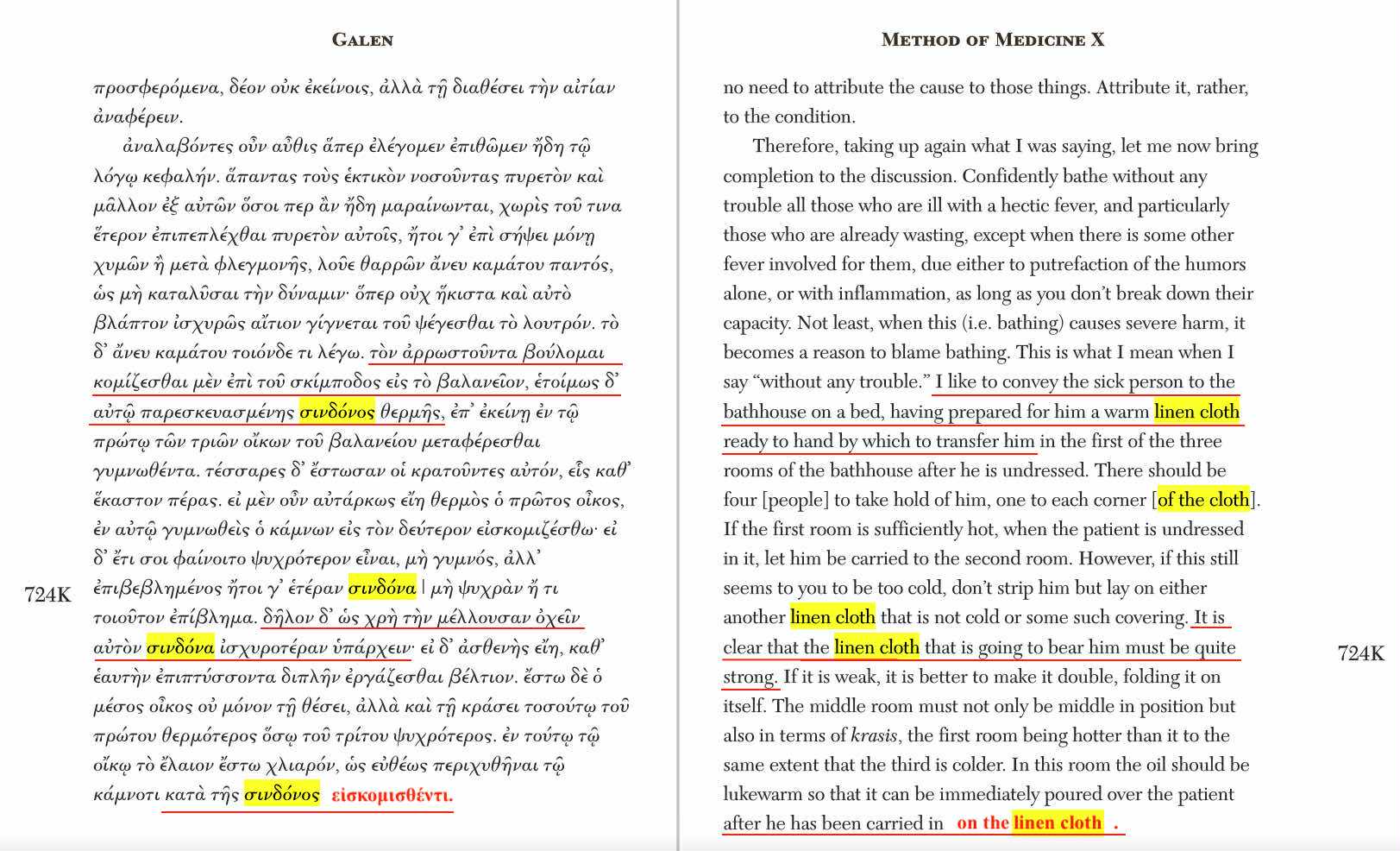
Still, so that you can understand how real experts know this, here below is a passage from the medical author Galen about what a sindôn is, from Method of Medicine 10.724 (this is a photo I took of my own shelf copy, with my fingers holding the page; but you can also look at a highlighted and underlined image of the same text):

Here Galen describes using a sindôn to carry a sick man, requiring four men, each holding a corner with the patient wrapped within. Galen did not have to add any qualifiers to explain that he means a “large” sindôn, or anything like that. He knows just the word sindôn would evoke no confusion, because everyone then understood that word to mean a large sheet, not a little bandage. Indeed Galen says not to leave the patient “naked” (gymnos, same word as in Mark), but make sure he is covered so he stays warm, which entails every reader understood “naked” to mean the whole body, and covering a “naked” man as covering the body, not some small part of it. He says this again using exactly the same vocabulary as Mark in On Treatment by Bloodletting 11.304. Other places Galen uses it to mean a large towel, not little washcloth. Indeed, Galen uses the word sindôn almost thirty times, and never in any other sense than these. No one then understood sindôn as a little bandage. Galen even specifically distinguishes a sindôn as a cloth for the body (or a large towel or body-wrap) from mere “bandages” (epidesis) in Composition of Medicines by Type (13 §671).
So, Hillman is full of it.
By contrast, this is what a competent analysis of Mark’s “young man” pericope looks like:
It is a well-documented fact that Mark is often reifying Paul’s letters into stories (see Mark’s Use of Paul’s Epistles for examples and scholarship). And Paul conspicuously equated our bodies of flesh to disposable garments, and our being naked at the loss of them, and then clothed again in glory when we receive our new resurrection bodies, which in Jewish literature were often described as like white robes (see Revelation 6:11, for example). The young man, someone in the prime of life, is identified distinctively as “a young man” both times so you will recognize his reappearance at the tomb and its significance: the arrest of Jesus symbolizes his death (and so, in parallel, the young man loses his humble “garment” of flesh and becomes naked), and the empty tomb symbolizes his resurrection (and so, in parallel, the young man reappears gloriously clothed in white). And in both cases the same word is used to describe his being clothed: the perfect participle of περιβάλλω, “having thrown around” him. Which makes three coincidences confirming Mark intends these to be the same man and their fates compared. There’s no room here for dumb drug sex stuff.
Mark’s story happens to reify Daniel 12:10, where the resurrected will “be made white” (ἐκλευκανθῶσιν) and Daniel 12:3 where they will “shine” like stars. Mark had already had Jesus tell everyone the resurrected will be like angels (Mark 12:25) who were often described as shining white, and presaged the resurrection in the transfiguration, when Jesus became shining white (Mark 9:3). But the biggest clue is Paul’s description of the coming death-and-resurrection (in 2 Cor. 5:1–5):
For we know that if the earthly tent we live in is destroyed, we have a building from God, an eternal house in heaven, not built by human hands. Meanwhile we groan, longing to be clothed instead with our heavenly dwelling, because when we are clothed, we will not be found naked. For while we are in this tent, we groan and are burdened, because we do not wish to be unclothed but to be clothed instead with our heavenly dwelling, so that what is mortal may be swallowed up by life.
The disposable tent (skênê) is the equivalent of a sheet surrounding us. And when we die we lose that, becoming naked (Paul using the same word describing the young man: gymnos), and thus we long to be reclothed in a new, better, “celestial” body like the stars in the sky (1 Cor. 15:40–54). That the idea of using clothing and nakedness metaphors (likewise plain vs. glowing raiment) was then commonplace for death and resurrection I document extensively in my chapter on the resurrection body in The Empty Tomb. And many other experts have come to the same conclusion about this young man (see Abraham Kuruvilla, “The Naked Runaway and the Enrobed Reporter of Mark 14 and 16: What Is the Author Doing with What He Is Saying?,” JETS 54.3 (September 2011), 527–45).
This all follows from rational literary and vocabulary analysis. Our conclusions follow from our premises, and our premises account for all the actual data, requiring nothing to be made up. And you can confirm we are not snowing you with false claims about the Greek or misleading citations. Yet we aren’t finding penises, fellatio, raped children, or bizarre drug rituals involving dirty socks in this passage of Mark. Go figure.
4. That Bonus Jesus Anal Sex Nonsense
There is a lot of gross, sick shit like this from Hillman (in this chapter and in his online rambles), including his farcical claim that Jesus had to resort to gay pedophilia because Christians were otherwise off on the idea of “prostitutes” (Hillman seems unaware that boys could also be prostitutes, and girls can as easily be raped as boys without being prostitutes) because the Gospel of Mark says “Mary [Magdalene] used a dildo-shaped drug applicator on Jesus called an alabastron” (pp. 383–84), which he did not, and “therefore” that’s why there are no vagina bongs in the New Testament (right … that’s why).
So I’ll end with this (which amounts to claiming that Jesus had anal sex with a drug-oiled dildo) because it is so fantastically egregious in its deceptions that it conclusively proves how little you can ever trust Hillman:
- The word alabastron does not mean dildo or applicator. It means “alabaster container,” alabaster being a kind of stone, and tron a suffix denoting tool, and together denoting a commonly known small jar for ointment (whether pharmacological or not), exactly as it is described in Mark (an alabastron “of” nard-oil, not an alabastron “covered in” nard-oil; and an alabastron that had to be “cracked open” to extract the oil; and “oil of pure nard,” μύρου νάρδου πιστικῆς, hence not even a “mixture,” much less a “poison” or “hallucinogen”). All of which entails Hillman is making a flunkable amateur mistake in reading Greek—unless it’s not a mistake and he is intentionally lying to you about the Greek. Your call.
- No one named Mary brings an alabastron to Jesus in Mark. Hillman is conflating this with a different scene in John, with no alabastron, and only oiling his feet with Mary’s hair (not his anus, and not with a jar—even the claim that there is a Hebrew, not a Greek, word that can mean both feet and penis is disputed, but still doesn’t get you an anus). So. Flunkable amateur mistake? Or liar? Your call.
- In John, the Mary who oils Jesus’s feet is not the Magdalene (the Mary from Migdol), but the Mary from Bethany (sister of Martha and Lazarus). These were conflated only in the Middle Ages. And no Mary is a prostitute in any Gospel (again, that was a Medieval fabrication). So, again. Flunkable amateur mistake? Or liar? Your call.
- In Mark an anonymous woman instead crushes an alabastron, not inserts it anywhere. And grammatically, she broke or shattered it before she poured its contents down onto Jesus’s head. So there is absolutely no way to get this sentence to mean what Hillman wants you to gullibly believe. This woman smashes the alabastron, and the oil it contains then pours down onto the kephalê of Jesus, which only ever means the top of the body, by which you count people or cattle. And yes, the verb absolutely means “pour down onto” (kata + cheô), not pump up into or any other nonsense. And crushed means crushed, not inserted. And so on. So. Flunkable amateur mistake? Or liar? Your call.
And nothing Hillman cites for this says what he claims either. To trick you into believing alabastron means dildo, Hillman claims a “Priapic dildo (alabastron / fascinum) was employed in magico-medical ritual as a pharmaceutical applicator,” none of which is true. There is no actual “magico-medical ritual” and none of his citations here say there was. But more importantly, by writing “alabastron / fascinum” after dildo, Hillman misleads his readers into thinking those are the same word (one Greek, the other Latin). But they are not. An alabastron I already explained. A fascinum, by contrast, just means an artificial penis—literally “little fasces,” in reference to the secular power symbolized by the rods and axes lictors carried before magistrates, but describing talismans of protection, which just happened to depict a penis (as a symbol of spiritual power). Some authors would use it thus as simply a synonym for any object shaped like a penis.
So when Hillman references Richard Burton’s 19th century (and thus hopelessly obsolete) Priapeia, you can check: Burton never uses the word alabastron, and never refers to a fascinus as a dildo in relation to any actual religious ritual. These are nowhere in Hillman’s citation of Augustine, either (see City of God 6.9). Augustine only complains about the Roman practice of brides preparing for sex with a statue of Priapus (known as Mutunus Tutunus). No magic. No religious ritual. No ointments. No alabastron. While Burton instead only references a joke: that Petronius, a satirist (and in the Satyricon, a satire) has the fictional sorceress “Oenothea introduce a leathern fascinum,” not an alabastron, “smeared with oil, pepper and crushed nettle seeds, into the anus of Encolpius as an aphrodisiac,” which is obviously comedy. Burning nettles up the ass? No one would ever really do that, nor does this describe anyone ever really doing that (this is slapstick). And it is not some mystery rite; it’s a perverted spell. Anyone who is competent in Classics knows Petronius is inventing a horrifically stupid and painful suppository “as” an aphrodisiac, to make fun of people who try weird and uncomfortable things for sex, and of wizards and their weird and uncomfortable mumbo jumbo. So for Hillman to tell you this is a real account of an actual thing is either massively incompetent—or outrageusly dishonest. Your call.
The key takeaway here is this: notice how Hillman has tried to fool you into thinking an alabastron is a fascinum, with a false juxtaposition, and some false source citations (as in, real sources that do not say an alabastron is a medicinally oiled dildo). Then he brazenly tries to trick you into thinking maybe that’s what Mark means, by conflating a story in John with no alabastron and clearly only an oiling of feet, with a story in Mark with an alabastron that is a container that is shattered and then dripped down onto the head, not shoved up an anus as an applicator—all hoping you don’t know Greek and thus are easily duped by his shining you on. It’s the same with Jesus and the young man. All bullshit. Either incompetence or malpractice. And you have to choose which.
Hillman’s Bogus Vox Orphica
As I mentioned, Hillman keeps claiming he is using some kind of secret language called the Vox Orphica (pp. 364–65), the “voice” of the Orphics (as one might call an “Orphic dialect”). But there is no such language. He made that up. He claims it’s “a term used by Otto Kern, editor of the Orphic Fragments,” and that “It denotes a technical language employed by mystery religion participants.” But he does not cite any actual source for this claim (no page number in Kern’s Orphic Fragments, or anything else by Kern or anyone). You can’t claim to know a secret language if you can’t point anyone to where or how you know it. There is a particular vocabulary used in mystery cults but it’s not a secret “language” (see OHJ, pp. 97–98). It’s just the same Greek language, whose words change meaning by context, so you have to know the context to ascertain the sense. You can’t claim to know what a secret language says as if by magic anyway. Whether code or context, you need to be able to cite examples proving any particular meaning for a word you are claiming, or be able to cite context that does. Hillman never does either, for any controversial claim he makes. He just makes those up. And he makes them up against all the evidence, not with any (as you’ve already seen).
This becomes clear when you find out all his citations for this don’t really say what he wants you to think. He claims, for example, that the medieval John Lydus in De Ostentis 2.6 evinces this vox as a special language of the mystery cults. But if you check, you’ll find no such thing there. The first time anything about “language” comes up in that section (which is in §3, not §2), John only refers to the Etruscan (or old Italian) language, not any secret language. Nor in either section does he mention anything to do with mystery cults—De Ostentis §2–3 pertains to divination by astronomy (ἀστρονομία, §2.12) and by entrails (θυοσκοπία, §3.2), and not, as Hillman claims, “complex interdimensional physics,” much less “the mysteries.” And you don’t have to take my word for it. You can read Lydus yourself (section §2 and section §3). And we know what Lydus means from a better earlier source as well: Cicero.
So maybe Hillman meant us to find this supposed “vox” in the only modern scholarship he cites on this, Otto Kern? But Kern never discusses this in his Fragments, much less provides any lexicon for translating it, either. So where is this secret language proved and detailed so we can read it? Hillman won’t tell you. Instead, if you search Kern’s Fragments for vox Orphica you will find only one use, in a footnote (p. 166, n. 100), and there only with a question mark, as he then cites evidence for a word having a particular meaning in an Orphic context (not an Orphic language), but is unsure because the evidence is weak. This is not a reference to a secret language, but to a word having a particular meaning in a particular context. And Kern correctly knows you can’t just claim that, you need evidence, for each specific word and meaning you are alleging. Hence Kern supplies the kind of evidence Hillman never provides when using the “term” vox Orphica, and unlike Kern, Hillman never admits when the evidence is weak or nonexistent. We see this again in the one other time Kern uses, instead, vox mystica, where for the word “bosom” he cites Dieterich’s work on Mithraism (pp. 123, 136) because it extensively documents evidence for that word having a particular sense in mystery contexts. Hillman never does this either.
You need to not be duped by this tactic. Never let Hillman “claim” a special meaning for a word is proved somewhere, if he never tells you where. And watch out for the bait and switch, where he will “claim” it is used in a source or by an author in a certain way, but still never where. So you cannot check him. That looks like he doesn’t want you to be able to check, while still “looking like” he cited a source. An honest scholar making an out-of-the-mainstream claim is morally responsible for defending that claim with evidence. And that means actual evidence—a precise citation to the actual passage(s) or peer-reviewed scholarship where a special meaning is demonstrated—not handwaving that merely looks like doing that but isn’t. That’s shady. And you know it.
Also don’t be duped by motte and bailey, either, where Hillman might (maybe in a video) cite real evidence that, let’s say, “milk and meat” had a particular contextual sense in mystery cults (like I cite sources and scholarship for in OHJ, for example, e.g. pp. 110–11, referencing the resources already discussed earlier on pp. 97–98), and then claim without evidence that some other word also has some other contextual sense in mystery cults, and just browbeat you into agreeing with him. The grift there is that when you challenge his second claim, he might cite the first claim as proof that the “voice” exists and therefore you cannot doubt the second claim, when in fact he has no evidence for the second claim like he does for the first (which should cause you to ask why). Obviously you should only believe the first claim, not the second. He may want to trade on having evidence for the one claim to con you into agreeing he has evidence for the second claim when in fact he does not. That’s also shady. And you know it.
Remember these terms and how they work: motte and bailey and bait and switch. Because I won’t waste any more time dealing with Hillman’s bullshit. Any time he tries responding to what I have exposed, I will simply call out the tactic(s) he deploys, by these or other commonplace terms. It will then be your responsibility to check whether that is indeed the tactic he just used (or to just not care and stop listening to him, as you really should). Other tactics I expect from him are excuse-making (coming up with what are actually irrelevant reasons to not provide evidence or not heed or debate an argument—since the truth should be defensible regardless), ad hominem (attacking me in some way rather than any relevant thing I said), false citation (citing some source or scholar as saying or proving a thing they do not), arguing by omission (leaving evidence out that, when put back in, refutes rather than supports his point), arguing from authority (claiming his qualifications excuse him from presenting evidence—when in fact they obligate him to), appeals to emotion (trying to rile you into emotionally supporting a point rather than giving an actually rational, evidence-based reason to), and (as always), straw man, red herring, possibiliter ergo probabiliter, and every other kind of non sequitur.
So from now on I’ll just call it and not explain. You can then check if the call is correct.
Conclusion
I’ll let you decide whether Ammon Hillman is a liar or a conman—or, let’s be honest, insane. When you watch his videos he does come across like a schizophrenic hobo rambling about spyware in his soup. Leonard Cohen’s “First We Take Manhattan” sounds completely on the nose for the mindset here. The random pattern matching; the implausible leaps of logic; the absolute confidence in the bizarre result. But I’ve presented evidence you can check yourself (so you don’t have to trust me) to confirm everything he’s not telling the truth about, and how egregious and suspect that is. Would you ever trust anyone acting like that? Like all grifters or cranks, he mixes reasonable claims in with absurd claims that are demonstrably false (and often sickening). And when you remove those absurdly false claims, he has nothing new or interesting to say.
Hillman has no evidence the Gospels imagined Jesus as a drugged-out pedophile. None whatsoever. It’s all fabricated. And I believe he is immorally using his Ph.D. to manipulate and gaslight you into not checking so as to find that out. He handwaves instead of giving you real evidence or relevant citations; he misrepresents the citations he does give; and he uses tricks rather than sound logic. And he makes nothing but excuses to avoid ever facing a real expert who actually knows what they are talking about—while depending on your lack of expertise to fool you into believing him and listening to his sick pedophilic fantasies, under the guise of it being “academic” (it’s not).
You need to ask yourself why is Hillman doing this specifically—why, of all the fake stories he wants to make up and trick you into listening to, he chose graphically sexual and pedophilic fantasies that have no legitimate reason to be brought up? And why are you falling for it? Why are you listening to him? Why are you trusting him in anything at all? If you haven’t been, blessed be. But if you have been…seriously?
Discover more from Richard Carrier Blogs
Subscribe to get the latest posts sent to your email.







I hope his loved ones are able to get him some help.
He wouldn’t admit he needs it – no narcissistic ever does
Yet the people discrediting him repeatedly resort to triangulation, and other manipulations – but are not the narcissists?
Telling.
Triangulation isn’t manipulation. It’s detection.
I didn’t read the whole article because the subject doesn’t matter to me, but there was something you said that does interest me. You mentioned Kipp Davis and Dan McClellan. I know that Kipp Davis says something that I think is similar to Dr. Hillman’s peculiar beliefs, but actually many Hebrew Bible scholars say it, and I think it is equally nonsensical. They say that God’s private part fills the Temple in Isaiah 6:1. Usually, translations say that God’s train or the hem of some garment He is wearing fills the Temple, but some scholars say it is God’s private parts. I think it simply says that the edges or extremities of God’s throne fills the Temple, which fits the context.
Kipp Davis goes everywhere on YouTube telling that it is about God’s private part, but it doesn’t make any sense. I told him my idea recently in a comment on one of his videos, and he said that it could be what I said, but he disagrees. I consider this interpretation of Isaiah 6:1 to be insane, but accepted by mainstream scholars. I wonder if you are aware of that strange Bible interpretation.
That’s not in my skillset so I can’t weigh in on that debate.
Davis can at times be unreliable. But whether he is on that unrelated topic or not, I couldn’t tell you.
Probably the world’s leading experts on your question are Andreas Wagner and Francesca Stavrakopoulou.
I give advice on how to approach scholars with questions like this and get an answer in my Primer on Actually Doing Your Own Research. So my recommendation would be to read and follow that advice and contact them (they have public email addresses and even social media accounts).
First step (before contacting them) would be checking their books to see whether they already discuss this, and then search key terms in Google Scholar to see if anyone else has; and then if you contact them, prove you did that, because they will more likely put in some work if you show them that you did.
Hi Dr Carrier, Simone here – I’m on your side on this one, and can illuminate this issue, as I’m a friend of Kipp’s and know the ins and outs of this issue.
The word here is שול, and the interpretation is disputed – it generally describes the edge or tassels of something that “hangs down”, but is also clearly attested euphemistically describing female nether-regions (I don’t know how censorous your moderating system is here). However, crucial for interpreting its meaning in Isa 6 is that in every use (including the euphemistic ones) it is attached to something in some kind of genetive relationship – “the tassels of a curtain” or “the hem of a garment” or something like that. The conventional translation supplies this – “his garment” isn’t in the text – the text just says “his שול”. By the unusual deployment of the term here, the clearly attested euphemistic use elsewhere, comparative data from other related religions at the time, and, most importantly, the context that includes the eupemistic use of רגלים (“legs”) for the masculine member relative to the Serafim (very widely acknowledged) the reading is not at all unreasonable. On strictly philological grounds I am not entirely convinced by it, but it’s highly plausible.
Kenneth, I can vouch for Simone’s expertise here.
Simone, just so you know, I don’t censor anything legit, so you don’t have to watch your words this carefully! You’re a serious scholar, so any wording you felt was appropriate I am confident would be.
And to Kenneth and Simone: “on strictly philological grounds I am not entirely convinced by it, but it’s highly plausible” is exactly where I am after hearing Simone’s case. I am skeptical of these kinds of arguments, but not because I think they are implausible, but because I think they are insufficiently evidenced. It might be false. But it’s not ridiculous, and sounds like it’s a legit argument in the field.
But it might still be worthwhile to see what Wagner and Stavrakopoulou would say.
Thank you Richard for bringing sound reasoning and a clear magnifying glass to the chaos of deceit that Hillman produces
This is the career niche I carved out for myself: to be the guy who can do expert but popular no-holds-barred communication on phenomena like him..
This was a great read … good to see some rebuttals to Ammon.
Hillman himself seems to have fried his brain with drugs. I think that he has taken a few too many acid trips. I think that prolonged cannabis and LSD use can impair one’s cognitive abilities. I don’t think that it is any secret that Hillman uses illicit drugs. I think that it was Hillman’s refering to his recreational drug use in ‘The Chemical Muse’ that got him fired from Saint Mary’s College, Minnesota.
I am tangentially familiar but haven’t researched any of that; I’m deliberately sticking to the evidence of his (purported) scholarship. But there are a lot of story-wars about exactly what actually happened in his past that I doubt is all smoke and no fire.
I have direct written evidence from Hillman himself how very much even cannabis gives him wild hallucinations. And a third hand report that he’d confided he’d used Meth in the past. But it wasn’t for drug use that he was fired.
I have the full rundown from his own mouth under oath from his lengthy deposition when he tried to sue St Mary’s for professional defamation and unfair dismissal. In short, he was fired for sexual harassment, stalking a student and creating an unsafe learning environment for the students. He claims he wasn’t and the University administration were persecuting him in revenge for him exposing their greed through their reaction to a scene in the play of Medea that he produced.
I gave more details recently in a comment on Michael Knowles’ show looking at his second appearance on Danny Jones.
In this well liked comment [search that page for “I have thoroughly investigated the facts” to find it], I have provided a link to the entire proceedings of the Minnesota Court hearing. I think his deposition is very revealing of his character, his sense of entitlement, his misguided perceptions and lack of ownership of his actions. I have also been the recipient of much slander and maliciousness from him since March 2023 when I started giving countering facts and rebuttals to his eisegesis in his live chats and video comments.
I made him work hard to either bullshit his authority and integrity or simply hide my comments from them, while lying profusely to destroy my credibility. I’m not offended by it because I fully expect it as the typical Narcissist’s pathetic, immature paranoia. He will make every dirty trick against his nemesis and very worst fear: being unmasked to the codependents who supply his external self-worth and validation.
For the record, I don’t take a position on that here. But it is fair to report, as it’s all prior public record, including YouTube comments, Hillman’s responses, the investigation findings, the trial documents etc.
People who want to deep dive the trial records can search (as Ari points out) the Minnesota Courts Database for case 85-CV-17-2777.
The most legally important document listed there is the April 3, 2019, “Order Granting Motion,” which is the judge’s summary judgment. That contains a short brief of the whole situation and the reasons for the court finding for the defendants (and thus against Hillman).
That then puts the other documents into context. I agree the most informative is the January 22, 2019, “Memorandum” (from the Defendants).
But I have to correct one point made in the YouTube comments:
The Judgment (pdf p. 3) establishes that “Hillman was an adjunct professor from the Fall of 2014 to December 2015 in Latin and Greek and in that capacity he worked as a playwright and translator for a play titled Medea, to be performed in the Fall of 2015” and “Hillman was [also] employed as a janitor for St. Mary’s University … from the summer of 2015 to December 2015.” The Memorandum (p. 4) says Hillman was an “adjunct professor teaching Latin and Greek from the fall of 2014 until December 15, 2015,” and a “playwright that translated Medea, a Greek play that Saint Mary’s students performed in the fall of 2015” (other documents show that was as a subcontractor hired and paid by the director, not as a teacher or uni employee), and a “janitor from late summer of 2015 until December 17, 2015.”
Hillman’s deposition establishes (frame 56) that he was not even informed that his teaching contract would not be renewed until after the play was performed, in December. So he was still an adjunct officially until December, and thus “legally” an advisor on the play its whole way through (as in, so far as this court of law was concerned). Note that adjuncts don’t receive annual or monthly salaries, but a lump-sum for each semester, so what establishes employment are privileges (e.g. the validity of his campus ID, access to library resources, etc.), not paychecks. It’s not clear what his teaching schedule had been, but St. Marys has a Spring and Fall semester, and he was an adjunct through Fall.
These might be trivial distinctions but cranks like to shove wedges into trivial distinctions.
The rest of the “Memorandum” looks pretty damning regardless. And Hillman’s own testimony (the January 22, 2019, “Other Document”) does not help him.
We should be thankful (but to whom?) that most loons are less energetic than Hillman. William Kamp seems content with, mostly, just posting “Nerones!” and “Druses!” here and there. I have seen LSD push borderline schizophrenics over the line to full-scale psychosis, and also seen MDMA motivate seeking treatment. We may guess Hillman got his graduate degree before the event, but we must be at least a little impressed he has been able to hold it together well enough to get invited onto to many YT channels, and even to show up on time. I think even most of those have had more than enough of him.
hillman has never done LSD
That may be so. But, I have learned through a contact with another souce in whom Hillman confided, that he had used methamphetamine in his past. For how long a period, is unknown, but it is indutible that this potent drug can cause serious issues with mental perceptions, processing and emotional responses. Some of these side-effects can remain permenant
If it’s a third hand report, then why even mention it? Especially, since you don’t know the length of his supposed usage. It is highly unlikely that even a short period of experimentation with meth would any psychosis. Even if he used drugs, that shouldn’t be a factor of whether or not one is credible, since drugs aren’t inherently bad.
It’s weak evidence of his use of meth, certainly, but yes, it is possible for even occasional meth use to have significant long-term psychiatric effects, especially when there are underlying conditions or combined with other pharmaceuticals.
But I don’t think this is a hill worth the bother of dying on. It does not matter how one becomes mentally ill. They’re still mentally ill. This is not a referendum on the supposed dangers of drugs. That Hillman is clearly mentally off is self-evident from any viewing of any video or interaction of him ever. His insane writings just supplement that observation. And under-oath legal testimony, even from himself but as well from multiple witnesses, well supports this conclusion. It’s not enough “to be sure.” But it’s well enough to seriously suspect him of being mentally ill, probably a psychosis (delusional or schizotypal).
You may think that prolonged use of cannabis and LSD can impair one’s cognitive abilities, but extensive scientific research doesn’t support that idea.
That’s not quite true. Abundant science in fact establishes excessive cannabis use can have numerous adverse psychiatric and cognitive effects (I’ve linked to just the last five years of studies; but similar results go back decades). More so if there was an underlying condition (e.g. if a subject began schizotypal).
Likewise LSD, the abuse of which can cause Hallucinogen-Persisting Perception Disorder and other forms of persistent psychosis. It’s not a typical effect, but does occur in some subjects. So the word “can” in Ciaran’s original comment remains correct.
Thanks for breaking this down Richard. Big fan of your work already but this was much needed and I appreciate you tackling this absurdity.
Thank you. Sometimes I worry I’m just screaming into the void. So it really does matter to hear things like this are useful. It’s a lot of work to do something like this (which is one of the reasons usually no one does it—and cranks count on that; that’s why wordwalls are their favorite genre).
What is a Christ? Is it a drug term? What about the polypharmakon? Where’s his death inducer and the Theriac? And does Jesus make Eunuchs? What’s with the Eunuchs? What’s with the vipers and asps man? Where’s he getting the “christing of eyes” bit? You didn’t mention the stinging in the flesh, or the gadfly. You need to get in there real deep brother!
I don’t. That’s just more nonsense. But it’s not in his published chapter. I don’t care about his endless internet rando rambles.
But it’s all the same methods of manipulation (e.g. say a trivially true thing then stack a wildly false thing on top of that and hope the truthiness of the one rubs off onto the falsiness of the other; make assertions with no checkable sources or sources that don’t say what he claims; etc.).
So all the same debunking tools apply. So if you want to know the truth about any of those things, follow the same procedures I documented here for every other example, in order to find out.
Don’t you get it, Chase? Among many other things, Dr Carrier has 100% demonstrated that no text anywhere ever describes:
* Vaginal drug production
* A burning purple venom polypharmakon
Therefore there is no:
* ios-rite with snake venoms
* drug-induced death and resurrection operation for aionic life
* need for a theriac from a child’s body
* “boy in the park” scenario
* Truth in ANY of Hillman’s novel concepts and “translations”
Hillman has built his entire Lady Babylon theory on no foundation, whatsoever, but convinces the gullible it’s real by philological fakery and textual trickery – all clearly exposed here.
Just think it through, please.
And if you have more bravery than Streamis_Mundi (who said he’d come with more thoughts after reading through this article) you’d spell out this logic on the sub-reddit post.
And if you want a comprehensive demolition of all those concepts you’ve listed, Stephen CrossBible has already done so. And when Gnostic Informant prioritizes and releases the Dr Ruck critique, you will see he concurs completely with Stephen. Ruck does not endorse a single thing that Hillman has imagined the texts “reveal” to him through his Muse.
And you’re understating the case. Because, as Richard points out repeatedly, even if all of his bogus premises were even remotely plausible, his conclusions from them don’t follow. It’s a mountain of spurious speculation.
I will never understand why people who get high can’t just realize that they can just get high and not be weird about it.
Typical Bible Scholar Bullshit. I can read the Greek myself. I have seen the sources Ammon presents and I can see from above how YOU twist words to suit a false narrative. I can read Euripedes. I have Galen sitting on my shelf. “Christ” was a drug term long before “Jesus.” It was a drug term after “Jesus.” And it was in common usage. You may be able to sell your worthless and weak arguments to those who cannot read Greek for themselves but not to me λῃστής supporter. Your mistake is in attempting to sanitize the arrest of “Jesus.” Bible Scholars do this all the time, because they lack reason. When you sanitize the passage, removing the actual context… there is no crime for which to arrest “Jesus!” Make SMALL BOY into YOUNG MAN and the crime is gone and there is no need for “Jesus” to set guards. Who cares if he’s in a cemetery with a young man?! Not a crime. Sanitize and white wash the actual context of obvious pedophilia and there would be no crowd wanting “Jesus” to be, not only put to death, but crucified. Ahh… but there is context to the passage, and the evidence of λῃστής culture IS there, and there WAS a crowd wanting him put to death. You can’t have it both ways Bible Scholar.
ROFL
This entire comment looks to have been written by a seven year old.
And I say seven and not nine because I know a nine year old and even they are side-eyeing this laughable schoolyard trash.
There is no better refutation of Hillman’s crankery than that this is the best defense his flying monkeys can come up with. Even the vague semblance of an argument that sort of almost dissolves into view at the end of this comment is incoherent gobbledygook.
And that is like hearing a drunk uncle get all huffy and complain about the plot to the movie First Blood, insisting there was no reason for Sheriff Teasle to arrest John Rambo, ergo Rambo “must” have just taken a Schedule I drug and blown a toddler. Um. Did you even watch the movie?
What is it about emotion-driven insecurity that so readily becomes a victim so entirely to a web of false promises and wholesale BULLSHITTING by a fake persona whom they defend with such unwavering faith? Absolutely no different to a MAGA Trumpite!
Dr. Carrier, you affirm the following:
I’d appreciate your thoughts on a related exchange I had recently. In Toxicology in Antiquity, Hillman writes:
And later:
In the first instance, “burning purple” appears in double quotes alongside a citation to Ruck (within the quotation boundary). In the second, the term is unquoted, presenting it as if it were standard or attested.
To me, this appears to be a textbook case of citation laundering—Hillman embeds his own invented phrase within a citation to Ruck (and others), creating the impression that these sources used or coined the term, when in fact Ruck never did. But I would like your opinion on this.
Someone online challenged this by asking, “Why would you expect Ruck to have used Ammon’s neologism before Ammon coined it?”—arguing that Hillman’s use of quotes clearly signals a coined term, just like Ruck’s introduction of “entheogen” in Chapter 24, where Ruck explicitly explains its origin and rationale before using it more freely.
But Hillman offers no such disclosure. He doesn’t clarify that “burning purple” is a newly coined term, nor does he inform readers that the sources he cites in support of it never use that phrase. In fact, I documented in my exposé that Hillman publicly claims (on the Danny Jones podcast) that the chemical used in the rite was called the burning purple, and even tries to anchor it in a passage from Dioscorides using the phrase πορφύρα καεῖσα (“burnt purple”), as if it were the same concept.
So my question is this:
Do you regard Hillman’s use of quotation marks as the standard scholarly method for signaling a neologism? Or do you see this as a case of misrepresentation? Should readers be expected to recognize a coined term based on punctuation alone, especially when paired with misleading citations? Or is this a violation of scholarly transparency?
I’d greatly appreciate your perspective. Thank you.
That’s how it looks to me: a specious post hoc attempt at a “cover up” of what he actually did. Hillman went through grad school. He knows quotation marks followed by a source (said to be) attesting what you are claiming entails quotation not fictitious imputation.
That someone wants to “make this not have happened” by changing what he supposedly meant years later, thus throwing him under the bus of not knowing the standards-and-practices of his field (and thus accusing him of incompetence) in order to “get him out” of the actual fact that he was being deceptive (since I guess “he’s incompetent” is at least better than “he’s a con man”), is a desperate move. But alas.
It’s also not even true in its revisionist history: even if Hillman didn’t use the quotation marks and didn’t use the specific name “burning purple” Ruck, where cited, still does not attest anything Hillman is talking about. So even this under-the-bus apologetic does not rescue him here.
(The cited page in Ruck only claims murex shell contains DMT and thus could theoretically have been a hallucinogen—which is also scientifically false, the purple dye comes from the glands not the shell or meat of the murex, and neither contains any hallucinogen, much less DMT—but even as a false claim about purple dye, it still contains none of the other claims Hillman is making about “burning purple,” which is supposed to be a caustic, and a concoction not just murex dye, and contain snake venom, and be commonly used in mystery cults, etc. So even what “burning purple” refers to is not in Ruck. And, of course, what Ruck does say that Hillman relies on—that murex dye is a hallucinogen—is also false.)
Which of course anyone can check and confirm absolutely is not (see p. 2 of this edition of Diosc. Mat. Med. 2.4; Greek here). That is talking about literally just burning conch (shell, flesh, or ink, it’s not clear) to clean your teeth or desiccate boils with. There is nothing there about hallucinatory snake venom concoctions.
Dr. Carrier, I’d like your feedback on the following point you made:
As I understand it, you’re referring to the sources cited in Toxicology in Antiquity, not any of his recent views expressed on YouTube. One specific claim you’re addressing is this:
As you’ve already noted, this is false: ἰός (masc., “arrow; poison; venom; rust”) and ἴον (neut., “violet,” with stress on the first syllable) are unrelated nouns, though both produce the adjective ἰόεις (“poisonous,” “violet-colored”).
Where I’d like your perspective is on Hillman’s use of Hesychius of Alexandria’s Lexicon. His followers lean heavily on it (especially when LSJ doesn’t support their view). Hesychius has no entry for masculine ἰός, but under the form ἴον (“violet”) he bundles several glosses:
ἀφίκοντο – they arrived
ἄνθος – flower
εἷρπον – they crawled
βέλος τοξικόν – poisoned arrow
μόνον (ἢ σκώληξ) – rust (or worm)
This is clearly a case of homonymy: the form ἰόν looks similar to the neuter ἴον, while only the shift in the accent confirms that it’s the accusative case of the masculine ἰός. So glosses from both nouns were conflated. Hesychius also glosses ἰοειδές as πορφυροῦν (“purple”), which aligns with LSJ’s entry:
As John Chadwick notes in Lexicographica Graeca, some entries in Hesychius are “plainly wrong” and the text is often “too corrupt for any emendation to carry conviction.” Hillman nevertheless cites such glosses as decisive evidence — for example, to argue that νεανίσκος could be understood as referring to a “baby” (and ostensibly to a “9–12-year-old boy”) because Hesychius glosses it with the word νήπιος (the adjective meaning “childish”).
I’d be interested in your thoughts on how best to evaluate or respond to claims that rest solely on Hesychius.
Hesychius is a medieval author of Byzantine Greek obsessed with high (especially Homeric) Greek. Which is not wholly informative as to first century koine. His lexicon is also hugely corrupted (its textual transmission was dodgy and only one ms. from a thousand years later survives), so is not exactly reliable even in transmission. But I don’t see those problems here.
Rather, he does not format his lexicon the same way as modern lexicons. His list for ion is for all words in that form, e.g. when masculine accusative it can mean poison but when nominative accusative it means a flower. That’s why the first item on his list is the verb “to arrive,” because ion is the participle of εἶμι. Notably, ion is the participle of εἶμι in masculine accusative and neuter nominative. So he is not listing these entries for the lemma but for the form. Thus, he is translating numerous different words here (ion as “going” when it’s a verb, ion as “poison” when it’s in predicate position, ion as flower when it’s in subject position, etc.), not a single word. His entry is thus useless for etymology. He isn’t doing etymology.
But in the case of glossing neaniskos as nêpios, unless that is a textual corruption (and words were lost signifying he meant something more nuanced—see my update below), that would have to be an error, or an assumption placed on the reader.
If we pick option 1 (error) then Hesychius does not seem to know the actual meaning of the word but is assuming the diminutive (-iskos) attached to young (neos) meant baby (which is still not “nine year old boy,” but literally an infant, so Hillman has no room to argue his own case here even on this error), when in fact that word never had that sense (which is counter-intuitive, but that’s the difference between someone who actually knows the language in its original context and someone who is guessing based on some rudimentary principles).
If that’s the case, then it’s rather like the translators of Hitler’s Table Talk that I caught confusing ne que in French as “not” when in fact it means “only,” despite ne and que intuitively meaning “not that.” They were applying general principles to “guess” what a word meant when in fact a native speaker knows it doesn’t follow those principles but means the opposite of what it looks like.
If we pick option 2 (assumption) then Hesychius was counting on readers never mistaking him for meaning nêpios in a literal but only a figurative sense (and so he meant “childish,” i.e. “being a baby” nonliterally), as suggested in the previous comment (see below).
And we can know all this because no one in ancient Greek ever used neaniskos to mean a babbling babe in arms (or child), but always to mean a young man in peak of life, indeed specifically always teens to twenties. That’s just the fact of the matter. Anyone claiming otherwise by following (or misunderstanding) a medieval antiquarian (or their corrupted text) is like someone believing ne que means “not” rather than “only” because some later French translators sucked at their job.
-:-
Since I first wrote this comment evidence was presented me that Hesychius uses neaniskos consistently elsewhere to mean men and not babies (much less boys), so the probability is that he wrote here nêpios anêr and the latter was lost in transmission. The less likely possibility is that, as originally suggested, he is using shorthand and intended anêr to be assumed. I think that’s unlikely as it produces gobbledygook in Greek that a competent author would not write, and if we are thus now assuming his competence, we have to assume he wrote the correct appellation and it was corrupted by later scribes. The second most likely possibility is that he was being excessively brief and just counting on no one mistaking him for meaning the word literally.
In that scenario, Hesychius meant that sometimes in literature calling someone a “young man” was an epithet meaning “childish” in mind or behavior, and not actual infancy. That’s what he would more likely have correctly indicated with nêpios anêr, and even his strangely omitting the qualifier anêr is far more likely (by several orders of magnitude) than that he meant “nine year old boy” by the words for “infant” or “young man” (he clearly never did).
The same goes for any other context-dependent meaning (like a nêpios “entering puberty” thus signifying a child rather than an infant). If the context is absent, the word cannot take on that context-dependent meaning. Absent context the word always retains its primary sense, not its unusual case-dependent sense.
This is linguistics 101. And anyone who tells you otherwise is a liar. And this is why it would be incompetent of Hesychius to assume a context he did not present. And that is why it is far more likely he didn’t make that mistake; copyists did. But the next most likely thing is that Hesychius incompetently fucked up (or expected his readers not to), not that he has discovered a new contextless meaning to a word that exists nowhere else.
So, for example, if this entry in Hesychius is not textually corrupt and he competently intended the behavioral and not biological sense of nêpios to be understood, then he was counting on the reader to understand already that neaniskos cannot be a biological nêpios, and therefore he “must” mean the behavioral sense.
It is then the incompetence of the modern reader who thinks he really meant child when he was assuming no one would be so stupid as to mistake antonyms for synonyms: since neaniskos literally means “young man, not child” it is an antonym, not a synonym, of nêpios in the literal sense of either infant or child, and therefore he can only mean the figurative sense.
It’s annoying to have to explain such obvious basic things about how language works. But Hillman is a liar and won’t tell you ant of this. So he has forced us to explain to everyone rudimentary first-day linguistics.
P.S. And I must add that Ammon Hillman has to know everything you and I just said. He’s not some random amateur. He has a PhD in ancient Greek. He knows every single thing you and I just pointed out. Yet he conveniently “leaves all that out” when selling his bullshit to his yokel “gullibilly” audience. Which is simply unethical.
If multiple words share every similarity except a subtle stressing of syllables, that is a major clue that those words share or once shared common contextual meaning. Not always, but dismissing the connection outright is not good science.
No, it isn’t, Richard. That is almost always indicative of unrelated etymologies producing the homology. That’s why real linguists need more evidence than that to reach such a conclusion, so acting like you recommend instead is crank; and when there is abundant evidence against that conclusion, and you still act like this, we are then not just dealing with cranks, but grifters—outright liars.
As documented, these have completely unrelated histories and etymologies. Their homology cannot convey common meaning at all. It could convey an audible pun, but there has to be an actual pun being made, and that is not the claim being made here. So pretending it is is just more lies.
Why all the lying?
Great job!
Testing the new comments system here. It has too many bells and whistles for me to build or track. So let’s hope it works out of the box.
Testing the new comments system!
I also have to say I am slightly surprised by your First We Take Manhattan comparison. Cohen is obviously prone to high metaphor, but my read of the character in FWTM is that of a fanatical artistic revolutionary launching some kind of vaguely-defined attack against the system while others try to remind him of his humanity and steer him away from his vicious judgmentalism.
Oh gosh. With all the casual harassment elements and stream of conscious changing of subject, I am pretty sure he didn’t even write those lyrics but just recorded what a subway nut was rambling and wrote a tune around it with a chorus. Though he himself did say it was a glimpse into the irrational mind of a terrorist.
But the clues to its source text lie in things like this:
If you’ve ever lived in Manhattan (as I have), you will have literally seen bums say things like this to passing women. And this even references the location (this is occurring in a subway station). The casual sexual harassment is the tell here. The lunatic has been distracted from his ridiculous dreams by someone walking by.
Another clue:
It’s not just passing women, but businessmen he’s shouting strange prejudiced things at (assuming bankers in the subway are coked up). And then he suddenly switches gear to some ominous thing that happened to “his sister” that he never explains. Which is so spot on to the type of person, a subway rambler.
Completes the tinfoil hat stream-of-consciousness that sounds exactly like a stock Manhattan subway schizophrenic. “Who’s he even talking to” is a line you’ll hear uttered a dozen times around these guys. The clues continue but these suffice. I’ve met this guy quite a few times. And Cohen has nailed the mindset. That he equates that mindset with the mind of terrorists (as babbling subway lunacy) is artistic genius, but is the metaphor, not the literalism.
IMO.
That’s actually super apt. Having never visited Manhattan, I missed some of that context; also, a classic issue with trying to capture the kind of people that he would be referring to is that they actually aren’t as coherent as he is, even metaphorically, because Cohen was a genius. It’s extremely hard for rational people, even people prone to spiritual exaltation like Cohen clearly was, to actually capture the reasoning of deranged folks. (It’s a classic problem with depicting the Nazis, for example: They always come off smarter and cooler than the actual meth-addicted lunatics of history). But that’s a new interpretation I have for one of my favorite songs!
I still suspect that the terrorist element is also critical to his interpretation. “You sentenced me to twenty years of boredom / for trying to change the system from within” is not really something most crazy subway buskers would say (though to be fair they might) but is perfectly apt for an artistic terrorist (and, frankly, likely Cohen himself expressing frustration at dealing with the system of artistic production under capitalism). And the female voice speaking back to him (which is missed in a ton of covers which use the same voice for the woman and the man which ends up in my opinion really flattening the poetry) is not disgusted but enamored, which suggests a person with an incredible ability to command others… to destroy Manhattan and Berlin.
I suspect that the point he’s making is, as you note, that the line between a Bader-Meinhof-Gang-type terrorist and a deranged subway harasser is actually far blurrier than it may seem, that mere erudition separates them but both have a fundamentally broken relationship to reality and to violence.
And the music matches. It’s in a mysterious and omnious The Prisoner / James Bond style but also heroic and triumphant.
I think the chorus though is in the protagonist’s head (he’s the hero of his own story). I don’t think they are singing at him. I think they are his voice, as an angelic chorus, suggesting divine endorsement of what he thinks and does. That’s why they start singing together halfway through the song. It’s all him, how he sounds to himself in his mind. It’s a further reflection of the lunacy, of how ecstatic and confident he is.
That’s an interesting interpretation. It’s quite funny that there’s that criticism, “I told you I was one of those”, though that could easily be an incel imagining a chorus of women admitting that they were in fact shallow and sex-driven. But even that actually matches those personalities: they often have some aspect of their internal narrative that constitutes some remainder of self-criticism and that just becomes incorporated into their exaggerated self-image and mythology, especially if they also have histrionic emotional outbursts. Napoleon Blownapart’s YouTube documentary on Count Dante shows that character, someone who would still be violent and weird even to people he thought he owed his life to and then would histrionically overcorrect.
Relatively unrelated, but it just came to me:
Another artistic “inside depiction” of insanity in song that is similarly constructed, but that takes a darker turn into chilling horror, and is about Evangelical religious madness, is “Insanity” by Oingo Boingo (from their last studio album). There IMO the children’s chorus is again something going on in “the protagonist’s” head, as what he hears children singing to him—so he imagines them participating in his nightmarish POV. Though occasionally the singer assumes a “reportorial” voice to convey a fourth-wall comment (perhaps something “the protagonist” hears on TV).
A world in which the Meta Sudans is a giant fascinum?
I don’t understand the relevance of your remark, but as the proverb goes, sometimes a cigar is just a cigar.
When you mentioned the author’s bizarre idea that the alabastron was a dildo, it reminded me of an art-historical issue about Roman turning posts and the Meta Sudans. All Roman representations of turning posts, at least, as far as I know, are conical. All depictions of the Meta Sudans are conical as well, and there does not seem to be any phallic connotations. But there is a very strong modern tradition of almost phallic “cigar-shaped” Roman turning posts and of the Meta Sudans (perhaps based on the rounded remains of its core) in modern tradition. You can find them in oil paintings, archaeological reconstructions and movies like Ben Hur. In Gladiator, they are even placed in the arena of the Colosseum.
Only a marginal note. Not relevant to your subject.
Note the most sophisticated sundials then were also conical. Because conics allowed more detailed construction accounting for seasonal changes in the position of the sun (and for portable sundials, for latitude as well).
But yes, sometimes these things can be styled with penis shapes on purpose, for aesthetics or spiritual power. The universal apothecary symbol then (on hanging signs above their shops) was a dwarf with an enormous, hyper-realistic, erect penis. And of course any Classics student knows the legal scandal of the broken herms at Athens. And so on.
So they weren’t shy about this. So they wouldn’t hide it were that the intent.
Yes, phallic pendants and signs were both apotropaic and would have enforced prosperity. It’s a very simple symbolism, which does not even need to be backed up by myth.
And then there are all those famous statues of heroes and gods with ridiculously small equipment. At least in some contexts, large or erect penises seem to have been something vernacular and improper.
In Vienna, where I grew up, you can see genital symbols at the main entrance to the Gothic Cathedral of St Stephen. It was the Middle Ages, it was clearly superstition, and still, they had to place them there. Visible and comprehensible to all believers. So not even then they hid this.
The “burning purple” is real and NOT invented by Dr. David Ammon Hillman. I attach below the source where you can find it.
The “burning purple” (πορφύρα καεῖσα) absolutely exists in ancient texts – it’s explicitly mentioned in Dioscorides’ De Materia Medica, Book 2, Section 4, lines 10-12 of the Greek text (Wellmann edition 1907, Vol. 1). The passage describes burning purple shellfish to create a medicinal powder with “drying power, biting/cleansing for teeth, suppressive for overgrowths, and cleansing for ulcers.” This can be verified in Lily Beck’s 2005 English translation of Dioscorides (the current standard) or the original Greek in Wellmann’s critical edition available on Internet Archive.
That is not anything Hillman is talking about. That’s toothpaste. Not a hallucinogen. Much less one based on snake venom.
I already pointed this out.
Moreover, the phrase πορφύρα καεῖσα is not “burning purple” but “burnt purple” (passive aorist participle, hence past tense) i.e. conch that has been baked into a dry powder (as that passage describes, for cleaning teeth or drying boils), and nothing in a conch shell, ink, or flesh has psychoactive properties, as I already explained before (same link).
Please stop being gullible. You know how to check these things first. Please check. Don’t just believe stuff.
So just the mention of ‘burning purple’ in an ancient document already falsifies your premise that the term ‘burning purple’ was invented by Hillman. And as you can see, there are many references to burning purple (or burnt purple) in ancient documents.
I include another physician, Aëtius of Amida, who mentions ‘soot/residue of genuine purple’ (αἴθαλης πορφύρας ἀληθινῆς) applied to the eyes as a salve. Proof below for this text in case you have not seen this one.
I am assuming you are either profoundly unintelligent or being disingenuous. Because I just explained to you there is no “mention of ‘burning purple’ in an ancient document.”
Because this is “burnt” not “burning,” and is just a reference to ashing shell as an astringent, not creating a hallucinogen out of venom that burns you, and Hillman is only talking about the latter.
And you know that.
Hello Dr. Carrier,
I just wanted to thank you for making public information known about the fallacious work of Ammon Hillman. It is very refreshing to hear from a credible source on the subject. I recently encountered his work, and followers, and have been shocked to see the level of hubris and arrogance with which it is being promoted. it is nice to know that the feeling of something being deeply off about the situation can be supported. Could you please check your instagram inbox? I have shared some work with you that is being publicly propagated in a way that deserves academic attention.
I have been hoping someone would assess it — as it is accessible publicly — but have not been able to find anybody who is qualified to do so. Thank you.
I rarely use Instagram. Could you please use a different medium? Facebook Messenger is ideal. But my email address is richard.carrier@icloud.com.
Dr. Carrier,
i implore you to please check your instagram inbox. Attached are posts from a user who is publicly speaking on these subjects and providing translations in a manner that presents them as matter-of-fact, objective material. I have never encountered somebody with so much hubris in my life, and they desperately need to have their Greek checked, but I am unqualified to do so. It’s nothing personal against this User, but it is just really difficult to see this information being promoted publicly and knowing that only a scholar could validate it. It makes it additionally difficult when you see someone presenting it in a fashion that is arrogant, and conceded beyond belief.
please do us a favor and check this Greek.
I don’t engage on Instagram.
Can you be more specific as to what you are talking about? Are you referring to someone somehow appearing “in my feed”? Can you point directly to it (by hyperlink or time and description)?
Otherwise, I don’t know how you can know about what is in my “in” box unless you sent it. But if you sent it there, why can’t you instead (more usefully) send it here, so I can know what you are talking about and whether it’s worth the bother of spending any time on?
Hello Dr. Carrier,
Thank you for your response.
This is not somebody appearing on your feed. You would not see this users work unless you follow them. However, they are an independent researcher making claims of academic research. I feel that the Greek deserves attention and only a scholar could validate these claims. Here are links to the posts, which are all publicly available. I will need to direct you to the platform for the sake of copyright laws, but sharing these links is covered under the fair use act.
https://www.instagram.com/p/DPJUIyMjuwq/?img_index=3&igsh=MW42Z3VrdnowZHpndw==
https://www.instagram.com/p/DN798p5Dsa4/?igsh=MW82M2ppcnNzZDR5ZQ==
https://www.instagram.com/p/DSNLRgsjhwn/?img_index=1&igsh=bDBrOTZhd2E3NjNz
https://www.instagram.com/p/DQwpwq1Dowm/?img_index=2&igsh=MWJ6bGp0eGRoY3ltbA==
there are more that I would encourage you to investigate if you see fit, but our community could really use some clarity on this information. Thank you!
Sorry, I don’t understand the relevance of citing random amateur quips on Instagram here.
I am an expert scholar of ancient Greek. And I have documented Hillman’s claims are bunk.
There is no “more” research needed here. It’s done. All you have to do is vet it.
I want to thank you for your thorough analysis, rebuttals and debunking of Hillman’s claims. I and tens of thousands of people like me are who specifically need your effort and expertise here, however insane or unsavory the topics may be.
I’m a complete layman when it comes to ancient Greek, Latin, Hebrew, etc… and have no ability to check Hillman’s claims. I’m not going to take the decades of time and effort it would require to get to a point where I could participate meaningfully in an expert discussion. So without all of the time and effort you put in here I would be left attempting to ascertain what level (if any) of validity I should assign to such fantastical claims.
I love podcasts like the Danny Jones show and other information and entertainment that deal with alternative, non-mainstream topics. They are extremely entertaining and bring color and fun to life. But information of this nature can become problematic when no expert counterarguments are available; after I listen or watch anything like Hillman’s interview I immediately search the Internet specifically looking for these counterarguments to find context.
Unfortunately in too many cases the experts don’t or won’t bother to put in the time and effort to rebut, which once again leaves laymen like me skeptical of the fantastical but lacking a solid scholarly foundation to base that skepticism upon. A good example of this is the Flat Earth phenomenon – I know it’s ridiculous, but if the couple of physicists that have taken the time and effort like you did here to refute the ridiculousness had not done so I wouldn’t mostly be left saying “nuh uh!!” to the specious arguments instead of having a real foundation upon which to dismiss those claims
So thank you again for “screaming into the void” for all of us who try to be open minded but also don’t want our brains to fall out, I know you have better things to do with your time, but that’s exactly what the thousands of people like Hillman out there with microphones and cameras in their face are counting on.
Thank you. I appreciate it.
Given the problems with Hillman’s reasoning and use of sources, I would think AP would reevaluate his published articles in Toxicology in Antiquity. Are you aware of any reconsideration by the publisher?
That almost never happens. Academic publishing is essentially corrupt in that respect. To get a retraction is extremely difficult, and almost never happens unless monetary liability is on the line. So unless you have standing to sue them, it’s never worth the inordinate time it takes to get a complaint going. That will just end in “academic freedom / we don’t endorse what our writers say / it’s all just, like, an opinion, man.”
And yes, if this alarms you in respect to what this entails about the reliability of academic publishing, welcome to the woke.
I’ve read your “review”, thou it was hard due to your own predjuce and your own incompetence. Especially your lack of knowledge of ancient greek. I think you clearly lack the expertise in this field, as its clear that you don’t understand how language works, nor understand how literature works, and the whole complexity. This can be shown in the first part, where you talk about Argonautica and the honey being “just” honey (in a fiction story about the god of intoxication…). Its like you would say that πότερα δὲ χριστὸν ἢ ποτὸν τὸ φάρμακον in Euripides is not related to drugs. The same goes with your about “bogus claims about vox orphica”. This is the last nail that shows you don’t know much, as vox orphica is a well researched and documented fact. Everything in between is OK, but I think you have missed the point: there is too much evidence that drug rituals were a part of the religious experiments in ancient times.
A bunch of bogus assertions and insults is not rational behavior, Lakiman.
Why not act rationally and give an example of my “lack of knowledge of ancient greek” or any other slander you assert here? You just make assertions. But you give no evidence of any error.
Or maybe actually read the article you are commenting on?
Because the claim that the “vox orphica” in Hillman’s sense “is a well researched and documented fact” is refuted in it, with examples. And none of my article disputes “drug rituals were a part of the religious experiments.” It disputes Hillman’s specific claims. Which are not supported by the general reality of drug use in ancient religion.
It’s insane to me that people are actually believing this stupidity
why dont you go on danny jones alone? im sure he would want to talk with you about it. if you went on and ppl like what you have to say then ammon would have no choice but to talk to you or be shown to be a coward
Jones isn’t interested in having me on alone.
He also dubiously claimed he never pays guests and wants me to appear for free (and I guess that includes travel and lodging at my own expense, too, as he prefers in-studio). I think he is lying about that. But alas, it’s what he said. Even though my appearance fee is much lower than the travel and lodging expenses of having me in the studio and would barely be a rounding error in his show’s account books.
I get the impression that Jones isn’t a sincere operator and is not actually interested in the truth of this matter but only in making money.
Thanks for a well written scholarly article concerning this matter. As a Greek speaker, born and raised in a Greek speaking home, with various dialects (Macedonian and Aegean Dodecanese, as well as Smyrnaic), and educated and well read in Attic and Homeric (which is Ionic and Aeolic mostly), including Koine from church and the NT, and more formal Katharevousa, as well as the modern common Demotiki, I would have to say my Greek is pretty good. I also speak fluent Spanish, Italian and Sicilian dialect as well which give me a very good Latin base too. My point is that Greek is most certainly a very poetic language, but it is also a very word specific language. And although metaphorically speaking, words can be stretched in their actual meanings to mean something else, Greek is so expressive a language that choosing specific words to avoid any misunderstandings is paramount to its function. Take for example the fact that the word LOVE has as many as 9 different Greek counterparts. I think that should clarify things up to say the least in pointing out how important specifics and expression are in Greek. This guy Ammon sounds like some burnout druggy himself, whose Greek is horrible, no matter how much or how little he stretches the words to metaphorically or actually mean something else. As you stated, even a little kid who speaks Greek KNOWS sindon = sheet, gymnou = nudity, neaniskos = young man. This guy is one brain cell short of fried, which means he’s burnt!
Leonidas Demetris Koronis Romanos
Society of Panhellenic Romans
Indeed. Though I am not sure it’s incompetence. Yes, that’s one way to explain it. Another way is that he well knows everything you just said and is lying about everything. And I think there is enough evidence in my analysis to weigh in favor of that conclusion. I personally think Hillman is a con artist who is lying to the public, to get attention and push his personal perversions. He’s doing this because he likes it. Not because it’s true.
A third possibility is that he is insane, and thus holds contradictory beliefs from one moment to the next, such that he literally “forgets” that he knows what you are saying as soon as his delusion needs him to. Like flat earthers who know all the truth about astronomy and physics, but temporarily forget every fact they have to the moment they need to in order to defend their belief in a flat earth, and then re-remember those facts when it is safe to.
Hi Dr. Carrier. I have written an article in which I cited this one. Hope that’s ok!
https://medium.com/@angeliazerbinski/your-greed-stains-your-soul-with-the-stench-of-ruin-the-licentiousness-of-dr-david-hillman-c93535d42484
Thank you. That adds valuable context. And helpful links and perspective.
Anyone researching him should account for that data as well.
Dude I get you don’t want to come off as antisemitic.if point A is the Bible the origins of these claims and homo/pedo behavior Jesus was clearly some kinda of Marxist proto communist. Point B is thousands of antisemitic claims throughout history it doesn’t matter if they true thy exist. Point c is we have those very people leading lgbt activities doing these very types of behaviors. A basic question is that hard to believe Jesus behavior is really that different?
I’m sorry, I do not understand what your argument is, or what you are responding to.
There is no homo/pedo behavior in the New Testament.
There is Marxism. But in no connection to pedophilia. Or even sex.
What any of this has to do with antisemitism or even Jews really is unclear. You aren’t making any sense.
Christianity’s communism was fringe, not normative Judaism, so it wasn’t especially Jewish. Nor antisemitic. Even if it were true, and even if it were not. It’s probably a myth; utopian myths were popular “among the people” at the time, among Jews and pagans, including other counter-culturalists like the Cynics, who were essentially the version of this the pagans had, while Qumran was the earlier version among the Jews. But I don’t see any way to connect any of that with modern fabrications about Jesus being a pedophile.
Not saying I believe Hillman is right on all fronts, but I don’t think you can discredit everything he says so easily, especially given that we have found artifacts that corroborate, at the very least, the idea that vaginal secretions and other bodily fluids were used in the ritual of those times – and the fact that you seem completely unwilling to put even half of what he claims to serious consideration makes me wonder if there isn’t an ulterior motive at play.
As for Luke…
It is my opinion that Luke Gorton is a pretentious weasel. Regardless of who is right or not, during their DJ debate, Luke did little more than try to babble over and discredit Hillman not by merit of knowledge, but by merit of ‘making him look foolish’ – immediately making Gorton look like a self-righteous jack**s to anybody who actually cares about letting the argument be made.
Throughout the length of the episode, every time Hillman was given a chance to talk, Gorton would immediately discredit his words without letting him finish – and by the 3rd quarter of the podcast it had gotten so bad that each time Hillman opened his mouth Gorton would attempt to use (often successfully) Danny in triangulating against Hillman – without hearing half of what Hillman had to say in trying to explain himself.
I’d like to point out that not being very good at debating does not mean that the given perspective of the apparent master debater (Gorton in this case), who achieves his rather pyrrhic victory through ad-hominem attack, triangulation and other manipulations in order to make their opposition look incredulous – is correct.
He’s a proven liar. So yes. We can distrust everything he says. He is simply not a reliable operator and you should know that by now.
The use of bodily fluids in ancient magic has nothing to do with Jesus or the Gospels.
And Hillman had ample time to speak in his debate with Gorton, and has since.
So you are evidently just spinning apologetics.
To test whether you are not secretly Ammon acting under a sock puppet, tell me the number of the “Avenue” your terminal address is on or nearest (presumably your house or office in Alberta). If you cannot identify it, or if you admit you are not posting from Canada, then I know you are running a VPN to fake your IP address, which is evidence you are trying to con people here.
“The word for garment in Mark, sindôn, does not and cannot ever mean “a bandage” (much less on some small part of the body).” -Richard Carrier (written in article above)
From the LSJ: “of surgeons’ bandages,”
σινδών , όνος, ἡ (ὁ, A.Fr.153; acc. pl. in Hsch.σινδούς, as εἰκούς from εἰκών),
A.fine cloth, usually linen, Hdt.1.200,2.95, A. l.c., S.Fr.210.67; “βρόχῳ μιτώδει σινδόνος” Id.Ant.1222; ς. βυσσίνης τελαμῶνες, used for mummies, Hdt.2.86; of surgeons’ bandages, Id.7.181(but also “ἐξ ἐρίου τὰς ς. ὑφαίνουσιν” Thphr.HP4.7.7, cf. Str.15.1.20).
Direct link: https://www.perseus.tufts.edu/hopper/morph?l=sindon&la=greek#lexicon
(press the LSJ button where it says “Show lexicon entry in”)
You can’t just read a dictionary like an amateur. You have to check the examples. Also, you need to understand English (“of” bandages is not “bandages” but something about them; you’d understand if you checked, but you forgot to check).
The only example given makes this clear: Herodotus 2.86 [corr. 7.81—ed.], which reads σινδόνος βυσσίνης τελαμῶσι κατειλίσσοντες, “wrapped with large straps made of sindôn.”
Notice that does not say sindôn “means” bandage. It is there a word describing the material that the bandage was made of, not the bandage itself; the bandage itself is there called a τελαμών, “a broad linen bandage,” meaning something large enough to carry things (like a sling or body). So even the bandage there described is the wrong one for Ammon’s argument; and τελαμών isn’t used in Mark anyway, so this is moot.
You need to behave more responsibly when making arguments like this. You either need to actually check these things (not knee-jerk quote things you didn’t check and don’t understand). And if you got this from Ammon, you now know he lied to you, and is thus a conman. And you need to adjust your beliefs accordingly. He counted on you not checking and thus not realizing this does not evince any point against what I said but actually confirms what I said.
(Note that’s the only example; Strabo 15.1.20 reads “Nearchus says that their fine clothes were made of this wool,” no bandages; and Theophrastus, Enquiry on Plants 4.7.7, “the island also produces the ‘wool-bearing’ tree (cotton-plant)…from which they weave their sindonas,” no bandages.)
I am less than an amateur. I want Ammon debunked. I have not seen one ‘debunk’ that satisfies.
There’s always a hole. (maybe it’s just a hole for amateurs to fall in but never the less, a hole.)
From someone who knows nothing it’s pretty crazy to see an expert make such a crisp and final statement and just poking around the same dictionary the same expert provided in the same article and come up with such a weird find in said lexicon/dictionary.
From a less than amateur perspective, you might take some of your own advice on responsibility.
Love your work. Not sure I like you now though, lol. #$%@
Damien, I didn’t make the amateur mistake here. You did. You are the one acting irresponsibly. I responsibly corrected you.
Maybe your ego prevents your admitting this so you have to falsely claim I’m the one who made the mistake that needs correcting, but I can’t help that. You have to fix yourself. I am showing you how to behave responsibly even as an amateur. Follow my advice. Or continue to be the butt of the same rebuke. Your call.
So, then I have a question. I’m just asking a question. I know nothing, and made and am making no claims…
Original post I said nothing, at all (I added no comment or statement) and brought it directly to you, a very confusing ‘to me’ juxtaposition -that didn’t work (well it worked but I got chewed up thinking saying less is better). So this time I’ll preface it.
This is a question. I’m confused.
From your response, show me what I’m doing wrong. I’m not joking or being facetious when I say that I am less than an amateur.
This is a question, don’t bite my head off. I don’t know how any of this works.
Hope that will suffice.
You said in your response:
“””The only example given makes this clear: Herodotus 2.86, which reads σινδόνος βυσσίνης τελαμῶσι κατειλίσσοντες, “wrapped with large straps made of sindôn.”
Notice that does not say sindôn “means” bandage. It is there a word describing the material that the bandage was made of, not the bandage itself; the bandage itself is there called a τελαμών, “a broad linen bandage,” meaning something large enough to carry things (like a sling or body). So even the bandage there described is the wrong one for Ammon’s argument;””” (in reference to Herodotus 2.86)
-I looked at Herodotus 2.86 (and it’s not used in the context of a sling or carrying) – it appears to be a wrapping or binding of wounds in combination with an application of myrrh (what I would consider a bandage in the modern sense of the English usage) (Now you accused me of not looking, so what did I do wrong here??? I’m so so so confused….)
Then after your response I looked up τελαμών in the LSJ (and the 1st definition is exactly as you described but 2nd definition is: broad linen bandage for wounds) – so I’m even more confused now trying to understand your response (I’ve got my head bit off and I’m confused)…
I’m so bad at this I can’t even understand half of your response to me, so yeah, I’m less than an amateur and am very happy to admit that. (and after this I don’t think I ever want to look at this stuff ever again -and thank you for that, I need reasons to use my time better, it’s a favor you did that you probably won’t understand, but a very sincere thank you is in order)
Your other point of contention (“Notice that does not say sindôn “means” bandage. It is there a word describing the material that the bandage was made of, not the bandage itself;”) – is perfectly understandable and APPRECIATED!! Thank you for that. That part I get. It’s the other part of your response that I don’t get, at all.
Best to you, a further response or not (I’m sure you have better things to do than to talk to me). Hoping not to get lynched here, but given my life experience I should know better than that by now. [I’ll try to add this to maybe assist with defending my imminent decapitation, I don’t want to respond to your next response, I’m not trying to have an long or endless back and forth. I’d really rather give you the final word and then never look at anything Greek or anything to do with religion ever again] – best to you, good luck in whatever you do and a friendly Goodbye. – (insert polite waving goodbye emoji here)
I don’t understand why you sent two comments. And burned hundreds of words to just convolutedly say I was right. You could have just done this in two sentences.
Also an addition for clarity (addition to my currently unpublished reply -link-
https://www.richardcarrier.info/archives/37056#comment-44035 )
Your first reply to me is labeled Herodotus 2.86 but the hyperlink it’s attached to actually links to Hdt. 7.181 (my reply to you copies this label and link mistake)
The line you referenced: σινδόνος βυσσίνης τελαμῶσι κατειλίσσοντες is from Hdt. 7.181 (not Herodotus 2.86)
In Herodotus 2.86 it reads: σῶμα σινδόνος βυσσίνης τελαμῶσι κατατετμημένοισι
–
(7.181) is a wrapped wound with some kind of ointment.
(2.86) is a wrapped mummy.
Hdt.7.181https://www.perseus.tufts.edu/hopper/text?doc=Perseus:abo:tlg,0016,001:7:181&lang=original
Hdt.2.86:https://www.perseus.tufts.edu/hopper/text?doc=Perseus:abo:tlg,0016,001:2:86&lang=original
Again, I do see the word for bandage separate from the material used as the bandage, (in both cases!) that part I get. (Thank you)
Anyways, there was some confusion there from that incorrect link label combination and then I used that in my response, which correctly should be 7.181
(if publishing, please include this for clarity, since the time to edit my reply is lapsed) – honest mistake and then reuse of a digital technical mistake on both our parts.
And again a humble (and hopefully final final, Goodbye)
Yes, good catch, 2.86 was the mummies. I transposed the wrong cite. The relevant one is the one I linked to.
“Cloth” is a material. Not a bandage. Bandages can be made of that “cloth.” But when it’s just the cloth alone, it refers to a sheet of the cloth (like for wrapping a mummy), not a small bandage.
Just as I said. So all this wheelspinning and we’re right back to what my article said in the first place.
There’s a lesson there.
What a waste of energy. 90% of this article is “Hillman is crazy, see what he wrote here, that’s so insane right! It’s obviously wrong let’s move on”
Are you 13 years old? Do you expect your audience to have the intellectual rigor of a child? This read more like a toxic exploration of the tortured mind of the author, and much less a critique of Hillman.
Then when we get to the actual “debunking” section you just lazily cite one Christian-influenced mainstream authority source for everything. Really quite embarrassing – I don’t expect any serious people who are simply looking for the truth to take you seriously. No wonder Hillman refused a debate, this is low brow.
It is curious how people feel the need to actually publish lies like this. Like, you didn’t just think all these false things. You needed someone to hear them. Why? What’s your pathology?
The actual article has a perfectly sensible introduction/backstory section, a methodology section, five sections of detailed, evidence-based refutations of specific claims people are being convinced by even though they are fabricated lies generated by pseudomethodologies, and the world needs to be aware of this lest they be conned, and then a reasonably concise conclusion summarizing all this.
You have completely failed to describe the actual article you are commenting on, and instead filled your sentences with ad hominem, well poisoning, straw men, and lies of commission and omission.
Why?
Talk to him about it. Why are you involving a bunch of other people who have nothing to do with this?
Talk to who about what?
In Genesis 24:2–9, Abraham instructs his chief servant to “put your hand under my thigh” before swearing an oath not to marry Isaac with a Canaanite woman, but with someone from Abraham’s own people https://services.bingapis.com/favicon?url=www.biblegateway.com
Bible Gateway
. This gesture was a solemn oath‑taking custom in ancient Hebrew culture.
Literal and symbolic meaning
James 5:12 echoes this: “Above all, my brothers and sisters, do not swear… Simply let your ‘Yes’ be yes and your ‘No,’ no, so that you will not fall under judgment” Which is it? The Fallen Angels swore an oath to choose wives from among the daughters of men. Enoch 6. The oath was taken on Mount Herman. Mount Hermon is Mount Sion. The same sacred mountain that Moses gave the law to the Israelites (Covenant). What is the difference between and oath/promise and a covenant? Deuteronomy 4:48 explicitly states, “from Aroer on the rim of the Arnon Valley as far as Mount Sion (that is, Hermon), Why would the God of Israel choose Mount Horeb/Hermon to form a covenant with the Israelites when that is the origin of an unholy pact? Mount Sinai (also called Mount Horeb) is traditionally identified with Jebel Musa in the southern Sinai Peninsula, Egypt, though some scholars propose other locations in the region. *What does the bible say??
The bible is a double-edged sword. Genesis 1:26 Come let US make man in our image and likeness: *Who is speaking? Elohim/Divine counsel/Watchers?
Truth is the only weapon we have against deception. The bible seems to play deceitful games. Good is evil and evil is good by design. IMO.
What is the relevance of any of this to anything here?