
Quick notice: I discussed the possible evolution and diffusion of resurrected god ideology in the ancient West, in a live public Zoom. The video (mostly just audio over slides) is now archived here (with the slides here but they are only useful with the lecture).
Discover more from Richard Carrier Blogs
Subscribe to get the latest posts sent to your email.






Of course it’s the one Saturday I’m out of town. Any follow ups?
Well, best I can say is:
I’m often doing YouTube shows. And I don’t advertise those on my blog. So if you want to catch those announcements: follow me on Twitter, Facebook, or Bluesky (see Guide to My Social Media).
Dr. carrier I would like to know what you think about “messianic Jews” trying to convert Jews to Christianity. I think it’s hilarious.
I’m generally not very academically interested in inter-sectarian debate. It’s all false. So one crazy cult trying to convert another crazy cult is just noise from the perspective of anyone who is concerned, instead, with reality rather than fantasy. It’s just all the same Conspiracy Theory with minor variants.
Arent the jews done with the messiah thing. the Roman empire is extinct. I wonder what he will be saving them from this time.
Not sure what you mean.
Messianism arose before the Romans. It was a lift from the Zoroastian messianism they adopted during the Persian exile, and its sole function was to wish for the restoration of the Davidic dynasty and self-rule, which existed from as long ago as the 5th century BC or certainly no later than the 2nd century BC. It was attached to a hope of militarily (or supernaturally) defeating oppressors from at least as early as the Seleucid occupation and indeed the blueprint is Daniel 9 and 12 which is explicitly about the messiah destroying the Seleucids, not the Romans. And in between some even dreamed the messiah would overthrow the Hasmoneans, who claimed to be enacting Jewish self-rule but not every Jew felt that way, since the dreamed-of promise was a proper Davidic heir, not some Jewish usurper. Not all messianism was the same (Jews were very diverse in what they expected a messiah to be or do). But these varieties of it were certainly prominent before the Romans.
Messianism adapted to defeating the Romans only when the Romans took over (which was only really in 6 AD).
Since then messianism was associated with Zionism (the restoration of Israel, after its destruction in the 1st century and complete erasure in the 2nd century). And since Israel was re-founded, it has been associated with the messiah destroying all of Israel’s enemies (which are obviously still aplenty) and reclaiming all the land believed to have belonged to the “united Israel” and perhaps even restoring Davidic rule.
Current Jewish messianism also retains the old ideas that the messiah would not just destroy all of Israel’s enemies but also resurrect the dead and make everyone immortal and restore the Earth’s bounty (creating endless vegetation and clean water and so on).
There is no need to write Inanna with a double n. The etymology is clear and confirmed by the grammar and the Emesal spelling. Originally, it was a title: *nin-an-a(k), nin = lady, an = heaven and a(k) the genitive suffix. Literally “Lady of heaven”, but since Sumerian uses the genitive in cases we would use adjectives, “heavenly lady” is perhaps a better translation.
The “k” of the genitive is dropped in the auslaut, but reappears every time another suffix is added, like another genitive or the ergative. If Inana does something to anybody else or there is an object involved, she’s Inanake, if something belongs to her, it is Inanaka. But the genitive does not change the “n” in “an”; it does not double it or make it longer.
If you want to write her name in cuneiform, you will use the dingir sing and then mush2, a sing resembling her; it even looks like all the straw figures placed in the streets back then. Only lousy scribes would spell her name syllabically, and sticking to the rules of cuneiform, they repeated the “n” of “an”, writing an-na, and that’s where people like Kramer or Jacobsen started to write it with a double n.
We’re writing in English (and colloquial at that) so that isn’t really important.
English letters don’t exist in Sumerian. Indeed Sumerian doesn’t even have letters. So how we choose to represent conjunctions, digraphs, dipthongs, and other phonemes in Sumerian using English letters is to some extent arbitrary, and more dictated by how English works than Sumerian (see below). The same reason is why we have two systems of English spelling for Chinese, Wade-Giles and Pinyin. Which anyone prefers is pretty much arbitrary, or maybe political, but it isn’t etymologically meaningful.
Tradition also trumps exactitude. An example is how we still spell Iakôb “James,” when there isn’t even an m or an s or an e in the ancient spelling (neither in Hebrew nor Greek). Likewise how we spell John (when it should be Yochanan) and Matthew (when there isn’t any letter corresponding with w in Matthaios or Matityahu or even in either entire language; and needless to say even Matthaios does not one-for-one transliterate Matityahu).
But if you want to be a stickler for consistency in phoneme reconstruction from the pictographic language of Sumerian into the alphabetic language of English, then you should know the reason there is a double-n is because in English that is conventional for representing the previous vowel as short rather than long. So the reason all experts in Sumerian write “Inanna” is because the vowels are short. It’s In-ah-n-ah and thus must be In-a-nn-a. If the second syllable were long (-ay- rather than -ah-) it would call instead for a single n.
I now see that I made a horrible error. It’s mush3, not mush2. Sorry for that.
You can, of course, use the older spelling; it is not a big deal. But you are wrong. It has nothing to do with English. There was much work done in Assyriology to unify the transcription and transliteration of Sumerian and Akkadian (some signs have tens of different readings) and to have people print the same diacritics around the whole world. The older generation of Assyriologists simply used to write double letters where the syllabic writing shows them. R. Borger uses Inanna in the earlier edition of his Zeichenliste, a German book. But the spelling is obsolete.
The Pennsylvania Sumerian Dictionary prefers one n, and so does the Electronic Text Corpus of Sumerian Literature, and there is good reason for that. BTW, both are valuable tools, which I warmly recommend. And I spelled it correctly as well when I wrote on the subject (which I wasn’t sure about, until I checked). Konrad Volk, whom I criticised, did not.
Come on, Wade-Giles? Really? This transcription is used by a couple of Taiwanese romantics when they get drunk. It’s basically dead. As much as I hate Putin, his administration has created a near-perfect transcription of Russian. I love it and use it. Still missing are transcriptions for Ukrainian, Old and New Greek. That’s a shame. But that is not a problem of Sumerian and Akkadian: The work has been done, and it works.
I am not so sure that’s what happened. The convention of doubling n after a short vowel predominates even in this scholarship. Since there are no “n’s” in Sumerian, the idea that scholars were importing them from Sumerian is not the most plausible explanation for their translitteration choices.
That’s the relevance of the old Wade-Giles example. It was based on how English works, not how Chinese works. Exemplifying my point. That’s how imperial-era scientists translitterated pictographic languages. And why Hebrew gets spelled in Roman letters the way it does. And even sometimes Greek. And those are even alphabetic languages where one could do letter-to-letter transcription.
Hence how traditional spelling become normed, even in scholarship. Thus for all the political preference for Pinyin, it’s still Confucius (not Kong Fuzi) and Sun Tzu (not Sunzi) and Tao Te Ching and Lao Tzu and Kung Fu and Tai Chi and Szechuan and Chiang Kai-shek, and so on. Just like it’s still James, John, Pliny, Constantine, Augustine, and why we say Xenophon but not Platon or Heron, Athens not Athenai, Democritus not Democritos, Mary not Miryam, and so on.
Thus, a search of JSTOR for the last ten years returns over 300 studies still using Inanna as the spelling. It thus remains as in-use as the specialist spelling Inana.
This is great. I’ll try to be there.
I’ve been pondering lately on how the proposed solutions to the Sumerian Problem may support the idea that Innana was a pre-Sumerian goddess, potentially from the speakers of the so-called “Banana Languages”. This could hint at a really old origin to the Descent into the Underworld myth. The Cosmic Hunt myth has been dated to 40kya, so maybe we’ll be able to do something similar with the Descent into the Underworld myth someday.
Alas, I won’t have anything to say on that other than that we can’t know for want of evidence, alas.
I will start simply from the presumption that the resurrected god motif predates the written record so we don’t really know how far back it goes or where it started, and then I will analyze how it proceeds from the point of the first records.
How do I get the link to the zoom Richard?
Details are in the PDF (linked above but again here).
Received it too late. Was it recorded Richard?
Yes! See other comment.
I use the recommendations in your articles to discover scholars and interesting books to read and I just found out that Raphael Lataster is insanely anti-vax and far right. His substack is so deranged that it makes the political ideas of Robert Price seem palatable.
Sadly. He was driven total bonko by Covid. Like a lot of scholars (e.g. Kulldorff, Malone, etc.); something just broke them, and they went permanently insane.
There are scientific studies of this.
Hi Richard, did you record the discussion, and if yes can I catch it up on YouTube? Thanks!
Yes. I will announce it when I know it, on my social media (and in the comments and post here).
The video is now archived here.
Has the 3-day resurrection motif been linked with the time it reputedly takes for a corpse to start visibly decomposing, and hence a time period associated with certitude of death? Rising within a day or two could be dismissed as mere revival, but rising on the third day is somewhat more convincing.
“…linked with the time it reputedly takes…?” It has, and I discuss examples in The Empty Tomb. But IMO that is more likely an effect rather than a cause, i.e. there is no fixed rate at which corpses decay and so a ballpark of “three days” is hard to explain arising as a fixed rule unless it arose under the influence of pre-existing affinities for the number three, which can be lunar (the new moon dies and rises in three days, for example) or psychological (“rule of three,” which fits your suggestion that it “feels more right” to have the death be three days rather than two which would feel too few or four which would feel too many). There are exception cases. Not all the resurrection myths, particularly of mortals, match the three day mark, e.g. some match a twenty day period and the Zalmoxis account at least as told us has three years instead of days. But most myths carry the three-day motif.
You mentioned Göbekli Tepe in the Zoom. Graham Hancock opines that it’s being recognised as a cvilisation with analogous iconography in other places eg Indus Valley and South America. Is there anything to this in your view?
It’s debated. As best I can tell, there is no resolution yet. Everyone has a theory. No one’s theory has won out in the relevant subfield. But if anyone can find recent studies that come close to resolving this question do cite them here. Needs to be in the last ten years and should be more than one independent concurrence in that same period (otherwise it’s just another opinion of many and thus not resolving the debate).
Also, to note: Hancock is a crank and cannot competently comment on the state of the anthropology. If he is correct, it is by accident.
This might not be the right place for this comment, so you might want to reject it or move it to another space. I just wrote this comment for the blog “History for Atheists” by Tim O’Neill, and it might get rejected:
Yes, YES, and YES: The main argument for historicism (the view that Jesus existed) is the most plausible view because it is more parsimonious than the competing alternative outlook that Jesus never existed as a historical person (mythicism). This can be considered the strongest argument for historicism. No doubt about that, am I right? Right. Only cranks assume otherwise and develop complicated stories about an invented founding figure of Christianity.
But the human mind is more complicated and twisted than most people assume. I am a psychologist with a master’s degree, deeply interested in the development and evolution of religions. By looking at the anthropology of religions, we might come to the conclusion that the argument at the start might not be as good as we think it is.
There is a religion that started when anthropologists were around at the location. They could take an in-depth look at how religions could start. You will find some details here: Cargo Cult, Wikipedia, https://en.wikipedia.org/wiki/Cargo_cult.
In a nutshell, cargo cults started as a religious and political movement based on revelations from priests. 20 years later, some branches developed that had a founding figure at the start: an American soldier named John Frum or Tom Navy. If you apply the argument from the start, you must assume that someone like John Frum or Tom Navy must have existed. But, plain and simple, you would be wrong: We know for sure that there never was an American soldier named John Frum or Tom Navy.
Today, most of the branches that have no founding figure have ceased to exist. There is a simple reason for that development: If you choose between two branches of a religion, one that is solely based on the revelation of some priests and one that is based on an authoritative founding figure, which do you find more attractive and more plausible?
There is a profound problem with religions based on revelation: at any time, anyone can come forth with new revelations and change the religion. This religion will branch again and again. A religion with an authoritative founding figure will not branch that easily, because you can reject any new revelation if it differs from the original words from the founding figure. Over time, the branching religions based on pure revelation will die out and fade into oblivion. Because any sane person will assume that it is more plausible that a founding figure started the religion.
We can see a pattern here:
Confucianism: Founding figure Confucius might not have existed.
Buddhism: Buddha might not have existed.
Judaism: Founding figure Moses most probably never existed; the same is true for Abraham.
Islam: Mohammed might not have existed, but this is a complicated topic. The Koran only uses the word MHMT, which could mean Mohammed or Machmut, which comes from Hebrew and means “messenger.” MHMT might be a title and not a name.
Mystic cults: The founding figure (rising and dying god) did not exist. This is acknowledged by insiders of the cult. People who are not enlightened and are not members of the inner circle might have a different opinion.
Paganism: Gods are not humans and might not exist. So the philosopher Eumer had a different view about that.
Hinduism: Krishna might not have existed.
But of course we know about religions with an existing founding figure, like Mormonism or Scientology.
Here is the irony: Because most people think that an authoritative founding figure is more plausible and more parsimonious, in a competing religious environment, the branches that claim to have such a figure are more competitive and more likely to survive.
For atheists, there is a second irony involved: as an atheist, did it never cross your mind that the ultimate founding figure of every monotheistic religion, namely god, might not exist? For every believer in a monotheistic religion, it is more plausible that God actually exists, without any room for doubt. They have the same argument for that, and this includes Buddha, Moses, Mohammed, Jesus, Krishna, and others.
Notice: I do not claim that my take on this argument makes Jesus mysticism more plausible than historicism. But if we do not know from independent sources that Jesus existed, the main argument for historicism is blown out of the water. It simply cannot be used as an argument against mysticism and for historicism. Likewise, it cannot be used for mysticism and against historicism. The argument is neutral and cannot be used for the claim that Jesus actually existed because it is more plausible or parsimonious or is the best explanation for Christianity. Logically, you can turn this argument effectively against itself.
If you take human psychology and the development and evolution of religions into account, the argument does not hold any water. You should not use it against Jesus mysticism; it is factually debunked. If you do not know from other sources than religion itself, you do not know and cannot know whether the authoritative founding figure did exist or not. Logically, you cannot draw any conclusion from not knowing something. It might seem more reasonable that the founding figure did exist, but for the very same reason, it might not have started the religion.
In short, you should not use the argument that the existence of Jesus is more plausible, more parsimonious, or the best explanation for Christianity. You have to resort to other arguments. There are too many examples that a conclusion based on this is wrong or might be wrong.
Happy to publish it here. But note, O’Neill is not a sincere operator. He is a crank and a liar. Despite being (supposedly) an atheist, his methods are actually worse than your average Christian apologist. And the methods of apologetics are pretty bad.
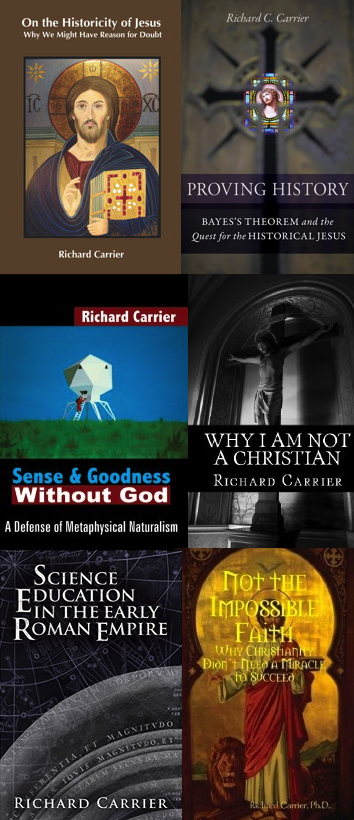
Case in point: historicity is not even parsimonious; it has to invent a giant stack of “just so” stories to explain away all the evidence against it and make any of the evidence plausible again. I document this especially in chapter eleven of On the Historicity of Jesus and now give some new and more developed examples in The Obsolete Paradigm of a Historical Jesus.
These “hidden epicycles” are generated the same as throughout all Christian apologetics: by stacking a bunch of assumptions, not mentioning any of those assumptions are assumptions, and thus not weighing the improbability of their conjunction. This method of “explaining away by making excuses” is a stock tool in any apologetics arsenal (see my discussion of its actual—and thus, by apologists, ignored—mathematical effect in Bayesian Counter-Apologetics).