

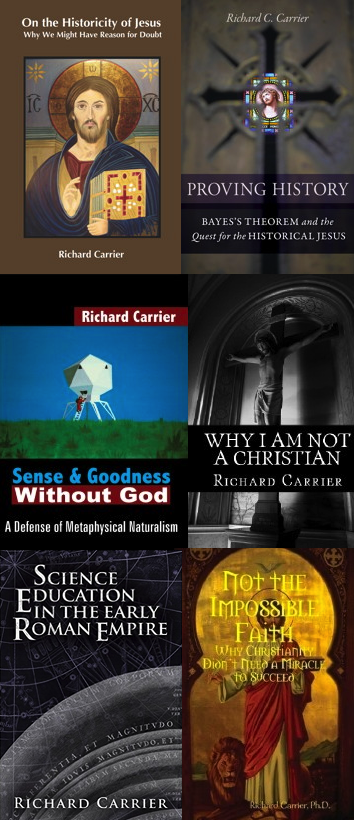
Upon request I am creating an open thread here for any continued scholarly Q&A on my book On the Historicity of Jesus (published under peer review by Sheffield-Phoenix) and its thesis—that at best there is only (but still possibly as much as) a 1 in 3 chance Jesus actually existed, rather than began as a revelatory being only known from visions and scripture. Any serious question about that posed here I will publish and answer.
Overall, I expect this to operate similarly to an AMA (“Ask Me Anything”) on a Reddit like AcademicBiblical. Only it will have no expiry. I’ll keep it open indefinitely.
Please do not post comments here unless you have both read On the Historicity of Jesus and have it on hand to refer to (I will be citing page numbers in it, for example). It is not productive to ask questions already answered or dealt with in the book. Please attempt to ask questions about how I already treat the question that interests you in the book; or to ask questions you confirmed aren’t addressed there.
My other book pertaining, Proving History: Bayes’s Theorem and the Quest for the Historical Jesus (published under peer review by Prometheus and now available through Rowman & Littlefield), you might also want to consult or have on hand. Because if questions of methodology come up, for example, I will likely be citing it.
Also please be aware of my continuing catalog of responses to scholarly critiques and of my existing corrections list for OHJ. There are also some few minor things I would more substantively correct in a future edition if ever I produce one, and if those don’t come up in Q&A here already, I may add them myself as they occur to me.
Note: This thread often gets bombed with troll-posting that doesn’t meet the comment requirements. And sometimes it gets overwhelmed with legitimate queries but too many to get through in a timely fashion, which then get buried amidst the trollery. All this results in unusually long delays in my getting through the queue. Because of all this, please expect thirty to sixty days as a typical timeline before posted comments will be vetted for appropriateness and be published and answered.
Reminder: Only questions about the content of my books addressing the historicity of Jesus are allowed here. Questions about anything other than that will be deleted. So will comments that don’t ask a question at all.
Discover more from Richard Carrier Blogs
Subscribe to get the latest posts sent to your email.






I read your book and am grateful. It was a milestone in my apostasy from the ‘secular tail’ of Christianity (an historical human Jesus). But as a non-academic I have always wondered how scholars manage to handle so many bibliographical sources.
How long did it take you to research Jesus? And about what percentage of the references of your footnotes you actually read?
I am curious because, although I am a literary writer (in Spanish, my native language), I cannot figure out how academics work; how they cite so many sources in their treatises…
Everything in the biblio was consulted for whatever it is cited for (rarely do historians read an entire work; they only read the portions of a book or article that they need). The postdoc research for OHJ and PH took six years, essentially full time. Of course I had also spent over a decade researching and studying Greco-Roman and early Christian history for my Ph.D. so I had a foundation of background knowledge already to build on, which I think is essential for anyone endeavoring such a project.
You have received huge flak for this comment. Did you know that? Would other scholars give the same comment that you gave here? It’s supposed to be a big scandal that you confessed to not having read all your sources. Someone is trying to make a big deal out of this. I wonder how many scholars would defend your response here as totally normal.
Pretty much every real scholar would. This is what all scholars do. So anyone scoffing at it clearly has never obtained a relevant Ph.D.
No one would read a whole book (unless they wanted to or need to for some other reason) when, for example, 95% of it isn’t pertinent to what they are discussing. You only read, and vet, what pertains. For example, in the articles by Trudinger and Howard (pp. 589-90), everything pertained, so I read it all (and usually read articles entire). But in Kannaday (p. 265) all I needed to confirm was that it contained many “examples” of what pertained, and I only cited it as such. I did not have to read every page of it to vet it for that purpose. Likewise, in Heidel (p. 405) all I needed to confirm was that he discovered and defended the Barabbas-Leviticus theory, nothing else in his book was relevant to anything in OHJ, so all I had to do was read his treatment of that one issue and confirm it was there and worth citing.
This is, literally, common sense.
Indeed, it is in fact a fallacy to assume a scholar agrees with or relies on anything else in a source that isn’t pertinent to what they are citing it for. Anyone who acts otherwise is not a competent scholar. I discuss this fallacy in Proving History as Axiom 12 (pp. 34-37).
Your book suggests that Paul represented the theology of early Christianity and that Mark (or his predecessors) developed this theology further, including into a historical Jesus. Now there is the German theologian Hermann Detering, who advocates the thesis that ALL of Paul’s letters were forged and were probably only written in the second century. If he were right, the probability of the historicity of Jesus Christ would increase significantly, right? Have you ever heard of Detering’s theories?
Actually, removing the letters of Paul would remove the best evidence we have for mythicism on the a judicantiori margin; but remove the best evidence for historicity on the a fortiori margin. The result would simply be narrowing the error margins. But it would keep the same general result (“more likely than not, myth”).
Formally, I would then be personally less certain of myth, but still doubtful of historicity (as my lower error margin would substantially move toward historicity, indeed about sixteen fold, but remain below 50%, while my upper margin would drop from 1 in 3 to something like 1 in 8, which is lower but still not confidently).
But Detering’s hypothesis is not plausible. It depends on too many possibiliter fallacies. See The Historicity of Paul the Apostle and How Do We Know the Apostle Paul Wrote His Epistles in the 50s A.D.?.
Nevertheless, unknowns like this are actually what probabilities take into account. Thus this “possibility” is already accounted for in my error margins. It just doesn’t operate as evidence generating those margins. Because it is a possibility, not a probability.
Did you make a mistake by using the phrase “cosmic sperm bank?” Putting aside whether the idea makes sense or doesn’t make sense, is the terminology itself not mocking and inappropriate-for-scholarship?
Is that language itself not mocking?
Is that language itself appropriate for scholarship?
Anyone who thinks a straightforward factual statement is “mocking” something must have a perverted sense of what the words being used mean.
If rather you don’t like colloquial English, you are an elitist. Which is a character flaw. The inability of scholars to talk to the public in their own language is a defect in scholars, not the public.
Was it necessary to attack Andrew Wagner with “if you don’t like colloquial English you are an elitist. Which is character flaw”? A reasonable academic writer might find it sufficient to say “In my opinion, the inability of scholars to talk to the public … is a defect in those scholars.”
LOL
I have just finished reading Philo, The Embassy to Gaius. One point that struck me that was not mentioned in OHJ (unless I missed it), was that given Philo’s book can be dated to almost exactly 40 AD, and certainly within a decade of the death of the miracle working Son Of God, Philo was in possession of the scoop of eternity. That is to say that as a notable Jewish scholar he could have written the Gospel according to Philo as 40 AD likely pre-dates any other book of the New Testament. The fact that not only did he not write his own gospel, but fails to mention the coming of the messiah in this or any other book strongly suggests there was nothing notable to write about.
Most of Philo’s works predate even that (that treatise may have been his last; he was by then an old man whose publication history had already made him famous and revered). But I discuss the point you raise (and explain why it’s not a strong argument against “minimal” historicity and consequently assign it a weight of zero) in OHJ, pp. 294 & 304-05 (with pp. 291-92).
These question aren’t about the specifics of OHJ, but they inevitably come up for any layperson who’s trying to suss out, “Who is this Carrier person? How reliable is he? How seriously should I take him?”
1) Why are you so abrasive in your communications? Should such abrasiveness make people regard you with suspicion? What about etiquette and politeness? Are you “unprofessional” or impolite or abrasive in your demeanor and language and approach?
2) How well-regarded are your books on the history of science? Your books on the history of science aren’t dealing with hot-button issues that might cause problems for various Christian dogmas, I would think. Therefore, it might be useful for laypeople to ask how well-regarded your non-“controversial” books are. Do historians of science regard your history-of-science books as high-quality? How well-regarded are your history-of-science books among the leading historians of science?
Give me a specific, quoted example.
By whom?
If you want them vetted by an actual expert (a published historian with a Ph.D. in ancient science or equivalent), find one and ask them to read Science Education and/or Scientist and give you their opinion.
How else could you or anyone know the answer to your question?
In other words, you are here asking the wrong person this question.
However, do be aware, my books on ancient science are based on my Ph.D. dissertation, which passed the approval of multiple peer reviewers on my dissertation committee. And science historians have praised my work (e.g. Adrienne Mayor).
As for abrasiveness, I would just note that simple fact that you use the word “liar” and “lying” a lot. Search both those words on your blog and you’ll get tons of results. Isn’t that kind of language just an obvious bridge-burner? You need to learn how to sugarcoat your criticisms or else you will ostracize yourself!
Go CTRL+F “lying” here and you’ll see one instance in the blog-post itself and another in the comment-section: https://www.richardcarrier.info/archives/10134.
When someone lies, and we catch them at it with abundant evidence, we are obligated to call them a liar.
You will never find any instance of my ever calling someone a liar without that statement being immediately followed by extensive and clear evidence that they lied.
You should be attacking them for lying. Not me for proving it. Otherwise, your standards of respectability are quite backwards.
What about the strategic/tactical suicidality of calling people like Ehrman “liars,” even if they did lie?
Also, isn’t “lying” notoriously hard to demonstrate, since you have to SOMEHOW rule out a million other psychological possibilities that are distinct from a deliberate intent to deceive?
In every case, I present evidence of actual lying. Show me an example where I did not.
Quite frankly that their lying doesn’t bother you is disturbing. You are literally defending liars, and suggesting there be no consequences to lying, and that we never catch them at it or admit they did it. “How dare you expose a liar!” Seriously? I don’t take moral advice from someone whose advice is to shield liars from the consequences of their lying, and whose amorality is so shameless they attack the person who exposes liars and not the liars themselves.
You should be ashamed of yourself.
I don’t defend Ehrman. If Ehrman lied, then that’s bad, and he should be called out for it.
Part of life is to sugarcoat things when it’s useful to do so. I think that sugarcoating things in the Ehrman case might have been a smarter thing to do.
It’s true that he lied, but I could go up to someone on the street and say, “You’re fat.” It’s true, but it would be a dubious thing to announce that truth.
My point about how hard it is to PROVE lying has a potential weakness: it might lead to the dubious conclusion that we can never know anyone’s true motivations for ANYTHING they do. And it might also lead to the conclusion that we can never know our OWN motivations for anything we do. Somebody once pointed out this dubious consequence that comes from my reasoning about how hard it is to demonstrate lying.
I don’t know what a court of law will require in order to show that someone was lying. It certainly can’t be PROVEN without maybe some kind of fancy brain-scan that shows activation in a certain brain-region that’s been scientifically PROVEN to only activate when deception is intended.
That’s the thing: Does lying require you to INTEND to deceive? So much of our psychological life exists in a murky realm where we don’t fully process of be conscious of what we’re doing.
Identify any instance in which I fail to adduce sufficient evidence to conclude someone lied or (if so I say) might be lying.
Without any examples of that, nothing you just said is relevant.
For example, you cannot dispute I caught Ehrman lying. Not only once, but twice.
Why are you not disgusted by Bart Ehrman having lied like this?
1) Do you think that mythicism will be taken more seriously in 10 years? 20 years? 30 years? How much more seriously?
2) Do you think that your general Bayesian project will gain any momentum in the decades ahead? My thought about this is that it only becomes ideologically threatening when applied to Jesus. But the problem is that using it on innocuous subjects might be seen as a “slippery slope” because people will think, “If we start using this on X then it’s only a matter of time until Jesus is subjected to this same methodology.”
3) You could literally make a Reddit account right now and start your own thread on /r/AcademicBiblical. Have you ever considered doing that? It would give you a way to defend yourself against Bible scholars now and then. Of course, you don’t have to go on Reddit every day, but you can go on it now and then and debate various topics with knowledgeable scholars. You could go on Reddit every month or so.
4) Is it crucial for your projects’ success that you secure debates with as many major scholars as possible, since these debates can really elevate your prominence? Is that a key part of strategy for you going forward, and is it crucial that you apologize profusely/sincerely/thoroughly to people like Bart Ehrman in order to secure those all-important debates that will help to advance your OHJ project as well as your general Bayesian project?
1) Yes. It’s only been a few years and it has already gained the approval of over a dozen fully-qualified experts, admitting now to either agnosticism or disagreement but acceptance of the hypothesis as at least plausible. I expect as the old guard ages out and retires and dies off and younger scholars more and more take the helm, the old rhetoric and ideological commitments and bogus arguments-from-prestige will decline. Just as happened with the historicity of Moses. As Thomas Paine wrote, “Time makes more converts than reason.”
2) No. But hope springs eternal. I think, in general, historians are terrified of math and logic and will mostly refuse to learn either or even be told they need to. This is a serious problem with the field, already well called-out by famed historian David Hackjtt Fischer in Historians’ Fallacies. I would wish they not act like this, since it’s hard to claim history a legitimate field if its members can’t even explain why anything they argue is logically valid. But I can only do what best I’ve already done to change that. The rest is on them.
However, be aware, all historians who are arguing validly, even though they can almost never explain what it is about their arguing that makes it valid, are in fact already arguing with Bayes’ Theorem. In other words, we can fully model their argument with Bayes’ Theorem and thus explain why what they are arguing is valid—even though they are not consciously aware of this fact about their reasoning. See my article Bayesian Statistics vs. Bayesian Epistemology (and philosophy of history expert Aviezer Tucker’s demonstration in Our Knowledge of the Past and Efraim Wallach’s demonstration with respect to the evolution of the consensus on Old Testament historicity).
3) I have never seen anything worth engaging on Reddit. IMO, the amount of time it takes sorting through the garbage is not worth the trivial payoff the effort could even bring. If some academic group there wants to invite me into a formal, moderated engagement that will filter out trolls and amateurs and lazy readers who misrepresent what’s in my book or won’t even actually read it, I’m game. But otherwise, it looks like just a useless time suck to me.
4) No. Debates are of minimal actual utility. Few scholars attend them, so it’s mostly just entertainment for lay audiences. And I find they devolve mostly into tricks and rhetoric rather than facts or enlightenment. I never organize them. If someone else does, I can be persuaded to participate if the incentives they offer justify the time (and in result I have engaged countless debates and have built skill at it now).
And yet I must note that written debates are far superior to oral; they can be steered to be less about rhetoric and tricks and more about facts and enlightenment. But for that very reason, most people won’t engage them—precisely because it punishes rhetoric and forces them to actually defend their position with evidence (it allows fact-checking and careful analyzing of logic and demands the citing of sources who will actually be checked, for example; few opinions can survive that).
But if you find any actual Ph.D. in a relevant field willing to engage a written debate with me on OHJ‘s thesis, I’m always game for that. A good format I’ve worked to success is illustrated by my last debate on a question of history with Jonathan Sheffield.
1) I’m 50/50 on Jesus’s historicity. Should I be called a “mythicist” if I look at the evidence and can’t find enough evidence to move the needle one percentage-point in either direction, leaving me right on the 50/50 line?
2) Is Robert Price 50/50 on Jesus’s historicity? Should he be called a “mythicist?”
3) Is it likely that in the future the “50/50” position will become more popular long before scholars start to venture toward the “more likely myth” side of the equation? How do you see the whole evolution unfolding over the decades ahead?
4) Would you have been tactically smarter to argue for complete Jesus agnosticism in “OHJ,” rather than pushing the “1 in 3 at the very best” position that seems provocative to many scholars?
You get to call yourself whatever you want.
If your question instead is, will people be able to accurately categorize you as “a mythicist” if in fact you are only a historicity agnostic, then the answer is no. You would then at most be accurately called a mythicist sympathizer, that you deem mythicism plausible and are undecided or unsure as to whether historicity is more likely.
Robert Price regards the historicity of Jesus as overall less likely than his historicity. He could correctly be described therefore as a mythicist and so far as I know accepts the label.
As to what will be more common in twenty or thirty years time, if this follows the same trend as for Moses, then the most common view will be “lean more toward mythicism” among scholars who are not conservative Christian apologists (whose faith prohibits them from admitting such a position).
And this is not a game. I am not engaging in “tactics.” I am simply stating what is true. If I had found the odds of historicity to be 50/50, that’s what I would have reported my findings to be. I reported what I found. Because I tell the truth. You have to choose. Do you care about tactics or the truth? Pick which. I’m for the truth. If you are for tactics, then you are against the truth. And if that’s so, you are thereby no ally of mine. Nor an honest scholar of any kind.
Commenting on if the idea of nonexistent Jesus will catch on: I agree with Richard, it’s only a matter of time. Paradigms fall one funeral at a time. I started out believing strongly in an historical Jesus, but after years of studying the issue, don’t consider it to be believable anymore. To me, it’s no longer much of question.
Are you familiar with Russell Gmirkin’s theory that the Pentateuch was not composed until around 270 BC? His most recent book on the topic is Plato and the Creation of the Hebrew Bible, which I’m now reading. If true, his theory might have interesting implications for the Jesus historicity question since it would imply a much later date for the development of Jewish law and dogma.
I too am trying to poke Richard Carrier as well as others to further investigate these things. We can only make sense of Jesus – historical or mythical – if we realize what Judaism was. In so many was it was the historicizing (Hellenizing) of mythology (ANE).
Instead of the Imperial Authorization of 430 BCE of Persia, what about a Ptolemaic Authorization?
I’ll reiterate what I answered to Griffin (below): whether the OT dates two rather than four centuries before Christianity would have no effect on any probabilities in OHJ (so I’m not even particularly interested in the thesis; but I’ve also not seen any sound argumentation for it).
I’ve seen the peer review status of OHJ challenged a lot in internet forums, ranging from attacks on the publisher’s status to the specific review process followed, and even to peer review in general. Perhaps it would be worth noting a quick summary of the facts to end such speculations?
All slander. Of both me and Sheffield-Phoenix and its staff.
See my section on this in Killing Crankery with Bayesian Reasoning.
Whenever you catch people telling these lies, please shame them for it, and direct their audience to that link.
There are people on /r/AcademicBiblical who cast doubt on the peer review status of OHJ. They want to know where they can learn about the process from Sheffield-Phoenix itself. They don’t trust you yourself to tell them what the process was for OHJ.
Suggesting that Sheffield-Phoenix threw out its entire professional standards and practices for me (!) is both absurd and a slander upon them.
I suggest not listening to people who prefer to slander a well-respected academic publisher on absolutely no evidence, rather than address the actual content of the books they publish.
The claim that I hear a lot on /r/AcademicBiblical is that you CHOSE your reviewers, and therefore you were able to choose sympathetic reviewers, and therefore it’s not genuine peer-review.
Is there anything on the publisher’s website that clarifies their exact peer-review process to which each and every book they publish is subjected?
Or could the publisher just be e-mailed in order to confirm the process that OHJ underwent?
So you are in the habit of believing a claim made without any evidence that slanders a respected publisher by claiming they abandoned their standard professional practices?
I linked you to Sheffield-Phoenix defending their peer review standards against one of these very slanderers, and you ignore it?
Sheffield-Phoenix Press is the heir (resurrected, hence “Phoenix”) of the former Sheffield Press of the Biblical Studies dept. at the University of Sheffield. It’s under the auspices of bona-fide scholars and editors, and published works by some of the top scholars in the field. It’s a fine academic press to publish with, which is why it’s still chosen by seasoned scholars who have published with the who’s-who of university presses, etc. etc.
I don’t find Gmirkin’s arguments plausible.
The textual dating stuff I can’t comment much on; until he convinces more colleagues (or gets even so much as one favorable critical review in an academic journal), I don’t see much that’s sound here. Too many presuppositions are guiding his inferences; it’s a lot of possibiliter fallacies, arguing “possibly, therefore probably,” which is invalid, or simply making assertions (about things like causal order) that don’t actually have any evidence to decide them. But none of that matters to OHJ or its thesis. Nothing in OHJ changes if the OT texts date only two rather than four centuries earlier than Christianity.
I find even less plausible his theory of influence from Plato. I think it applies to the Vatican, which IMO clearly tried reifying Plato’s Republic exactly as Gmirkin proposes, and for that we have real evidence for almost every particular detail; not so much Judaism, which did not even have a controlled canon until the 2nd century A.D. and even that was not a “canon” in the Christian sense (there was no longer any Jewish state to enforce one). There are some similarities (the idea of some books being inspired by God, the use of such forged books to control public sentiment or push policy), but it wasn’t organized so neatly as Gmirkin’s thesis requires. That’s why Judaism exploded into some three dozen sects around the turn of the era, and no one agreed on which books were scripture. There was sort of an agreement on a core selection of texts (e.g. the Pentateuch), to which various factions would add different things, but even that core wasn’t enforced by any political mechanism.
But even this has no effect on OHJ. “Why” Judaism was vehemently factional doesn’t change any probabilities in OHJ. And the Vatican’s adoption of Plato’s Republic as a model for controlling society arose long after Christianity began. It’s an interesting story to explore in its own right; it just doesn’t have any effect on the probability Jesus existed (apart from the one sense I already accounted for: that Medieval document control affects all expectations of evidence survival).
Gmirkin does seem to have convinced some scholars to take him seriously. See, for instance, The Bible and Hellenism, edited by Thomas L Thompson and Philippe Wajdenbaum).
Can you identify what scholar(s) says they agree with Gmirkin’s redating of the OT texts in The Bible and Hellenism?
This is in reply to your question, “Can you identify what scholar(s) says they agree with Gmirkin’s redating of the OT texts in The Bible and Hellenism?” [My apologies, I’ve literally lost the thread here — your question isn’t showing up on the site for some reason, so I’m replying here.]
Basically, all the authors who contribute to the book, at least as I’m reading it. This is the conclusion of Thompson & Wajdenbaum’s introductory chapter: “The fourteen contributions gathered in this volume all agree that Hellenic culture influenced, directly or indirectly, the Hebrew Bible and later texts such as the Apocrypha, the Dead Sea Scrolls’ Pesharim, Josephus and the New Testament. Although each essay offers a unique understanding of how Hellenic influences permeated the Near East, we are in general agreement that most of the books known as ‘the Bible’ were written when ‘God made room for Japheth in the tents of Shem’; that is, at a time when the influence of Hellenism was likely to have reached Samaritans and Jews. Japheth, known in Genesis as the son of Noah and the ancestor of the Greeks, is known in the Greek tradition as Iapetos, the father of Prometheus, himself the father of Deucalion, who had survived the great Flood in the Greeks’ version of the myth. Among Deucalion’s descendants, was one named Ion; that is biblical Yavan. Our title indeed implies not only that the Hebrew Bible was written in a Hellenistic context, but that the authors of Genesis had made room for Hesiod’s Theogony.” Contributors to the book are Emmanuel Pfoh, Etienne Nodet, Gmirkin himself, Lukazs Niesiolowski-Spano, Thomas L Thompson, Yaakov Kupitz, Philippe Guillaume, Anne Katrine de Hemmer Gudme, Flemming Nielsen, Philippe Wajdenbaum, Ingrid Hjelm, Reinhard G Kratz, John Taylor, Bruce Louden,
That’s still not quite the same thing as agreeing with Gmirkin.
I don’t think any mainstream (as opposed to fundamentalist) scholar doubts such influence existed or could have; that’s not the remarkable claim (it’s long had mainstream defenders, e.g. Lemche, Gnuse, etc.). Gmirkin’s remarkable claim is that everything was written in the third or second century BC. Hellenism was influencing Judea for hundreds of years before that, so saying “Hellenistic influence” is not saying “the whole OT was written in 250 BC.” To the contrary, you can say “Hellenistic influence” and still affirm every traditional date for each OT text. Likewise, saying “Hellenistic influence” is not saying “the Bible was written by a team of scholars deliberately implementing advice they read in Plato’s Republic,” which is an even more implausible claim. (The Documentary Hypothesis, and evidence of period editing also undermines Gmirkin, e.g. that there are sections of Isaiah written centuries after other sections kind of eliminates the possibility of it all being written in the middle of the second century; and Genesis is clearly a merger of two earlier, separate texts, which means there were earlier texts).
So when I ask for what scholars say they agree with Gmirkin, I mean, agree with his dating of the OT and/or his bizarre Platonic thesis. Not merely agreeing that Hellenistic influence may exist in parts of the Bible. So is there anything like that?
Innana and Jesus, three days before rising again. Jonah was in the fish for 3 days, in the depths of the sea. The Sea of course represents chaos and disorder from which God (pick your god here) created order. Is the name Jonah in any way related to Innana? Was the fish symbol that was later adopted by Christians used BCE for anything else?
I do not know the answer to either question. But neither has any relation to the thesis in OHJ.
Can you provide textual criticism on whether Paul refers to Jesus as a man in this passage?
“The first man is of the earth, earthy; the second man is the Lord from heaven.” – KJV 1 Corinthians 15:47
What do you think of the claim by Doherty that this passage contains an interpolation (Jesus: Neither God nor Man, pp. 207)?
“born of a woman, born under the law” – NIV Galatians 4:4
Does Paul say that Jesus comes from the seed of Abraham, and how is that reconcilable with his other claim that Jesus is from the seed of David?
“Now to Abraham and his seed were the promises made. He saith not, And to seeds, as of many; but as of one, And to thy seed, which is Christ.” – KJV Galatians 3:16
You must not have read OHJ.
My thesis is that Jesus was believed to be a man. I see no evidence of interpolation. Please read my article Can Paul’s Human Jesus Not Be a Celestial Jesus?
On Galatians, see my article Yes, Galatians 4 Is Allegorical.
Paul not only says Jesus comes from the seed of Abraham, he says Christians come from the seed of Abraham (Galatians 3:29), by which he explicitly means allegorically, not literally. This is the argument he keeps on going with into Galatians 4 (which is not a new argument, but the continuance of this one).
Paul does believe Jesus is the seed of Abraham in some sense (indeed, more specifically, of Jesse and hence David, in every case based directly on scripture), but whether allegorically or literally is unclear; and even if literally, it’s unclear in what way. I discuss this extensively in Ch. 11.9 of OHJ (see also The Cosmic Seed of David).
So, do you have a question about some specific thing I claim or argue there?
Christians claim the phrase in 1 Corin 15:47, “the Lord from heaven” refers to Jesus as Lord coming from heaven to the earth. However, some of the research I have done suggests that “the Lord” is an interpolation and earlier manuscripts omit it. Moreover, the Greek word used is “ek” and the KJV writers translated it into English as “of” in the first sentence and “from” in the second sentence. Compare that to other translations like the NIV which only translate it as “of” throughout.
King James Bible
The first man is of the earth, earthy: the second man is the Lord from heaven.
New International Version
The first man was of the dust of the earth; the second man is of heaven.
English Revised Version
The first man is of the earth, earthy: the second man is of heaven.
American Standard Version
The first man is of the earth, earthy: the second man is of heaven.
I read the book but don’t remember everything. According to mythicism, was Jesus sacrificed around 33 AD or at the beginning of time?
Some parts of the epistles suggest his sacrifice was at the beginning of time. However, if Jesus is manufactured from the seed of David, then I don’t see how he can be sacrificed at the beginning of time if David did not come to exist yet.
Correct. For that and many other reasons the “he was sacrificed at the beginning of time” thesis simply does not agree with the evidence (e.g. see another comment I made on my site about this). Paul clearly believed it was a recent event, one planned since the beginning of time and kept hidden all that time and only now having happened and revealed as having long been God’s (secret) plan all along.
As to 1 Corinthians 15:47, that’s in a different context about assembled bodies. It does not specifically refer to any one point in time, it’s only about when someone is a man of heaven then they are made of heavenly stuff (and not flesh), which refers not just to Jesus, but to us as well (see the context: 1 Cor. 15:35-55).
This does mean Jesus was believed to be in heaven. But it isn’t specifically talking about when he ended up there. So one could still say this refers only to Jesus after his resurrection (I don’t think Paul or any early Christian would agree, but since Paul isn’t talking about that here, we can’t use this verse to prove that; one must resort to other verses establishing Jesus came from heaven, like Philippians 2:6-10 or the various verses where Paul establishes Jesus existed, doing God’s bidding, thousands of years ago, prior to enacting his sacrificial scheme).
But that is also still compatible with historicity, too. As Bart Ehrman correctly argues, even historicist Christians (e.g. the author of John’s Gospel) believed Jesus descended from heaven to assume a mortal body of flesh, preach, and die, and then ascend back to the very heaven he came from (Romans taught exactly this of Romulus, too, so it wasn’t even an unusual concept). So “he came from heaven” is not evidence against historicity (though its compatibility with mythicism remains relevant).
Can you comment on the relative probabilities between:
A) A small cult of personality losing its leader and recovering with a shift of leadership while nominally still having the original leader at its head.
and
B) A cult modifying its theology by altering an existing figure or adding a new figure.
It seems to me that the former has difficulties, such as:
• The odds of having a second cult leader in a small group who was capable of taking over and successfully expanding the cult.
• The odds of a small cult surviving the attrition after losing its leader sufficiently to recover and grow.
• The odds of the second cult leader not placing himself as the leader, but remaining subservient to the other person after his death.
• The odds of a cult believing in a resurrection if they had actually witnessed the finality of a public execution.
Perhaps this is more psychology than history, but when these two options are compared this seems to be a weak point in the typical arguments for historicity. I’m sure there are more points that make the two unequal in probability as well.
I don’t understand the question.
I assume you are criticizing historicity theory somehow.
Is the idea that, you think it’s more likely Christians would disband after Jesus’s death rather than rallying around a new belief-saving notion under Jesus’s right-hand man? That’s actually not so certain. Cognitive dissonance theory was literally developed using the fact that that’s not what happens to religions (see When Prophecy Fails for the seminal work). So it’s not even uncommon. This is precisely the sort of thing that when tried usually works.
But on top of that, you are running up against the multiple comparisons fallacy here: if your prediction is that few movements do that, then Christianity fits that expectation. In the field of messianic movements whose leaders were killed, Christianity matches the expectation that “few” would continue; in other words, if the odds are 1 in 7, say, then we expect to see 1 in 7 cases; Christianity would make the 1 in 7, confirming expectation, rather than going against expectation. (And I am assuming certain things here that actually aren’t in evidence, e.g. that other messianic movements “ended” at the death of their leader; that they died out eventually is true, but we don’t actually have documentation showing they didn’t linger decades before doing so.)
So I don’t see any weight here for or against either origin story (a Brigham Young scenario or a Joseph Smith scenario; i.e. the former is an example of a right-hand man taking over and expanding the religion after the ignominious death of its leader, which would be your scenario A, and the latter is more like an example of a religious leader “inventing a new founder,” i.e. the Angel Moroni, and folks buying it, which would be your scenario B).
The Embassy to Gaius by Philo of Alexandria can be dated almost exactly to 40 AD. That is within 10 years of the supposed death of Jesus and likely earlier than any book in the NT. If the miracle working Son of God and expected Messiah had been a reality it seems improbable that this could have escaped the attention of a prominent Jewish scholar such as Philo.
That Philo fails to mention Jesus of Nazareth in this or any other of his writings would suggest that there was
in fact no story to tell. Apologists often say that the argument from silence is weak, but in this case I would suggest the argument from silence is deafening.
On Page 117 of OHJ it is noted that Philo interprets the scriptures allegorically which would imply that he would reject stories of the supernatural in any case unless proven to be true, and if not true then not worth recording, or put another way, it simply never happened.
You seem to have duplicated comment material. For your first half, see my previous reply. For your new query, that’s a non sequitur. That Philo endorsed and used allegorical interpretation does not mean he always rejected literal interpretation, at all much less of the miraculous. I haven’t extensively reviewed Philo’s enormous corpus to ascertain any trends in regards the miraculous. But this wouldn’t have any bearing on historicity. He could just as easily remark on a mundane Jesus as belief in a supernatural one, so the distinction would have no effect on his doing either. Odds are he just never ran into any Christians, or if he did, he didn’t find them worth the bother of ever writing about.
Yes, sorry about the duplication, I wrote the second comment as I thought it was a better construction and then tried and failed to delete the first. I will read again the passages in OHJ as suggested and ponder your reply.
OHJ uses a mid-2nd century cut-off date for the collection of background evidence. If this date were to be relaxed until c.381 CE how long would you estimate for another OHJ (version 2) to be researched considered and published? And would you expect there to be any substantial change in the historicity conclusion of OHJ?
I don’t understand the question. You seem to be confusing different things. I do not cut off “background” evidence at all. My mid-second-century cut-off is for evidence. And the reasoning is given in OHJ (pp. 258-59, 273-74): there is nothing after that date that shows any sourcing independent of what predates the cut-off; no witnesses could possibly still be alive; and after that point Christian forgery and fabrication dominates the evidence pool. So, there literally isn’t any evidence to add after that date (per the methodological point on pp. 254-56).
In OHJ, pp. 557-63, you argue also that Paul did not mention anyone at the Lord’s Supper, other than being based on revelation (“I received from the Lord”, 1 Cor 11: 23-25). But some questions arise:
Paul could not refer to this, as being a tradition of gathering for supper – which presupposes an earthly/human gathering of people; that is the context (17-22) – What would come of the Lord, who did so in the past? Would it make sense for Paul to use this as an example for the Corinthian Church, if he did not have an earthly and group event in mind?!
Another point is: who was the Lord talking to? Who should “take and eat”? And was the blood given by you? Doesn’t that presuppose other people over there ?! Can we simple say that was a “didactic vision”?!
Thanks for listening.
Paul is not describing a historical meal the church is emulating. He’s describing Jesus explaining what the meal they take symbolizes. There is no “Jesus” at Corinth doing or saying any of these things (so obviously Paul is not giving them a depiction of something they are doing, but an explanation of what they are doing). But who the Jesus is talking to in Paul’s vision is the Corinthians (because he’s speaking to all future Christians). This is in fact so peculiar it’s astonishing no one ever notices this.
As I wrote in OHJ (and please explain why you do not know this is in OHJ; you’re supposed to be asking questions about a book you have read):
That’s pp. 559-60; with footnote 60:
See my discussion of how Mark changed Paul’s version to include people being present, in exactly the way Paul would have done had he meant what Mark is relating, thus illustrating the very point. Seen side by side, it becomes quite clear what Paul is not saying, and what Mark has decided to add to convert this esoteric vision into a historical event.
“He’s describing Jesus explaining what the meal they take symbolizes.”; ” an explanation of what they are doing”
Yeah, but does not answer my point that was why the church was doing that in group if Jesus didn’t? and why Paul use that to correct the church if this wasn’t done like them? And again, what kind of so didactic hallucination is this?! With the Lord inviting to EAT (i wiil comment Acts 10.9-17), giving grace and teaching without audience. ‘You’ is also all inclusive;could be the apostols and future christians, has you did note (p. 558): but a private vision use of plural is at least strange.
In note 61 you apeal then an another “mystery religion element”, right? but realy, this kind of thing – supper – could be very jewish – passover. And in the end of p. 558 you pressuposes naturalism to draw the a suicid man who believe that will ressurect and come back.
Your critique of translation and identification does not help much, i think. ’cause if ‘Jesus ate’, he then do something that a human do. gods some times “eats”, but you are giving the suggestion that is a normal meal. the usually humans do.
And would not Paul correct them, or be more clear, if it’s wrong of call this episode Lord’s Supper (1 Cor. 11. 20)? dinner was not implicity if was night (23)?
“One does not have to perform a ritual to proclaim someone has died whom everyone knows had died. But [only] if his death was only mystically known,”
…the jewish passover, as you regard in p. 562.
I know you argue for a markan expansion before that (p.558). But let’s just discuss Paul report that could be one peace of an tradition.
Revelations (argue by you mostly in Element 15 and 16)
Paul does not use the word revelation like in Gal. 1.12. So not necesseraly is the source. So “recieve from the Lord” could mean another thing here, like tradition.Acts 10.9-17 ist literaly a vision, and report as a vision. Something that Paul don’t do. And was private; the voice was speaking Peter just. What is more expected in a commom hallucination…
you also argue that Paul must has teach iLord’s Supper before have contact with another apostols (Gal. 1.15-20) and “therefore must have received this revelation then, or claimed to have (Gal. 1.11-1 2).” (p. 559) This argument is more strong but as you regard:” may have been based on things he learned from the Christians he had been persecuting outside Judea” (ibid) like Ananias if we regard Acts 9.10 in Damascus as he said in Gal 1.17 to come before go to Jerusalem.
I don’t quite follow your English here. If you mean, why did Christians invent a Eucharist ritual, the answer is the same as for all rituals in all religions the world over: it will have an internal reason (a proximate cause) and an external reason (a contextual cause).
Paul tells us the internal reason: he had a vision that Jesus instructed all future Christians to do this for the reasons Paul states (and what he says elsewhere suggests previous apostles had similar visions).
Contextual historical analysis tells us the external reason: all salvation cults then had a similar meal ritual that served the same overall function; Christianity began as a Jewish version of these cults; so the Christians needed to construct one of these meal rituals too, one based on Jewish conceptology (as in this case, a reimagining of Passover).
Whether the apostles’ subconscious did that for them, or they did it on purpose and merely “claimed” to have received it in a vision (or some combination of both, e.g. they deliberately constructed it and their subconscious then conveniently “confirmed to them” in a vision or dream that their construct was approved by Jesus), we cannot know, because we do not have access to the evidence that would discern which.
Likewise, whether Paul’s vision was in particulars the same as or in any way variant from the prior visions of prior apostles, we cannot know, because we do not have access to the evidence that would tell us. The most we have is Paul telling the Galatians that his gospel did not differ from theirs, except in regards his claim that Jesus told him he could induct Gentiles without converting them to Judaism, which they gave their seal of approval to nonetheless. Paul could not have been lying too much about that, as he would then be exposed as a fraud as soon as they checked with the other apostles. But Paul could have stretched the truth just enough to be defensible, e.g. their visions (as claimed, anyway; what they actually saw, as I just noted, is a different matter from what they claimed to have seen) might have differed in particulars but been the same “in gist,” which would be sufficient for them to conclude Paul was telling them the truth.
Some scholars, e.g. Lüdemann, believe Paul innovated and thus introduced the Eucharist (and thus no one prior to him had a vision or dream like that). That’s also possible. I am slightly doubtful, but not strongly. That innovation might not have been seen as adding to the gospel. In which case it could well have originated with him.
Again, I am having trouble understanding your English. But it sounds like you think he was “correcting” someone. Paul is not correcting anyone. He is reminding them of something he already taught them (“I received from the Lord what I also passed on to you”). Paul started the Corinthian congregation. They were engaging in this ritual because he told them to, and clearly he had told them then that he learned it from Jesus in a vision.
Indeed, your analogy is exactly on point. This was a commonplace kind of vision. Acts attributes one like it to Peter, which was based on one like it claimed by the Prophet Ezekiel, no more honorable an authority and model to emulate. Angels and gods could do all sorts of things in visions, and Paul is here relating what Jesus revealed to him he had done when he was wearing a mortal body (i.e. before his death). The only question is: where did Paul think this happened? The answer is: He does not tell us. He does not mention anyone being there, either; and his description has Jesus speaking to all future Christians (including Paul’s Corinthian congregation), which obviously could not have happened in a real historical event.
Why do you think it is strange? You do realize the diversity and strangeness of visions is a normal fact, attested across world religions and ancient Judaism and paganism and beyond. There is nothing unusual about this vision, compared to the visions had (and claimed to have been had) all across that period and since. I mean, just read Revelation. Or the popular early Christian book the Sepherd of Hermas!
That’s exactly what I argue in OHJ. So indeed, you seem not to know what I have argued.
The Eucharist Paul describes is not, of course, a Passover, because it replaces and inverts many themes of Passover, inserting Jesus and his sacrifice in the place of the lamb’s blood and angel of death, and calling for the remembrance not of the Exodus but of Jesus’s death.
It is clear the ritual Paul imagined (or whoever first contrived it) was modeled on the Passover and intended to replace it. This is in concurrence with the sect’s entire anti-temple stance (they could not practice Passover in the traditional, Biblical way, as that required accepting and participating in the temple cult; they wanted to make temple cult obsolete, by having Jesus replace all the functions of the temple cult).
To learn more, see “Passover” and “Eucharist” in the index of OHJ.
Yes. OHJ is a work of modern, mainstream scholarship. Outside fundamentalism, all modern, mainstream scholarship is naturalist. In OHJ I dismiss early on (pp. 26-30) all supernatural theories of Jesus as irrelevant to the debate. The only versions of historicity I consider as plausible and test against my alternative are the naturalist theories of mainstream consensus scholarship.
If you are still lost in a superstitious worldview, you are incapable of engaging rationally in this debate.
Gods and angels can do anything they want in visions, even create the appearance of their eating. If you mean, why would Paul imagine Jesus eating if Jesus didn’t need to eat, Paul says the vision granted him was of what occurred while Jesus was wearing his mortal body. Such a body eats.
I don’t understand your question. I agree they called it the Lord’s Supper. I say so in OHJ. They partake of what they call the Lord’s Supper because it is the Supper the Lord commanded them to partake in. And Jesus’s being handed over for death did occur in a night. You seem to be confusing time with space. The mythicist thesis is that Jesus was killed at an actual identifiable time, during a day or a night for example. The only difference it makes from historicism is in regard to where it happened, not when. I discuss this in detail in OHJ, so you seem not to be reading OHJ (see pp. 560-62, with p. 144).
Which never happened. The Passover is a myth. Hence my point.
(Maybe you are unaware that all mainstream scholars now agree Moses, the Exodus, Passover, are all mythical. OHJ is a work of mainstream scholarship.)
He doesn’t have to. He says he only ever got things from the Lord by revelation in Galatians 1. And uses the same vocabulary of receiving and handing on in Galatians 1. Ergo, when he says in 1 Corinthians that he received a thing from the Lord that he passed on to the Corinthians, using again the same vocabulary, we know he means a revelation. Likewise 1 Cor. 15, which has identical vocabulary, and clearly demarcates what he means as the gospel, the very thing he is telling us in Galatians 1 he never received any other way than by revelation.
Again, OHJ, Ch. 11, discusses this so thoroughly, it is absolutely clear by this point that you aren’t reading OHJ.
Please go read the book before asking questions about it here.
The question of how Paul really learned the gospel he claimed only to learn by revelation is a separate matter, thoroughly discussed in OHJ (pp. 536-37, 588-90, with pp. 131-32, esp. w. nn. 176 & 178). Go read the book.
Update:
I did not pass through moderation comments that didn’t ask a question. This thread is for questions only.
I also did not pass through moderation a huge quantity of massive word-walls that a single troll sent quoting other people who clearly hadn’t read either of my books and were simply making false or confused assertions about them.
That wasted an inordinate amount of my time. If you have a question or criticism regarding OHJs or PHs contents and arguments, please ask it here yourself. I will not engage in third party proxy debates, least of all with people who can’t even get right what’s in my book.
Stand up for your own assertions here. Or don’t stand up for them at all. Your call.
Update:
I mentioned accumulating correction ideas here I’ve already struck upon. There are many minor issues I may revise in a future edition. Three come to mind just now:
-:-
(1) My wording in OHJ appears to have confused some readers regarding the actual significance of the legends I cite of the demoness Igrath stealing semen from David’s belly. I wrote as follows (OHJ, p. 576):
And in the appended footnote:
Some readers have overlooked my words “in later Jewish legend” and mistook me as citing an ancient source for this (in fact it is Medieval; although the legends it contains could be ancient, in OHJ I do not maintain they were). I said “later” for a reason. My point was that this legend is a proof of concept (if Medieval Jews could imagine this, so could ancient Jews), not a claim to prove a contemporaneous belief.
Other readers also mistook me for affirming Igrath effects this trick by transporting sperm into enemy queen’s wombs. I have suggested that possibility elsewhere, but I don’t affirm it in OHJ (notice my wording above), because the most elaborate version of the legend has Igrath bear the child herself (and thus presumably “switched babies” with the Edomite queen to trick her into believing the baby was a royal heir of Edom, although that is not explained in the text). Shorter versions of the legends of demons stealing semen are more vague about this.
In subsequent work I have since collected better, and older, evidence of cosmic sperm transport in Jewish legend and beyond, and added the point that even Matthew and Luke appear to believe in it (see my discussion here and in my forthcoming book Jesus from Outer Space). In OHJ I also cited evidence in Irenaeus (pp. 580-81) and made an extensive argument for the conception being inevitable to any literalist reader of Nathan’s messianic prophecy.
-:-
(2) In OHJ I cite the Revelation of Moses for the burial of Adam and his relations in the third heaven (p. 197), but as that can refer to several texts, I should have specified the Life of Adam and Eve and which version thereof, or better yet, quoted it to make my point clear.
I am referring to the text that says after Adam’s corpse is mourned on earth God commands the angel Michael, “Raise him into Paradise, even to the third heaven, and let him be there” until the resurrection, and this text makes clear this means the actual corpse of Adam (e.g. “they came to where the body of Adam was, and took it; and they came to Paradise” and “the body of Adam, then, was lying on the ground in Paradise” etc., where it remains until the End of Days, and next to which the rest of his family is buried after they, too, die). This is not the earlier passage that describes Eve watching Adam’s soul rise up into the bosom of God. It is a later passage that describes the disposition of Adam’s body, well after his soul had already risen.
Some readers confuse the words earth (as in dirt) and Earth (as in the world below where Adam and Eve literally fall from Paradise above), or confuse other geographical pointers. For example, when people on earth stand “near” to Paradise, this means in a high place, “near” to heaven, not adjacent to it; because the text twice explicitly says Paradise is in the third heaven and not on Earth, so there cannot be any confusion here. And when God is telling angels to fetch things for him, you should not imagine this is happening in the third heaven, but the seventh, as God does not himself venture down, so he has angels come to him up above the third heaven and tells them to go back down and fetch him materials from Paradise, which he then presumably blesses or arranges before having his angels then bring them back down from the higher heavens to Paradise in the lower heaven to treat Adam’s corpse with. And so on.
Evidently I need a paragraph in OHJ forestalling these errors and making clear how explicit the text is as to the fate of Adam’s body (and the bodies of his family). The text is unambiguous.
-:-
(3) My wording on the discussion of Philo’s “Archangel of Many Names” being possibly named “Jesus” has confused many readers and is worth a clarity rewrite. If you are confused by what I said there and what significance I actually attached to it, read my summary article The Difference Between a Historian and an Apologist.
What did you mean by “accumulating correction ideas I’ve already struck upon?“ Did you have all these ideas fleshed out in advance of this thread? Wouldn’t they be on your “corrections” page if that were the case?
I’ve discussed them all in various comments and threads scattered about for years now. I just organized all that material here and explicated. I mentioned in the post above I had some to discuss. Here they are (there may be more; these are just the ones that come to me at present). The Typos page is linked in the main article but only covers straight-up textual corrections; these are not fleshed out as to what text I would put in a future edition, they only describe what I think needs to be explained better, not precisely what form that better explanation will take in any possible future edition (that would involve future work).
G.R.S. Mead and Alvar Ellegard hypothesized that Jesus lived in the first century B.C. There appears to be a great deal of evidence that points to that conclusion coming from multiple sources: the Talmud, the Toledot Yeshu, the Nazoraeans mentioned by Epiphanius, Mara Bar Serapion, and the “Chrst the Magician” cup from Alexandria. Toledot story elements of there being 5 disciples before the 12 apostles or 7 “deacons”, Jesus’ body being stolen, and the betrayer owning the burial plot are referenced in the gospels, proving a version of the Toledot existed before the gospels (Mark 8:19-21; Matt. 28:13, Matt. 27:5). References to a Jewish execution of being stoned and hung on a tree that could only have existed before the Roman era can be found in 1 Thess 2:15, Gal. 6:17 (ref. Paul/Jesus’ stoning), Acts 10:39, 1 Peter 2:24, Gal. 3:13, John Dominic Crossan’s Cross Gospel (“The Cross That Spoke”), and Delbert Burkett’s Sanhedrin Trial Source (“From Proto-Mark to “Mark”, p.177). The Gospel of Thomas also implies two sets of 12 prophets (Th. 52) and that Salome was an elite highborn equivalent to the role Queen Salome plays in the Toledot (Th. 61). The 12th century Spanish historian Abraham ben Daud is recorded in Dr. Adolph Neubauer’s Medieval Jewish Chronicles from 1887 as saying that the belief that Jesus lived during the time of Alexander Jannaeus was not just a tradition, but the tradition of the Jews, implying that the modern Jewish agnosticism towards Jesus is a result of the subsequent Catholic censorship of the Talmud and Toledot. Why is this hypothesis either largely ignored today or used only to disprove the Orthodox version of historicity in order to bolster the idea that Jesus didn’t exist? Certainly the dying-and-rising gods and all the mystery religion elements of Christianity preceded the first century B.C., but that does not preclude multiple origin points that were later combined.
Because the evidence isn’t that good. I discuss this in chapter 8.1 of On the Historicity of Jesus.
All we can establish is that by the Middle Ages there was a Torah-observant Christian sect outside the Roman Empire that placed the death of Jesus circa 70 BC. We cannot establish how ancient that sect or its teaching was. By contrast, all other sects place the death in 30 AD, and their evidence is more abundant and much earlier. So the balance of evidence weighs in that direction, not the other.
Nevertheless, the evidence for the latter also has its problems; and even if the earlier date was the made-up one, historicists still have a problem: they need to explain how that happened, and any explanation they come up with, undermines confidence in historicity (for all the reasons I explain in OHJ). So it’s not necessary to even decide which theory is correct. If Jesus did live in the 70s BC, he existed, and historicity is proved; whereas the existence of two completely different historical placements for him is more likely if he didn’t exist, regardless of which century the religion actually began in.
Similarly, I discuss in OHJ the problem that Paul does not clearly say Romans did anything to Jesus. His words for “crucifixion” for example are actually well known to also refer to Jewish stoning procedure (I cite examples and scholarship establishing this); likewise other evidence you note. But this does not establish the earlier date for the death. He could still have been killed by stoning in the 30s AD, and only the Roman involvement was invented. And whether stoned or not, a Jesus historically killed is a historical Jesus. So I don’t need to ask which century Jesus was killed in. My only question is whether he existed at all. And to answer that question I don’t need to challenge the when (and one should never add disputable points to one’s argument that aren’t needed).
As we see the proliferation of Jesus gospels after the destruction of the Temple in 70 AD, we also see this BCE version of Jesus being dated to near the time of Jerusalem falling in 63 bce to Pompey the Great, who was initially invited into a squabble for power. They seem to both be about expectation of Daniel being fulfilled.
Perhaps. Most messianism was. See Element 7 in Chapter 4 of OHJ.
I agree with your comment that accepting the dating hypothesis is not the same as agreeing with all aspects of Gmirkin. I thought you were asking about dating to the Hellenistic period, so I responded to that.
As to accepting all aspects of Gmirkin’s thesis: Philippe Wajdenbaum seems to come close. Thompson seems not entirely convinced, but not totally dismissive either.
Please tell me more about what Wajdenbaum says regarding Gmirkin’s redating of the OT books (if you have access to that presently). I’m curious to hear an OT expert’s take on it.
Will do. Should I post it elsewhere or keep it on this thread? May be somewhat off topic.
I found this by Wajdenbaum, apparently in response to a review of Gmirkin’s book Plato and the Creation of the Hebrew Bible. I haven’t read Wajdenbaum’s Argonauts, but it seems to put forth a similar theme:
“Russell Gmirkin’s “Plato and the Creation of the Hebrew Bible” is a most important book that will elicit a paradigm shift in biblical studies. The detailed comparison of biblical laws with Greek and ANE parallels convincingly demonstrates that the biblical legislation, although having a background in oriental law-codes, was also fashioned on Athenian law and specifically on Plato’s Laws, which contained not only legal prescriptions but the very impetus for creating a national literature, of which Russell Gmirkin brilliantly shows that the Hebrew Bible was the achievement.
In addition, readers interested in the subject of the use of Plato’s Laws by the biblical authors of Genesis-Kings may also consult my book “Argonauts of the Desert: Structural Analysis of the Hebrew Bible” (Equinox 2011 / Routledge 2014); as well as some of my articles, such as “Is the Bible as Platonic Book?” Scandinavian Journal of the Old Testament 24, 2010; and “From Plato to Moses: Genesis-Kings as a Platonic Epic” in “Biblical Interpretation Beyond Historicity: Changing Perspectives 7″, edited by I. Hjelm and T. L. Thompson, 2016; also available on-line on the Bible and Interpretation.”
Thank you for taking the time to gather and post that. That was very helpful. Yes, clearly Wajdenbaum buys both theses hook line and sinker. Alas, I don’t see any sound reason for him to do so (he seems to be ignoring all the problems with the thesis I pointed out upthread).
Just wanted to mention that Wajdenbaum and some other scholars (notably Brodie) reject the documentary hypothesis. They seem to view the (nonexistent) JDEP manuscripts the way I view Q — as a probable figment of commentators’ imaginations. Wajdenbaum gives a fairly good summary of the reasons for this rejection in his article “From Plato to Moses:
Genesis-Kings as a Platonic Epic,” available at http://www.bibleinterp.com/articles/2016/04/waj408011.shtml
Sorry I’ve gotten us so off topic, BTW. Just thought some of the more recent OT scholarship might offer an interesting back story on the Jesus historicity question.
I’m struck by the amount of animosity directed toward you on Reddit. How do you explain this animosity?
Also, as a thought experiment, suppose that you were (1) extremely polite/sugarcoating in all your communications as well as (2) had never been accused of sexual harassment (or whatever the allegations actually were) as well as (3) had never been attacked in long/well-crafted/humorous attack pieces by Tim O’Neill.
In that scenario, how would people be reacting to the arguments presented in PH and OHJ?
The same result will always transpire. Note you are engaging in “the bully is the victim” reasoning. I am attacked and lied about, then I respond by demonstrating I was attacked and lied about. Then you come in here and attack me for that. The bully gets beaten, fights back, and you attack their victim.
You should instead recognize when people use lies and ad hominem or make claims about me without any evidence, this discredits their opinions. Rather than ask the person they are attacking and lying about to be nicer to them.
Reddit has long ago been discredited as a sesspool of vileness, trolls, bullies, liars, and ignoramuses. You should find a more respectable crowd to discourse with. And stop defending that one.
1) The truth is that 99.9999% of people will never have the time to dive into all the documentation regarding the sexual-harassment case that accused you. How do you deal with that?
2) Incidentally, do you believe firmly that 100% of people who DID find the time to dive into the documentation would find you to be 100% vindicated without any doubt?
3) I also want to make a point that we need to have a forgiving attitude toward truth. I know some great scholars who constantly tell me in private correspondence that they withheld X/Y/Z in order to be polite. They’re not like a criminal prosecutor in a courtroom who wants to nail the defendant with all that person’s crimes so that the judge will throw the book at that defendant and lock them up for life. People withhold things. People lie. They do that in their private lives to avoid offending people, and they do that in intellectual tiffs. I think that it’s genuinely autistic (sorry for the pejorative use of that word) to expect intellectuals to be “truth-machines” who have to nail everyone they interact with to the wall for all that person’s sins and dishonesties.
4) One of the most interesting cases of this is Norman Finkelstein (NF). NF was crucified; the man never got tenure and was unemployed. As he says, he couldn’t even get a job as a dog-catcher today (literally) because if you google his name you see accusations about Holocaust denial. He’s written to Google about it, apparently, but he’s had no luck in getting them to change, so I guess NF is just screwed forever job-wise. Brutal. He basically opened Pandora’s Box when he exposed a powerful academic (Dershowitz) as a fraud in great detail in a book. It’s brutal. He called Dersh out for plagiarism too. Dersh unleashed a massive attack against NF that resulted in NF getting banished into the wilderness. It’s a sad story. NF will presumably remain in the wilderness (and I mean WILDERNESS!!! I’m not kidding) till he dies. You might say that he should have held back or been more polite. If you look at his tenure battle, they were talking about how his language was too inflammatory. I mean, Raul Hilberg himself praised NF’s scholarship to the skies, and I don’t think that anyone was able to claim that NF’s scholarship was flawed. But the language was supposed to be inflammatory. Apparently the chapter-titles (not sure if NF wrote those titles) attached to the chapters in “The Holocaust Industry” were problematic in their tone. The book itself is great, but the titles were apparently problematic in their tone. Again, I’m not sure who came up with those titles. You remind me a LOT of NF in terms of your getting crucified; in NF’s case he went up against Dersh ill-advisedly and in your case you went up against Ehrman ill-advisedly. See below:
https://english.sxu.edu/sites/kirstein/archives/680
I find it difficult to share their net assessment of Professor Finkelstein’s scholarly contributions. My own estimation of the tone and substance of his scholarship is that a considerable amount of it is inconsistent with DePaul’s Vincentian values, most particularly our institutional commitment to respect the dignity of the individual and to respect the rights of others to hold and express different intellectual positions—what I take to be one significant meaning of what we term Vincentian “personalism” as well as our commitment to diversity.
In agreement with the minority report, I find the personal attacks in many of Dr. Finkelstein’s published books to border on character assassination and, in my opinion, they embody a strategy clearly aimed at destroying the reputation of many who oppose his views. I find this to be an unfortunate characteristic of his scholarship—one that threatens some basic tenets of discourse within an academic community—to conduct inquiry with civility and without undue or unnecessary personal injury or attack.
The departmental minority report cites Dr. Finkelstein’s personal and reputation demeaning attacks on Alan Dershowitz, Benny Morris, and the holocaust authors Eli Wiesel and Jerzy Kosinski. My own examination of Prof. Finkelstein’s works corrobarates the minority report’s claims and conclusions in this regard. My reading of Dr. Finkelstein’s work, especially The Holocaust Industry, where in one chapter alone Goldhagen, Morris, Wiesel, Kosinski and many others are collectively attacked as “hoaxters and huxters”, typifies his apparent penchant of reducing an argument and oppositional views to the inevitable personal and reputation damaging attack, demeaning those with whom he disagrees. It is my view that DePaul’s commitment to personalism basically prohibits addressing individuals with the kind of invective or insult that I find all too common in Dr. Finkelstein’s scholarship where the dignity of the individuals with whom he disagrees are routinely disrespected.
While the CPC found this aspect of Dr. Finkelstein’s scholarship to be troubling but not sufficient to merit rejection of his application for promotion and tenure, I must say that I find this very characteristic aspect of his scholarship to compromise its value and find it to be reflective of an ideologue and polemicist who has a rather hurtful and mean-spirited sub-text to his critical scholarship—not only to prove his point and others wrong but, also in my opinion, in the process, to impugn their veracity, honor, motives, reputations and/or their dignity. I see this as a very damaging threat to civil discourse in a University and in society in general. Such inflammatory polemics in no way further the civil discourse and serious intellectual inquiry that the Academy stands for to say nothing for the deeply shared DePaul University and Vincentian value of “personalism”…respect for the dignity of the individual. I also wish to note that Dr. Finkelstein’s tendency to personally attack those who disagree with him is also borne out in his behavior with his colleagues.
I don’t see the relevance of anything you just said.
I have never just collectively attacked people as “hoaxters and huxters” or anything you are describing. Making this a false analogy. The only critical things I have ever said about any individual are always followed by factual, evidence-based demonstrations of what I said.
So you aren’t anywhere on point here.
Moreover, there is literally nothing in OHJ that even answers to this description at all. So why are you avoiding talking about what’s in my book? You can’t say “it’s too polemical.” There isn’t anything in it that meets that description. It’s a calm, reasonable, professional discussion of evidence. And its peer reviewers agreed.
So why not ask me a question about the book. One that shows you actually read my book.
Hi,
What do you think about the attested Gnostic belief in a celestial crucifixion on a cosmic Stauros ?
The evidence is very strong in that sense. That celestial crucifixion is strictly connected with the creation of the world, along the separation between upper heavens and lower heavens. The role of separator held by the cosmic Stauros is alluded also by a separationist reading of proto-Mark (the spiritual Christ abandoning the man Jesus on the earthly cross is a cryptic reference to the celestial crucifixion in outer space separating lower heavens from pleroma). Does this mean that the celestial crucifixion was originally a Gnostic idea and co-opted/”judaized” by the Pillars + Paul ? Or was it the contrary?
Thanks for any answer,
Giuseppe
That belief is attested too late to be of any use in reconstructing the origins of Christianity.
I mention such beliefs in general only in two sentences in OHJ and only as proofs of concept, i.e. that some groups could imagine such things (pp. 580-81, 609-610, and that only in regards nativities, although the same point would extend to crucifixions).
Gnosticism, BTW, didn’t exist. It’s a modern construct that actually had no ancient correlate.
1) Where do you make the case that Romulus was dying-rising? I’ve heard it claimed that Plutarch’s “Life of Romulus” makes it clear that Romulus was most certainly NOT dying-rising.
2) You said that your book has only won a few people over, but that it’s only been a few years since OHJ’s publication. That’s true, but isn’t it also true that there have been many other recent mythicist publications that also failed to win anyone over, and the clock has been ticking a long time since the publication of those other mythicist books? Isn’t it therefore dishonest to use OHJ’s publication as the point when the clock starts ticking? Iosif Kryvelev published a peer reviewed title in 1987. Jean Magne published a peer reviewed title in 1993. Thomas L. Brodie published a peer reviewed title in 2012. You are at best the fourth person to have done so, unless we eliminate Brodie’s “memoir”, in which case you are third.
3) You’ve said that one of the reasons that people might be worried about “coming out” about being doubtful about Jesus’s historicity is that people remember what happened to Thomas Thompson in the 1970s. However, what do you think about the points below about why Thompson was treated so badly?
–Thompson’s dissertation did not pass the first time so he had to go to another university to get it passed. So scholars were dubious.
–Mostly he was treated bad because he was kind of a nuts person (lets say he had some well known habits when he worked at Marquette University for instance).
–He was also treated like that because lots of his work was dubious and far reaching, hence why Van Seters was the far more influential.
Then you were lied to. Or mislead. There are a variety of dishonest apologetic devices by which people do that; I don’t know which you are the victim of. But for the truth, see OHJ, pp. 56-58 and 226-29 (cf. pp. 481-82).
Who have said so provably on the public record. Obviously more will have been convinced than that, but I have no way to count them. Especially if they don’t want the backlash attending their admitting it.
None that passed peer review, and thus none that could convince anyone.
Indeed, part of the problem is that the market was filled with garbage mythicism for decades, so that that is mostly all any historians know about, and they are right to dismiss it as crank and unworthy even of their time. This then causes many to assume my book contains the same arguments and evidence and dismiss it without having read it (or indeed, causes many not to even know my book exists). Which hinders the ability of a proper peer-reviewed case to even be heard. Much less evaluated.
This is even used as a tactic: when people lie about what’s in my book (and I’ve documented they do; a lot), their evident purpose is to dissuade scholars from reading it, by dishonestly claiming to them it contains arguments it does not, or lacks arguments it contains. Historicity would not require such a tactic to defend it, were it defensible.
Um. Magne is 1989, not 1993, and he did not argue Jesus didn’t exist. He argued the same thesis many mainstream scholars agree with, that we can’t know reliably anything about Jesus; that’s not the same thing as arguing Christianity began without a real Jesus.
Kryvelev was a Russian crank, with no relevant qualifications, whose book was never peer-reviewed. It was published as propaganda by the USSR. For obvious reasons, no Western scholar has even bothered to look at that book. And wisely so. It’s not scholarship.
And Brodie only wrote a memoir about himself and how he came to doubt historicity. He advanced no theory of the origins of Christianity without a Jesus and made no attempt to thoroughly examine arguments for and against historicity. Hence as I’ve already explained, his book is simply not a defense of mythicism; he may have planned one, but the Vatican forced his silence.
The only actual peer reviewed books that actually defend mythicism, as in, make a systematic study of arguments for and against historicity and describe any alternative theories of the origins of Christianity, are my On the Historicity of Jesus (published by Sheffield-Phoenix) and Lataster’s Questioning the Historicity of Jesus (published by Brill). In fact those are the only peer reviewed books in a hundred years that have examined historicity at all, pro or con; as in, make a systematic study of arguments for and against historicity and critique any alternative theories of the origins of Christianity. That hasn’t been done since Case in 1912 (latest edition 1923).
Revisionist history. Read what actually happened. And don’t let revisionists fact-check it for you. Fact-check it yourself.
How much danger does a scholar truly face if they come out as a mythicist?
Apparently only one professor at a secular university has ever been fired for being a mythicist (Bruno Bauer).
And only three have ever had negative repercussions in religious scenarios (Thomas L Brodie, and William M. Brown).
I heard a quip that the chances of you losing your career over mythicism in academia is around 2.22%.
See this: https://cmepshansen9.wixsite.com/mysite/post/mythicism-and-victim-complex-the-myth-of-mythicist-oppression
The question isn’t so much how much they “truly” face as how much they “believe” they face. I personally believe any career could take the hit, especially among young scholars. But history has scared many from allowing that might be true. It’s too much to risk, when you have no need to risk anything at all.
I’ve had scholars, some notable, tell me point blank they worry about the hit to their reputations or the intolerable vexation of having to defend themselves against attacks and interminable questioning, the loss of prestige, and possibly grants and other support. We all know academic departments are vicious pits of vipers; you never want to give anyone a weapon to attack you with—it is not only about keeping a job, but tolerating it. There are a dozen ways to “hurt” you short of getting you fired. And they’ve seen how the likes of Ehrman and others have viciously declared anyone who admits to being a mythicist should not be allowed to hold a job in the field, and will be condemned as incompetent (including how they even came after Thompson again for it, so shockingly that Davies had to write a warning piece to the academic community that their behavior is dangerous).
Scholars notice things like this. Better to be silent, when you have no horse in the race. No one risks a 1 in 50 chance of losing their job, when the alternative is to take no chance of losing it at all. Zero is always better than 1 in 50. And again, losing their job is not actually what most scholars I’ve spoken to are worried about. It’s about their lives being made uncomfortable, their access to resources being diminished, and losing station and prestige.
But I do think it’s at least nice if people are trying to make mythicism an acceptable position to hold in the field, and not grounds to attack, hinder, hurt, or make uncomfortable anyone who dare admit it. I encourage that. Please continue doing what you can to make that the case.
Hello, Dr. Carrier. In chapter 5 in OHJ you demonstrate how Philo interprets the Jesus in the passage of Zechariah 6 to share many similarities and terminologies as our Jesus does. I found that a very fascinating point. When Philo talks about this Jesus in his book On the Confusion of Tongues and tells us even if we aren’t “worthy to be called a son of God” we should “labor earnestly to be adorned according to his firstborn Logos, the eldest of his angels, the ruling archangel of may names”, is Philo still referring to the Joshua, the son of Jehozadak, the high priest mentioned in Zechariah 6 as the firstborn logos and ruling archangel? Do you think it is possible that the archangel that Philo is talking about is actually the “Angel of the Lord” that is mentioned many times in the Old Testament? When the Angel of the Lord appears, it is understood that it was God himself manifesting to people. Could it be that Philo was talking allegorically about this Joshua son of Jehozadak? Earlier in Zechariah 3, God tells Joshua that he and his men are “a sign of the things to come”, and later in Zechariah 12:10 we read: “And I will pour out on the house of David and the inhabitants of Jerusalem a spirit of grace and pleas for mercy, so that, when they look on me, on him whom they have pierced, they shall mourn for him, as one mourns for an only child, and weep bitterly over him, as one weeps over a firstborn”. When it says here “look on me whom they have pierced”, isn’t God saying that will look on himself and not someone else?
Many questions asked here, but I want to thank you very much for the work you put into writing this book! I have learned so many new things from listening to it on Audible!
Nathan Butler
All of those things are possible (except Philo certainly did not think this was Joshua son of Jehozadak; who was not an eternal being, creator of the universe, etc.). But how much is certain, varies. The most relevant article you should read (and if after reading it you still have questions, definitely ask, here or there): The Difference Between a Historian and an Apologist (which is all about Hurtado’s false statements and rhetoric regarding Philo’s angel, which clarifies my position on it).
Just heads-up; this is a forceful critique of OHJ. No personal animosity here, just presenting a strong critique. I hope that this creates no animosity between us. :)))
1: See the criticism here about your scholarship, even though it’s got a verbally abusive title so I apologize for that (I didn’t write the title, and I’m just pointing to the content of this): https://amateurexegete.com/2019/12/24/a-brief-note-on-richard-carriers-inability-to-read-why-aging-unemployed-bloggers-need-bifocals-guest-post-by-chris-h/.
2: There is apparently a case where you claim Jupiter Dolichenus was resurrected, but you give no citation for that. Is that bad scholarship, and should you correct that?
3: Apparently you misrepresented Mircea Eliade (read Zalmoxis the Vanishing God p. 69):
Though these legends are late [talking of Pythagoras’ descent into the underworld], they help us to grasp the original meaning of Zalmoxis’ underground chamber. It represents an initiatory ritual. This does not necessarily imply that Zalmoxis was a chthonian divinity […]. Descending into Hades means to undergo “initiatory death,” the experience of which can establish a new mode of being.
You cite (page 100 OHJ) Eliade on Zalmoxis being a dying-rising god. This is expressly wrong. As every single commentator on Eliade’s work has noted, Eliade thought Zalmoxis descended into the underworld, i.e. descensus ad inferos. But, as you have admitted yourself, you don’t even read the whole book you cite (see your comment 4 July 2020, 3:37PM in this thread).
4: You’ve misrepresent in OHJ: Van Voorst, Mark Smith, Tryggve Mettinger, Mircea Eliade, Gunnar Samuelsson, and more. In fact, in many cases it seems like you never read the books in question.
5: For instance, when you argue that the “dying-rising” god category is valid (starting p. 169 OHJ), you specifically cite Tryggve Mettinger, except that Mettinger expressly argues in his conclusion that there is no singular “dying-rising” god type and that there is no ideal type of such figures. So arguing that there is this “category” of dying rising gods using Mettinger’s work is entirely errant. Furthermore, had you read Mettinger’s work, his claim that Marduk was a dying-rising god (which you do claim on the same page) would have been summarily disproven, because Mettinger does so in the first 25 pages (as does your other source Tikva Frymer-Kensky).
1: Please ask your own questions here. I don’t read other people’s abusive wordwalls. No one who understands how the internet works will do that. There are thousands of garbage critiques of just about anyone. Rarely are any worth reading. If some specific thing that that rant said leaves you uncertain about something I’ve argued, please ask about it here yourself (and hopefully that’s what your ensuing questions were). I’m not reading a wordwall of abuse. But please, please, actually read my book first. Don’t trust anyone who claims to tell you what was or wasn’t in it, least of all someone who acts like that.
2: Case in point: “There is apparently a case where you claim Jupiter Dolichenus was resurrected, but you give no citation for that. Is that bad scholarship, and should you correct that?” Why not actually check my book and find out? If you actually would read my book, you would know I wrote, and only in a footnote, “the Ugaritic Baal at the time … became the resurrected savior god of the Greco-Roman-era mystery cult of Jupiter Dolichenus.” It’s very unlikely a Roman mystery-cult savior-god based on a well-known Syrian resurrected god would not still be a resurrected god establishing his savior status. But it doesn’t matter. I never say anything more, and never use this point in any argument in OHJ.
Nevertheless, for Baal, I cite abundant scholarship as to his resurrection (p. 169; the evidence is in fact undeniable); but you should be wary of internet trolls misrepresenting how I cited it. Here is a corrective on that. Meanwhile, that Baal is Diolichenus requires no citation, as it is common knowledge in the field. But if you need proof see “The Cult of Jupiter Dolichenus in Moesia” by Vladimir P. Petrović published by the University of Leiden.
3: You’ve been misled. You should never trust someone making a claim like that who hides important text behind ellipses. They’ve fooled you. You should have checked the original source, what Eliade actually said. In context. When you do, you get different results than you were told. See my corrective. And if you want to double-check, get a copy of Eliade’s book through Inter-Library-Loan (ILL) through your local public library when it reopens (or find an e-text online somewhere) and see who is correctly representing what he said. Then you know whom to trust. And whom not.
4: Give me an example. I cannot respond to vague accusations. And you should know no one can respond to vague accusations. (So why did you ask me to?)
5: You’ve been duped again. When Mettinger says that there is no singular “dying-rising” god type, he is not arguing the contrary of any point I made. I do not argue for any ideal type of such figures either. And if you actually read my book you would know that. So why not actually read it? (You’ve also been duped about what Mettinger and Frymer-Kensky said about Baal Marduk. I’ll append an additional comment to cover that.)
P.S. As I noted just now also, you’ve been lied to about Mettinger and Frymer-Kensky; or at least, very misled. And if you don’t believe me, ILL a copy of Mettinger and Frymer-Kensky and find out.
Of course, in OHJ I specifically cite “Frymer-Kensky…but only in light of the further analysis and evidence in Mettinger,” and only in a footnote, and no argument in OHJ depends on any conclusion about Marduk. But since I told my readers to only read Frymer-Kensky in light of Mettinger, and you are being lied to about what both Frymer-Kensky and Mettinger said, here is every statement Mettinger makes about Marduk in The Riddle of Resurrection:
p. 21: “The idea of the resurrection of a god of nature (“Naturgott”) is not foreign to the North Semites: it seems to be present in the cases of Marduk and Melqart (p. 135),” citing Baudissin. Mettinger says nothing the contrary.
p. 23: “Quite soon, Marduk also came into the picture” of dying-and-rising gods in scholarship, and Mettinger describes disputes that arose as to whether the texts depicting him as risen were authentic or satirical, involving Von Soden’s famous dismissal of it as satire. Mettinger does not weigh in here, he only describes the disputes, chronologically. Then…
p. 25: Cagni “was not, without further ado, satisfied with von Soden’s attempt to do away with the ‘passion of Marduk’ (pp. 589-597).” Mettinger hereby implies he sides with Cagni more than the doubters; as he never reaffirms the doubting position again after this point.
p. 40: “Already by the 1950’s a drastic reduction in the claims for Dumuzi-Tammuz (and Marduk) had thus taken place.” Again, simply describing previous historiography, not Mettinger’s own position (and thus only reports a frequency of published papers, not a position on Marduk’s resurrection).
p. 125: “Teixidor (1977: 106: 113)…takes Bol as the name of the local deity, whose name is later changed into Bel under influence from Mesopotamian Bel Marduk.” Note: Bel, i.e. Baal Marduk.
And that’s it. Mettinger never discusses Marduk again in Riddle. Never once does he say anything about his concluding Marduk was not a resurrected god. To the contrary, he describes the controversy, and ends his discussion with a supporting tone, not a critical one. (I believe he says more in this direction in his “Mytheme” article, but I no longer have access to that to check it again; I recommend your acquiring a copy and finding out.)
What does Frymer-Kensky say?
p. 131: some scholars have concluded from the extant text that “Bel had gone down to the netherworld from which he was subsequently resurrected. Apparent allusions to ‘graves’ and to ‘bringing to life’ in lines 10-11 seemed to support the ‘death and resurrection’ interpretation,” while other scholars tried various other ways to interpret the text, particularly Von Soden, who argued it was satirical, originating the derogation of the text as “The Ordeal of Marduk.”
p. 132: “Von Soden’s interpretation has been generally accepted, and the text has been referred to since then as the ‘Marduk Ordeal Text'” … “However, the anti-Babylonian bias of this text is not clear, and it seems likely that the text justifies and celebrates, not the subjugation of Marduk, but his ultimate vindication after his tribulations.” So, Frymer-Kensky rejects Von Soden.
p. 139: “the fact that the goddess goes looking for Bel through the gate of the graveyard in line 11 make it likely that the hursan of this text has something to do with the netherworld, and that this text gives a political ‘interpretation’ of a tale in which Bel went down to the netherworld (and perhaps was trapped there). We have other hints of such a tale.” and “This does not mean that our text is a tale of Marduk as a ‘dying and resurrected god'” only because “The material in our text (and probably in KAR 307) is manifestly political,” in other words, Frymer-Kensky agrees the text depicts Marduk being trapped in the land of the dead and having to return from that “death,” but thinks this is a political metaphor and not meant literally (“The return of Bel and their previous capture had to be cast into some sort of rational framework”; Frymer-Kensky doesn’t give any evidence the one excludes the other, however, so the conclusion is not logical; hence my instruction to read this article in light of Mettinger).
p. 141: this “text was written to incorporate this historical event into the religious framework and to include a celebration of this event in all future Akitu celebrations,” and “it should by now be clear that the text is not about an ordeal, that it is not manifestly anti-Marduk and that the title ‘Marduk Ordeal Text’ [assigned by Von Soden] is misleading and should be dropped.” So Frymer-Kensky rejects Von Soden. The only person who has argued the text is a satire and thus does not describe a real belief (everyone else who argues that merely cites Von Soden, as Mettinger points out).
And lest we be uncertain, here is how Frymer-Kensky translates the relevant passages of the (fragmentary) text—read this and decide for yourself what this describes (key items I have put in bold):
Mourning? Graveyard? Land of the Dead? His enemies brought him there and leave him there covered in his own blood? (He didn’t venture down willingly) Multiple demands from the gods to give “life”? A dug-hole (a.k.a. a grave) he must rise from? He must come back from the land of the dead? One might stretch this into maybe being a katabasis, a “descent into the underworld,” a la Odysseus, but those are usually voluntary, heroes venture there. Here, we have specific references to the hero’s death: graveyard; mourning; he needs to be granted “life” before he can return; he must crawl up from an apparent grave; and his enemies put him in among the dead—which the most obvious way to do is killing him.
Mettinger was right to be skeptical of Von Soden’s attempt to dismiss this as establishing Marduk among the dying-and-rising gods of the Middle East. The most that can be said is that the evidence for this is the weakest of all the many other examples Mettinger and I present, which are numerous, and all very well proved. And that is only because it is the scantiest and most damaged. I don’t think it is reasonable to be so sure Marduk isn’t among the class of gods Mettinger establishes; and Mettinger himself wasn’t. He never says Marduk wasn’t, and implies his sympathy to those scholars who conclude he was.
A few quick questions.
1) How would you respond to the claim that Kryvelev was a PhD anthropologist of Christianity whose book was peer reviewed and published by the USSR Academy of Sciences, which was internationally recognized?
2) How would you respond to the claim that Jean Magne DID in fact argue Jesus didn’t exist?
3) Lastly, how would you respond to the claim that you cite nobody on Romulus other than yourself, and that actual experts disagree with you about Romulus? (People are very forceful about this point; I’m not sure why there’s so much agitation about Romulus.)
1) Dude, if you think the USSR (!) was a real peer-reviewed, reliable press, you’re too far gone to have a conversation with. And Kryvelev was a philosophy Ph.D., not anthropology; and anthropology isn’t history. He was also well known propagandist for the USSR.
2) Quote Jean Magne arguing “Jesus didn’t exist.” Cite page number and edition.
3) I cited numerous works on Romulus other than myself (besides numerous primary sources). In OHJ I cited:
You can locate each one using OHJs source index.
So. Care to explain why you keep lying about my book?
There’s someone who’s writing a big book-length response to OHJ and everything. They cited this, and I wonder if you think that it’s good evidence or what the deal is:
Mettinger on Marduk in email correspondence:
“If I remember correctly I was of the opinion that von Sonen [sic] is right and that I have not changed my opinion in the meantime. But please do know that I can survive even if someone arrives at different conclusions from what I once did.”
That’s worth a correction to OHJ then. I just added that to my existing list of corrections. Mettinger’s book does not say this. But it’s good enough that he does. It also establishes that he agrees the alternative position is viable and that other experts hold it, which is also what his book attests. But I should not imply he is advancing the position himself. So, revised.
Here is Tikva Frymer-Kensky:
“This does not mean that our text is a tale of Marduk as a ‘dying and resurrected god.’ The material in our text is manifestly political and relates the enmity between Assur and Marduk, i.e. between Assyria and Babylonia.” (139)
https://www.jstor.org/stable/601866?seq=5#metadata_info_tab_contents
I just quoted that very line myself. Did you not read what I wrote just above?
You are just repeating me.
Per my comment, the one you are now trying to respond to, this is an exact quote of what I there say:
“This does not mean that our text is a tale of Marduk as a ‘dying and resurrected god’” only because “The material in our text (and probably in KAR 307) is manifestly political,” in other words, Frymer-Kensky agrees the text depicts Marduk being trapped in the land of the dead and having to return from that “death,” but thinks this is a political metaphor and not meant literally (“The return of Bel and their previous capture had to be cast into some sort of rational framework”; Frymer-Kensky doesn’t give any evidence the one excludes the other, however, so the conclusion is not logical; hence my instruction to read this article in light of Mettinger).
All these scholars were contacted by email, and they said that they disagreed with your interpretation of what they said. I know for a fact that these emails were posted in this thread, but the comments haven’t appeared yet.
Oh. That may be the case. I haven’t gotten to everything submitted in the queue. In that event, you need only be patient.
On Marduk and other topics, the scholars you cite were contacted, and they responded in opposition to the way you’re describing what they wrote. Have you seen these postings on this thread? Why haven’t these postings been made visible to the public yet?
I don’t know what postings you are talking about. If you can provide links to something said by one of “the scholars I cite,” please do (and identify which scholar I’m looking to find a quote from there). Otherwise, how do you even know what anyone said if you can’t even find where they said it?
P.S. I just looked at your previous comment (as I am now going through the queue again). It sounds like you are referring to a comment still in the queue. If so, please be patient. There is a big queue. And it can take me days or weeks to find time to get to each item in it.
How would you respond to the general claim (I know that this isn’t anything to do with PH/OHJ) that you’re just so abrasive (or “verbally abusive”) in your language that it offends people and puts people off and makes people not want to engage with you?
Someone said that you were particularly verbally abusive in your review of Maurice Casey and in your response to Ehrman.
Words like “Hack”, “liar”, “trash scholar”, etc all come to mind.
1) Would you agree that these words are all insults?
2) What do these words add to the argument?
3) Would you agree that this language is “abrasive?” “Insulting?” “Verbally abusive?”
I never say anything I don’t prove with evidence. So, here is an assignment for you:
Find any actual example in which I said any such thing you allege. And consult its context. Is what I say true, as in, do I not merely say it, but adduce sufficient evidence to establish that it is a correct assessment?
Then ask yourself: why are you bothered by what we call lying and incompetence, than by the lying and incompetence?
Have you read in Hebrew, Aramaic and Greek the various pre-Christian treatises, such a the Book of Enoch, The Testaments of the Twelve Patriarchs and the Book of Jubilees, whence our “presumed” Jesus pilfered most of his revolutionary ideas?
That isn’t a subject of my book and thus not a pertinent question in this thread.
When you discuss 1 Cor 15 on p 536, etc…Paul’s use of the word “received”, you often note in your book and lectures it’s the same word he uses in Galatians and Romans, where he cites scripture and revelation as the only methods of “receiving” any of this information, never human tradition. I find this a fascinating observation, and personally, you’ve convinced me that’s the likely meaning. 2 questions: 1) Is this a view unique to you, or have historicist scholars argued for this reading of the word “received”? 2) I don’t recall you ever making note of the fact that you’re going against the consensus on this point. At other points you’re careful to say when your views diverge from the consensus. Have I overlooked that? If not, why don’t you make note that most (all?) scholars see the word as referring to human traditions? Thanks!
On the linguistic point, most scholars agree (i.e. they will agree it can mean both). On the interpretive point, most scholars choose according to their preferred dogma. In other words, if they want to believe Paul changed meaning and meant human tradition, they so conclude; if they want to believe Paul was referring to revelation, they so conclude. Either way, I might be the only scholar who has assembled actual arguments and evidence for his conclusion, meaning evidence that wasn’t false (note that the scholars who vehemently argue for “human tradition” are themselves evidence of scholars who disagree; otherwise they wouldn’t be arguing so hard against that position). But otherwise, you can find scholars on both sides of the issue (case in point just this week: Antonio Piñero concurs with my interpretation, despite being an angry anti-mythicist himself).
Would you be willing to debate Tom Jump on the topic of Jesus mythicism?
I don’t know who that is. But as long as they aren’t well documented to be an intolerable debate opponent (e.g. someone who always lies or argues in bad faith etc.), I will debate anyone on any topic in which I have expertise. But I don’t organize debates. Someone else would have to do that, including securing the venue, host, and opponent. And I won’t do in-person debates for at least a year. And I prefer written debates to YouTube infotainment rodeos.
Regarding Chrestus
OHJ page 347 makes reference to the passage from Suetonius that mentions that Claudius expelled the Jews from Rome because of riots instigated by Chrestus. Christian apologists suggest this is a mis-spelling of the word Christ, who incidentally would have died during the reign of Tiberius.
For the record.
In his book A brief History of the Roman Empire, Stephen Kershaw on page 260 mentions another Chrestus. During the reign of Alexander Severus, 222 AD – 235 AD, Geminius Chrestus was a commander of the Praetorian Guard. Now this is certainly not a mis-spelling of the word Christ.
Are there any other known examples of actual people called Chrestus ? other than Googles reference to it being a common slave name.
Chrestus was a very common name. Especially among slaves and freedmen; and many ancient slaves and freedmen were Jews. It’s more like a nickname, it means “Handy” (hence, obviously why slaves would commonly acquire it).
The Christian apologetic argument confuses Vulgar Latin with elite Latin. See my remarks here, here, and here.
I found OHJ extremely faith-challenging, but the Talmud (both variants) have a comment that the Rabbis taught that four highly illuminating signs occurred in the last 40 years before the [Second] Temple was destroyed. This constitutes an hostile source, to put it mildly, and it’s hard to square with the Jesus-as-myth theory.
Jesus wasn’t any of those four signs. So isn’t that in fact evidence against the historicity of Jesus?
The Talmud places Jesus a hundred and forty years earlier. Not forty years before. The Talmud has no knowledge of any pertinent Jesus forty years before the temple was destroyed, much less one predicting it (pro-tip: he didn’t; the Gospels invented that prediction after the fact, as happens with most apocalyptic literature, like Revelation and Daniel).
Moreover, the very same reason Jews imagined a meaningful forty year period preceding the collapse is the same “kind” of reason Roman Chrisians invented a similar date to place Jesus in (whereas Christians outside the Roman Empire decided on a different historical period to put him in, possibly because they took Greek, e.g. Seleucid, history as more salient there).
On all of this, re-read Chapter 8.1 of On the Historicity of Jesus.
I should add, the Talmud is also making this up. None of those “four signs” happened. As we’d know of them from Josephus, who endeavors to record all the signs he could, and he never heard of these, except the one single incident of the temple doors, which he does not place forty years prior, nor as an event that happened every night for forty years as the Talmud absurdly claims. So the authors of the Talmud invented the forty year legend, probably centuries afterward. Forty years is a Biblically meaningful mythic period (it’s the span of time the Israelites were lost in the desert, for example).
Christians couldn’t make this work with their source text, Daniel 9:25-27, which can be interpreted lots of different ways (it was originally meant to “get” a date of 164 BC by convoluted means, but when its apocalypse didn’t occur, Jewish interpreters kept trying different solutions to get a later date by; as we see in the Dead Sea Scrolls, and later in Christian theology). It claims there will be about 24 years between the Christ’s death and the destruction of the temple, so many Christians started claiming Jesus’s ministry occurred in the reign of Claudius to get that to match (see, again, OHJ 8.1). Others gave up on that logic and stuck with their original math, which landed the 62 “weeks of years” before the messiah’s death in the 30s AD (see Elements 4 through 5 in Ch. 4 of OHJ). They then fudged what the ensuing “week” of years referred to. But the fact that their Danielic math got them a date a meaningful forty years before the temple was destroyed allowed them to claim that magical mathematical point, even though it contradicts their actual Danielic source. So the same reasoning that led Jews to invent a myth about signs forty years before the temple’s destruction also helped Christians invent a myth of a messiah predicting it forty years before the temple’s destruction.
Check the URL on your first hyperlink. It’s a dead link. It’s the link that’s attached to this text: “wasn’t any of those four signs”.
General lesson about the internet:
Whenever a link dies because its server crashes like that, and you don’t know if it will get fixed or when, copy and paste the URL (by right clicking the hyperlink and selecting “copy” or “copy link” or equivalent, whatever your browser and operating system offer) into the top URL search block at archive.org. Then navigate to the most recent working version of the link in the archive.
For example, I just did that and found the latest archived version from Jan. 22, 2020.
Haven’t we reached an impasse in this thread? Basically you won’t respond to third parties posting to you the criticisms of scholars on /r/AcademicBiblical. However, those scholars on /r/AcademicBiblical seem to be wholly uninterested in posting on here. Therefore, you will never engage with the major criticisms of your work that appear on /r/AcademicBiblical and as a result nobody will be able to find out how well OHJ truly holds up under scrutiny.
My recommendation is that you allow third parties (like myself) to post to you the criticisms of scholars on /r/AcademicBiblical.
If you ALLOW third parties to post, then soon enough the critics THEMSELVES will post because they will see evidence that you’re willing to engage.
If they won’t engage me there (they turned me down) and they won’t engage me here (they aren’t here), then you are right: they have refused to even interact with me and my work. They chose that outcome. And that failure on their part tells you all you need to know about how useful they are as a resource. I suggest you stop hanging out there and find some real scholars to discuss this with who actually believe in discussing things rather than blindly ranting about them.
Why don’t you make a post on /r/AcademicBiblical? Make a Reddit account. Nothing is stopping you. It would be a chance for you to extend a hand toward the scholars on there. Nothing is stopping you. You can be really nice/pleasant and fix your reputation among those scholars. Don’t be cyncial; be optimistic and do your best.
Because you have made very clear that is just a pit of trolls and slanderers who aren’t even addressing the content of my book. There is a reason everyone despises reddit. There is nothing stopping them posting questions here. You need to ask why they won’t.
How is it fair to conclude that because they won’t engage they therefore aren’t “useful…as a resource?” That seem super fallacious.
They probably have misconceptions about your arguments and/or think that you’re an asshole. How does it follow from that that they aren’t knowledgeable/cogent in their commentaries about what you write about?
No one who has even read the peer reviewed presentation of an argument should ever be listened to regarding it. Because their opinions have zero weight or relevance. Only informed persons can have anything worthwhile to say. Even the fact that they think an uninformed person can have anything reliable to say proves the unreliability of their judgment.
This is historical method 101. Learn it. Live it.
I’ve seen a lot of resistance to your use of the term “outer space.” How would you respond to that resistance?
See here, for example:
https://www.reddit.com/r/AcademicBiblical/comments/hun09u/does_scholarship_agree_that_burials_in_outer/
I think a first point to get out of the way is that something being in the ‘heavens’ does not mean ‘outer space’. Referring to things in the heavens as being in outer space is needlessly clunky terminology, and I think only Carrier chooses to use such obfuscating language. If something is in the ‘heavens’ we can just say ‘heavens’.
To the contrary, “outer space” is more accurate terminology. It is anachronistic to use “heaven” when translating ancient texts as today we mean by the word “heaven” at an alternate dimension that has no physical place in this universe; whereas they meant by the word what we mean now by…outer space. Literally. The physical space above the earth that contains the moon, planets, and stars, exists a measurable (and flyable) physical distance from us (and is, indeed, inhabited by extraterrestrial beings). I explain and demonstrate this in the Preface to my new book Jesus from Outer Space. You cannot understand what ancient peoples, and early Christians, were saying, if you do not understand this.
Anyone who pretends it’s otherwise is thus demonstrating their commitment to modern dogmas and their fear of ideas that make them uncomfortable, rather than logic or historical accuracy. And it is high time to stop coddling them.
1) How do we know what PERCENTAGE of Jews and Christians believe in the physical version of heaven? The “outer space” version?
2) Would this “outer space” fact about how Jews perceived heaven be fascinated to Jewish people who would be interested to learn about how Jews viewed heaven? I have a Jewish friend and I wonder how much of a bombshell this would be to him.
There is zero evidence (absolutely zero) for any ancient person, Jew or Gentile, believing in anything other than a physically reachable celestial heaven.
The modern notion of heaven as another dimension not located in this universe is indeed modern. It thus has no applicability to any ancient thought. (When exactly it arose I have not studied; the concept might originate in the Middle Ages, or the Enlightenment, or sometime thereafter. It does not appear anywhere in antiquity.)
This is not my view. It is the mainstream consensus in all pertinent fields. See the scholarship I cite in OHJ (index, “heavens”).
How modern believers will be scandalized by their ancient predecessors actual beliefs is not relevant to this thread. Ask pertinent questions only please.
I urge you to go on Reddit and engage with people. I would even pay you to do so. I think it’s absurd to say that simply because there are indeed some trolls/bullies/liars/slanderers on there that therefore making ONE thread and fielding some criticisms would somehow be the end of the world. You’re essentializing everything when you suggest “Reddit BAD” just because SOME people on there are bad.
You can pay them to engage me here. That will test how much you actually value their opinion. And it will produce a productive outcome. There is no troll farm here.
I did see one quick comment about your work that seemed like a strong criticism. How would you respond to it?
I’m of two minds about this, because, indeed, it is more than annoying when people critique your argument having clearly not read your work, and new (or renewed) theories take a lot of pages to work out. Anyone who has written a controversial book can tell you that. On the other hand, I feel comfortable dismissing Carrier out of hand because of several non-starters that tell me not to waste my time, many of which are summarized in the other post linked above. Another not mentioned there is basic scholarly decorum, which he seems to lack. Regardless of the field, any time someone says “don’t trust the entire field because they’re under a spell of x, trust me instead,” that shows not only an ignorance of the field (which bears out in his misuse of sources and scholarship), but that they are an immature scholar. This is a recognizable adolescent phase that pretty much all researchers go through when they learn to step out and do research on their own during graduate school. When someone hasn’t grown out of that, it raises a red flag.
Like all faculty, I’m extremely busy and have to be selective about which dozens of books I read in a year out of hundreds. If it’s not directly on something I’m working on, chances are not high I’ll read a book unless I think it’s important. Among a host of other factors, if the reviews of your book are good, it goes in the read pile. If the reviews of your book are bad, I won’t read it. If I think you’re a twat, I’m not going to read your book. If the reviews are bad and you seem like a twat, then I’m definitely not reading your book. These considerations are for mainstream scholarship, add on fringe stuff and…yeah, not worth my time.
This is childish reasoning. When a dozen books & articles pass peer review making the same point, that Jesus studies is enthralled to unreliable methods, it makes no sense to “refuse to read them” because of childish beliefs and uninformed rationalizations like that. I cite numerous such works by other scholars in Proving History, which synthesizes their work into a unified argument that itself also passed peer review (I mandated it in my contract). I published strong empirical demonstrations of this unreliability in its peer reviewed sequel as well, On the Historicity of Jesus. And now Lataster has published an even more concerted peer reviewed critique with Brill, one of the world’s most renowned academic presses.
To ignore the evidence all these peer reviewed works present, to “refuse to even look at it,” based on the circular logic that the consensus can never be wrong so no challenges to the consensus need ever be looked at even when they multiply pass peer review, and then this fallacy is used to dismiss all that published and peer reviewed evidence, makes it quite clear who is acting unprofessionally here, and indeed by doing so only evincing the very point contended: that the methods of the field are broken, and no one will listen even to a dozen of their peers pointing that out.
Please ask questions here about the argument in the book. Not questions about asinine childish rationalizations to avoid ever confronting what’s in that book.
Did you ever respond in any detail to this article? https://cmepshansen9.wixsite.com/mysite/post/mythicism-and-victim-complex-the-myth-of-mythicist-oppression
What do you think about the idea the mythicists have a fake victimhood thing that they do that isn’t based in actual fact?
Now how many of these actually lost academic or church related jobs because of this? In academia, Bruno Bauer is the only one to have lost a position in all of history for mythicism. None of these other academics ever lost positions. John M. Allegro quit his job before publication. Robert M. Price left main academic universities and seminaries and was not terminated to my knowledge. Carrier never procured a position, and neither did Hermann Detering. Tom Harpur left both the church and academia. In the current world, Blackhirst, Pfoh, Simms, Lataster, Avalos, Murphy, Spence, Droge, and Thompson are all publicly challenging historicity in some form and yet are holding academic positions and titles. In academia, thus, out of the 45 academics I have listed here, only 1 was ever removed from a position, or roughly around 2.22% (repeating). This is different in religious instutitions where mythicists make statements against the Church doctrine which they have made oaths to uphold (and thus firing is to be expected and shouldn’t be surprising). Of the four in Christian churches throughout history, two of them (Brodie, and Brown) were removed from their positions, thus 50%.
This question does not relate to anything I argue in OHJ.
On the general question anyway, see my other comment and the actual history, for example, of Thomas Thompson, which historians still remember with worry.
Is it correct that there are only 13 qualified mythicists/agnositcs? Isn’t that a tiny number?
There are currently 13 qualified academics who support mythicism/agnosticism on Jesus in relevant fields.
Most of those who defend the historicity of Jesus do not find the extrabiblical sources particularly helpful, because we have no way of validating their independence (see Prchlík, 2017; Van Voorst, 2000; France, 1986).
It is not problematic because we would not really expect anything else. First century Jews are an exceedingly underrepresented group historically, with basically only Josephus, Philo of Alexandria, and then Christian writings remaining to attest to what they were doing historically (along with the Dead Sea Scrolls, which may be sectarian and therefore not representative of the wider climate). In short, we have virtually nothing for any of them. And there were probably no contemporary sources. In fact, aside from Paul, Peter, James, John, and a handful of others written about by the apostle Paul, we really have no contemporary evidence. Not even Josephus was cited by his contemporaries (except perhaps Tacitus, see Dornsieff).
With Paul writing 15-30 years after Jesus supposedly died, we actually have very good evidence. Fifteen years is good even for many rulers and kings of the ancient world. For example, we are relatively certain that King David existed, the earliest evidence being the Tel Dan inscription written about a century after his death (see Finkelstein and Silberman, 2006).
Are they good enough to determine what happened in his life? Other than Paul (and even some comments by Paul are clearly theological not historical), probably not. At best we probably know who Jesus was, that he died in Jerusalem, had followers, possibly gave some teachings including the last supper, and he was executed via crucifixion. C. Hansen has compiled all the best historical references to Jesus in Paul’s letters.
That sources have bias is really only a reason to doubt their theological and specific contents with regard to historicity, but there is no specific reason to doubt the person they discuss existed.
Sources:
Ivan Prchlík, “Auctor Nominis Eius Christus. Tacitus’ knowledge of the origins of Christianity,” Philologica 2 (2017): 95-110
Robert Van. Voorst, Jesus Outside the New Testament: An Introduction to the Ancient Evidence (Grand Rapids: Eerdmans, 2000)
R. T. France, The Evidence For Jesus (Vancouver: Regent College Publishing, 1986/2006)
Franz Dornsieff, “Lukas der Schriftsteller. Mit einem Anhang: Josephus und Tacitus,” Zeitschrift für die neutestamentliche Wissenschaft 35 (1936): 148-55
Israel Finkelstein and Neil Silberman, David and Solomon: In Search of the Bible’s Sacred Kings and the Roots of the Western Tradition (New York: Free Press, 2006)
(1) It’s only been six years; let’s see where we are in twenty. But that there are a dozen experts already now who concur mythicism is at least plausible is enough to shift the debate to what the evidence then supports. Truth is not elected by vote. Historicists can be in majority wrong, indeed even for a decade, just as they were about Moses.
So now you need to ask: who actually is even checking to find out? and those few who are, is their evaluation sound? A scholar who has never read OHJ cannot have a usable opinion as to the merits of its argument; which is by far most scholars, so the consensus isn’t citeable until it actually engages with the peer-reviewed challenges to it (which are now two in number). And the scholars who have read it and opine on it, you can yourself independent verify whether their conclusions are based on what is actually in OHJ or not (or is actually true or not, or is actually logical or not, and so on), and thus whether it is a valid opinion at all.
This is where the debate stands. And thus what you should be doing to evaluate it.
See On Evaluating Arguments from Consensus.
(2) I agree, the argument from the silence of external sources has no effect on the probability Jesus existed (at least on some plausible theory of historicity; not all are plausible, but enough are to hold the point). If you had actually read OHJ, you would know that is exactly my finding for that evidence in Chapter 8.
(3) Paul is actually very bad evidence for the historicity of Jesus. If you had actually read OHJ, you would know why. So please read OHJ and ask a question about what it argues. Don’t just repeat assertions OHJ has already extensively rebutted.
(4) In OHJ I make the very point you do: that we don’t need to agree everything about Jesus is true to conclude he nevertheless existed. Hence the only theory I test against is minimal, not maximal historicity. If you had actually read OHJ, you would know that. So you are wasting everyone’s time here by simply repeating what OHJ already says.
Is there any merit to the point that if people were going to invent Jesus then they would’ve invented Jesus in the distant past?
The proper historical method is to establish the known features of the early Jesus movement and then ask what explanation for these features is most likely.
The bottom line is that it is overwhelmingly more likely that the early Jesus-followers developed their theology as a response to the cognitive dissonance of their Messiah being executed than from … nowhere.
People following charismatic religious leaders and then reinterpreting (usually elevating) their significance after death, or re-interpreting failed prophecy, is really common in history. We have tons of examples.
By contrast, people coming up with new religious ideas de novo and then inventing a historical figure to ground the religion is far less common. When it does happen, it’s more common to place the figure in a far mythical past. For instance, when Joseph Smith came up with the mythology of Mormonism, he didn’t set his story in the contemporary present or just one or two generations back.
All reconstructions of the earliest days of the Jesus movement are inherently speculative because of the paucity of hard evidence, but some speculations are much sounder than others. One recent foray into this field that I think is both very readable and fairly representative of modern scholarship is Paula Fredriksen, When Christians Were Jews.
Some did invent a Jesus in the distant past: Christians outside the Roman Empire set Jesus in the 70s BC, a hundred years earlier than Western Christianity did (see Chapter 8.1 of OHJ).
The tendency wasn’t to set heroes in a distant past per se, however, but at the origin point in history of whatever they were invented to explain. Thus, Romulus was set in the 8th century BC, at the founding of Rome. Moses, right before the founding of the Kingdoms. King Arthur, when the idea of the United Kingdom first gained steam. The heroes linked to the Trojan War cycle, around the believed date of the Trojan War. John Frum was set at the founding of the Vailala cult just forty or so years before, and Ned Ludd likewise at the dawn of what became called the Luddite movement, again just forty or so years before (hence I discuss these in OHJ as the closest analogs to Jesus).
These points are also covered in OHJ 8.1. Also relevant is Element 7 in Chapter 4 of OHJ, where I discuss why the messiah was dated to specific recent times to satisfy the requirements of scripture, a particular unique need of any Jewish savior cult that would arise.
Indeed, if we believe the accepted chronology and Paul was writing that the new era had just begun in the 30s AD (as is entailed by his discussion of chronology in Galatians, and placing his letters in the 50s), specifically that the eternal Christ had recently effected his atonement to thus usher in the end of the world, this entails the religion began in the 30s AD. So when creating a mythical founder of Christianity, he had to be placed in the 30s AD. As all mythical founders are dated to when the thing they are claimed to have founded began. Evidently, more eastern Christians figured he could be dated a hundred years earlier; likely based on their own scriptural math, or their own understanding of when their sect began (as I discuss in OHJ 8.1), but whatever the reason, they clearly had one, because it’s what they did.
This is precisely the method I meticulously follow in OHJ.
I know you’ve been told that. But when you look at the evidence, it doesn’t actually hold up. This ends up in fact being a circular argument. When you disallow using the conclusion as a premise, much of the evidence for it goes away. I discuss this in OHJ as well as PH. If you want to talk about what my books actually say about this, that’s what this thread is for. But it sounds like you don’t even know what that is yet. So please go read them first.
Indeed. I make this very point and demonstrate it myself in OHJ.
The issue isn’t “does it happen,” the issue is, “how frequently is it that, rather than mythical founders,” when the baseline mythologization is comparable to Jesus. Thus you have to actually look at frequency data. This is exactly what I do on OHJ and how I derive a prior probability of either outcome in cases comparable to Jesus.
So it sounds like you don’t know any of this, which means you haven’t read OHJ. This thread is for people who have read OHJ and have questions about OHJ. So please read OHJ.
What do you think about the argument that (a) people on Reddit say false things about you and your book(s) but (b) they might not be LYING about you and (c) even if they ARE lying about you (or presenting false claims about you, or presenting claims about you without evidence) then that does NOT logically entail that they don’t ALSO have some great arguments disproving PH/OHJ?
I don’t get your whole logic in dismissing the people of AcademicBiblical. Strong critiques are perfectly compatible with having heard and believed various false rumors/slanders. There’s no conflict there.
Certainly. If someone has a valid argument, that is actually honest about what is or isn’t in my book, that’s precisely what this thread was designed to find out. To separate the garbage from the serious. So if someone has a serious point to make, this is where they should publish it. Case in point, you’ve inspired one valid correction to the text already. By simply following sound procedure and being honest about the evidence. See how easy that was?
Whereas, for example, when you said I cited no one but myself on Romulus, and I just showed how false that was, you need to ask yourself: How did you come by that false information? How did the person who gave it to you come by it? Why should you continue to trust them? You now know they are untrustworthy. Which means, you should stop relying on them, and actually check their claims in OHJ yourself, to see what the truth is, and then if you still find an error or problem in OHJ, you can bring my attention to it here—rather than simply repeating some lie someone told you that you didn’t check the truth of first.
That’s why the instruction in this open thread is: “Please do not post comments here unless you have both read On the Historicity of Jesus and have it on hand to refer to.” All you (and they) have to do is follow that procedure, and tell the truth here. Is that difficult?
I feel like there is a “blockade” against OHJ on /r/AcademicBiblical. Until the blockade is eliminated and the floodgates are opened, the layperson will have no idea where the truth lies within this whole controversy.
1) Why does this anti-Carrier “blockade” exist, as evidenced by the attitude you see on /r/AcademicBiblical?
2) What precisely needs to be done in order to eliminate this “blockade?”
You do not need to consult a Reddit troll farm to “have an idea where the truth lies within this whole controversy.” Why you think you do perplexes me. Reddit is like a shabby dive bar. Not a school or respectable discussion forum.
You can vet the debate yourself: just read OHJ, and check who is lying or ignorant about it and who is telling the truth about it and actually gets right what’s in it, and disregard all opinions of the former group as thereby demonstrably worthless, and listen to the latter group seriously, and compare what it says with my responses in my response index (linked above), and use that to simply vet them: check if what I am saying is correct, or what they are saying is correct. That’s it. That’s all you have to do. Then you will know.
This requires no special expertise. Just logic and effort and common sense. See my article On Evaluating Arguments from Consensus for further explication.
What “irons in the fire” do you have regarding:
–upcoming debates about OHJ with important scholars?
–upcoming reviews of OHJ by important scholars?
Nothing presently. Other than the coming publication of Jesus from Outer Space, the pop market summary and new defense of the essential points in OHJ.
I am also working on a peer-reviewed submission about the few academic articles now out on OHJ but as that does not pay anything, it’s not a top priority (revenue-earning work always takes precedence). So I do not yet know when it will be completed or published. But my goal is to submit by end of year. Peer review and publication can often take one to three more years (depending on how well-oiled the chosen journal’s staff and apparatus are and how overwhelmed they are with submissions generally).
My publisher is also contemplating the possibility of a corrected edition of OHJ sometime in future, which would incorporate nearly all of these listed changes and possibly others. But no word yet on whether they have decided to do that or not.
You only linked to a list of typos. What about your list of corrections of various errors; won’t that be changed too in corrected edition?
That would not be a corrected edition, but an actual second edition. But so far, none are large enough to affect any probability calculations on which the book’s conclusion depends (all the corrections I’d make are fairly trivial), so the publisher has no incentive to expense that, and all are already addressed on my blog somewhere. Some are simple enough that a corrected edition will already include them (as those fixes won’t affect page count and thus won’t require an expensive new editorial project; note, that list does include some factual corrections—I must conclude you didn’t look). The rest are addressed by my colloquial edition, Jesus from Outer Space. That will have to do for now. Until anything in more serious need of revision comes along. So far I haven’t been shown anything that fits that bill.
In looking to understand the meaning behind the math I noticed in the concluding summary of OHJ that the upper bound for the Consequent Probability on Minimal Historicity (h) result being 373248 / 390625 is very close to 1/1. As an exercise I found if you change 4 of the 5 4/5 (80%) odds to 5/6 (83.33%) and one of the two 9/10 (90%) odds to 8/9 (80%) you end up with exactly 1/1. For example a detailed example results in P(Extra | h) = 25/54 (46.3%) vs the original P(Extra | h) = 288/625 (46.08%) and P(Acts | h) = 3/4 (75%) vs the original P(Acts | h) = 18/25 (72%). I did not change P(Gospels | h) = 1/1 or P(Epistles | h) = 72/25. Note the odds in this example are slightly more favorable to the minimal Historicity but this is a mathematical necessity to increase the odds from 373248/390625 to 1/1 and is only an example and not a statement on the specific odds. This also does show how close the result given of 373248/390625 is to 1/1 odds.
The reason for this example is to show in this case that the concluding probability [Odds on H] = [Prior Odds] X [Consequent Odds] which in this example would be {Odds on H] = [1/2] X [1/1] = 1/2 and converting to probability would be 1/(1+2) = 1/3 = 33.33%. This is slightly higher than the conclusion given of 32% but this makes sense since we have artificially slightly increased the odds in both P(Extra | h) and P(Acts | h) for this specific example.
The purpose of this exercise to show that since the result of the Consequent Odds is so close to 1/1 is to ask the question are we saying that in the a fortiori (upper bound) case we find that all of the evidence reviewed P(Extra | h), P(Acts | h) and P(Epistles | h) in combination are therefore 50/50 (when there is literally no evidence yet to favor h over ~h, or vice versa.
Note this conclusion has already been concluded for P(Gospels | h).
So can we say in the end after reviewing all of the known relevant stories about Jesus that we find that in combination that there is no evidence to favor either the minimal Historicity or minimal Mysticism position and given this conclusion we then revert to the Background probability since no additional favorable evidence is known.
Thanks,
For the example above I choose:
P(Extra | h) = 5/6 X 1/1 X 5/6 X 5/6 X 1/1 X 8/10 X 1/1 X 1/1 X 1/1 X 1/1 X 1/1 X 1/1 = 1000 / 2160 = 25/54
P(Acts | h) = 5/6 X 9/10 X 1/1 = 45 / 60 = 9 / 12 = 3 / 4
P(Gospels | h) No Change
P(Epistles | h) No Change
This is not the only possibility to create a 1/1 result such as:
P(Extra | h) = 5/6 X 1/1 X 5/6 X 5/6 X 1/1 X 9/10 X 1/1 X 1/1 X 1/1 X 1/1 X 1/1 X 1/1 = 1125 / 2160 = 225/432
P(Acts | h) = 5/6 X 8/10 X 1/1 = 40 / 60 = 4 / 6 = 2 / 3
P(Gospels | h) No Change
P(Epistles | h) No Change
If you include the 4/5 in P(Epistles | h) there are 8 more variations on this but since the purpose was to illustrate a point and not to debate the specific values assign to the various primary source material that is being evaluated there is no need to discuss these possible variations.
Indeed. I was surprised to find the a fortiori estimates for e(total) came close to 1/1, as in, the evidence is pretty much equally expected on either theory, leaving the prior to essentially remain the posterior (with, as you note, only some minor variance around that).
Technically (as I do explain in OHJ; there is a note on this somewhere in Ch. 10), there is one set of evidence that deviates from that, and that’s the evidence I used for the reference class and thus the prior (moving it from e to b in the process), which is basically an estimate of the mythologization in the Gospels generally (rather than for specific pericopes). This is what generates the 1 in 3 prior and thus final odds (on the a fortiori side).
I have also often noted how easily this could be altered with even so much as any decent evidence for historicity. A 1/2 prior can be reversed by a 4/1 likelihood on any evidence, and for most historical facts we easily can find evidence four times as likely to exist on the fact being true than being false. So that we can’t for Jesus is essentially why the book concludes historicity is doubtful, far more so than for any other figure we are otherwise sure existed.
(If you intended to ask a question let me know. I didn’t discern one so I’m just confirming what I think you said.)
Thank you, your reply was exactly addressing what I wanted to know.
I could not find any note in Chapter 10 related to the reference class but I think that your summary in chapter 6 specifically related to the Rank-Raglan assigning data was most sufficient.
In looking at the specifics in Element 48 I do have a comment/question related to note 193 (chapter 5) page “pp. 231-32 (n. 193)”.
I reviewed your correction for this note but this still seem to only list 9 of the 10 Alexander scoring items (1-4, 10, 12, 16-17 and 22). What it the 10th item?
Oh, sorry, it isn’t in a note, it’s in the main text in Chapter 10 (p. 395; see also p. 606 and 612-13).
Good catch. 10 was the count from the erroneous scoring. It should read 9 on the corrected scoring (unless you see him scoring any of the other criteria; if so, let me know, with a source citation so I can confirm). I have updated the typos page in the meantime.
If there’s going to be nothing but slander and misrepresentation and ignorance and ad hominem attacks on /r/AcademicBiblical, then what can you do to CIRCUMVENT that forum? How can you do an “end run” around all those ignoramuses and start to debate key people like Ehrman and so on?
Reddit has long been known to be a sewer. So there is nothing even surprising about what you are saying. Other than that you ever thought it could be otherwise.
You need to find a real venue, one that has actual moderation standards and intellectual honesty. I do not know for sure, because I do not have time to participate in forums, but I hear the one on Facebook is more respectable and has actual standards.
What is the most recent in-depth/detailed peer-reviewed defense of historicity that engages with and responds to the two peer-reviewed criticisms of historicity?
The only peer-reviewed books defending mythicism (i.e., making a systematic study of arguments for and against historicity and describing any alternative theories of the origins of Christianity) are Carrier’s On the Historicity of Jesus (published by Sheffield-Phoenix) and Lataster’s Questioning the Historicity of Jesus (published by Brill).
What are the most recent in-depth/detailed responses to Carrier and Lataster? Carrier and Lataster (though I think they’re wrong) both have quite sophisticated argumentation/analysis, so the responses would need to be quite in-depth in order to engage with all of the argumentation within these two volumes.
None has been published yet.
A couple of peer-reviewed articles respond to some of the content of OHJ but ignore most of it and get much of the rest wrong, and thus don’t really mount a defense of historicity. See my index to responses. And I am not yet aware of any response to Lataster’s book (if you run across any, please cite it here, or better even, send me a PDF copy).
I’m starting to really lose “faith” (no pun intended) about /r/AcademicBiblical.
Whenever I or my friends post on there about Richard Carrier, our posts always get removed immediately by the mods.
I think that the only hope for any OHJ engagement is for Carrier himself to post on there.
But if you look at the posts on there, everyone just assumes that Jesus was real and completely dismisses mythicism. Just look at these titles of recent posts:
Was Jesus Christ homeless? Did he leave his job as a carpenter or continue it?
What happened to the blood related siblings of Jesus?
Were Jesus’ mother and brothers baptized by John as well?
Did Jesus have any education from Egypt?
Are the nativity narratives of Luke and Matthew considered good evidence that the historical Jesus was from Nazareth?
Did Jesus go to a mystery school?
What Jesus wore
…
There are so many posts on there that assume for certain that there really was a historical questions, and then the posts ask questions about Jesus’s life and relatives and so on.
Now, I think that Carrier is a brilliant scholar. In fact, many of the people who oppose him in debates even say, “Holy shit, you’re really smart/knowledgeable,” even though they 100% disagree with Carrier. But I think that Carrier is shirking his responsibility here. It would take Carrier less than 60 minutes to figure out how to use Reddit and to go on /r/AcademicBiblical and educate people. That sub is clearly very ignorant about certain topics, and Carrier could easily remedy that if he cared to. I think that he ought to care to.
You just admitted the Reddit is engaging in censorship and ad hominem and otherwise acting like amateur trolls, and then arguing I am shirking a duty by not participating in that garbage?
Indeed, if they delete your stuff, why wouldn’t they also delete mine? I asked them for a moderated AMA and they refused; so clearly they would not support my participating there without their permission, but would simply delete whatever they wanted. Thus proving they are not a professional or honest venue for any discussion. That they treat me with slander and ad hominem only proves the point discussion there is useless. You should not even imagine it would be worthwhile.
This is clearly the only place sober discussion can occur. Your own evidence extensively proves that. They are shirking their responsibility by not standing up for themselves here.
And I now know why: as evidence continues to pile up here and show, they have not actually read OHJ and do not actually have responses to what is actually in it. And when I am present to prove that, with material they can’t delete, they can’t abide. That’s why they are not here. This tells you that site is garbage and no one running it is ethical or reliable or can actually defend what they say.
See these points that might be useful critiques even if you don’t agree with them in the end:
How come scholars don’t take the Mythicist interpretation of the Bible seriously?
There are a number of reasons why.
Firstly, most of their reinterpretations of the Epistles are usually pretty ad hoc. For example, Carrier attempts to translate genomenos as meaning “made” in Rom. 1:3, thus, Jesus was “made of the seed of David,” the implication here being that God stored or kept David’s sperm to be used later. The idea is nonsensical, however, because (1) there are no actual concepts of such an idea in Judaism or the ancient world at the time of Jesus (Carrier misrepresents both late Zoroastrian and Judaic tales to do this, from the 9th century CE onward), and (2) we have active proof that genomenos could mean “born” to the Jewish people, as both Philo and Josephus use it in such a fashion ( Josephus’ Antiquities 1.150, 1.304, 7.154, and 20.20-21; Philo, Life of Moses 2.192). The interpolation theories of Price and Detering fair no better, since it turns out all the arguments they make can be gotten around quite easily. It is mostly based on their very particular interpretations and assumptions about 2nd century Christianity, which really can’t be vindicated.
Secondly, it requires excessive parallelism which is not taken that seriously, because most of the parallels they are forced to use come from disparate times, locales, and of various types, which require them to make even more ad hoc explanations to account for why they are so insanely different (for ex., connecting Baal and Jesus, even though Baal is only said to die at Ugarit, and other texts, closer to Jesus, have since said the exact opposite, such as the Safaito-Hismaic Arabic Echo of the Baal Cycle, discovered by Ahmad Al-Jallad).
Thirdly, many of their theses are hampered by epistemological problems. For example, Carrier’s use of the Rank-Raglan is undermined by his own selection bias in attempting to remove any historical figures from reaching 12 points or higher on the Rank-Raglan archetype, yet, an objective review actually will find several do, including a currently living person (Lord Ra’Yel who hits every point Jesus does, because he is believed to be the second incarnation of Christ). This means there is an epistemological issue with the Rank-Raglan, in that it can provide no distinct nor epistemologically sound way of actually assessing the prior probability that someone did or did not exist.
Ultimately, these are just a few of numerous reasons. Others include how immature most mythicists are, how they never respond to criticism in an intelligent or respectful manner, how they cannot take an ounce of metacritique, etc.
Sources:
DSS 11Q19 Column 45 lines 7-17
Bava Kamma 82b
Berakoth 22a
Niddah 13a
Lev. 15:16
Josephus’ Antiquities 1.150, 1.304, 7.154, and 20.20-21
Philo, Life of Moses 2.192
Philip L. Tite, “How to Begin, and Why?” in Stanley Porter and Sean A. Adams (eds.), Paul and the Ancient Letter Form (Leiden: Brill, 2010), 98
Robert Matthew Calhoun, Paul’s Definitions of the Gospel in Romans 1 (Tubingen: Mohr Siebeck, 2011), 104 (footnote 43)
Robert M. Price, The Amazing Colossal Apostle (Salt Lake City: Signature Books, 2012) 254-255
Hermann Detering, “The Falsified Paul: Early Christianity in the Twilight,” Journal of Higher Criticism 10.2 (2003): 110-112
Simon Gathercole, “The Historical and Human Existence of Jesus in Paul’s Letters,” Journal for the Study of the Historical Jesus 16 (2018): 183-212
Richard Carrier, On the Historicity of Jesus: Why We Might Have Reason for Doubt (Sheffield: Sheffield Phoenix Press, 2014), 555-567
Raphael Patai Gates of the Old City: A Book of Jewish Legends (Detroit: Wayne State University Press, 1981), 459
Phillipe Gignoux, “Dēnkard,” in Encyclopedia Iranica, ed. Ehsan Yarshater, Vol. 7 (Costa Mesa: Mazda Pub., 1996), 284-289
Yukimo Yamamoto, “The Zoroastrian Temple Cult of Fire in Archaeology and Literature (1),” Orient 15 (1979): 43
This is methodologically unsound. You need to attend to the same author’s style and idiom, not apply other author’s style and idiom to them. That is a fundamental violation of the methods of literary interpretation. This is why in OHJ I attend extensively to demonstrating usage in Paul. How Philo used words is not applicable to that. Paul was not Philo.
This is also dishonest. I did not misrepresent anything in OHJ. See for example my discussion of this misinformation here.
I do not endorse or employ either in OHJ. In fact, I dismiss such arguments in OHJ on the mathematical grounds of their inherent improbability.
This is a thread about what’s in OHJ. You should be asking questions about what’s in OHJ.
This doesn’t address what is actually argued in OHJ. I rely minimally on parallelism, and don’t employ it there in the way this comment assumes. Please ask a question about what is actually argued in OHJ.
Also, the Safaito-Hismaic Arabic Echo of the Baal Cycle is not as clear as this statement implies. Though scholars can interpret it that way, that requires presuppositions contrary to other evidence. When that brief Arabic poem says “Baal is not dead” after saying he was “cut off” that is as likely a reference to his resurrection after his death (he “is” not dead, not he “was” not dead). Note the linked scholarship presents no evidence otherwise other than his presupposition as to what the ancient myth said, which is the very presupposition Mettinger disproved with abundant evidence.
This is false. It is actually impossible for me to have kept fifteen members in the RR set and at the same time have gerrymandered it to exclude historical people. The mathematical impossibility of this is explained in OHJ where this set is discussed. So I suggest you actually read OHJ.
I also explain in OHJ (and in PH regarding anachronistic methodology, p. 245 and 250-52) that persons aligned to the myth of Jesus after the dominance of Christendom are no longer relevant parallels for what was typical when Christianity formed. The data show that when Christianity formed no one was majority-aligned to that model except mythical people. This is therefore the pertinent statistic. Anything else violates the rule against anachronistic reasoning in history.
Moreover, whoever said this seems not to know I actually count five of the fifteen members of the RR class as historical even though there is no evidence they were. Which means I already accounted for historical persons being made into RR heroes. If someone wants to show that more RR heroes were historical than I allow, they have to do so. With evidence. No one has. So this comment is not even responding to what is argued in OHJ.
Which is all ad hominem, and thus fallacious reasoning. There is no evidence I (for example, much less Lataster who has also published a peer-reviewed critique of historicity) am “immature” or “cannot take an ounce of metacritique” or have “never responded to criticism in an intelligent or respectful manner” (in fact all my responses to expert criticism are intelligent or respectful by any definition of either that actually matters to those who have respect for the truth) or that that would have any thing whatever to do with whether my conclusions logically follow from the evidence I present. Whether someone presents evidence and argument respectfully or not is not relevant to whether that evidence and argument is sound; so anyone who acts like it is relevant, is being illogical. And anyone being that illogical, you should dismiss as having no rational opinion here.
Meanwhile, to conflate my proving someone lied with any of that, for example, is to display a completely broken epistemology, where you do not get outraged at the actual liars, but instead at the people who exposed them. To side with liars and not those who expose them definitely disqualifies anyone from having a respectable opinion in this debate. Don’t you agree?
How would you respond to this point about how “plausibility and economy are the trump cards?” Have you corresponded with Davies? Should I try to arrange a friendly discussion/debate between you and Davies?
http://www.bibleinterp.com/opeds/dav368029.shtml
I realize that I have said nothing new in all this. In addition, I have not trawled through the massive secondary literature.8 But the primary and secondary sources are few: what else is there to read? I have on the other hand thought (and written) a lot about doing historical work with biblical literature. Am I inclined to accept that Jesus existed? Yes, I am. But I am unable to say with any conviction what he may have said and done, or what his words and deeds might tell us about who or what he thought he was. Even what his followers thought about him is highly coloured with hindsight, embellishment, rationalization and reflection. Two articles in Is This Not the Carpenter? (by the two editors, in fact) amass a great deal of evidence that the profile of Jesus in the New Testament is composed of stock motifs drawn from all over the Mediterranean and Near Eastern world. These parallels are valid: in trying to provide an account of who and what Jesus was such resources were inevitably drawn upon, consciously or unconsciously by the gospel writers. But one should not argue from these, as do Thompson and Verenna, that Jesus was invented. The use in this particular case of such mythic types ought to have been provoked by something, and the existence of a guru of some kind is more plausible and economical than any other explanation—which, by the way, does not necessarily make it the right one, but historian’s rules apply: plausibility and economy are the trump cards. How quickly stories about a guru can be manufactured, and how the outline of a possibly historically figure can be obliterated by all kinds of creative ‘memory’ is clear from the Qumran allusions to the ‘Teacher of Righteousness’. Awareness of such types and tropes should inform the historian how easily traces of historical reality can be painted over in the colours of myth and the conventions of storytelling.
Davies died several years ago. So you wouldn’t be able to arrange anything. But…
Everything in this comment (particularly methodologically) is addressed extensively in OHJ.
This thread is for questions about OHJ.
Do you have any questions about OHJ?
I must say that this is a confusing sentence:
http://www.bibleinterp.com/opeds/dav368029.shtml
I don’t think, however, that in another 20 years there will be a consensus that Jesus did not exist, or even possibly didn’t exist, but a recognition that his existence is not entirely certain would nudge Jesus scholarship towards academic respectability.
We have three options:
1: Jesus did not exist.
2: Jesus possibly didn’t exist.
3: Jesus’s existence is not entirely certain
How are 2 and 3 any different, pray tell?
I assumed Davies meant by “possible” not “logically possible” but “probable enough to evoke some doubt,” as opposed to “logically possible but not probable enough to even entertain as plausible.” A better word choice, IMO, would have been “plausible” to convey that sense, but as historians don’t study logic, they often make semantic mistakes like this. You have to read them charitably as what they intended, if that is easily enough discerned, and not be too pedantic.
Also, he is talking about “consensus” and not a divided opinion-state, i.e. it could be that in twenty years the field will be evenly split between “possible enough to doubt” and “not possible enough to doubt,” and that would satisfy his prediction that there would not be a consensus as to either. And that will certainly be true if Christian believers who need Jesus to be historical are included, as no evidence can ever persuade them (by definition, without also persuading them their religion is false); and yet most pertinent scholars are Christian believers, and remain so against all evidence (quite apart from the myth question, which is the weakest evidence against their religion of all the evidence there is that still doesn’t move them).
What do you think about the Thompson/Verenna volume? See this comment:
The Thompson/Verenna volume went by without much interaction by academics. James F. McGrath was one of the few scholars to review it in peer reviewed literature, and ripped into it, especially with Thompson’s and Verenna’s entries. Besides that, it has not made many rounds. Most of the contributions were completely unaware of the rest of the debate, so what they posited and suggested was not only unoriginal, but kind of irrelevant since much of that had already been addressed. And Verenna’s allegorical Jesus in Paul nonsense has since been so closely adopted by Carrier and updated that it is now wholly irrelevant.
The only two entries worth much interest or discussion, imo, are those by Kurt Noll and Roland Boer.
I agree with that assessment. I published my review of that book eight years ago, before I produced my peer-reviewed treatment of the same subject in OHJ. Anything from it not used in OHJ, I didn’t find of use, or else improved upon so as to render it obsolete. OHJ has a source index so you can check (so you should already have done that). Please also use my blog’s search engine. It will answer questions like this for you.
Dear Richard,
I’ve read your book, and based on the information presented there I came to a hypothesis that, in my opinion, it’s more likely than the minimal myth theory (MMT). This hypothesis, let’s call it HMH (historical + myth hypothesis) is presented below:
At the origin of Christianity, Jesus Christ was thought to be a celestial deity much like any other.
Paul and other apostles, such as Peter, received in dreams or visions the information that this deity came to Earth, in human form. His human body was created probably by a divine fertilization of an earthly woman with king David’s seed. Jesus was killed by Satan (probably indirectly, through demon-controlled humans). Jesus was buried, but he came back to life. This sacrifice would allow God’s creation to liberate from sin.
If Satan were warned of this plan, he would stop the sacrifice, so Jesus’ life on earth had to be kept secret. Nobody knew who he was, when or where he lived, when and where he was killed and by whom.
Paul and the other apostles preached only what they received by revelation or from scriptures. They believed in a historical Jesus, but, as stated above, they did not know anything about his life on Earth.
Christians were obviously curious about the historical Jesus and tried to locate him in their more or less recent past (probably by looking at crucified men named Jesus). Some suitable candidates have been found, such as a Jesus killed by the romans at the orders of Pilate or another one killed a century earlier when Alexander Jannaeus was King.
Mark’s gospel is probably based on a historical core (whatever information he could find in the archives, like the reason Jesus was executed), Paul’s revelations and scriptures.
The reasons I believe HMH is more likely than MMT are:
It explains better the evidence in Paul’s epistles (in almost any aspect is similar with MMT but additionally, it has no problem with some “inconvenient” passages like “made from sperm” or “made from a woman”.
It explains better the “historicization” of Jesus. If Paul really preached a Jesus that was manufactured from the sperm of David in the outer space and died there, killed by demons, Mark’s story, about Jesus being born in Galilee, having human parents and getting killed by the romans, is a direct denial of Paul’s. On the other hand, according to HMH Mark simply added some detail to Paul’s story, which would be more easily accepted by the Christians.
It explains better the fact that two or more such “historicizations” occurred.
Please let me know your expert opinion about the above hypothesis!
Thanks!
It’s good to try out different theories. But methodologically this one would fail for the same reasons I lay out for other mythicist (and historisist) theses that even mainstream scholars agree fail (in Chs. 2 and 3 of OHJ).
This is ad hoc. There is no evidence for the “added step” you are inserting: that an earthly woman was involved. Every time you add an ad hoc assumption to a hypothesis (in this case, to what I describe as minimal mythicism), your theory becomes less probable than it, not more. I do mention the possibility of an earthly myth in OHJ, but don’t emphasize it for this very reason: it is too ad hoc on extant evidence. This is what I say about it (n. 67, p. 563):
By contrast (as I show in OHJ) we have actual evidence for the celestial death hypothesis. But in any event, minimal mythicism is compatible with both, so your thesis is already subsumed and thus included in what I call minimal mythicism in OHJ (hence lemma 3 of the definition of that hypothesis only says “in a supernatural realm,” not being specific as to where; and lemma 4 only says “on earth, in history” to distinguish mythical places on earth from ordinary, historical places on earth). So we have no need of your hypothesis, and it isn’t competing with mine.
Note OHJ makes very clear the minimal mythicist thesis fully asserts that they believed in a historical Jesus. Just as they believed in a historical Satan or Gabriel.
The only issue debated in OHJ is whether that Jesus was actually historical; just as with Satan or Gabriel. The issue of “where” they thought a historical Jesus lived and died is not the same as whether there really was a real Jesus who lived and died there. OHJ only concerns itself principally with the latter. As to the former, it is formally nonspecific, and only spends most of its time on the celestial alternative because it’s the one we have the most evidence for (per above), not because minimal mythicism requires it.
These may be possible, but these are again ad hoc. We have no non-circular evidence either person existed. Any theory that does not require these ad hoc assumptions will always be more probable. As will any theory that already includes these possibilities—as my minimal mythicism already does.
For example, unlike those, which you merely conjecture, we have actual evidence for a Jesus ben Ananias killed in the 60s whom Mark used as a model for his passion narrative (see the index to OHJ for where this is covered), as also the “Jesus Christs” (Joshua-emulating messiah-figures) Josephus documents (see Ibid. Ch. 6.5 and Element 4, Ch. 4). So we already have evidence that the “Jesus” of the Gospels was built out of other actual historical Jesuses. But as none of them founded the religion, they don’t count for minimal historicity (which is defined in Ch. 2.4).
Likewise we have extensive evidence the Gospel Jesus was invented using other models as well, principally Moses, Elijah-Elisha, and Judeo-Christian missionaries and holy men generally (and possibly John the Baptist, Romulus, Odysseus, and Bacchus, although I don’t lean on those for any conclusion as to probabilities). In short, there is no single “historical Jesus” the Gospel Jesus is built out of, and no historical Jesus at all that had anything actually to do with Christianity. Hence, minimal historicity cannot be sustained with a thesis like yours. To the contrary, you are simply describing a sub-variant of what I already define as minimal mythicism.
Neither does the celestial hypothesis. The belief that that does create problems is based on modern anachronistic understanding of what ancient people thought was possible or normal, and what Paul actually says in the Greek.
Theories need to be based on the actual context of ancient beliefs and norms and language, not deliberately crafted to evade any need for a correct understanding of those things.
No more than the Osirian Gospel was a “direct denial” of the actual secret teachings of the priesthood who disseminated that very Gospel. Mark is not affirming his account is true. He is representing the Gospel in allegory, just as was done for all other mythical heroes, including celestials like Osiris and Bacchus. This is extensively explained in OHJ. This is why he has Jesus tell his own readers:
It is only later authors who try pushing harder the literalism of the stories. Though their intentions could be various, as I discuss in OHJ—until John, who adamantly insists you must take his story as actually true lest you be damned. John is therefore the first extant author to positively affirm historicity as an actual doctrine (and not as a symbolic fiction of use in mission work).
That doesn’t make a whole lot of sense. On your theory, Mark finds some non-Christian Jesuses Paul never had in mind, and still invents a Jesus who is not at all the person Paul preached. So it’s just as denying of what Paul actually preached.
So does any kind of mythologizing a nonreal Jesus. So this is not an advantage to your theory. As discussed in Ch. 8.1 in OHJ.
So, in short, your new theory has no advantages, and can only be less probable than my MMT, which already includes your HMH as an available variant. I deliberately avoided theories like that so as to avoid the charge of being overly ad hoc. So I stuck with a minimal theory, that is inclusive of all other theories like yours, without having to commit to any one of them.
Richard,
“This is ad hoc. There is no evidence for the “added step” you are inserting: that an earthly woman was involved.”
Paul says that Jesus was a human, “made from a woman” and a Jew “made under the law” and a descendant of David “ made from the sperm of David according to the flesh”. So, an earthly woman is implied directly by the text, it’s not even an assumption, let alone an ad-hoc one. The only ad-hoc element is the “divine fertilization” part which is indeed speculative. But I am ready to drop that assumption and retain only what the text plainly says, Jesus was a (human) Jew, descendent of David.
I know that you provide an explanation for all this in your book, that the “woman” is an allegorical one and Jesus was manufactured directly by God from a sperm bank, but you also admit that Paul is evidence for historicism. OHJ reads:
“So on this account the evidence of the Epistles, as strange as it is, is still more likely on h than on ,~h, by just over 3 to 1 (and thus about three times more likely if Jesus existed, than if he didn’t).”
My hypothesis combines the best of both h and ~h (as you define them). The silence of Paul in regards to historical details about Jesus is perfectly explained by the fact that Paul did not know who the guy was. The secrecy involving Jesus’ identity is not ad-hoc either, because Paul does say that:
“For if they had known it, they would not have crucified the Lord of Glory”
“I do mention the possibility of an earthly myth in OHJ, but don’t emphasize it for this very reason: it is too ad hoc on extant evidence. This is what I say about it (n. 67, p. 563):
The original ‘revealed’ death and burial could have been imagined as occurring on earth and still be (from our perspective) mythical, if, e.g., the passion sequence was ‘revealed’ to have occurred somewhere like the Garden of Eden, a place no one knew the actual location of and thus where no ordinary witnesses could have been available (of course, the earliest Christians thought even the Garden of Eden was in outer space: 2 Cor. 12.2-4; see Element 38).”
My hypothesis does not imply a mythical realm, like the Garden of Eden. According to HMH Paul believed Jesus to be a “normal” Jew, having parents, neighbors and all that. It’s just that his true identity was unknown to Paul and to all people around him.
“minimal mythicism is compatible with both, so your thesis is already subsumed and thus included in what I call minimal mythicism in OHJ (hence lemma 3 of the definition of that hypothesis only says “in a supernatural realm,” not being specific as to where; and lemma 4 only says “on earth, in history” to distinguish mythical places on earth from ordinary, historical places on earth). So we have no need of your hypothesis, and it isn’t competing with mine.”
In OHJ you say:
“Premises 3 and 4 could similarly be denied and mythicism still be true so long as we posited that the founders of Christianity hallucinated the entire life and fate of an earthly Christ, or outright lied about it ever having occurred.”
HMH does not say anything like the above. According to HMH Paul believed Jesus was a Jew of unknown identity, while Mark identified this person as being some guy executed by Pilate. I agree that HMH does not compete with mythicism because Mark’s Jesus was not the same as Paul’s Jesus and it was not Mark’s Jesus that started Christianity. But HMH is still distinct from all the variants you are describing and IMO it scores a higher probability than MMT. I would say that HMH is an improvement on MMT.
„These may be possible, but these are again ad hoc. We have no non-circular evidence either person existed. Any theory that does not require these ad hoc assumptions will always be more probable. As will any theory that already includes these possibilities—as my minimal mythicism already does.”
I disagree with you here. Let’s imagine the context in which Mark presented his gospel. According to MMT Paul preached a Jesus that was manufactured by God in outer space and was killed there by demons. So, before Mark, this is what Christians believed. It’s not difficult to imagine that Mark invented a guy, with a mother named Mary, a guy that was crucified by Pilate. But it’s difficult to understand how Mark’s Jesus could be accepted by the Christian community as the same guy as Paul’s Jesus. It’s just like you trying to convince the Muslims that some random sorcerer in India is the archangel Gabriel. It’s not going to happen unless that sorcerer fits Gabriel’s profile as presented in scriptures. And Mark’s Jesus does not fit the profile of Paul’s Jesus according to MMT. But it’s a perfect fit for Paul’s Jesus according to HMH. So, the fact that Mark’s Jesus was accepted by the Christians as the same as Paul’s Jesus is more likely on HMH than on MMT.
“For example, unlike those, which you merely conjecture, we have actual evidence for a Jesus ben Ananias killed in the 60s whom Mark used as a model for his passion narrative”
Mark (if he intended his gospel to be believed to be true – I’m not arguing that he did) or some other Christian who presented Mark’s gospel as being true, had to present an argument of some sort. The best argument I can think would be for him to find a guy executed by Pilate, or at least, if no documents from that period were available, to claim that he found such a guy in a lost document. I agree with you that he used a lot of material from other sources to “fill in” the details.
“In short, there is no single “historical Jesus” the Gospel Jesus is built out of, and no historical Jesus at all that had anything actually to do with Christianity. Hence, minimal historicity cannot be sustained with a thesis like yours. To the contrary, you are simply describing a sub-variant of what I already define as minimal mythicism.”
I fully agree with the above, I’m not supporting a single “historical Jesus”. I agree with mythicism except for the part with Jesus being manufactured from sperm taken from a sperm bank and being killed by demons in the outer space.
“Neither does (has no problem with some “inconvenient” passages like “made from sperm” or “made from a woman”) the celestial hypothesis. The belief that that does create problems is based on modern anachronistic understanding of what ancient people thought was possible or normal, and what Paul actually says in the Greek.”
I disagree here. You counted those passages as evidence for h in your book, so they are less likely on MMT than on HMH (which is identical with h as far as those passages are concerned).
“No more than the Osirian Gospel was a “direct denial” of the actual secret teachings of the priesthood who disseminated that very Gospel. Mark is not affirming his account is true. He is representing the Gospel in allegory, just as was done for all other mythical heroes, including celestials like Osiris and Bacchus.”
According to MMT, as you present it, Paul believed and preached a Jesus that was not on Earth. Is there any evidence that this was a secret teaching and he also preached, for the less initiated, that Jesus was on Earth, like Osiris’ priests? If no such evidence exist this is ad-hoc and it decreases the probability of MMT.
It might be that Mark did not intend his gospel to be believed as true, but then some other Christians did, that’s a fact. So, you still need to explain why they accepted Mark as true when they previously believed in a Jesus that never came on Earth. On HMH this is 100% expected.
“On your theory, Mark finds some non-Christian Jesuses Paul never had in mind, and still invents a Jesus who is not at all the person Paul preached. So it’s just as denying of what Paul actually preached.”
According to HMH Paul preached a Jesus that was on Earth, actually a Jew, but he did not know who he was. Mark finds (if he had documents), or, invents (if no such documents existed in his time) a historical Jesus killed by Pilate. This is not a denial of Paul, because, according to HMH, Paul did not say who killed Jesus, so it might very well be Pilate. Paul says Jesus was a Jew and descendant of David, and Mark says the same. Mark never contradicts Paul. On the contrary, Paul’s Jesus according to MMT is nothing like Mark’s Jesus, so MMT is less likely than HMH.
“So, in short, your new theory has no advantages, and can only be less probable than my MMT, which already includes your HMH as an available variant.”
I have argued above that HMH is more probable than MMT as you present it, with Jesus never living on Earth as a human. Yes, it is a variant of mythicism, but, IMHO, a better variant than the one you defend.
1) Are you saying that your “minimal mythicism” does NOT in fact stipulate that Jesus was thought to have been crucified in outer space, but instead ALLOWS for the possibility that they thought that Jesus was crucified on earth? How does that work, exactly? I thought that the “outer space” component was CRUCIAL.
2) Speaking of “outer space,” how MANY Jews in the time of Jesus would’ve had those hilarious/awesome/wacky beliefs about “outer space?” How much penetration did this wacky belief have within the population at the time of Jesus?
3) And HOW exactly did Jews come to have these weird ideas about outer space? It seems to me that these beliefs would only have been prevalent among the “Ivory Tower” of the time, because such a BIZARRE belief could never find much penetration among the average person on the streets because it’s so CONTRARY to common-sense intuition!
1) OHJ, p. 563, n. 67.
2) All of them. There is literally zero evidence of any Jews thinking substantially differently. See OHJ, Elements 34-37, Ch. 5.
3) See OHJ, Elements 34-37, Ch. 5 and the scholarship there cited.
It probably doesn’t make much difference to the debate, but when Paul says “on the night Jesus was handed over” (as in, handed over by God to Satan to be sacrificed), it seems like Paul means that Jesus was killed at night time, rather than the Gospel version where Jesus is handed over to the authorities to be held overnight and then killed the following day.
Do you have any thoughts on that?
Alas, no. Because Paul’s statement is not clear enough to come to any firm conclusion about that. Jesus could have been delivered up by God to Satan and held over in a celestial jail and crucified the next day, in the cosmic myth that would be known to Paul then and his Christian congregations (if the most plausible mythicist thesis is true).
I’ve been thinking about the whole issue that OHJ addresses.
The problem is this: for the vast majority of historical people, it’s impossible to establish as a fact, beyond any shade of doubt, that they existed. There’s always a line of thinking possible that lets you doubt whether proof is really proof, and the further back in history you go, the easier it becomes to pursue this line. We don’t really know for sure that Shakespeare existed – only that other people wrote about him as if he had written those plays. But it’s possible that he was a persona for someone else, or some other tenuous way in which we can doubt his existence. The same goes for Socrates – it’s mostly Plato who refers to him, but only after his death, so maybe Socrates was just a clever creation for Plato to present his philosophical ideas, as he did in other cases. (Yes, I’m simplifying here for the sake of argument.) So history does not deal with 100% certainties. It deals with probabilities, likelihoods, and other ‘statistical’ approaches to how we construe a historical narrative, because a purely empirical approach (i.e. not accepting the historicity of any person unless some impossible standard of proof is reached) just isn’t productive. Sure, you can be that guy who ends all discussion on Gilgamesh or Lancelot or David by saying ‘this is pointless, you can’t prove any of this’, but that ignores that history very rarely sets out to prove anything. It seeks to establish plausibility. And as far as Jesus goes, it seems far less plausible that he did not exist than that he did: we need some point of origin for Christianity, so on all accounts a charismatic person who may or may not have been called Jesus just is way more straightforward than that Paul invented the whole shebang (which just raises even more questions that cannot be answered than it solves). And if you really want to go down that path, who’s to say that Paul even existed?
So the question is less “do we have undeniable proof that Jesus existed?” and more “how do we establish historicity within the methodologies employed by historians?” Of course, we’ve shifted from ‘everything the gospels write happened’ to ‘well maybe most of what they claim either didn’t happen or we can’t prove happened’ – but on the whole it seems most plausible that there was this guy Jesus who kicked off this movement, rather than any other explanation.
Do you have a question about OHJ?
Because nothing you just wrote pertains to anything in OHJ.
I actually affirm your every stated methodological point there (how do you not know that?), I do not argue anywhere in there that “Paul invented the whole shebang” (so why do you think that?), and the entire book presents evidence to the contrary of your conclusion—so why do you just reassert the conclusion refuted in the book, rather than ask an informed question about how an argument actually in the book does not refute that conclusion?
Why will you not read OHJ? Why do you not know what it argues? Why are you uninterested in even finding out?
How would you respond to this video criticizing you? https://www.youtube.com/watch?v=Ha_oiEKk4y4
I don’t watch videos. They are usually garbage and even when not are massively inefficient and a waste of time.
Please instead just state the argument you want me to respond to here, and how it relates to anything I argue in OHJ.
You might save yourself time though by just using my blog’s search engine. That would get you what probably already serves as a response in articles like this and this. Also pertinent is in this very Open Thread: see my other related comment on this question.
Where have you analyzed the historicity of Paul?
I’m not your search engine. There is a search engine on the upper right of this blog. Type in the words historicity Paul.
My own opinion is that there are two basic options here:
1) You’re too afraid to go on Reddit and engage with your detractors, many of whom have detailed/erudite objections to what you argue for in OHJ. (Obviously some are trolls; just ignore them…it’s not that hard.)
2) You’re too technologically illiterate to figure out how to use Reddit. There are tutorials online that could teach you how to use the site in less than 20 minutes for sure. I doubt that it would even take 10 minutes to learn. And you’re a bright person, so I highly doubt that it’s beyond your abilities.
That’s the dichotomy, as I see it.
It’s clearly the other way around. My detractors are too afraid to engage in a fair venue void of trollery and bullshit and derailing. And from everything I am hearing, that’s not surprising. Reddit appears to be a cesspit with no honest or serious or possibly even real scholars engaging on this issue at all.
So if there are “detailed/erudite objections to what I argue in OHJ,” why have none appeared here? No one is stopping them. So, where are these arguments here?
My opinion on the issues with your projects in OHJ and PH breaks down into a few major points.
Consider Socrates. It certainly is possible that Socrates never existed—and literally nothing changes. His students, followers, and everyone after him, wrote and acted as if he existed. And that’s what historians study.
So this is where Jesus Mythicists come off like naive STEMlords who were born yesterday and have never stepped into a Philosophy 101 class.
This will shock Mythicists: It’s actually impossible to prove the entire universe didn’t come into existence this very morning; with all the appearance of age and false memories implanted into everyone’s skull.
That could be what really happened. Everything could be a lie. You can’t 100% prove otherwise. SpooOOoOoooOooky!
This position is called “ultimate skepticism” and it’s routinely applied to various topics by people who need to get laid more often. This is why historians don’t study what “really happened”—because nobody can. They study probabilities; our “best guess” based on sources that are always suspect. That means our reconstruction of history will never not be a fuzzier, messier, less secure version of the past.
So on day one of History class you’re (hopefully) taught that an extreme historical minimalism for every topic could very well be the correct position. And then everyone moves on with the assumption that people mentioned in history at least had the virtue of existing, because otherwise: We’ve got nothing.
Because in the end, nobody likes an “ultimate skeptic.” That guy is boring as fuck. And annoying. And doesn’t get invited to any cool parties.
What you find in a lot of mythicists, even if they use some nuanced language, is basically old school empiricism (a la Hume), which inevitably leads to a radical skepticism (if every claim requires “impressions” ; i.e. experience, then even causation is questionable), as Kant and others rightly critiqued Hume for. It also leads to sophistry, the sophistry of “questioning everything” as if this is a truly rational way to reason. I see David Irving, the Holocaust denier, as such a good example of this. Very intelligent, very analytical, a little bit of truth, and then rank skepticism and sophistry; it’s conspiratorial.
In reality: philosophy, historiography, even science, have moved on from this sort of empiricism, preferring to speak in probabilities, with inter-subjectivity, and the triangulation of meaning on the basis of probable interpretations and critical assumptions. Everyone holds (or should) open the possibility of any reasonable claim – including those of historical minimalism across the board; but when we speak about probable belief (belief itself not being a clear function of probability), we speak so often about a blend of critical intuitions and assumptions, based on probable analogies and a whole host of other things we like to shuttle out of our critical discussion but which obviously play a significant role: our sensibilities, desires, traditions etc. Of course, we also like what seems to us to be demonstrability, coherent reasoning in accord with other kinds of “knowledge.”
There’s no such thing as a “view from nowhere,” and everyone has to make brute assumptions somewhere down the line, in order to construct meaning. This can still be rigorous, analytical, testable, etc.
Thus demonstrating you never read OHJ. You don’t even know it treats Socrates extensively as an example and demonstrates why that example actually supports Jesus mythicism, not historicity. And you evidently have no idea what OHJ‘s stated methodology actually is (which is laid out in more formal detail, based on current leading scholarship, in Proving History).
The rest of your screed is thus just armchair nonsense spoken in complete ignorance of the actual peer-reviewed scholarship you are supposed to have read and be responsibly asking questions about here.
Why is it so difficult to actually act like a responsible person and actually read the things you wish to critique before critiquing them? What has gone wrong with you? And why is this the only way folks like you can defend historicity?
Reddit will delete any post about you and ban any user who mentions you. That’s what it seems like, based on my own experience, anyway.
Every time I try to ask a question about your work (even if it’s not related to Jesus historicity) I get my posts deleted. And I get banned from the sub too.
/r/AcademicBiblical and /r/AskBibleScholars have both blacked me out entirely.
I hope that it’s just me that they do this too, and that they don’t do this to other people who post about you.
The only way that I can see this blackout being circumvented is if you yourself message the mods. You could link to a post on your own website that says the username of your Reddit account, so that they know for sure that the username claiming to be you is indeed actually you.
I feel like subs with titles like “AcademicBiblical” and “AskBibleScholars” should be able to offer thorough/detailed/erudite rejoinders to all your points, but only if someone can break through the blackout on those subs.
From everything I keep hearing, Reddit is a garbage pit. There is no fixing it.
I also already asked the mods to have me do an AMA there; they refused. That’s why I opened the thread here. So their censorship is fairly absolute, thus demonstrating their lack of integrity or seriousness as scholars.
I feel so lonely/sad that every calls me a “Carrier quack” and deletes all my posts and bans me from all the academic subs.
It makes me feel lonely/sad.
Is there any sub/forum you know of that has a bunch of smart/knowledgeable scholars who will engage with OHJ/PH and who will not call me a “Carrier quack” and be rude to me and ban me and delete all my posts?
There must be a place where I can post about OHJ/PH and get a warm reception and strong/serious scholarly engagement with the arguments.
Definitely stay away from Reddit, which is just a shithole of trolls and douchebags.
I don’t have time to participate in discussion groups anymore so I don’t know what to recommend. But I have heard there are some better moderated discussion groups on this subject on Facebook, particularly this one. It proclaims very strong moderation standards, for example.
And of course serious questions about OHJ can always be asked here.
Do you know a lot of people who express the following view on Jesus historicity?
I’m very much 50/50 on the whole thing. I have a nuanced position on Carrier’s work because my view is that (a) I have no idea if he’s at all correct on anything that he’s written but (b) I DO have a strong belief that he is not being properly ENGAGED with…which leads to me (c) a suspicion that he MIGHT have strong arguments because if they weren’t strong arguments then Bible scholars would just tear him to shreds without needing to misrepresent his arguments in any way/shape/form.
That’s a correct assessment. I have no access to relevant polling data so as to ascertain how many people have sensibly realized it. But it is a featured point in the second-to-date peer reviewed book on historicity, Lataster’s.
Won’t your second edition of OHJ need to include all the new points that Lataster’s new book explores?
Give me some examples.
And be advised: they had better be examples that are not already in OHJ (so you had better finally actually read OHJ first). And cite page numbers in Lataster for each example. Don’t trust someone else who claims to have read Lataster. Actually read Lataster. And prove it with page numbers. I will delete any comment that fails to comply with this procedure.
Have you responded in detail to this criticism? This is actually a solid criticism:
https://www.scribd.com/doc/305750452/Richard-Carrier-s-On-the-Historicity-of-Jesus
Please use the link already given to you in the article you are here responding to: “please be aware of my continuing catalog of responses to scholarly critiques.” That is included there.
How would you respond to each comment below? I’ve seen these comments about you a lot:
–Ehrman got your preferred job title wrong and in response you raged about him being a malicious liar
–academia is about kissing ass and you thought it was bright to call the top professionals in the field liars and cranks; that’s how to kill a career
–you are just pissed because you left an academic career to write your dumb book which was meant to be provocative and groundbreaking but barely got cited
You’ve been lied to then. I never called Ehrman a liar for that. What I caught him lying about is far more serious.
See for yourself (in particular, on my degree, I only identified that as a careless error; instead, he lied to cover his ass about two other things: this and this).
Then please direct your outrage at the people who lied to you. And at the scholar who actually lied to the public.
Meanwhile, anyone so petty as to claim OHJ is a “dumb book” and that being a successful independent scholar (which is rare to achieve) is “leaving” an academic career and that we should “kiss ass” rather than censure scholars who violate their professional ethics by lying, is not a person whose opinion you should be giving any heed to. Don’t you agree?
What do you think about this criticism regarding your conduct regarding Ehrman?
https://ehrmanblog.org/fuller-reply-to-richard-carrier/
Apparently Ehrman thought you did Classics rather than Ancient History. Seems like an innocent mistake. Then you freaked out and called Ehrman a liar and tried to diminish Ehrman’s achievements.
One person commented on this:
“You are dealing with a child who manages to get a degree. That’s not professional, it’s not fun to interact with, and it’s not how anyone worth their salt takes criticism.”
I actually did not call Ehrman a liar for misclassifying my degree. And that is the only mistake he has corrected and apologized for. None of the actually serious ones I caught him at (only some of which I claimed were lies, and only because I could prove they were lies and not mere errors).
So you apparently need to actually brief yourself better on the facts of cases like this. Then ask me a question, if you have any, once you are up to speed on what really happened.
Meanwhile notice how I have never insulted Ehrman or anyone by calling them a “child” or any such petty nonsense. You’ve just exemplfied how people are far more insulting to me than you think I am to anyone else. I have never said anything offensive about any expert that I don’t prove both true and relevant.
You need to be able to tell the difference. And appreciate why it matters.
Have you responded in any detail to these two criticisms, which seem to be quite substantive?
https://brill.com/view/journals/jshj/15/2-3/article-p310_310.xml?language=en
https://www.scribd.com/doc/305750452/Richard-Carrier-s-On-the-Historicity-of-Jesus
Yes. Just follow the link already given to you in the article you are here responding to: “please be aware of my continuing catalog of responses to scholarly critiques.” Both are listed there.
I’ve compiled here all the SERIOUS criticisms of you that I know of.
If you can answer all 4 of these then you will be impressive to me in your scholarship.
If you can respond to all 4 of these then I will consider you to be a courageous person and a person of courage, not somebody who runs away from criticism/critique/challenge:
https://brill.com/view/journals/jshj/15/2-3/article-p310_310.xml?language=en
https://www.scribd.com/doc/305750452/Richard-Carrier-s-On-the-Historicity-of-Jesus
https://www.reddit.com/r/DebateAnAtheist/comments/fk4bud/jesus_never_existed/
https://ehrmanblog.org/fuller-reply-to-richard-carrier/
I already did respond to those. Follow the link already given to you in the article you are here responding to: “please be aware of my continuing catalog of responses to scholarly critiques.” All four examples you list are there.
Did you respond to all four?
The third one they listed is actually a Reddit thread.
That’s a Reddit thread about Hurtado’s argument. Follow instructions. I linked you to the list. All four scholars’ arguments are addressed. Including Hurtado. Go read what you were instructed to do and stop trolling this comment thread.
If you come up with a question about my rebuttals I just directed you to, a question that shows you actually read the rebuttal, then you may ask that question in the comments box for that article.
This thread is for questions about the content of OHJ. It is for people who actually read OHJ.
Which of the following have you responded to in detail, and where do you do so in detail?
J.P. Holding: “Shattering the Christ Myth” (2008)
Van Voorst, Evans, and Chilton: “Jesus outside the New Testament: An introduction to the ancient evidence” (2000)
D. Tutu: “Jesus beyond Christianity: the classic texts” (2010)
B.D. Ehrman: “Did Jesus exist? The historical argument for Jesus of Nazareth” (2012)
M. Casey: “Jesus: Evidence and Argument Or Mythicist Myths?” (2014)
E. Standing: “Against mythicism: A case for the plausibility of a historical Jesus” (2010)
S. Gathercole: “The Historical and Human Existence of Jesus in Paul’s Letters” (2018)
Bill Cooke: “Six Reasons Why the Myth Theory of Jesus is Bunkum” (2018)
HOW DO YOU RESPOND TO THE POINT THAT MANY OF THESE ARE WRITTEN BY NON-CHRISTIANS? This seems like an important point to raise!
The entire book On the Historicity of Jesus was written in refutation to most of these works. Do you find any claim in any of them that is not addressed in OHJ? If so, please let me know.
As to the others, just follow the link already given to you in the article you are here responding to: “please be aware of my continuing catalog of responses to scholarly critiques.”
That is a complete index. Anyone not on it (e.g. Holding), is already refuted in OHJ itself (insofar as they even need to be; many works you list, e.g. Holding, address crank or amateur mythicism more than the serious peer reviewed mythicism I write about).
Have you responded anywhere to Jan Bremmer’s 2014 work “Initiation into the Mysteries of the Ancient World”? Apparently it’s a highly heterodox view to consider Christianity a mystery religion.
Which is why I don’t “consider” it, I extensively prove it (OHJ, Element 11, Chapter 4). Do you have a question regarding that demonstration?
Is there something said in Bremmer that isn’t already refuted in OHJ that you’d like to ask about?
I’m sad about the state of discussion on this issue of Jesus historicity. It’s just sad to me.
I once had some confidence (back when you used to blog about this, before OHJ was published) that there would be good engagement on this.
Do you have any idea how much the average layperson, like myself, depends on good/solid/clear engagement in order to know what the state of scholarship is, and in order to know what the evidence is and what the truth is?
There will be no engagement on this issue within my lifetime. I have zero confidence in this. I think that it will only be a future generation that will ever get to see proper engagement.
I think that you have failed us. I think that Bart Ehrman has filed us. I think that mainstream scholars have failed us.
Everyone has failed us. There is, by now, so much bad blood that I doubt that you will EVER secure a debate with Ehrman or with anyone else.
This will be punted to a future generation. And maybe it will be many generations until, one day, some proper scholarly engagement occurs on this issue, based on an honest representation of what OHJ argues and based on respect/honesty and all sides.
Shame on you for not being more polite. Same on Ehrman for lying. And shame on everyone evolved.
See you in a couple generations; I have no confidence whatsoever that any useful discussion will emerge that will help the layperson suss out the truth.
We will all be left in the dark because the the immaturity of Richard Carrier, the dishonesty of Bart Ehrman, etc., etc.
It is improper to complain to the person who is lied to and insulted, for responding in kind. And it is destructive to any chance of knowing the truth for you to care more about tone than the truth.
If, instead, you do care about the truth, then you can cut through all of this by simply checking disputed facts yourself and see who is misrepresenting them and who is not. Set aside irrelevant things (things that don’t pertain to whether Jesus existed or not) and things that require expertise to verify (like disputed meanings of a Greek word). That will leave a great deal still that you yourself can confirm without special expertise. Then all you have to do is catalogue who is telling more of the truth and who isn’t.
This is especially easy in cases where someone like Piñero makes claims about what is in my book. You can check those claims yourself; as it does not hinge on whether what’s in my book is correct, only whether Piñero is not telling the truth about what my book does and doesn’t argue. Once you realize he (and so many other expert critics of OHJ) are deeply and pervasively misleading you, you will know you cannot trust them. And when you can find no expert critic of OHJ represents correctly to you what’s in OHJ, you know historicity is indefensible—because were it, someone should have come up with an honest and effective response to OHJ by now, instead of everyone not telling you the truth about it. They wouldn’t have to do the latter, if they could actually do the former.
And when you do realize all these guys are lying to you, you will get as outraged as me, and then you will understand my tone is fully justified.
You cite Dennis MacDonald a lot, but what is your response to this critique of MacDonald below? Have you read/reviewed this critique?
https://www.amazon.com/Mark-Elijah-Elisha-Narrative-Considering-Greco-Roman/dp/1608992012
Mark and the Elijah-Elisha Narrative: Considering the Practice of Greco-Roman Imitation in the Search for Markan Source Material
In this monograph, Adam Winn proposes that the ancient Greco-Roman literary practice of imitation can and should be used when considering literary relationships between biblical texts. After identifying the imitative techniques found in Virgil’s Aeneid, Winn uses those techniques as a window into Mark’s use of the Elijah-Elisha narrative of 1 and 2 Kings. Through careful comparisons between numerous pericopes of both respective narratives, Winn argues that the Markan evangelist has, at many points, clearly and creatively imitated the Elijah-Elisha narrative and has relied on this narrative as a primary source.
I don’t understand your question. Do you not realize I actually use Winn’s work in OHJ and extensively demonstrate his very point, that Mark (and especially Luke) mythologize Jesus by updating stories about Elijah and Elisha? Helms and Brodie likewise demonstrated this before Winn, and I employ their work as well.
Also, MacDonald studied under Brodie and employs his work too. He agrees with Winn on this point:
So MacDonald does not argue Mark didn’t create stories about Jesus using Elijah etc. as a template. He agrees he did (and many mainstream scholars concur with this; it’s neither new nor controversial). MacDonald only argues Mark also crafted some material using Odysseus etc. as a template.
I rely almost not at all on that hypothesis of MacDonald in OHJ. Which you would know if you would actually read OHJ instead of following whatever lies people are telling you about it. (See my discussion of this odd disinformation campaign here.)
As to Winn’s critique of MacDonald, it only amounts to saying MacDonald has less clear evidence for his thesis than the traditional Septuagintal thesis (that Jesus stories were fabricated from Septuagint stories), which is IMO true. I only disagree with Winn that this entails there is not enough evidence to support MacDonald’s thesis. This is a point I made even in my mostly positive review of MacDonald’s first book on this, and why I don’t make much use of the MacDonald thesis in OHJ, and never there depend on it.
So, do you have a question about OHJ yet? Anything that shows you actually read it and have any productive query to make about it? Because so far, you have repeatedly displayed near complete ignorance of the content of my book and have yet to ask any question that is even pertinent to it or not already answered in the book. Why is that?
Aren’t there a million historical contingencies that could have easily erased all the evidence/hints that allow us to think that Jesus wasn’t real?
What if there were no other dying-rising Gods to compare Jesus to?
Or what if the other dying-rising Gods all happened to be based on real people except for Jesus?
Or what if there were no hints such as that thing that snuck through that says “we did not follow cleverly-devised myths…we were eyewitnesses to his majesty!” ?
It’s disturbing to think how easily history could have erased all relevant evidence such that OHJ would have come to a high probability of existence even in a world where Jesus didn’t exist.
All addressed in OHJ. Read the book. Then ask a relevant question, based on knowledge of the book’s answers to these questions.
No more comments like this will be posted. If you haven’t read the book, you have no pertinent question to ask here. And if you have read the book, you need to reframe your questions so that they show you know how the book already answers your questions. In other words, ask a question about what the book says. Not a question that shows you have no idea what the book says.
1: Is your new book “Jesus From Outer Space” intended to present all the latest scholarship on early Christianity’s (for us, very bizarre) doctrines in humorously blunt language? Even “outer space,” however accurate it may be, is a humorous term in this context.
2: For example, will “JFOS” talk about how early Christians thought that we had “android bodies” waiting for us in “outer space,” which you describe in one interview as a “creepy” belief? I suppose that the term “android bodies” goes beyond accuracy and becomes satirical.
No. Nothing in JFOS is humor. It is all presented accurately in colloquial English. Read up on what the point of that book is here.
False. Stop lying about my work. The words “android” and “creepy” never appear in JFOS. And it opens with an explanation of the accuracy and correctness of “outer space” nomenclature.
1) Do you actually read ancient languages? Greek? Hebrew? Which ancient languages do you read FLUENTLY? That’s an amazing skill to have.
2) How would you respond to the comments below?
In 1 Cor 2:8 the Greek is τῶν ἀρχόντων τοῦ αἰῶνος τούτου, (ton archonton tou aionos toutou) “the archons/rulers of this age”.
A few verses earlier, 2:6, he says that his proclaimed gospel message is a wisdom “not of this present age nor of the archons of this present transitory age”: οὐ τοῦ αἰῶνος τούτου, (ou tou aionos toutou) οὐδὲ τῶν ἀρχόντων τοῦ αἰῶνος τούτου τῶν καταργουμένων (oude ton archonton tou aionos toutou ton katargoumenon).
In 2 Cor 4:4 Paul refers to Satan or some similar being as being ὁ θεὸς τοῦ αἰῶνος τούτου (ho theos tou aionos toutou), “the god of this age”, blinding the eyes of unbelievers from understanding the gospel message Paul preaches.
In Galatians 1:3, Paul starts off his letter by speaking of Christ sacrificing himself to save us ἐκ τοῦ αἰῶνος τοῦ ἐνεστῶτος πονηροῦ: “out of the age of this present evil” or “this present age of evil”.
Ephesians is not considered an authentic Pauline epistle by all scholars, but even those scholars who doubt it (except 19th Lutheran scholars who desperately want to save Paul from apocalyptic) would usually say that it was written by someone deeply influenced by Paul’s thinking, a direct disciple probably. As such, even if it wouldn’t represent Paul’s own writing, it would represent the earliest recorded reception and interpretation of his texts.
In Ephesians 2:2 we have the author speaking of the time when the Ephesians were living κατὰ τὸν αἰῶνα τοῦ κόσμου τούτου, “according to the age of this world” or “according to this age and world” and κατὰ τὸν ἄρχοντα (archonta) τῆς ἐξουσίας (exousias) τοῦ ἀέρος, “according to the archon of the power of the air” τοῦ πνεύματος (pneumatos) τοῦ νῦν ἐνεργοῦντος ἐν τοῖς υἱοῖς τῆς ἀπειθείας, “the spirit that is now at work in the sons of disobedience”.
Add to that the list of “powers” listed in Ephesians 6:12: “For our struggle is not against enemies of blood and flesh, but against the rulers (ἀρχάς, archas), against the authorities (ἐξουσίας, exousias), against the cosmic powers of the this present darkness (τοὺς κοσμοκράτορας τοῦ σκότους τούτου, tous kosmokratoras tou skotous toutou), against the spiritual forces of evil in the heavenly places (τὰ πνευματικὰ τῆς πονηρίας ἐν τοῖς ἐπουρανίοις, ta pneumatika tes ponerias en tois epouraniois). (NRSV)
Now, if you really want to, you could make the case that since this might not be a genuine letter by Paul, later people in his tradition are the ones entirely responsible for a “spiritualization” of something that for Paul would have been exclusively about physical, human rulers and powers. But the way I read Paul – with or without the deutero-Pauline epistles – I definitely find it more plausible to interpret him as thinking of cosmic, spiritual powers as the ultimate culprits behind the historical crucifixion of the historical Christ – even if those powers were allying themselves with human political actors.
I’ll add some more examples of Paul speaking of this victory over the cosmic powers:
Romans 8:38-39, NRSV: “For I am convinced that neither death, nor life, nor angels, nor rulers (ἄγγελοι οὔτε ἀρχαὶ), nor things present, nor things to come, nor powers (δυνάμεις), nor height, nor depth, nor anything else in all creation, will be able to separate us from the love of God in Christ Jesus our Lord.”
Philippians 2:8-10, NRSV: “he [Christ] humbled himself and became obedient to the point of death — even death on a cross. Therefore God also highly exalted him and gave him the name that is above every name, so that at the name of Jesus every knee should bend, in heaven and on earth and under the earth,”
Ephesians 1:20b-21, NRSV: “[God] seated him [Christ] at his right hand in the heavenly places, far above all rule (πάσης ἀρχῆς) and authority (ἐξουσίας) and power (δυνάμεως) and dominion (κυριότητος), and above every name that is named, not only in this age (τῷ αἰῶνι τούτῳ) but also in the age to come.”
Colossians 2:13-15, NRSV: “And when you were dead in trespasses and the uncircumcision of your flesh, God made you alive together with him, when he forgave us all our trespasses, erasing the record that stood against us with its legal demands. He set this aside, nailing it to the cross. He disarmed the rulers (τὰς ἀρχὰς) and authorities (τὰς ἐξουσίας) and made a public example of them, triumphing over them in it.”
What is your question?
I failed to see any question in there. All of this is already covered in OHJ (Element 37 in Chapter 5, cf. Elements 34-38).
As to my credentials in ancient Greek (the only language pertinent to anything you posted):
Two years of ancient Greek translation at UC Berkeley (including New Testament); then at the Columbia University graduate school: one year of Greek papyrology, one year of ancient Greek linguistics and paleography, three years specialized work in translating Roman-era Greek (emphasis on the New Testament and early Church Fathers, Josephus, Plutarch, Lucian, Diogenes Laertius, Galen, and Sextus Empiricus), and I passed the Columbia University’s graduate school translation competency exam in ancient Greek. I’ve also since successfully published multiple peer reviewed books and articles on subjects in ancient Greek.
I have a similar record for ancient Latin.
For Semitic languages I rely on peer reviewed publications by experts in those languages. I make no arguments of my own with respect to languages I don’t know. And no early sources on Christianity are in any such language.
What if your fans just raise $100,000 and offer it to Ehrman to do an extended 8-hour debate with you on OHJ?
The money could be crowd-funded.
For that money, why waste time on a live debate? Those are largely useless, as they turn more on rhetoric and clocks than on research and careful vetting and fact-checking. So why not have that $100,000 fund a detailed written debate. It could be a book in which he and I alternate short position chapters, say twenty each (at 2200 words each, not counting citations or bibliography), which would produce a final output of approximately 250-300 pages. And we’d both have no excuse not to have had ample time to mull words carefully and fact-check claims. This would be a far more useful contribution to the field.
As a matter of ethical principle, however, I do not debate opponents unless I am equally compensated, so either you would have to raise $100,000 to pay each of us $50,000, or raise $200,000 to pay each of us $100,000.
But either way, you are welcome to go forth and attempt this, as long as you keep it ethical and professional (e.g. you actually use the money raised as you directed from the start).
Would you be willing to do another debate with Zeba Crook, if it could be arranged? The first one went well, don’t you think?
Of course. I’d be delighted.
But no more questions in this thread not about the content of OHJ.
On “cultural diffusion,” I agree that it’s PROBABLE that the Jews borrowed the dying-and-rising stuff from surrounding cultures.
1) But how do you quantify/determine the exact PROBABILITY that it was cultural diffusion as opposed to coincidence?
2) And what PROBABILITY would you attach to the claim that it was cultural diffusion and not coincidence?
Note one doesn’t need to know an exact probability to know that it’s low. You know the probability of a meteorite hitting you in the head in the next five minutes is too low to worry about, but you probably have no actual idea just how low that probability is. You would rightly laugh at anyone who insisted you calculate “the exact probability” before dismissing it as too improbable to worry over. You already know that’s factually the case, no exact math needed.
The probability of the dozens of features I list all lining up by random chance is exactly akin: that probability must necessarily be so low we should ignore it; we don’t need to know exactly how low it is to conclude so.
For example, if each element could arise “by chance” at even a probability of 50% (and we know that’s not true, because “50% of all other religions” don’t have any of those elements, the base rate is observably much lower, so obviously none of them arise by chance accident even so often as that), and there are even just six elements (and there are quite a lot more than that that I document), then the probability of accidental conjunction is 0.5^6 = 0.015625 or less than two percent.
Since the odds per item are much lower than that, and the number of items of similarity is more than that, we know the probability of “chance accident” is too low to even show up in our math. Whereas the probability of these shared features on standard theories of cultural diffusion is as near to 100% as makes all odds.
And that’s just the likelihood ratio. The prior probability is already high (see elements 30-33 in OHJ, Ch. 5), even from the precedent of previous Jewish dominance by Persia (when they adopted numerous features from Zoroastrianism not previously a part of Judaism but subsequently practically definitive of it, e.g. apocalypticism, messianism, resurrection, eternal life, the Devil as enemy of God, and so on), and all other examples of ongoing diffusion (e.g. of influence of Greek science, philosophy, and education and literary standards on Hellenistic- and Roman-era Judaism), but more so (as I explain ibid.).
I have a ton of major criticisms.
First, regarding your response to Aviezer Tucker, I can see exactly what you’re doing: “This guy reviewed my book and said there was a bunch of things wrong about how I implemented Bayes’ Theorem, but he missed this one thing and I’ve fixed up the other thing, and he did admit that in theory it could be useful, so he is now pretty much a supporter of mine!”.
Second, regarding again your response to Tucker, how can you simultaneously say “Tucker didn’t read his work with any care” and “Tucker got it right”? That seems self-contradictory to say both those things.
Third, you criticize the traditional criteria for subjectivity, but when grilled about Swinburn et al applying Bayes, you say that it that doesn’t have any bearing on Bayes’s proper application. The implication is that Bayes isn’t any better than the criteria you criticize. The only detectable difference is that people can now give their theories the patina of scientific credibility by throwing up a bunch of impressive looking mathematics CV x 27 to the 3rd power divided by AD = a flat earth, lizard people, and mythicism. Do you not see the subjectivity here and how this reveals your criticism of traditional criteria to be hypocritical?
This isn’t a question about OHJ. I presume it’s supposed to be a question about Proving History?
It’s not clear. Since you are only asking about something in neither book, my article about Tucker’s review of the latter (Tucker has never reviewed OHJ). I did not say anything about Tucker supporting my thesis vis-a-vis the historicity of Jesus, only my thesis that historical methods are fundamentally Bayesian and that is the correct approach scholars should use to resolve any question like that. Which is true. He wrote a whole book arguing that point.
Your rewording of what I said in my article is not even close to correct. You’ll have to get right what I actually argued before you can ask a question I can answer. Otherwise, my answer is: try actually reading my article more carefully. Then ask a question about it that shows you understood what it says. (As Daniel Dennett has explained, being able to correctly state back at someone their actual argument in your own words is fundamental to any advancement of understanding.)
You also don’t seem to have actually read what I wrote about Swinburne. And that wouldn’t be pertinent here anyway. But please go actually read what I wrote, and if you still have any questions about it, ask it in comments there. Be sure your question shows you actually read the article first. Ask a question about what the article says. Not what someone told you the article said. Honestly.
I have a few criticisms about this passage:
Even the original forgers of Daniel 9 were already imagining something along these lines [i.e. “expected their dying messiah to soon return victorious, even imagining his resurrection had already occurred to signal the end was nigh”]. Modern scholars are generally agreed that its authors were saying that the then-high-priest Onias III was a Messiah (a Christ), and his death would presage a universal atonement, after which would come the end of the world — effected by the coming of the angel Michael.39 (39. As explained in Daniel 12, Michael is not there called a messiah, but plays the role of what many Jews expected of the final messiah. Both Michael and Melchizedek were regarded as God’s celestial high priest in Jewish writings generally, thus they would have commonly been equated: Joseph Fitzmyer, ‘Further Light on Melchizedek from Qumran Cave 11’, in Essays on the Semitic Background of the New Testament (London: Geoffrey Chapman, 1971), pp. 245-67 (254-55). This would further link these figures to the pre-Christian Jewish theology of God’s Logos and celestial firstborn son, also named Jesus (Element 40). (OHJ, p. 78)
I’ll just number my criticisms below:
(1) You wrongly state that modern scholars agree that Onias is a Messiah figure in Daniel 9:26. Rather they agree that Onias III is the מָשִׁ֖יחַ of v. 26 but that this word is probably sacerdotal not messianic (cf. וְלִמְשֹׁ֖חַ קֹ֥דֶשׁ קָֽדָשִֽׁים in v. 24); it refers to the high priest as an “anointed one”, with the cutting off of the anointed one in v. 26 at the end of the 62 weeks complemented with the coming of the anointed ruler in v. 25 at the start of the 62 weeks (probably Joshua ben Jozedek). Thus Onias III is simply one of the anointed ones in this period covering the history of the Second Temple up to the reign of Antiochus IV. “[I]t is never an O.T. name of the Messiah….If mašiḥ in v. 26 is a later high priest (Onias III), it is reasonable to attribute the title here to one of the priestly line” (James Montgomery). “And in the two cases when Daniel uses the word, they are two persons whose identity is difficult to determine, though certainly not “messianic” figures” (Florentino G. Martínez). “One of the notable features of the Hebrew text of Daniel’s apocalypse of 70 weeks is its absence of a messianic expectation. The ‘two anointed ones’ in Dan 9:25-26 are simply historical figures in the succession of Jewish high priests, Jeshua and Onias III” (William Adler). It is also worth noting that the sacerdotal understanding is found in the early OG LXX rendering מָשִׁ֖יחַ as χρῖσμα and in early Christian interpretation in Hippolytus and Eusebius who regard v. 25-26 as referring to the line of high priests starting with Joshua ben Jozedek.
(2) It is also not agreed by scholars that the death of Onias III is here construed as personally “presaging a universal atonement”. Here you have in mind v. 24’s expiating iniquity and bringing sins to completion, but there is nothing in the passage that states that this is effected specifically by cutting down of the anointed one. Rather 12:3 makes clear that the martyred faithful collectively fulfill the suffering servant of Isaiah 53 (H. L. Ginsburg). “Collectively they are what the Servant of the Lord represented in Isaiah’s songs. As with him, their martyrdom has an expiatory value (see Isa. 53:11; Dan. 11:3), the rabbim benefitting from their sacrifice.” (Andre Lacocque)
(3) Absolutely no scholar I have heard of understands the anointed one cut down in 9:26 as “returning victorious” as a sort of resurrected messianic figure, though of course it is probable that the author implicitly included him in the collective Maskilim who come back to life in the resurrection. Nor does any scholar identify this figure with the angel Michael and this does not seem to have been any ancient interpretation either. There is no contextual reason to connect the two and ch. 10 refers to Michael as a heavenly figure in the day of the putative author. You elsewhere draw attention to the verb “stand up” in 12:1 as the same word used in the NT to refer to resurrection, but he refers to no ancient text that interprets Daniel 12:1 in this way and I know of no such reference to Michael as a resurrected being.
(4) In the footnote, you say “both Michael and Melchizedek were regarded as God’s celestial high priest in Jewish writings generally, thus they would have commonly been equated,” but this is an exaggeration. The reference to Fitzmyer makes mention only to later rabbinical and medieval Jewish writings (b. Hagigah 12b, Yalkut Hadash, fol. 115 col. 3), and the DDD similarly says that the priestly function of Michael is “decisively so only in later literature”. Rather the dominant functions of Michael in earlier literature is as military leader (as he is in Daniel) and as psychopomp (as in the Assumption of Isaiah and the Greek Life of Adam and Eve). Nor is it “common” for Michael and Melchizedek to be equated. In the DDD, neither article on each refers to the other. Fitzmyer leaves the question open on whether 11QMelch might construe Melchizedek as Michael, referring to van der Woude’s contention that the use of Elohim (God) in the passage might point in that direction (as a being exalted over the divine assembly). This seems a rather weak argument, as this is not specifically allusive of Michael as opposed to a second power in heaven like the Son of Man figure in Daniel 7.
I think you are confusing different things here. What the authors of Daniel 9 intended is not the same as what later Jewish interpreters started reinterpreting it to mean. Do not confuse the two. You also seem to have confused my sentences in the subjunctive as if they were in the indicative (is English not your first language?).
All mainstream commentaries on Daniel 9 I read conclude that it is purporting to predict the death of Onias as foreboding the end of the world, and thus verse 26 did mean Onias III. See Paul Reddit, Dean Ulrich, Bart Ehrman, even the John Collins commentary for the Hermeneia series. I already acknowledge by phrasing it as “a” messiah that it is ambiguous in meaning, and that it relates to eschatological messiahs only by the conjunction of an anointed one’s death preceding an eschatology. Accordingly I already explained I am using a broad definition of messiah in OHJ (pp. 60-61). So you are simply not responding to what I actually wrote here.
That some subsequent Jews reread this as most definitely referring to an eschatological messiah is also the majority mainstream consensus. With which I agree. I concur especially with Daniel Boyarin on this, as I indicate by citing him (see scholars-cited index in OHJ).
I don’t say Daniel’s authors wrote that his death caused the atonement. My exact words: “his death would presage a universal atonement.” Presage. Not cause. I am thus saying the same thing as Lacocque. You seem not to be paying attention to my actual words.
Hence I don’t say what you think. My exact words: “would thus have been an easy inference for a later interpreter to make.” I am referring to what facts render that possibility plausible; I made no claim to have proved it happened. Your claim that “there is no contextual reason” for such an inference to plausibility is refuted by all the contextual reasons I list for it in OHJ. None of which you mention here.
If you want to publish a peer reviewed article arguing the widespread notion that Michael was God’s celestial high high priest was a medieval invention, I welcome it. Provide me the citation when that happens. As to his being equated with Melchizedek, my exact words are “would have commonly been equated” not “were commonly equated.” Once again you seem not to be paying attention to what I actually said.
Just to add something that I should have added to my previous comment:
The issue here isn’t the plausibility of a pre-Christian dying messiah expectation but rather how you argue your position. It is a weak argument to claim that a text could have been interpreted a particular way without supplying evidence that this formed part of the text’s reception history, particularly such an unusual notion as conflating the Michael figure of ch. 12 with the martyred anointed figure of ch. 9. Also you come across as having a superficial engagement with existing scholarship, such as how you represent how Daniel 9 is understood by modern scholars. There is no reference in OHJ to Israel Knohl’s The Messiah Before Jesus: The Suffering Servant of the Dead Sea Scrolls (2000, University of California) or Rick Van de Water’s “Michael or Yhwh? Toward Identifying Melchizedek in 11Q13” (2006, JSP), which would have enhanced your argument and grounded it in contemporary research. Rather than inventing hypothetical interpretations of Daniel that we have no idea existed in antiquity, you could have discussed other texts (such as the Assumption of Moses, the Oracles of Hystaspes, the self-glorification hymn of 4Q491) and studies that would have better supported your argument.
If arguing something “could” have happened required evidence it “did” happen, you are saying it is logically impossible to prove anything could have happened in history. That is irrational.
Obviously when we are arguing something “could” have happened our entire point is that there is no evidence it did happen, only that it could have. You seem to be confusing an argument of the form “x could have happened” with an argument of the form “x happened.” I don’t fathom why.
All the evidence I present in OHJ on pp. 78-79 is in favor of the plausibility (none of which evidence you mention). Obviously that is not evidence it actually happened; if I had evidence it actually happened, I would argue it actually happened. So your confusing one argument for the other is really strange.
You also seem to be contradicting yourself. If you think my conclusion as to plausibility is supported by modern scholarship, why not just say that? You aren’t making any sense here.
As to Knohl, that’s my citation of Boyarin. His work in 2012 supersedes Knohl’s work in 2000. I’m citing the latest scholarship.
But it doesn’t seem clear what claims you even mean. I cite Boyarin on the very thesis of pre-dying-messiah views, which is the subject of Element 5; I cite it right at the beginning of the section you are referencing, as what most recently supports the statement of the whole Element.
My later side note about Michael as high priest is only a subjunctive possibility mentioned in a footnote. It’s not even a part of the main text’s argument. And here you are saying I was right to draw that inference, as other scholars have. And all you are complaining about is that you’d have liked a more thorough footnote on it. “Oh, yeah, that’s the same thing other scholars concluded” would be a more sensible comment from you in light of that. So I can’t fathom what’s going on here. You don’t seem to have any relevant question or criticism.
Just a couple quick criticisms.
If we are talking about mystical savior (Joshua of Zechariah?) worship pre-gospel writing, why would four gospels be written that identify him as a man and none be written that have him apparating or walking through walls or changing forms from doves into lions? The argument that other gospels were destroyed does not fit with early ecclesiastical control as we know it. It seems the splintering was early and often and there was no control of the narrative until the Roman see tried to gain control, but by then there were sects that would live right on until today. Other sects survived quite a while before disappearing, but I am not sure it was because of the success of the church in extinguishing them, or at least not in all cases. The earliest church was not powerful so that they could persecute rival sects out in the open. Often they were secretive so no one would persecute them for lack of worship of local, national, or emperor cults. I just do not see what force would have suppressed the earlier cult narrative you are saying existed.
What would you say to this claim that you misrepresented Philo of Alexandria and Zechariah? https://larryhurtado.wordpress.com/2017/12/07/gee-dr-carrier-youre-really-upset/
Lastly, what would you say to this claim that you misrepresented Suetonius? https://historyforatheists.com/2017/09/jesus-mythicism-1-the-tacitus-reference-to-jesus/
Your main question is extensively answered in OHJ. Please go read OHJ as you were instructed to do. Then ask a question about what OHJ says in answer to your question. You will find particularly relevant Chapters 8 and 10 and Elements 21-22 in Chapter 4. I also add points of relevance in Jesus from Outer Space, but let’s start with your questions about what OHJ says about this first.
On Hurtado see my response, expanded on subsequently (please do me the favor of checking my site for these things before asking me; using me as a search engine is a bit rude—you could have just gone and checked if I had responded to Hurtado on your own, particularly as the post you are commenting on specifically instructs you to do that).
On Suetonius, see my latest article on Blom. O’Neill, by contrast, is an amateur hack and a liar [example] [example] [examples]. You should never trust him to honestly represent his opponents or the facts. Always check his bullshit against what someone actually said. So just please look at what OHJ actually says about Suetonius first. It has a subject index.
1) My DPhil supervisor taught me that a good rule of thumb is that when someone says “clearly” or an equivalent, their argument at that point should be examined with a jaundiced eye. “Patently” is subject to the same general comment as “obviously” and its ilk. If a thing is obvious, you do NOT need to say so, so it’s a flag for a weak argument. How would you respond to that point, given that OHJ is littered with words like “obviously?”
2) Yes, there were mystery cults around, but it would be inaccurate to represent them as “the” context. Other parts of the context were Hellenic religion other than the mystery cults, and more importantly the various Jewish traditions to which the gospel makes explicit reference. To represent this as a mystery cult rather than the more obvious overt meaning requires more justification. Do you agree?
3) Is that justification present in the gospel? Well yes, it does represent Jesus teaching in parables. But then it goes on to give several examples of these parables, and in some cases shows how they should be interpreted. Given that we have referents for this statement, why should we look for another and structurally different referent?
4) As an aside: yes the incident of the fig tree is probably about justifying the rejection of the Jewish people, whether or not it is intended to describe a historical happening, and it is usually interpreted as carrying that meaning along with the more explicit one of “faith that moves mountains. But that does not build a case for the whole gospel being a parable; would you agree with me on that?
5) Suppose the gospel were a parable. Does it look in any way like the known parables? No: those are at most a few verses long, and quite simple in structure, carrying one message per parable (although in some cases there is argument over what the message is). What about an allegory? Again, does it look structurally similar to any allegory of the time, in either the Jewish or Hellenic tradition? None that I can think of.
6) If Markan Christianity operated as a mystery cult, how was not only the inner interpretation but also knowledge of its existence lost so completely?
7) To advance your case, you need to provide much better evidence for this interpretation, and to remove the two problems of the existence of the more obvious traditional interpretation and the absence of evidence for such a mystery cult (as opposed to the text) actually existing. Would you agree?
8) There may a hint of “mystery” in the ritual of the eucharist, but this is not obviously true, particularly when we look at the meal that Paul describes at Corinth. Further, to show that this was a mystery, you need to show that this was only explained to initiates: that is the basic feature of a mystery cult. Does that make sense?
9) Walking on water: this does not have the structure of a parable. My own theory is that it and the surrounding text is in some way a recapitulation of the Exodus narrative, since it contains elements such as feeding in the wilderness, and disciples falling away. However that is not fully worked out and I don’t want to convince anyone of it. Nevertheless, this does not mean that it was not meant to be taken as a literal account of events which had a symbolic meaning. Does that make sense to you?
10) Eucharist: it is not completely implausible that there is a trace of “mystery” there. But what about the point that Paul was describing ACTUAL practice in Corinth? And in what respect was this mystery CONFINED to initiates?
11) Lastly, would you agree that symbolic meaning is compatible with being historically true? We do symbolic acts all the time; e.g., Greta Thunberg sailing the Atlantic recently is a historic fact and is intended to be symbolic.
Please read OHJ. Every single question you ask is answered in there. You clearly therefore have never read it. This thread is for people who have read the book and have questions about what the book says.
I hope that it’s OK for me to make a “meta” critique that isn’t about OHJ’s actual evidence/argumentation.
1: I’m not sure I’d agree with your characterization of what peer review means. It means that it has sufficient credibility to be published by a specific venue. There’s a ton of peer reviewed biblical studies books every year. Most of those published by a major press, in fact. Peer review doesn’t mean something is inherently worthwhile – that’s all in the eyes of the beholder, given the incredible amount of peer reviewed publications every year. This is why book reviews are published.
2: Peer review means very little outside of a) there’s an argument, b) the work cites sources properly, c) the work is in an appropriate language, and d) the work has some potential to contribute to current scholarly discussions.
3: There are many truly awful peer-reviewed books and articles. Anyone with even a passing scholarly familiarity with a field knows that. Some of them come from highly respected, senior scholars who ought to know better.
4: Here’s I comment that I saw: “There are books and papers that pass peer review that are not actually good, and if you hear enough scathing reviews of the work, it’s not really an unreasonable decision to decide that it’s not making your list of things to pore over for the year. Additionally, even if you don’t read the entire work, you can often see pieces of it. In the case of Carrier, he gets closer to my current area of study when he weighs in on Hitler’s Table Talk, and it’s generally just… not good. If you keep seeing a track record of ‘not good’ show up with a scholar, it’s not really unreasonable to avoid their work in favor of works that are a bit more substantial— particularly when the scholar in question also has a track record of not acting professionally.”
5: And another comment: “I have not read much of Carrier’s work, but I have seen parts of it, I’ve seen rejoinders to it, and I’ve seen his completely inappropriate conduct, and that’s enough for me not to be interested. If he can’t respond to criticisms of his work without attacking other people’s characters and accusing them of being dishonest or completely biased without the grounds for it, then (1) he chose the wrong field, and (2) it makes me wonder why he can’t properly address the points they made without trying to smear them. Carrier has notoriety enough where people know of him by reputation. His reputation is just extremely poor in multiple respects, so I don’t think it’s unreasonable to not waste your time reading his work.”
(1-4) Not only do I completely agree with you, it’s what I myself have said, multiple times. Who told you I had ever said otherwise? And why did you believe them?
(5) None of that is true. I have never attacked someone’s character as a rebuttal. If I catch someone lying, I prove it. With evidence. That is not an ad hominem. It’s a relevant response, and in fact the moral duty of a scholar when they discover such. I suggest you try to find an example of my ever actually doing the thing that person said. After your attempts fail, as all you find are legitimate, well-argued, well-evidenced responses, I hope you will then stop listening to that person. They clearly are not a reliable source. They have made up a story that isn’t true, and used it as an excuse to not even look at my evidence and argument. Once you confirm that about them, ask yourself, is that the sort of person whose judgment you should even bother to consult?
Hi Dr. Carrier. Just a very quick question:
What is the BEST peer-reviewed critique of OHJ so far? Are there any peer-reviewed critiques of OHJ that engage well with the evidence/argumentation?
Not yet.
The only peer reviewed article on Proving History is Tucker; and the only peer reviewed articles on On the Historicity of Jesus are Gathercole, Gullotta, Lataster, Petterson, (sort of?) Litwa and Piñero. To see what I mean, for each one see my link list (which was also provided in the main article above). And compare what they wrote with what’s actually argued in OHJ or PH. Most ignore nearly every argument in either, and misrepresent what little even pertains. It’s frustrating.
I saw somebody from /r/AcademicBiblical taking you to task for what you’ve written about life-expectancy in the time that Jesus is claimed to have lived.
Is that a highly controversial subject, the life-expectancy issue?
No.
And instead of reading an amateur turd farm, please read the actual peer reviewed work in question. In OHJ I cite the mainstream scholarship on ancient life expectancy. I entirely concur with it. See Element 22, Chapter 4.
I have one major criticism of how you approach the historicity of Jesus, and it relates to the RR scale.
Jesus is certainly not a Rank-Raglan (RR) hero. Jesus scores, at best (http://ronnblom.net/is-jesus-a-rank-raglan-hero/), around 9 out of 22 .
Comparative reference classes like the RR hero-type list are universally rejected by scholars in their application, and scholars tend to look at a figure’s political, social, and cultural setting.
On the Historicity of Jesus twists the RR criteria so that Jesus will fit. For example, whereas one of the criteria of the original RR list (https://department.monm.edu/classics/courses/clas230/mythdocuments/heropattern/) is that the hero’s “mother is a royal virgin”, OHJ reproduces it as that the hero’s mother is a “virgin” so that Jesus qualifies (pg. 229 of OHJ for this and the other examples).
Another RR criteria is that the hero’s father is a king, whereas OHJ changes it to “father is a king or the heir of a king” to include Jesus’s Davidic lineage.
The RR criteria say that when the hero is born, an attempt to take his life is usually made by “his father or his maternal grandfather”. However, OHJ excludes this part completely to include Herod’s attempt to kill Jesus at birth.
OHJ changes the criteria that the hero “becomes king” to him being “crowned, hailed or becomes king”.
OHJ never states why it changes the RR criteria, nor ever tells the readers that it’s done so in the first place. This is because OHJ’s changes to the RR criteria are premeditated in order to fit Jesus in.
Jesus scores about 9 of 22 on the original RR list, so Jesus is not an RR hero.
This is central, because if Jesus isn’t an RR hero then your priors will drastically change, and so the whole probability that Jesus was a real figure will DRASTICALLY change.
A few final comments:
I think the Raglan scale itself isn’t that useful in a historical Jesus context, except to give an indication that parts of the Jesus narrative appear to be mythological elements. But D. F. Strauss already made a convincing case of that before Raglan was even born. The similarity with other hero figures may appear striking at first so it can I guess be of rhetorical use to get people to consider the issue carefully, but there’s the risk it’s considered the end of the discussion instead of a potential beginning.
Even if Jesus were to score highly, a lot of that is down to the birth narratives, which scholarship rejects almost universally as non historical anyway. Moreover, a famous historical character can accumulate such narratives: for instance Cyrus the Great.
There is another difficulty, where do we start and where do we cut things off? At what point in the development of the Jesus story do we apply this scale? If we go earlier, to Mark, we don’t have a birth narrative and the score would go down. We only have a promise of a post resurrection return but no return in glory portrayed in the original ending. If we go to Matthew or Luke we get more. And if we go much later where there’s a holy sepulchre the scale would go up, but then we are centuries into the Christian era.
None of that is true.
The only thing that’s close to correct is that I updated the criteria, because I am adapting three different versions of those criteria (Rank’s, Raglan’s, and the interpretations of Dundes, all as explained in what I cite as Segal in n. 188, p. 229), and my choice of wording describes how the criteria were actually applied by all three scholars (forestalling the trick you are trying to pull, of reading their sentences so hyper-specifically as to cause you to apply the criteria differently than they actually intended). I make this more explicit in Jesus From Outer Space, and have already noted I’ll repeat that likewise in a corrected edition of OHJ on my Typos page.
For the rest, see:
The Rank-Raglan Class…Again and the two other articles linked therein (Is Rank-Raglan Indicative? and The Rank-Raglan Class Again), and then McGrath on the Rank-Raglan Mythotype.
By then you will understand why your every statement is mistaken.
(Someone posted a link to this open thread on Reddit, so you might get a massive influx of comments!)
Do you think that it would be possible to make a big chart of all the leading Bible/Jesus scholars and then to fill in next to each scholar’s name the % they give to their confidence in a historical Jesus?
Ehrman uses the word “certainly” on the Wikipedia article for Jesus. Would Ehrman therefore say 100%?
I noticed that in one debate you had your opponent said 80% but then changed it later on it in the debate to 90% or 95%. What was the deal with that? Did they suddenly realize 80% sounded too uncertain? What could have possibly caused them to change their evaluation within the duration of your debate?
For scholars who oppose mythicism, it would be interesting to know what odds they might assign to the question. Surely not 100%. More than 99%? More than 95%? More than 90%? This is not meant to be precise, but rather to give a sense of one’s level of confidence in the hypothesis. If people gave figures like 100% or 99.9% then that would strike me as dubious; the evidence on this matter is not strong enough to warrant positions that confident (in either direction).
This would require a well-funded poll of the Biblical studies field, akin to the PhilPapers Survey for philosophy.
I would love that. But alas, I don’t see anyone paying for it. But if you do find an eccentric millionaire who wants to, let me know. We can put them in touch with the people who run the PhilPapers Survey and they can work together to develop an analogous project for Biblical studies.
If they say there’s a 2/3 chance that Jesus existed, then that’s wildly different from saying that it’s >90% or >95%.
It’s the certainty that seems highly dubious, given how the poor the evidence is.
If they said 2/3 odds, I would still want to know how they moved the needle from the 50/50 mark toward the “historicity” pole, of course. But I would not be as dubious as I get when they either (a) fail to even try to quantity their certainty or (b) declare impossibly-high confidence.
Do you agree?
Yes. I would be curious to know why they hold the position they do, whatever it is. And what exactly that position is. All too often the field is rife with hyperbole on this point.
Have you responded anywhere to this piece arguing in favor of Jesus’s historicity?
http://talesoftimesforgotten.com/2018/03/10/despite-what-the-internet-conspiracy-theorists-keep-telling-you-jesus-was-a-historical-figure/
Yes. I did.
The very post you are commenting on instructs you to “please be aware of my continuing catalog of responses to scholarly critiques” and links to the list of them. You will find this person on it. Follow that link, and you will find my reply.
Please stop using me as a human search engine. There is no excuse for this. You were given a list to check. And yet you were so lazy you didn’t even check it but wasted my time with a question there was no need to ask.
Also please check the articles you refer to. This one’s own author admits it’s inadequate, stating right at the top:
That you didn’t know this tells me you didn’t even read the article you were asking about. Which makes your question look extremely disingenuous.
The main criticism of OHJ that I see is that the numbers that you plug into the Bayesian equation are super random/subjective/arbitrary.
The application of Bayes Theorem is only as useful as the data that can be plugged in is solid. When dealing with issues involving concrete data and objectively known quantities it makes perfect sense. However that’s not really the kind of thing being worked with all that often in Historical Jesus studies.
I think the problem with your application of Bayes Theorem becomes immediately apparent when you start plugging your numbers in. Where exactly do you source these? How exactly do you quantify them? It’s pure guess work. You choose numbers at essentially random and work from there.
As far as I’m concerned it smacks of a dishonest attempt to give a scientific veneer to pure quackery.
Give me an example from OHJ where my inputs can be challenged, and explain how you would challenge them.
Otherwise, you do not seem to know how I argue for my inputs, and thus have no question actually pertaining to OHJ.
I even discuss my methodology of assigning probabilities on p. 16 therein. You do not seem to have read that page.
My whole book on this methodology, Proving History, which I reference repeatedly in OHJ and whose methodology I employ throughout, has several sections on justifying subjective probabilities (see the index, “estimating probabilities”), which explains how I go about doing that. You do not seem to have ever read that either.
When you have a question about what I have actually said in either book, please then post it here.
You note that in Zechariah 6.11ff LXX, Zechariah is commanded to make a crown and place it on the head of Jesus/Joshua the son of Jozadak the high priest, and this is the man named East/rising (Note that the Hebrew text does not read rising, it reads branch – צֶ֤מַח):
καὶ λήψῃ ἀργύριον καὶ χρυσίον καὶ ποιήσεις στεφάνους καὶ ἐπιθήσεις ἐπὶ τὴν κεφαλὴν Ἰησοῦ τοῦ Ιωσεδεκ τοῦ ἱερέως τοῦ μεγάλου καὶ ἐρεῖς πρὸς αὐτόν τάδε λέγει κύριος παντοκράτωρ ἰδοὺ ἀνήρ Ἀνατολὴ ὄνομα αὐτῷ καὶ ὑποκάτωθεν αὐτοῦ ἀνατελεῖ καὶ οἰκοδομήσει τὸν οἶκον κυρίου.
Philo quotes the phrase “The lord almighty says behold a man named East/rising” and says that it can’t be a man, but is in fact God’s own divine disembodied image and firstborn son:
ἤκουσα μέντοι καὶ τῶν Μωυσέως ἑταίρων τινὸς ἀποφθεγξαμένου τοιόνδε λόγιον· ἰδοὺ ἄνθρωπος ᾧ ὄνομα ἀνατολή· καινοτάτη γε πρόσρησις, ἐάν γε τὸν ἐκ σώματος καὶ ψυχῆς συνεστῶτα λέγεσθαι νομίσῃς· ἐὰν δὲ τὸν ἀσώματον ἐκεῖνον, θείας ἀδιαφοροῦντα εἰκόνος, ὁμολογήσεις ὅτι εὐθυβολώτατον ὄνομα ἐπεφημίσθη τὸ ἀνατολῆς αὐτῷ· τοῦτον μὲν γὰρ πρεσβύτατον υἱὸν ὁ τῶν ὅλων ἀνέτειλε πατήρ, ὃν ἑτέρωθι πρωτόγονον ὠνόμασε, καὶ ὁ γεννηθεὶς μέντοι, μιμούμενος τὰς τοῦ πατρὸς ὁδούς, πρὸς παραδείγματα ἀρχέτυπα ἐκείνου βλέπων ἐμόρφου τὰ εἴδη. (On the Confusion of Tongues 62-63).
Philo doesn’t explicitly claim that God’s image is named Jesus. Rather, he pulls a short citation from the LXX and interprets it allegorically, and that passage happens to be about a man named Jesus. I think it’s a bit of a stretch to move from this to “Philo’s Logos was called Jesus or Joshua.” It wasn’t. It was called Logos, and one random passage that Philo used (out of hundreds/?thousands) to ground his beliefs in the Hebrew scriptures (or Greek translations thereof) was about a guy named Jesus, which happened to be a popular name in the Hebrew scriptures.
Do you agree?
I mean, the name Joshua occurs 196 times in the Hebrew scriptures (these are not unique individuals, just occurrences).
Regarding Philo’s exegetical technique where the Logos appears in places where it is not in the source text, there are many examples, but here’s a quick taste: In de Cherubim 1.2-28, Philo argues that the Flaming sword from Gen 3:24 is a symbol of the Logos.
It told me that in the one living and true God there were two supreme and primary powers–goodness and authority; and that by his goodness he had created every thing, and by his authority he governed all that he had created; and that the third thing which was between the two, and had the effect of bringing them together was the Logos, for that it was owing to reason that God was both a ruler and good. Now, of this ruling authority and of this goodness, being two distinct powers, the cherubim were the symbols, but the flaming sword was the symbol of the Logos.
Here’s another, from de Sacrificiis 62, where Philo interprets breadmaking as controlling passions with the Logos:
. “For they baked their flour which they brought out of Egypt, baking secret cakes of unleavened Bread.” (Ex 12:34.) That is to say, they dealt with the untameable and savage passions, softening them with the Logos as they would knead bread; fore they did not divulge the manner of their kneading and improving it, as it was derived from some divine system of preparation; but they treasured it up in their secret stores, not being elated at the knowledge of the mystery, but yielding and being lowly as to their boasting.
And another, also from de Sacrificiis 118, where Philo interprets the selection of the Levites to be the selection of the Logos:
For Moses confesses that the Levites who being taken in exchange for the firstborn, were appointed ministers of him who alone is worthy to be ministered unto, were the ransom of all the rest of the Israelites. “For I,” says God, “behold, I have chosen the Levites out of the midst of the children of Israel, instead of every firstborn that openeth the womb from among the children of Israel; they shall be their ransom and the Levites shall belong to me: for every first-born is mine; from that day in which I smote all the firstborn in the land of Egypt, I dedicated to myself all the first-born of Israel.” (Lev 3:12) The Logos which fled to God and became his suppliant, is what is here called the Levite; God having taken this from the most central and dominant part of the soul, that is to say, having taken it to himself and appropriated it as his own share, thought it worthy of the honour due to the first-born. So that from these it is plain that Reuben is the first-born of Jacob, but Levi the first born of Israel, the one having the honours of seniority according to time, but the other according to dignity and power.
Philo’s method of interpretation looks pretty arbitrary and proof-texty to us moderns, but it’s really not that different from Matthew’s. Apparently it was(?is) pretty common.
Please respond to what I actually already said about this in OHJ. It already addresses everything you mention. That you don’t know that tells me you didn’t read it. This thread is for people who have actually read OHJ. Ask me a question about what OHJ already says about this. That will require you, of course, to actually find out. It’s Element 40 in Chapter 5.
(Then, and only then, you might read my subsequent blog articles on the point. But you really need to find out what’s actually said in OHJ first, so you can ask an informed question about it.)
I have one simple question for you: Isn’t your epistemology broken as hell if you think that people are LYING when they’re just making mistakes? Are you psychic? Do you have psychic powers?
Give me an actual example—as in, link and quote an article by me—where I state anyone is lying. Then list all the evidence I present there that that is what they did, rather than merely making a mistake.
When you fail to find any example of my ever just “assuming” a mistake is a lie, when you notice I only ever say that when the evidence is really good that they did indeed lie, then you’ll understand how off base your question is. You have been misled by some mythology about me, rather than actually reading any actual example of what you mistakenly think I’ve done.
Stop doing that. Stop listening to what other people claim. Go read what I have actually written. And judge me on my actual writing. Not myths and legends.
I think that OHJ does a great job showing that Paul is silent on the historical Jesus. But I think that OHJ does a TERRIBLE (absolutely TERRIBLE) job arguing that Paul’s silence on the historical Jesus poses any problem for historicity.
Why SHOULD Paul have mentioned anything about Jesus’s life? Why SHOULD Paul’s silence cause any trouble to a historicist?
Many pages should be spend explaining why the historicist should EXPECT to see non-silence in Paul, and yet almost no argument is presented to this effect in OHJ.
Perhaps you could do a long blog-post dedicated to this issue, having established that Paul is in fact silent. Silent, yes, but “strangely silent” is another matter that you have failed to establish.
Quote me three arguments (of the dozens I make in Chapter 11 of OHJ) that Paul’s silence poses a problem.
Because I don’t believe you when you claim to have read it or even know what my arguments are. You’ve shown time and again you have no idea what is in that book. But let’s find out. Show me you actually know what my arguments are, that you call “terrible.” Quote three such arguments. And explain why you think each one is terrible.
Until you do that, you are refuted by OHJ already. I present a dozen pretty good arguments in there that that does indeed present a problem. Until you show me you even know what they are and why they are “terrible,” I have no question to answer.
1) How strongly do you believe that some of Paul’s letters may have given the game away as to whether Jesus was a celestial being, but that historicists destroyed these letters?
2) What is the probability that new evidence will come out that tips the scale toward historicity? What kind of evidence might fit the bill here and where would it come from?
3) What is the probability that new evidence will come out that tips the scale toward MYTHICISM? What kind of evidence might fit the bill here and where would it come from?
1) Unknown. But as I show in OHJ, we know they did destroy some of his letters, and sections of existing letters. They obviously didn’t like what was in them. But we can’t know for sure what it was.
2) Low. I don’t expect anything new will be discovered that will be pertinent.
For example, I think the odds are so-so-to-decent that a new excavation of Herculaneum will recover a copy of Pliny the Elder’s history of Rome, which will contain his eyewitness account of Nero’s reign. I predict it won’t mention Christians, and will credit the purge after the burning of Rome to unrelated messianic Jews (as I’ve argued under peer review; see my latest blog on Blom). But even if I’m thus proved right, that isn’t evidence Jesus didn’t exist. We already have no reason to count the evidence in Tacitus that would have been based on this owing to its lack of independence from the Gospels even were it entirely authentic, so finding out that it wasn’t in Pliny as well would not change any calculation of probability.
Conversely, if Pliny the Elder is found to contain a mention of Christians that says Christians were already then claiming a crucifixion of Jesus by Pilate, that would weigh in favor of historicity, at least some, and I would adjust my concluding upper margin upwards, by whatever the actual wording of that found passage merits. But right now I don’t think it is at all likely Pliny’s history will contain any such information.
3) Same. Unlikely anything new will arise.
For example, if Pliny’s history is found, and does mention Christians, and says they worship a sky god named Jesus, no mention of any execution by Pilate, that would weigh slightly against historicity. Likewise if we find an early, provenanced redaction of the Ascension of Isaiah that actually does plainly say Jesus is killed in the air by Satan and his demons. But that would have to be a really reliable find (hence provenanced); a black market find would be too likely to be a modern forgery to be much use as evidence. Likewise finding a lost letter of Paul that is similarly explicit. And any of this is, again, all so very unlikely.
I don’t expect the evidence to change. The crappy state of evidence we have now, is what we are likely always to have.
How would you respond to the claim that Jesus may have in fact spoken the Sermon on the Mount?
It’s true that oral traditions are like a game of telephone; that’s a fact that we know based on studying oral cultures today and seeing how they make mistakes from the get-go even during their first transmission of a story. So it’s like a very inaccurate game of telephone.
But what if there were multiple people?
Consider these points:
—what if there were a community of eyewitnesses?
—what if there were many Christians who could correct each other and maintain the oral tradition?
—wouldn’t it only be like a “game of telephone” if it’s going from one person to the next with no correction in between?
Read OHJ (use the index, “Sermon on the Mount”). Then ask a pertinent question about what it says there.
How can Jesus be mythical?
Consider the fact that Jesus had biological siblings.
Most academic scholars believe that Jesus probably had siblings. The Gospels explicitly mention siblings, and Paul explicitly discusses his meetings with “The Lord’s brother,” James. We have some information about James that has come down historically; how much of that is reliable and how much is later tradition is a matter of scholarly debate, but the basic existence of Jesus’s siblings really isn’t a thing that’s debated. (I tend to be a minimalist, but between the Gospel references and Paul’s writings, I think we can conclude that Jesus’s siblings did exist.)
Given that we have these references to his siblings, do we think the writers of the Gospels or Paul have any reason to lie about this? I don’t; having siblings is quite a normal thing, neither having nor not having siblings would be embarrassing to early Christians in any way, so why lie about it? They’re not pivotal to any point that the Evangelists or Paul make.
The key point is that Jesus’s having siblings is not pivotal to any point that the Evangelists (or Paul) is trying to make. Why disbelieve it, in that case?
What do I say about that in OHJ?
Go find out. Then ask a question about it.
No other questions belong here.
Would you agree that there are some cases where Paul explicitly says that he received information from HUMAN SOURCES or from TRADITION?
Here are some examples:
The most known passages are the Last Supper (1 Cor 11:34) and the Resurrection Creed (1 Cor 15:3a-5). Paul uses rabbinic terms of transmitting tradition. Joseph Fitzmyer commenting on the passage of verse 11:2 gives a detailed explanation for the rabbinic terms of handing over tradition:
Although Paul has used the verb paradidomi, “hand over” (someone, 5:5) and will so use it in 11:23b; 13:3; 15:24; Rom 1:24, 26, 28; 4:25; 6:17; 8:32, he now employs it (with the cog. noun, paradosis) in the technical sense of “transmitting” or “passing on” a tradition; in this sense, it will occur again in 11:23a; 15:3; also in 1 Thess 2:13; 4:1; Gal 1:9, 12; Phil 4:9. For the use of such Greek terms about Jewish traditions, see Mark 7:3–4; Acts 6:14; Josephus, Ant. 13.10.6 §297 (Pharisaic rules); also Ant. 19.1.5 §31 (passing on a Roman sēmeion, “password”). Cf. the corresponding later rabbinic use of qibbēl min, “receive from,” and māsar lě, “pass on to” (m. Aboth 1.1; pace Jeremias [Eucharistic Words, 104], Mishnaic terminology is not “pre-Pauline”). In QL the verb māsar occurs in this sense only in CD 3:3, where Abraham is said to “pass on” God’s commandments (mişwot’ Ēl) to Isaac and Jacob. Cf. Wis 14:15, where Greek paredoken is used of a pagan grief-stricken father who fashioned an image of his dead child and “passed on” secret rites and initiations in his idolatry. The Greek terms paradidonai and paralam- banein were also used similarly in the Greek world, at least since Plato (see Klauck, “Presence,” 61).
Joseph Fitzmyer, Commentary in 1 Corinthians
Larry Hurtado points out that the sources of the tradition not being identified by Paul is not at all significant:
Paul does not explicitly locate the source of this body of tradition, other than to say that, just as the Corinthians had received it from him, so, still earlier, he himself had received it (15:1-3). The probable reason he does not give a specific provenance for the tradition is in 15:11, where he emphasizes that this tradition represents the message proclaimed both by him and these other figures.That is, Paul’s aim here is to present the beliefs in question as nonnegotiable and unquestioned among all the authoritative figures listed, which provides a basis for his reaffirmation of a real resurrection of Jesus and of believers in the rest of 1 Corinthians 15.
Larry Hurtado, Lord Jesus Christ, page 168
Furthermore, Paul claims that the traditions such as he repeats in 1 Corinthians 15:3-7 represent not only his own prior missionary message but also the proclamation of Judean leaders (15:11). Scholars may dispute the validity of Paul’s claim, of course. But we must also note that those to whom he attributed these traditions (e.g., Peter/Cephas and James) were still very much active and able to speak for themselves. He was not at as much liberty to make specious attributions and claims about the origins of Christian traditions as we modern scholars!
Hurtado, page 231
There is a unanimous agreement of scholars and commentators here; Paul clearly says he received information, which he in turn passed on to his Churches.
That’s all false.
And please read OHJ first. You are supposed to be asking about what OHJ already says about these things. You clearly don’t know. Stop asking questions that reveal you didn’t read OHJ. Only ask questions about the actual content of OHJ. Please. Seriously.
(1) There is no such grammar of Rabbinic tradition. You’ve been taken in. See my discussion of that point here. Where I also point out all the evidence to the contrary (as well as the absence of evidence for that false claim about grammar). When Paul means passing on a tradition, he means a tradition he received directly by revelation. He is absolutely explicit about this. You would know that if you would read OHJ, where I present all the evidence.
(2) Per above, once again, in OHJ I demonstrate with evidence that Paul is actually crediting the Corinthian creed to revelation. Go read my evidence there. Then come back with a pertinent question. Actually learn what my arguments are. Then ask an informed question.
No more questions demonstrating your ignorance of what’s in OHJ. This thread is for honest people who actually read it and have questions about what it says. Go read it.
You point out that since Paul said that he received everything from revelation of the Lord, then surely this is what he means in the other passage as well. However, this does not seem convincing. Joseph Fitzmyer’s commentary on 1 Corinthians actually addresses even the apparent contradiction with the Galatians passage (it is a great commentary, really recommended). Here is what he says:
In Gal 1:1, 11–12, Paul insisted that the gospel he was preaching was not a human fabrication or coming from human beings, but that it came to him di’apokalypsews Iēsou Christou, “through a revelation of Jesus Christ.” This insistence does not contradict what he now asserts about his dependence on tradition, because in Galatians he is referring not to the formulation, but to the content of the gospel as a whole. In using tíni logw, he insists on the very formulation, which he has inherited from tradition.
You are wrong to assert that the receive/pass on language refers to revelations; instead, it was the standard rabbinic language used when transmitting traditions.
Describe how I refute that in OHJ.
Then ask a question about that refutation.
Until then, you are just asking ignorant questions that betray your complete failure to read OHJ.
Why won’t you just read the damned book? What’s the matter with you?
This is a harsh criticism, so I apologize for the harsh tone.
You produce some highly delusional evasions around 1 Cor. 15. There’s absolutely no question that 1 Cor. 15 is a prior tradition, but you dance around it by calling it an example of Paul “lying,” which is quite laughably pathetic.
What’s more pathetic is your laughable supposition that Paul claiming to have gotten the gospel by revelation (=that Jesus, God’s Son, died on the cross for our sins and rose from the dead) is the same as him claiming to have received all his information from revelation. This is totally incompetent.
You’ve been lied to.
You clearly didn’t read OHJ. And someone has given you a false account of what I say about this there.
Please read the book. Stop listening to what other people “claim” I say in it.
What do you think of the scholarship, largely but not all post-OHJ, about the timing and thus dating of the gospels in relation to Marcion?
In OHJ, you briefly discuss the date of Luke and cite Joseph Tyson and Richard Pervo.
But you don’t mention the scholarship of others, such as Matthias Klinghardt, Jason Beduhn, or Markus Vinzent, about some (or even all) of the gospels being dated after Marcion.
This is something that might further support your arguments about the role of the Ascension of Isaiah.
I don’t find those other arguments for ultra-late dating of the Gospels to be convincing. They replace fact with speculation. My conclusion in OHJ must be based on facts, not speculations. And “we don’t know the Gospels were as late as that” is a fact. “The Gospels might have been as late as that” is a speculation.
This methodology is explained in OHJ; particularly, on this point, in chapter 7. I recommend reading it.
What do you think about the comment below?
I was thinking about the dating and authenticity of all the Pauline epistles (including the so-called authentic seven) and, indeed, the authenticity of the character of Paul (& other key figures) as others, such as Hermann Detering, Bob Price &/- others (the Dutch Radicals?), have argued.
I’m also interested in investigating what Justin Martyr might have really known or seen, especially in light of propositions and arguments of recent years that the gospels (+/- other texts) may post-date the so-called Marcionite Euangelion, and that these and other orthodox texts may have arisen after so-called Gnostic beliefs and texts and thus after other inter-testamentary texts such as Ascension of Isaiah (which could well strengthen Carrier’s argument for its role or a role of its theology in the genesis of Christianity).
Ask a question that pertains to OHJ or its arguments.
On unrelated issues, use the search engine in the upper right margin of this blog. For example, you can type there the words historicity Paul. Then you can find for yourself what I’ve already said on such subjects.
Your book “OHJ” is very interesting, because basically it points to various clues in the Pauline epistles (and so on) that hint that Jesus was mythical.
1) Suppose that Jesus was in fact mythical. But suppose we had none of those clues/hints that you mention, and suppose we had none of Paul’s letters. Would we have to conclude that Jesus was probably real? And wouldn’t we be logically CORRECT in that conclusion but still INCORRECT in reality? That’s epistemologically disturbing!
2) Suppose that Jesus was in fact mythical. But suppose that we had ZERO evidence except the Gospels and what came after the Gospels. What then would we need to conclude?
3) Or what if Jesus was mythical, but Paul had been a historicist and had relayed some “cleverly devised myths” in his letters? What then would we need to conclude?
4) Isn’t the idea that Bayes’s theorem can lead us to a FALSE conclusion if evidence is destroyed/doctored enough a HIGHLY DISTURBING fact?
(1-2) Since I count Paul’s letters as evidence for historicity in OHJ (on the upper end of my margin of error; I only count them against on the lower margin), losing them would actually reduce the probability of historicity. It would leave us with the prior, established in chapter 6.
That you don’t know any of this is one more proof you never read OHJ and have no idea what it argues.
I have a multiplication table in chapter 12 that allows you to run your own math for any state of evidence you like. So you don’t need me to answer questions like this. Just go read OHJ. If you struggle with sixth grade math, there is a calculator you can use.
(3) If Paul lied about a historical Jesus in his letters, having no evidence he lied we’d have to conclude Jesus probably existed. We’d be wrong. But we would have no way of knowing that. This is true for literally every fact in history. That’s why all propositions about factual matters can only be stated as a probability. The converse probability thus accounts for the possibility we’re wrong. All we can do is assess how probable something is given what we know. I explain all of this in Proving History. I recommend reading it.
(4) Every method, even straightforward logic, can be used to lead us to a false conclusion. There is no such thing as perfectly reliable knowledge. About anything whatever. All you can do is assess how likely it is that, for example, you’ve been misled somehow. That’s literally all we can ever do, about any fact whatever, in any field of knowledge whatever. Welcome to epistemology.
1) Why were dying-and-rising Gods so irresistible/appealing that the Jews decided to make their own?
2) Do you think that Paul (and others) really had hallucinations of Jesus? Or were they making it up?
3) If anything in their purported visions happened to indicate that Jesus was dying-and-rising, then doesn’t that make it less probable that they had an actual hallucination, and more probable that they’re deliberating lying to people since the idea is copied from other Mediterranean religions?
(1) OHJ, Elements 23-31, Chapter 5; and Elements 5-8, 11, 16-18, Chapter 4.
(2) OHJ, Element 15, Chapter 4.
(3) People are rarely conscious of how they came by an idea, and even when they are, they can easily rationalize it as inspired by God all along. For example, Justin explained all those other cults as the Devil copying God’s plan in advance to trick people. Justin invented an absurd excuse to convince himself cultural borrowing didn’t occur, that God meant the true dying-and-rising god to be his Son all along, and by tea-leaf-reading the scriptures as proof-texts could “convince” himself of that absurdity. That’s how religion always works, at all times in history. It’s exactly how the Jews “sold” Zoroastrian ideas as being their own God’s ideas “all along” even though that’s false (those ideas include apocalypticism, messianism, resurrection, etc.). I give other examples in OHJ, e.g. the cargo cults did the same exact thing (see Element 29, Chapter 5).
I think that it’s fair to say that your best discussion so far was with Zeba Crook: https://www.youtube.com/watch?v=BgmHqjblsPw.
Do you know if Crook would write a detailed peer-reviewed response to OHJ that could be the major defense of historicity?
You’ve always said that someone needs to write a serious/thorough/peer-reviewed/scholarly defense of historicity, something that you could tell people to read alongside OHJ so that it could be compared with OHJ.
Maybe Crook could be the one to write that defense of historicity?
Also, have you corresponded with Crook since your discussion, and if he can’t be won over then who can be? He’s a nonbeliever, after all, and seemed very open-minded.
That would be great. But so far as I know, he’s busy with other things. You can always write a polite letter to him asking him to undertake the project. But he will always choose his own priorities so don’t expect him to comply.
Why do you even need to establish that they believed in a pre-existent being that fits the bill for being Jesus? Suppose that there were ZERO evidence to that effect; how would that tip the scale? How much closer to 50/50 would that get us if we had ZERO evidence of any pre-existent Jesus-being?
I nowhere directly use that as evidence for or against historicity in OHJ. And note, I don’t argue that figure was definitely named Jesus, only that there is some evidence it might have been; the actual argument, in Element 40 in OHJ, is that regardless of its name, that figure is definitely a being the first Christians believed Jesus was. This is in the section of background knowledge (chapters 4-6) that is equally compatible with both theories. The evidence sections (chapters 7-11) don’t address it. You can tell by looking for it on the table of evidential likelihoods affecting the posterior probability in Chapter 12: it isn’t there.
But it does function as background evidence that does implicitly affect some probability estimates (see pp. 612-13), but so trivially I doubt its removal would create very much effect in reality. But scholars are often irrational, and don’t respond to how things work in reality. Thus, they need to confront uncomfortable evidence, so they won’t make up false claims in their place.
In this case, the false claim they would have relied on had I not included this factual information is that there is no evidence for a preexistent being whom Jews could have latched this new belief onto, and therefore the prior probability is higher that they needed a real person to latch it onto (this is a stock argument in historicity apologetics). So they would try to argue this increases the prior of historicity by a lot. It doesn’t; at best, it would by only a little; but that’s not what they would convince themselves of.
So by showing that as a matter of fact not only did a preexistent being already exist in their angelology to latch their new beliefs onto, we can show that in fact that is exactly what they did (and that’s a fact whether Jesus existed or not; as Ehrman now argues, they latched it onto a historical Jesus, which if Jesus existed, is essentially 100% a certainty what they did). Thus the argument “no such being existed in their lore to believe this of” is refuted and thus has zero effect on any probabilities (whether that effect would really be small or mistaken as large).
And even apart from this trivial effect on probability, by eliminating a common apologetic for historicity, it is an essential component of any complete theory of the origins of Christianity. So it can’t be “not mentioned.” If you want to know what most likely happened instead if Jesus didn’t exist, you need to know about this fact about Jewish angelology and what the Christians were doing with it.
You also need to know that if you are a historicist. Because any theory of historicity that isn’t compatible with nor explains that fact, is rendered less probable thereby. As it happens, there are plausible historicity theories compatible with that fact, so that fact does not affect the probability of historicity by any significant amount IMO, but it does limit which theories of historicity have a chance of being likely (as well as which theories of mythicism do).
I finally found something wrong with OHJ. This is based on good scholarship, so hear me out.
If mythicists think that this idea of Jesus having a brother named James comes from misunderstanding Paul’s reference to James, then consider this:
The gospels in general aren’t that knowledgeable about Paul’s epistles. For instance, Luke/Acts contradicts Paul’s conversion account. In my mind, that means they’re essentially presenting a double tradition. They’re not derived from Paul, but from another tradition that Paul was aware of (and maybe indirectly influencing). A literal misquote would be a little…on the nose for that kind relationship.
I personally find OHJ’s argument that James was just “a brother in the lord” like any other Christian, and that Paul is using this to say he wasn’t an apostle, kind of silly. OHJ references sources that say the grammar indicates that this is a title to distinguish him from the apostles (i.e., something the apostles are not).
There’s also solid tradition that the first pope of Jerusalem was named James, and possibly the very same James. Given all the work to put Peter and Paul into prominent positions in the text, this might even be accurate. Maybe “brother of the lord” indicates a position above the apostles, that he was the pope. I think if you’re going to go after an argument that there was no historical Jesus, and this title should be understood differently, that one at least respects the grammar more.
It is well known that Mark and Luke-Acts are extensively based on Paul’s epistles. So there is no double tradition. Nor would it be improbable without that fact. James, meaning Jacob, was an extremely common name, so any random string of four male names is highly likely to contain it, especially a string chosen for its Jewish symbolism, which makes selecting Jacob to include near 100% certain (see my discussion of this very fact in OHJ, pp. 453-54), so this would not be strong enough evidence to employ even if there weren’t the extensive evidence of Mark’s use of Paul’s epistles, such that Mark can easily have reified a passage in Paul. As he did with so many other passages in Paul.
But even more damning of the double tradition claim is that Luke has no knowledge of Paul ever meeting any brother of Jesus or any such person being leadership in the church at all (OHJ, Chapter 9.3). It is well nigh impossible for Luke to have never heard of that, when it is well demonstrable he deliberately wrote his narrative to subvert the narrative in Paul’s very letter to the Galatians (Chapter 9.1, esp. p. 360 n. 3 and pp. 362, 364, etc.). So Luke evidently did not think Gal. 1:19 was referring to a real brother of Jesus (or, though less likely, a reference to James was not in his copy of it).
There is a bunch more evidence than that against the conclusion you front. It is covered in Chapter 11.10 of OHJ (and in the other sections just now cited). Including the fact that there is not a “solid tradition that the first pope of Jerusalem was named James.” There is only late, unsourced, implausible legend. In Acts, it is not James the brother of Jesus so appointed! He was “converted into” the brother of Jesus in wild made-up legends a century later. All this is covered in OHJ (including the sections on Hegesippus and Papias in Chapter 8).
Additionally, since every baptized Christian, Paul tells us (Element 12, Chapter 4), is a Brother of the Lord, it is not possible “Brother of the Lord” could have singled out any special sub-group. If everyone was a Brother of the Lord (fact), then no sub-group could have that same exact title; sub-groups would have to have other titles. Paul incidentally lists all the ranks in the church anyway; the highest rank is Apostle. There was no “Pope” back then. The “pillars” only informally exerted more influence as being the first apostles, but Paul makes clear the church had no formal hierarchy, and was more democratic (among the apostolate).
Again, that you don’t know any of this tells me you never read OHJ and thus are violating the rules of this thread.
This thread is only for people who have read OHJ to ask questions about what it says.