
I’ve been running a series reviewing my three recommendations lists, and today I’m switching again to Origins of Christianity.
And check this out, because if I can bring Amazon over three grand in sales in a month I get a bonus (alas, yes, Amazon; but only they pay commissions enough to meaningfully earn, so rake off of the corpos we shall):
As always, I get a commission on anything you buy on Amazon after clicking any link on my website, here or elsewhere. Heck, I get a commission on everything in your cart when you check out within 24 hours after following a link from my site, even if you don’t buy the item you clicked on but instead wander around Amazon and buy, say, an illuminated world globe or real chainmail armor instead (those links might not convert outside the US; but follow a link that does—books usually do—and then find whatever products yourself in Amazon, and my commission on it all applies when you check out).
The books I’ll be discussing today are a grab bag of old things that are new again.
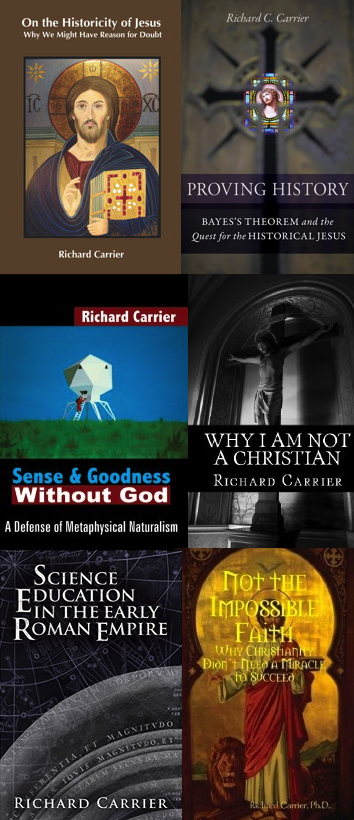
Because my recommendation of The Bible Unearthed for Old Testament Studies is now obsolete in many ways, I have replaced it with something more up to date: Lester Grabbe’s Ancient Israel: What Do We Know and How Do We Know It? (Revised Edition; T&T Clark 2017). By contrast, lately Christian apologetics has been regressing to prior dumber times and we’re getting a lot of gullible 101 arguments online and in shows now that we refuted a billion times before, and I realized my old book Not the Impossible Faith: Why Christianity Didn’t Need a Miracle to Succeed (Lulu 2009) still holds up quite well for that purpose. And in between both points is Bart Ehrman’s Forgery and Counterforgery: The Use of Literary Deceit in Early Christian Polemics (Oxford University Press 2012), which I am now recommending instead of its popmarket summary Forged.
I’ll explain more about all three decisions below.


-:-
Why Forgery and Counterforgery?
I’ll start with forgery. I used to recommend Ehrman’s pop-market summary of this, Forged. And that’s a decent book for the purpose, and affordable, and maybe if that suits you you can get it. But based on recent experiences online I’ve decided that’s kind of a waste of time now. Anyone interested in that subject really needs to read the official academic version. You’ll need it if ever you are going to argue this with Christians, because the pop summary doesn’t cut it for that function. And you’ll need it if ever you want to explore your own questions about the assumptions in the field about what counts as a forgery. The pop summary will only evoke a hundred questions from you that are answered in the academic study. So, I know it’s expensive, but I think this is one of those cases where it is unprofitable to skimp.
I know I find Ehrman screwing up a lot in popular contexts. But Ehrman’s actual peer reviewed studies tend to be excellent, indeed required reading on their respective subjects. And this is no exception. Forgery and Counterforgery is the ultimate reference book for its topic. In fact it is essentially an encyclopedia of ancient Christian forgery and could be honestly marketed as such, justifying it’s price. Although IMO that’s still unjustly high, which is a problem with corpo for-profit academic publishing now that I’ve had harsh words for before, it’s almost forgivable when what you are getting is indeed an encyclopedia. This will give you everything you need to know about the history of each text and the reasons academics find each to be a forgery, with extensive bibliography and footnotes. You can deep dive every example here.
Forgery and Counterforgery also starts with an invaluable Part 1 that covers the concept of forgery itself and everything you need to know about what ancient people of the time actually thought about it, destroying almost all apologetic defenses of the practice you’ll encounter today. Forgery was intentional lying. And everyone knew it. And no one respected it. Which is why these things were lobbied hard as authentic. The realization or admission that they weren’t would destroy the entire purpose of it. This section is a whole monograph of its own on just the topic of ancient forgery, and valuable by itself. But it also sets the context for the rest. Part 2 goes entry by entry for every ancient Christian forgery, in the New Testament and out, with entries organized by purpose. But you can use the index to locate any specific book you are interested in getting to the bottom of. As often, even when Ehrman is wrong about something (like Docetism), he correctly gives you the common sentiments and enough of a breadcrumb to check things yourself.
Consequently, Forgery and Counterforgery is the ultimate go-to reference for everything forged. And I think any counter-apologetics enthusiast should have it on their shelf.
-:-
Why Not the Impossible Faith?
I composed this book on hire almost twenty years ago to counter its namesake volume The Impossible Faith by J.P. Holding. I titled it so anyone who searched for his book on Amazon would always find my rebuttal popping up right beside it. And mine has since, I believe, outsold his, and often shows up on searches there before his book now. As my readers might expect, Not the Impossible Faith doesn’t just debunk Holding’s book, argument by argument, chapter by chapter (though it does, and humorously—which makes Not the Impossible Faith fun to read). I also used this as a platform to teach things about the ancient world and early Christianity. So each chapter is an educational survey of some subject anyone needs to be grounded in to understand why apologetics is so naive and uninformed, and why it really is important to understand the historical context before listening to their nonsense about it, which tends to be wholly divorced from that context, or even boldly asserted in contradiction to it.
This is actually a leading problem with Christian apologetics generally: apologists pose as experts and make strong and confident assertions to browbeat you into assuming they are telling you factual things about the ancient world and early Christianity; and if no one thinks to check, but just gullibly believes them (“But why would they lie?” “But didn’t they responsibly check?” “But aren’t they experts?”), they get to manipulate and grift you, filling your head with false assumptions and beliefs that can often be hard to knock back out again. This is why we need inoculations like Not the Impossible Faith (or even now, really, my whole blog, which, somewhere or other, debunks pretty much every Christian argument there is).
But “debunking J.P. Holding” is not the reason I’m recommending it today (I think he’s pretty much faded into irrelevance). Rather, what keeps NIF relevant now is that it serves a similar encyclopedic function to Ehrman’s Forgery, with each chapter covering a different subject you need to be “up” on to effectively counter Christian apologetics (and understand the ancient world). And I have noticed lately that all the progress in sophistication that some Christian apologists used to be making (in the 90s and early 2000s) has slid into a sinkhole, leaving the same 101 nonsense we started with (I discuss this general phenomenon in Addressing the New Christian Apologetics and, e.g., Ross Douthat’s Worst Argument for God). Hence online everywhere now again we are seeing the same arguments J.P. Holding contrived being “reinvented” and pushed everywhere, without any influence from him or awareness he was debunked.
So Not the Impossible Faith is relevant again. And it holds up pretty well even after all these years. Obviously I have evolved many of my ideas and findings since then. For example, NIF is written from the assumption that Jesus existed (contrary to many an ignoramus, including Bart Ehrman, assuming it is a mythicist book). And erroneously, it mentions some questionable evidence for Nazareth that should be replaced with more recent conclusions. And there might be other things in there I have updated in more recent studies—indeed, even when it’s not wrong. For example, a ton of studies on the dying and rising god mytheme have come out since, thoroughly establishing nearly everything I argued in NIF. I now cover that development on Obsolete Paradigm. But these occasional defects don’t seem to matter for the function.
So, don’t treat it as gospel, or current. But with caution you won’t be led astray: NIF grounds you in primary evidence and scholarship on questions like whether ancient people were critical thinkers or investigators and what limitations even critical thinkers or investigators faced then, how fast Christianity actually grew, did people avoid worshiping murdered or humiliated or working-class gods, did pagans all laugh off tales of resurrection or was resurrection a live hope already among them, why did people gravitate toward morally demanding religions, even toward persecuted cults, did no one accept “new” religious movements without evidence, how did ancient groupthink and pious deception work, did no one trust testimony from women, and several other subjects.
Not the Impossible Faith will arm you with facts and context and scholarship to combat a whole slew of assumptions underlying most Christian apologetics about Jesus or antiquity. And it’s needed now more than even when I published it. Understanding the origins of Christianity requires understanding what this book covers. And I had often been taking that for granted.
Plus it’s fun to read.
-:-
Why Grabbe’s Ancient Israel?
Finally, Lester Grabbe’s Ancient Israel: What Do We Know and How Do We Know It? is the best current study, accessible to any reader, of where the field actually is now, on what is or isn’t true in the Old Testament. Some of the pet theories added to Bible Unearthed, for example, have since been abandoned or revised, while the general picture it painted of the mainstream consensus has become even more firmly reinforced. I only add one recommendation on Old Testament history in my Recommendations list for the Origins of Christianity because the latter can’t be understood without at least a mainstream perspective on the former, and right now the best one-stop-shop for getting up to speed on that is this.
Ancient Israel is an academic work, not a pop-market book, but it is easy to read, and thus gets the best of both worlds: lay readers can follow it and benefit from it, while anyone who wants the serious detail and citation breadcrumbs will also have that. It is just a summary, and so is not quite like Forgery, but this work is a better one-stop shop than Unearthed for a similar reason: it provides more starting points to address all the questions and whatabouts a Christian apologist might throw at you if you try citing Unearthed at them. So if you want to be ready with the next layer of argument and evidence, Grabbe supplies it, as well as breadcrumbs to further dive any specific subject in it.
And the evidence in this is more thorough and up-to-date, too. But the position it establishes as now mainstream is the same: that the Israelites were Canaanites, not slave invaders from Egypt, and were only monotheists much later in their history than the Bible pretends, and not without substantial resistance within. Hence, likewise, Moses and the Patriarchs are mythical. The kingdom history of Israel is exaggerated beyond almost all plausibility. And so on. He finds the earliest real record of what happened starts in the 9th century B.C. and not before. And very little of even after that survives examination as true—though some does, and perhaps more than is sometimes still claimed.
There are recent serious arguments pushing even further than that consensus minimalism, to argue that monotheism and the books of the Bible are far later developments still. See Was the Entire New Testament Forged in the Second Century? for that story, which is about the NT being forged in the second century A.D. but opens with the studies arguing the OT is a second century B.C. development. By contrast, Grabbe is describing where most scholars are now (who aren’t fundamentalists or propagandists). That could change in a decade or two. But you need to know the state of things. And this is the place to get up to speed on that.
I’ll just give two examples of what I mean.
First, Grabbe leans a lot on “the Bible is near contemporary to what it gets right” when it matches the Babylonian Chronicles; but that suffers a problem he sidesteps, which is: that might be because its authors were using the Babylonian Chronicles. In other words, someone faking up those books in the 3rd century B.C. could well be simply cribbing from the BC (and other materials available then that we don’t have now). Grabbe remains rooted in the mainstream assumption that they weren’t. And you do need to know that.
But you would also be right to be more skeptical than Grabbe—when you consider all the ways the same evidence could exist now. Grabbe himself rejects bootstrapping (like “the author of Kings got some public political details right, therefore Elijah was a historical wizard”). So he’s not an apologist. But he is trying to “preserve the phenomena” a bit too much. It’s just that you can always tell this, because he is careful in explaining why he thinks you should believe any given thing. He doesn’t lie or obfuscate or chest pump. Obviously I’m more skeptical than Grabbe on many things (though not as skeptical as those arguing the whole Bible was forged), but he’s describing the center of the field, not the edges. And that’s the value of his book.
Also, perhaps unfortunately, Grabbe only brings the question up to the end of “Biblical” history, just like Unearthed had done, even though that conclusion is largely fake. For example, Daniel was actually a 2nd century B.C. text yet depicts itself as centuries earlier (as Grabbe knows, hence he barely references it); and all of the older texts were edited over time and only came into their current form around the same time, give or take a century; and there was no canon then, so what was actually considered scripture (what we would describe as “in the Bible”) was a much larger body of texts than are now in “our” Bibles.
There as yet remains no good one-stop-shop covering this part of the story, which consists of Israelite history from the exile to the Roman occupation, the period in which the Bible came into the form we now have it, and which actually set the stage and context for Christianity. Such a history is much needed. I realize lots of books talk about this period, but I am not aware yet of any academic monograph on a par with Grabbe’s that systematically covers it the way Grabbe covers pre-exilic history. If anyone finds such a thing, let me know. I’d like to add it to my Recommendations for the same reason. [See comment for possibles.]
But for “Biblical” history, Ancient Israel: What Do We Know and How Do We Know It? is now the best place to start getting acquainted.
Discover more from Richard Carrier Blogs
Subscribe to get the latest posts sent to your email.






Forgery and Counter-forgery is currently unavailable on Amazon. Any other ideas on how to obtain this? Thank you, and great summaries in this blog. 3/25/2026
Do you mean in a country other than the U.S.?
Because here Amazon lists it as available in every version, including 7 hardbacks in stock new (as of this moment; that updates daily), 60 used copies in the Amazon marketplace, and kindle and audible editions.
If you can’t find it in another country’s Amazon, and no used copies or kindle copies exist there either, then your only option is to go wherever it is you get books other than Amazon, including: special order at a brick-and-mortar bookstore. That’s my top recommendation, since then although I don’t get a commission, a real bookstore will.
Next option: other online stores that serve your country.
Last option: force your browser to go to Amazon US and order via overseas shipping; but I don’t recommend that unless that’s literally the only option left and you have the coin and still account it worthwhile.
I got it off archive.org
F&C at archive? To rent? Or stolen?
Looks like stolen. https://archive.org/details/books-on-Christianity-collection
I support throttled research views of paragraphs (like Google does) or limited rentals, but dumping entire complete books in the archive is a crime. I don’t endorse relying on it.
There was no chance I would have bought the work at retail, but this way I can read the introduction. He would be well-advised to post that on his own site.
Following up, I was surprised to find no mention in the volume of interpolation in Josephus, or in 1 Thessalonians, or the end of Mark. But there is plenty of forgery to talk about.
Oh, yes. Ehrman’s book only addressed forged documents, not forged passages within documents (which in field-jargon is more usually called interpolation rather than forgery).
No one has done a complete study of ancient interpolation that I know of. Those findings are still scattered across hundreds of books and articles.
Knowledge is of no use if only the priveliged can access it. Daft and naive behaviour from archive.org certainly; but we see the same from corporations like Google and Microsoft to train their LLMs into producing more realistic hallucinations. As far as I know those folk are unabashed and aren’t being slapped on the wrist even; archive.org have settled out of court. Important resource for good; I’m happy with that. Third time remains enemy action though. One of those things in the West that needs fixing to head of our very own Third Century Crisis: history is rhyming again I’ve noticed.
I am sympathetic to the idea of stealing as self-defense against price-gouging and corporate profiteering. And AI theft is its own crime (archive.org isn’t doing that, as they take down my work when I catch and report it, and aren’t making money off of it, and aren’t knowingly plagiarizing me every time anyone asks them to; whereas I am a party to the several AI lawsuits, for failing all three standards).
But creators deserve to earn a fair wage from what they create. So if you really think this is the high horse you want to ride on, you are morally obligated, after stealing from Dr. Ehrman and his publisher, to tip them what you think is fair. Either buy some book from Oxford University Press you can afford that you wouldn’t have otherwise and donate something meaningful to The Bart Ehrman Foundation, or get off the horse.
That said, there are exceptions. Since creators aren’t even paid for peer reviewed articles, you should steal those things all you can, specifically to punish the industry for their crime.
RC: “But creators deserve to earn a fair wage from what they create.”
Okaaay — if a penniless author is slogging away on his ownsome without support, certainly. But if, say, an academic is being paid to write — with money ultimately coming from donors and taxpayers — then the author has an obligation to provide his work to donors and taxpayers in return.
Publicly funded research publications ought to be made public. Authors supported by others have a similar obligation.
A moral philosopher who is not a fraud would agree.
Only if that was the contract both parties agreed to.
Hence, for example, my blog is free to the world because that’s my contract with my Patreon supporters: that is literally what they are funding.
My books, by contrast (same as anyone else’s, like Ehrman’s), are not constructed under any such contract. They are created at a net loss but for royalties and commissions.
One might go full anarchist and say Ehrman has enough money therefore it’s okay to steal from him. But that only begins the normalization of deviancy that destroys all independent art and scholarship in the end. If you want to promote illegally stealing from rich people because “fuck the rich,” be honest and say that. Everything else is rhetoric.
But maybe you are disingenuously moving the goal posts to some subject not relevant here, like open sourcing federally funded science, which is a valid thing to demand. You can make a more plausible argument for stealing stuff corporations already de facto stole from us or its creators.
But that isn’t what anyone is talking about here.
I’ve tried 3 times to get it via Inter Library Loan (several copies are listed on WorldCat). So far all attempts have failed. This is the only time ILL has failed me.
So it must be a conspiracy right? Nah.
PS in the middle of second reading of Obsolete Paradigm; many thanks!
Do you mean you tried getting Forgery and Counterforgery by ILL?
What did the librarians tell you each time that didn’t work?
Because it’s weird so common a textbook would be so hard to get. Unless your librarians suck and aren’t correctly using the ILL ordering system, which would be odd.
Yep, F&C by ILL, failed. In rural Mississippi you use ILL a lot. Weekly in fact, or near enough. This is the only time it’s failed.
It’s always the same 2 or 3 librarians, so I think they are OK. The reason given was simply ‘unavailable’.
I figure that it as the book is in sufficient demand that the request ages off before local reservations are fulfilled. If that is how ILL works, I don’t really know.
They must be doing something wrong. F&C is available in 1,335 libraries in the ILL system (for comparison, my Sense and Goodness without God is available to order from 73 libraries).
F&C is even available as a PDF/eBook through GALILEO and EBSCO Books (both of which I have home access to through Georgia’s public libraries). Mississippi’s GALILEO is MAGNOLIA and the web says it has EBSCO in it, so you should be able to get access that way. But surely an available print copy can be sourced from over a thousand libraries?
Are there apologetic defenses Ehrman just doesn’t bother to cover (or address indirectly, or however the “destroying” happens)? &/Or are some of them ‘fresh’ or modernized in some way that sits outside of the scope?
It’s just careful language to stymie trolls.
So here Captain Subtext will explain the secret cabalistic meaning of the word “almost” in that semantic context:
So, all that takes 100 words to say. I therefore collapsed it all into one word, “almost,” for ease of reading, and to not trouble good-faith readers with needless digressions.
I see a lot of phrasings like that, and wonder every time, but that it might be strategic had never occurred to me.
I think the first time I noticed was somewhere in talkorigins.
Ave Captain Subtext!
Morituri te salutant!
Yep. I do that all the time on Quora. And you have to do it both for a side of an issue you agree with and ones you don’t. You can’t say that there isn’t some utter idiot out there who has seriously argued that straight marriage should be banned. (I’ve never found someone sending me such a thing nor found it among the gay supremacist folks who use “breeder” as an insult, but that doesn’t mean that on some forum somewhere in 2017 or something it wasn’t said).
Of course, there’s also the argument if you want to minimize word count and avoid confusion to just say “all” and rely on Captain Subtext saying “When I say ‘all’, I mean ‘nearly all’ because of course there are almost always going to be exceptions especially if we count to some arbitrary point to the future”… but damned if you do, damned if you don’t. Generally better to not give the Peanut Gallery an irrational “in” (and a reason to stop reading, though frankly they tend to miss qualifiers anyways).
That’s the thing — I can fully cop to being a poor student of rhetoric (and much else during my “normal school time”) and quite gullible for most of my life, but qualifiers loom large in my toolkit, tower of memories, et al.
I just should have asked someone about it 10+ years ago instead of letting it bother me without responding until now. But glad our host was willing to oblige, as I most definitely fancy myself a good-faith (if sporadic and slow) reader!
Even then. Folk pounced when Dawkins said he was 99.999% sure no god. We love our black and white thinking.
Yep.
“So you’re saying there’s a chance” is the stock bullshit-lever of every liar, grifter, fool, and loon.
Update: Grabbe has just published a detailed four-volume history of the post-exilic period, A History of the Jews and Judaism in the Second Temple Period (for example,volume 3 runs from the Maccabees to the early Herods). That’s not concise enough for the purpose but may be what someone is looking for (or if not that volume, others).
But what may serve for an accessible one-stop shop for the whole period may be Grabbe’s previous summary text, An Introduction to Second Temple Judaism: History and Religion of the Jews in the Time of Nehemiah, the Maccabees, Hillel, and Jesus (T&T Clark 2011). I haven’t read it yet but would love to hear opinions from anyone who has. Is it decent? Does it serve well for the purpose?
I read the description and briefly misread it as you proposing a book on Israel Only, and was excited that someone else decided to rake them over the coals. Dang. Do you think there’s a book out there that would cover the requisite ground on that topic?
Do you think there’s another book besides Not the Impossible Faith that can cover some of the same ground? I always appreciate when you give recommendations to books you haven’t written because you have such a good bookshelf and I like to have multiple citations from separate authors if I want to make an argument.
I don’t keep up on hyper-weird sectarian disputes like Israel Only (I just did one research project on it), so I’m not the one to ask that question. You might need to periodically check in with hosts of channels who focus on critiquing it. They are more likely to know of the latest publications.
NIF is unique (that’s why I had to write it; no one covers those subjects like that). But if you want the best one-stop shop in resurrection apologetics (not quite the same thing), I duly recommend Pearce. But of course he quotes and cites me a lot, because, again, no one else does half the stuff I do on this subject. And by now, since I’ve done it all, it’s hard not to mention that and not sound like a plagiarist. 🙂
One recommendation is that, e.g. in NIF, I am often summarizing other scholars, and cite them. So you can skip me and just cite them. It’s just that you need NIF to locate which scholars discuss which things so as to cite them. NIF is the only one-stop shop for that. Which is indeed the point of it.
Oh, I don’t care that much about the IO cranks either. It was incredible to see that the virus deniers were less overtly insane and obnoxious than they were. It’d just be interesting to read a book that would utterly decimate their arguments while also being eludicating.
I’m actually a little more curious about the sociology of religious expansion; resurrection apologetics is only interesting, as you note, because the rabbit holes are fun to go down. I’ll look to see if someone has done an analysis in a Starkian vein with modern data and methods.
Certainly if you find anything of high quality, cite it under my IO article in case others can benefit.
“My recommendation of The Bible Unearthed is now obsolete in many ways”
Why? I bought the book thanks to your recommendation and enjoyed it, now I wonder if there’s something wrong or refuted there.
I explain in the article you are commenting on.
The authors of Unearthed have shifted or altered their positions on some things, as abundant new archaeology resolved various disputes. So, rather than fisk that old book to find what needs updating, it’s better to just go read an update.
The essentials remain the same. But the details are perfected. So Grabbe is now safer to cite, because all the straw men apologists could make of Unearthed are not in it.
The downside is that Grabbe is a more academic book, while Unearthed is more for popular reading. But people these days need the academic work. Because the Post Truth Era judos popular discourse into straw men constantly. So you simply can’t use it anymore.
Basically, the proliferation of liars is why we can’t have nice things anymore. So to the castor oil we go.
I bought the Grabbe book on your recommendation and am getting a lot out of it. But I’m glad I bought The Bible Unearthed first, because it explains the background that Grabbe, being for academics, assumes that the reader already knows.
Could you give me some examples of that information? (So I know what readers need that’s not in Grabbe; I’m evidently taking that for granted myself)
I just read Grabbe “Ancient Israel”; I would describe it as of mixed value. Overall, I do think it is very much worth the read, and the study beyond that. Yet to my mind there are some reservations that might be worth noting.
I must stress that these are just my readings of the book, as not a scholar, or extensive student, of the field. If I am in error in any way, I welcome correction!
The chapters (other than 1) are all in three parts, “Sources”, “Analysis”, and “Synthesis”. From an (fairly) informed layperson’s point of view, the Sources form an invaluable reference as a sort of annotated bibliography. This alone makes the book a must have for anyone beginning (or nearly so) the pursuit of ancient Israel.
Now onto the reservations.
Chapter 1 seemed sound enough, noting the importance of several factors, including archaeological evidence, and the wider cultural context of texts. Some of which he seems to ignore later in the book.
I was happy with the “Analysis” of Chapter 2; but I came to a screeching halt at 3.2.4.5 “The Early Monarchy: Saul, Samuel, David, and Solomon Traditions”. Here Grabbe ignores various positions he espouses in Chapter 1.
His principal argument for a historical Saul seems to be the Criterion from Embarrassment. “He was a problem for the narrator of 1-2 Samuel, which is an excellent reason for believing he was a historical character.” He then goes on to cite several good reasons for the existence of the Saul tradition, but none for the existence of Saul the person.
His principal arguments for David don’t seem much more sound. For the historical plausibility of the Saul-Samuel-David triad, he cites to the history of the Archbishops of Canterbury anet the English kings. Not sure about that. Then he supports the historical David by seeming to say the there are elements of the David story that are incoherent with mythography, but indicative of historicity, such as documenting regrettable shortcomings of David.
Then Solomon: here the principal arguments seem to be “David should be the builder of the temple, but he wasn’t, somebody built the temple, the tradition of Solomon is strong, ergo Solomon”. This despite acknowledging that the biblical stories of Solomon are not plausible, and that there is no archaeological evidence in support, rather the contrary.
One other final note that may (if my reading is correct) shed some light on the positions taken by Grabbe: he carefully notes when other scholars discount C14 dating, as conflicting with that scholars model, but he does not really take a position on this, but seems on the whole to accept it as a stance as valid as that of opposing scholars. Certainly if one were to take a single sample, from a single stratum, from a single site, then a single test following a single regime; that would be discard-able in the face of an otherwise sound model.
However, this is not how C14 dating is properly done. To discard C14 dates for a particular stratum/site, you must offer scientific (only) rebuttals to the date.
In sum, I cannot doubt that Grabbe is a serious, honest, and open scholar. I wonder if he perhaps has a bit of the shading so persistent in Bible related scholarship, where the Bible is given an (unconscious) certain heavier weight that other texts of the time and place.
Indeed, Ancient Israel (like The Bible Unearthed) is just a “where they claim to be now” book, an intro 101 to “current consensus” to get you up to speed on the field if you weren’t already there. And like his predecessors, Grabbe states clearly when a conclusion he reaches is his own opinion, and often acknowledges competing opinions, and gives some brief on why he takes his opinion and thinks it matches the majority. So, it’s not an oracle. It’s just a textbook.
Does he “ignore” them or overcome them? Those are different things. The set-up is the baseline (the background). That does not commit anyone to a conclusion. If Grabbe deviates from expectation it is usually because he thinks the evidence warrants doing that, and is describing why a majority of his peers agree. And when that happens, he usually makes clear what he is doing and why, and even cites competing conclusions. I think this is a fair way to do this. The reader is not misled (as long as they didn’t skip anything) but informed. What they are informed of is what a majority of mainstream OT experts think—not when the mainstream OT consensus is wrong. That’s 201, not 101; but requires knowing the 101 before collapsing it with a re-look.
The Bible Unearthed worked the same way. And so does Ehrman’s Jesus Interrupted, which is my matching recommendation for NT studies. I recommend these not because I 100% agree with them, but because they do accurately reflect where each field generally is on the subject, regardless of whether it’s there for a good reason or not.
Hence my point in my review: Grabbe is trying to “preserve the phenomena” a bit too much and “I’m more skeptical than Grabbe on many things.” Saul is a good example. But to be fair, Grabbe is honest about this: he outright states the sum of his reasoning and admits it can be questioned; and this allows us to question it. That’s a virtue of the book.
The case for David is stronger (we actually have hard evidence there was such a dynast; we just don’t have confirmation they were a hegemon). But again Grabbe gives you all there is and explains that he is concluding on that and not some hidden evidence he assures us of, nor does he try chesthumping and browbeating. He also cites other scholars for a further dive if anyone wants to pursue it. But we don’t even need to because he is so transparent as to his premises and reasoning that we can critique it right on the page. That’s good writing. He’s not trying to con you. He’s trying to explain his own thinking and not hiding disagreement. That’s what books like this need to do.
That isn’t quite what he says. As you note, to explain away a C14 result you need an alternative explanation of the result that is likely enough to intrude on the certainty of the result, and that usually requires presenting evidence supporting that alternative theory (not claims; evidence). Which can only be done meticulously case-by-case. Otherwise, you are left with the probabilities entailed by the result. You can’t just gainsay them with a “maybe, therefore probably” argument.
Hence I suspect Grabbe is bracketing: when digressing on a massively complicated subject will double the length of what is supposed to be an introductory text, you bracket it as unresolved and move on. This is SOP in all fields of history. I did this with the dates of the NT documents in Ch. 7 of On the Historicity of Jesus: I worked from standard consensus date ranges because that doesn’t burden my results with the weight of additional epicycles of controversy, and doesn’t add another hundred pages of wheel-spinning. I explain, though, that I am doing this (and that different dates are plausible), and chuck the principle when I have a strong case to make against the consensus that I can cover in just a few pages (e.g. on Hebrews and 1 Clement). By ensuring my dates are near 100% certain on any objective analysis, there is no burden weighing down my other results, and by being so clear-cut it can be covered in two pages, inclusion becomes physically possible again. With thousands of individual C14 results, Grabbe is not in that position.
Another way to bracket is to punt to another study, and thus offload most of the argument elsewhere. I do this in OHJ, with all my previous peer reviewed articles, allowing me to offload dozens of pages of argument to another venue and just fill that in with “see here.” But to do that the studies have to exist. I don’t know if Grabbe has other publications on the C14 question but I assume not, or else he’d reference them. It’s thus “haven’t been there, can’t do that.”
So what you are seeing is Grabbe not having wordcount to digress on a thousand different examples and just saying “disputes exist” and working from there. You can then check the disputes; he breadcrumbs through citing the scholars who raise the disputes. If some of them commit the fallacy you identify (e.g. they cite no disputing study or have no good reason to dispute a result), then you’ll find out. Grabbe is avoiding the problem of getting into the weeds by picking fights he has no wordcount to win, and just asking you to go watch reruns of the fights on CNN and make your call.
But all that said, as I noted in my review, I do think he tries harder to be charitable to the religious-Zionist nexus than it deserves. But he is transparent enough that this bias is trackable in every case. And that’s the best you could hope for from any summarizer of an entire field. There is, in fact, no better example to turn to. So like voting for President in the United States, you have to choose the least worst one. And right now, that’s Grabbe.
Thanks for the reply – and I agree with your observations, and I did find the book valuable. I may have been too harsh, hasting, or misunderstanding.
On Solomon in particular, Grabbe does acknowledge that the Bible is the only source, and that it is clearly fantastic, yet states he believes Solomon is historical. So you are correct, he qualifies it as a belief.
On the C14, yes, his book was not intended as an exploration of any issue, but a road map. I guess it may be a pet bugbear of mine; the constant questioning of radiometrics in general irks me.
Thanks
Your bugbears are indeed apt though. And your comment important, for any readers not aware of the things you and I are talking about.
Question – doesn’t modern genetic research of ancient genomes explain a huge chunk of origin and popularity of Christianity? It shows for example that:
1) Ancient pagan times including Bronze Age, through Ancient Grece up to Roman Republic had population with high cognitive abilities. Eg. as tested by polygenic educational attainment scores.
2) Roman Empire = population with low cognitive abilities. (Christianity becomes popular then!)
3) Within the city Rome itself – during the times of empire theres a popultion replacement, with conventional South Europeans loosing majority to Middle Easterners. (The need to change religion because of different population?)
4) During middle ages cognitive abilities in Norther Europe grow slowly up until the before Industrial Evolution. (thus Industrial Revolution can happen, as well as earlier movements)
No relevant variances exist for any world populations. So (1)–(4) is false vis-a-vis China, India, Mesoamerica, etc. There are no relevant genetic differences in cognition or any other relevant mental ability or capacity. And across time. There is no such thing as “polygenic educational attainment scores” for ancient Greece and Rome, much less any evidence they’d have been different (some of the most sophisticated thought occurred under the Romans), even less that they’d have been different because of genetics rather than economics or culture.
Most importantly, there is nothing about the scientific and industrial revolutions that would have even been odd for the Romans to develop—they only got stopped by happenstance decisions regarding economic and political structures, which took a thousand years to get back out of. In fact the Middle Ages evince some of the stupidest people making the stupidest decisions and failing to comprehend even basic things. Their brains or genetics were not different. Their economics and culture were. And it was those that had to be returned to previous pagan models to recover science and industrialization.
I cover this in The Scientist in the Early Roman Empire.
Ehrman doesn’t mention this in Forgery and Counterforgery but would you agree that the way Matthew & Luke used Mark was, at the very least, shady? The ancient education sources I’ve seen cited mention paraphrase and creatively using source material, not slavishly copying them verbatim.