
Just a couple years ago, secular archaeologist Ken Dark published Archaeology of Jesus’ Nazareth (Oxford University Press 2023), a summary of his own archaeological survey of Nazareth, going over all the previous archaeology there (even admitting its flaws and biases), and updating it with a variety of new and current findings. It is not flawless. But it contains important observations and analyses that completely overwrite everything you’ve heard before. So there is no way to discuss the town without having read this book now (or the 2020 and 2022 academic studies it summarizes: Roman-Period and Byzantine Nazareth and The Sisters of Nazareth Convent). All other discussions of it (including all critiques of them) are obsolete. Dark has some gullibilities and biases (I’ll give some examples here, and especially in my next article on his gullible and slipshod discussion of the historicity of Jesus). But he is not a Christian apologist. And his archaeological analyses are backed by real evidence, and are mostly of sound and cautious logic.
So I will use this article to do two things: summarize what Dark presents for the status and historicity of pre-war Nazareth (meaning the early first century, when Jesus would have been born or raised there, if such he was), and also put together everything I had already said on this point elsewhere, now all in one place.
Dark Has Reinforced My Position
I have long been critical of the illogical and fact-challenged attempts to argue that “Nazareth didn’t exist.” Dark not only bolsters every point I made before, he adds information that is even more important to understanding what someone (or even a movement starting) from Nazareth would be like. The mainstream view that it was a hovel or hamlet is quite false; indeed, impossible on current finds. It had to be a town, of modest size but of more than average wealth and industry, with abundant stone buildings and a considerable manufacturing, quarrying, and agricultural production and trade.
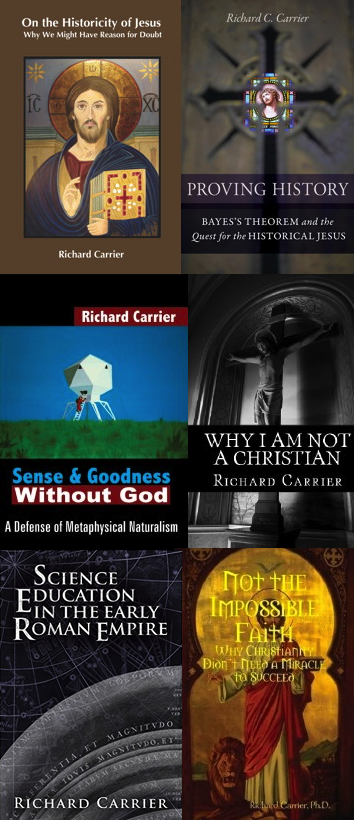
All previous claims that Nazareth was too poor to have a synagogue (even a stonebuilt one—though an assumption that it had to be is already anachronistic) or a torah scroll, or to have literate tradesmen and rabbis, or even tutors providing primary education to its select elite, slaves, and donees, are no longer tenable. It’s not even implausible that tutors were available to provide a secondary education there—after which its denizens would more likely get an advanced education in nearby cities just hours away on foot (on the ancient education system and who had access to it even in rural counties see my study Science Education in the Early Roman Empire). This changes a lot of assertions that get bandied about even by mainstream scholars (e.g. see my recent discussion of Ehrman’s bungling of ancient Galilean literacy)
Dark does mention and for the same reasons as me dismisses the so-called “Nazareth Inscription” as irrelevant (Hitler Homer Bible Christ, pp. 315-26). Adding new information to mine, he explains how we now know that inscription came from the distant Greek island of Kos, likely dates from the time of Augustus (due to a more pertinent incident there), and was only sold on the modern black market in Nazareth. It never had any ancient connection with that town or even Palestine. But he also mentions and for the same reasons as me notes the weight of the Nazarene inscription, which is a very different piece of stonework, not from Nazareth, but that prominently mentions it. This was most relevantly covered by Michael Avi-Yonah in “A List of Priestly Courses from Caesarea,” Israel Exploration Journal 12 (1962), pp. 137-139.
Some do attempt to claim this refers to the Bar Kochba revolt, but it cannot, as the temple was destroyed in 70 AD, necessitating the relocating of priests then. Not later. And Dark agrees (p. 25); as does Jewish tradition (see below). The debate is discussed in Matthew Grey’s 2011 dissertation for UNC Chapel Hill (“Jewish Priests and the Social History of Post-70 Palestine”). But the facts are these: there is no tradition of their being relocated (much less that relocation traumatically commemorated) twice. Yet Jerusalem and its temple remained in ruins and uninhabited by law until after the Bar Kochba revolt. So there can’t have been priests there to relocate then. Only assigns from the 10th legion remained to ensure the city was not reinhabited. Remarkably scant use of Jewish graveyards near Jerusalem then proves this; Cassius Dio outright reports it; and Josephus explained exactly why that was the case—indeed, this is why Josephus needed Titus to grant him new properties to compensate for the ones he could no longer make any use of there.
So the Caesarea inscription thus proves not only that Nazareth existed in 70 AD but was flourishing and wealthy enough already by then to be deemed suitable (and capable) of taking in revered Jewish priests—indeed, it was among the top 24 towns in the region selected for the purpose. It therefore can’t have been a new settlement. It had to have been developed for at least half a century before then (a single generation). As I wrote eons ago in Not the Impossible Faith (pp. 64–65):
A Jewish inscription from the 2nd or 3rd century confirms that Nazareth was one of the towns that took in Jewish priests after the destruction of the Temple in [70] A.D. Would priests deign to shack up in a despised hick town? And archaeology confirms it may have had a significant stone building before then (perhaps the synagogue claimed to be there in Luke 4:16). Nazareth definitely had grain silos, cisterns, ritual immersion pools, smartly-cut cave dwellings and storerooms, a stone well, and a significant necropolis also cut from the rock of Nazareth’s hill, all in the time of Jesus. This was no mere hamlet, but a village inhabited by hundreds experiencing significant economic success.
I then surveyed some other stonework and inscriptional evidence—which Dark has now rejected or disproved (it had been lazily or apologetically dated), replacing it with better observations and evidence. So that portion of NIF should be replaced with his. But then I (correctly) continued:
Otherwise, very little of Nazareth has been excavated, and therefore no argument can be advanced regarding what “wasn’t” there in the 1st century. All the more so, since evidence suggests any stones and bricks used in first century buildings in Nazareth were reused in later structures, thus erasing much of the evidence. There simply isn’t any case to be made that it was a despised or insignificant hovel.
[Archaeology even confirms] Nazareth was indeed built down the slope of a hill, and many of its houses, storerooms, and tombs were cut from the rock of that hill. The “brow” of that hill would likely have even been cut or built up to provide a suitable place for hurling the condemned as required of every town under Mishnah law (Sanhedrin 6.4).
Dark confirms all this by correcting, adding, and verifying considerably more evidence, and more secure evidence than I had mentioned. His conclusion, of which I am also convinced, is that Nazareth was a small but wealthy agro-industrial town beginning from the late Hellenistic period and thus would have been there in the Herodian era for a Jesus to hail from.
The Best Evidence
First, context: contrary to what you usually hear, Nazareth was surrounded then by woodlands and quarries, suitable for extensive timber and stone buildings; had several springs and seasonal waterways (and extensive cisterns constructed to store waters out of season, and irrigation channels—artificial rivers—to collect and distribute it); and had its hillsides dug into for settlement and agricultural terracing. The entire valley Nazareth was situated in was well developed with numerous settlements and industrial and agricultural operations and flourishing with fields, groves, and husbandry. In fact “the valley between Sepphoris,” the nearest city (a two hour walk), “and Nazareth was very densely settled compared to many other areas of Galilee” (p. 36), and especially compared to Judea. It was a rich and industrious valley.
Conclusive evidence of Nazareth itself engaging in considerable agricultural and quarrying industry from early on indicate it was running a profitable trade even by itself, locally and abroad. Dark tries to make the silly argument that they didn’t trade with the nearby city of Sepphoris because of religious bias (p. 160), but that’s one of his occasional daft inferences. It is literally impossible to even exist and not trade with a nearby city. Indeed it would be economically foolish. And doing so would not conflict with religious purity or separatism, so his inference lacks even internal logic. How often do you see extremely pious orthodox Jews mingling and doing business among the Goyim today—hell, even the Amish trade with “The English,” and in their heathen cities no less! Indeed, Sepphoris was populated with Jews and could plausibly have had a Rabbinical school. And anyone from Nazareth keen on becoming a Rabbi for Nazareth or beyond would not eschew Sepphoris (or any other city) simply because there were some sinners there.
But that goof aside, Dark faithfully documents the facts: extensive quarrying, terracing, wine and olive pressing, and storing of goods, both gathered and manufactured, indicates a considerable town and not a hovel. And even by the critics’ rewrite of all the evidence, this still all existed by the early second century, which is a remarkable (indeed extraordinary) pace of development for a new town, and indicative of the oddity of such a productive area not having been thus exploited before. “Gosh. Look at all this cool stuff here. Why did no one start using it before? Let’s start cutting rock, boys. And to the wine presses! All these wild grapes have magically matured for us somehow.” In short, alternative theories of dating all this don’t sound plausible on sober reflection.
One of the most interesting new observations is that besides extensive evidence of early Roman-era (even possibly pre-Roman) stonecut structures—storage vaults, workrooms, cisterns, and more—there are hastily cut crawl tunnels through them all in a network resembling the war tunnels found at other sites (p. 44). This would indicate the previous stonework indeed predates the Jewish War, and that Nazareth was pegged as a repository for hiding personnel and supplies during the war. The Galilee was not as heavily dug for combat during the later Bar Kochba revolt, and these locations are associated with pottery, various small containers, lamps, and other finds that more likely date to the first century or earlier (pp. 43–45).
Critics do try to throw shade on dating the mobile goods (e.g. Henry Davis) but their efforts suffer five general flaws:
- I’m not sure they are even valid. A lot of what I see critics doing is ignoring specific features that date an object and focusing on the general classification of the object, which is a reference-class error. So if you want to take any of this seriously, you have to get Dark’s formal studies and source materials, and the critics’ claims and source materials, and meticulously compare detail by detail. I do not think the effort will turn out well for the critics (e.g. Davis relies on, and misuses, outdated materials to “re-date” things like Herodian lamps). I think they are desperate to get a result, while Dark and his colleagues are simply following existing standards and practices.
- The large number and consistency of these finds make it inherently unlikely that they all cluster to the later rather than middle or earlier period of their popularity in use (especially when somehow none are found near any definitely post-war objects). So claiming “they could” is not a sound argument that “they probably do.” This looks more like a possibiliter ergo probabiliter fallacy, more a result of skeptical desperation than sound argument—statistically, that’s simply not the most likely interpretation of it all. The cumulative weight of all the evidence, especially in its specific particulars and in what is absent as well as present, looks to agree with Dark. “But he could be wrong” sounds like “but her emails” at this point.
- The only credible critics there are already agree that “if” Dark (and literally every other archaeologist alive who has looked at any of this) is wrong, then the artifiacts (and thus Nazareth) date to before the second war, which began in 135 AD, and likely before the second century altogether. Which creates a mathematical problem. It is extraordinarily improbable that Christians somehow invented, built, and named a whole flourishing town in Galilee based on their own mythology before 135 AD (and no Jews would have). But then it is extraordinarily improbable that Jews did this and just “by accident” its chosen name perfectly agreed with Christian mythology.
- Conversely, it is not extraordinarily improbable but still improbable that they did this and Mark or Matthew then chose to assign the town to Jesus, despite it being literally brand new (settled within mere years of their writing), and thus the least likely town they would choose for the purpose. It would be unlikely they could even know it existed, as any reference works or informants they’d rely on would be unlikely to be so remarkably current (in an era with no printing press). And a greater improbability also still attaches to how conveniently these Jews then named this new town—just in time for the Gospels to match it to their lore or prophecy of Jesus being a Nazorian.
- And on top of all that: admitting all this evidence is pre-Kochba entails accepting the war tunnels date to the first war in the 60s, and therefore the stone rooms and chambers those tunnels cut through must be pre-war. This pretty much makes Dark’s case. It’s a Catch-22 that honest critics can’t wriggle out of.
The critics’ scheme is further unlikely given the resettlement of priests there (impossible on the critics’ theory, as Nazareth had to already be there, and flourishing, in 70 AD), which corroborates Dark’s dating of all the numerous archaeological finds to date (with which all other actual experts concur), and not the critics’ need for it to not have been there yet.
I should also note the cherry picking of critics. They will zero in on what they think is a weak link but completely ignore the strongest examples. Case in point: the glass phials recovered at Nazareth cannot be post-war, nor derive from a hovel (delicate glassware was a pricey and luxurious trade commodity). As Dark summarizes (pp. 57–58, 118, 136):
[U]nrealized until my work, the glass phials found in [a particular Nazareth] cistern offer the first recorded archaeological evidence for an early first century settlement in Nazareth. [These] glass phials survive in the convent museum today. Some of them can be accurately dated by comparison with examples of known date found elsewhere. Most of them are made of green glass. At least two fragments of pear shaped vessels are characteristic of the first century AD. There are also ten fragments (shards) of others made in dark blue glass with yellow glass trails, which date somewhere between the first century BC and the first century AD.
Glass phials such as these were either put in rock cut tombs or used for perfume in houses. The only way in which these vessels could get into the rock cut cistern at this date was by falling through the opening at its top or being used within it.
Dark is referring to a particular type of distinctively Hellenistic glasswork that died out by the mid-first century. Critics will quickly accuse nuns of planting this (even though no one knew the date range of this type of glasswork then). Which exemplifies the desperation of even trying to be a critic of these kinds of conclusions. And this isn’t the only example. Dark lists others—and gets into the details and sources in his official work (here, pertaining is The Sisters of Nazareth Convent).
I won’t delve into all the evidence we’ve accumulated around a particular Nazareth-related site: Mary’s Well. Dark summarizes that well enough (pp. 32–33, 47–48). This began with studies by Yardenna Alexandre and expanded by others since. Its name is by all conceded to be a dubious legend (no serious archaeologist thinks Mary the Mother of Jesus drew water there). I’ve been skeptical of the use of this evidence before. But Dark’s summary, and my consulting subsequent publications on it, leave me more convinced that this site is indisputably pre-war. Dark admits it is not conclusively evidence for Nazareth, as it’s only certainly a farmstead that “might be associated with another settlement adjacent to” Nazareth (p. 47). But in conjunction with all the other evidence that is the less likely interpretation. It was more likely settled on the outskirts of ancient Nazareth.
Caveats and Sidenotes
I do recommend reading Dark carefully. Because I’ve seen him often misquoted or incorrectly interpreted by critics before, and his choice of wording is itself careful to maximize brevity without losing accuracy, and lazy critics will miss this. I’ll give one example of what I mean. Some take his reference to a tomb with a round stone door (pp. 37, 117) as proof that that tomb is pre-war (early first century) when “we know” it should be the other way around (such tomb doors tend to be post-war; though not always, and one should not confuse trends in Judea with trends in Galilee, since a similar tomb doorstone was identified at Migdal of around the same date). But he does not say that. He says it’s likely first century—and thus could indeed be post-war (he is explicit at B&I, where he more prolixly says these tombs “date to the first century but there is no reason to assign any of them to the first half of that century”).
Similarly, critics might “skip over” the fact that Dark makes a distinction between “large” (far more expensive) rollstones (which are all pre-100) and small ones (which were abundant in later periods but nowhere found at Nazareth). Indeed, the tomb in question may have been cut for one of the priests resettled there after the first war. And again, statistically, to have such a tomb there entails decades, probably at least a generation (about half a century), of prior town flourishing. So even if against the odds this was the last such tomb built, in exactly the year 100, that still makes it more likely than not that Nazareth had been there since at least 50 AD. And once you are admitting Nazareth predates the War, insisting it only “just” got established “right” after Jesus is supposed to have lived there is playing a high-wire act of coincidences—and on no evidence, just a desire for the result. It can’t be argued that there is no evidence of Herodian occupation “except” for all the evidence of Herodian occupation, simply because you “desire” all that evidence to be post-Herodian. That becomes a circular argument.
Generally, Dark often makes clear the difference between his facts (which are usually correct) and his inferences from them (which are usually decent, but sometimes weak, and occasionally even daft—like I caught with his thoughts about trade), but any critical reader can spot this on their own when it happens. And really, when everything Dark presents is considered and critically read, the conclusion in my original study remains even more firmly the case now (OHJ, p. 258n8):
Arguments like “Nazareth or Capernaum didn’t exist in the time of Jesus, therefore Jesus didn’t exist” are fallacious (with respect to minimal historicity) even if their premises are true; and their premises can rarely be proven anyway.
As to the fallacy: on a hypothesis of myth, all locations were necessarily invented for Jesus (whether using actually existing locations or not), which can be just as likely on a (minimal) theory of historicity (i.e., on which most of Jesus’ story is still just as mythical); ergo, even if Nazareth didn’t exist (or in fact even if it did), this is just as likely if Jesus existed as if he didn’t, or near enough as to make no notable difference (this argument only ceases to be fallacious if the ‘invented’ elements are too extensive to explain as a product of mythic development over a historical person, which for Jesus is not the case [see OHJ, Ch. 6].
As to the premises, see “Capernaum,” in The Archaeological Encyclopedia of the Holy Land (rev. ed. 2001), pp. 111-14; likewise in the same volume, “Nazareth,” pp. 362-63.
I would now update that to include Dark’s new book. To new evidence and analyses even I didn’t know he adds many things I did know but you might not (e.g. “there were purpose-built synagogues in first-century Galilee,” of stone or wood or even tent, and no reason to doubt Nazareth had one: p. 137); and many things I’ve said before that you might have missed (e.g. possibly Joseph “was a carpenter, but a tekton could also be a stoneworker involved in construction,” p. 137; although, of course, that can also be a metaphor for the Maker, or even the hero Odysseus: OHJ, pp. 440–42).
A Brief Pause on Rene Salm
In OHJ I also mentioned my discussing in Proving History (see below) and the debate in Bulletin of the Anglo-Israel Archaeological Society 26 (2008), pp. 95-135, which was initiated by René Salm over the contents of Stephen Pfann, Ross Voss and Yehudah Rapuano’s study in the previous volume, “Surveys and Excavations at the Nazareth Village Farm (1997-2002): Final Report,” Bulletin of the Anglo-Israel Archaeological Society 25 (2007), pp. 19-79. The 2008 volume also contains a critical review of Salm’s book by Dark. All of which is the official stuff, though Salm also gets pilloried online (example, example, example). You’ll find some excess trust in him at Vridar, where in critiquing prior work by Dark I see too much reliance on the assertions of Salm. They dispute that, but you can judge for yourself by reading their near thirty articles positively referencing Salm. By contrast, I personally find Salm shady and untrustworthy. Vridar’s critiques of Dark are also a decade out of date, while Dark now relies mainly on work published since 2020. Dark describes (often critically) prior work, even his own. But the culmination now effectively answers Salm’s critiques.
But in case you didn’t know, René Salm is an amateur who has advanced often contradictory and overreaching critiques of Nazareth archaeology, up to and including outright conspiracy theories. For example, to “get rid” of the Caesarea inscription he promotes the conspiracy theory of Enrico Tuccinardi (yes, that Tuccinardi) accusing Jerry Vardaman of forging it. This kind of desperate and bizarre apologetics is alone discrediting of Salm’s reliability (and Tuccinardi’s). Vardaman could not have forged this—he was working with an entire team in the field on its discovery, and there is no evidence anything about the original find is fake. Moreover, Vardaman was conspicuously not a forger. When he worked on this dig he had not yet gone insane—that occurred decades later, and even then his madness resulted in him seeing things on coins and inscriptions that weren’t there, not forging inscriptions on them (I thoroughly cover the Vardaman madness in Hitler Homer Bible Christ). We also already knew Nazareth was in Jewish legend one of the places priests were settled from a 7th century poem that the Caesarea inscription only confirms (and indeed that poem says this happened when the temple was destroyed, not seventy years later, again confirming when these relocations happened and why). And that fact is itself confirmed by another inscription (and yet others, as described by Grey, pp. 317–26) that only lost the part mentioning Nazareth but verify the poem and Caesarea inscription. So trying to insist the Caesarea inscription is fake is too crank to credit.
Still, because Christians are always dodgy to some degree, Salm of course often has valid points mixed in with his fallacies and conspiracy theories (and this is even acknowledged by Dark’s editorial introduction to that 2008 issue of BAIAS). Salm catches errors and biases in several archaeological studies of Nazareth (the more so the older they are). But when you sift through his claims that hold up and that don’t, his conclusions don’t survive. And this largely shows up in the results of Dark’s new summary, where he works from revised and critically evaluated evidence rather than the often exaggerated or fudged claims of previous archaeologists, in fact calling them out. The folly of Salm is to mix in valid points with equally exaggerated and biased claims, replacing his opponents’ fallacies with his own. So we have two sides at war over interpretations of the evidence, and both are dodgy. So you need some way to cut away all the bullshit on both sides and compare the cases that remain. I think Dark has more or less done that.
Not that Dark is immune to biases and fallacies. His fawning attempts at the end of this book to leave it “possible” that a house claimed to belong to the family of Jesus is the actual house that belonged to the family of Jesus are ridiculous and embarrassing. As is his persistent avoidance of even mentioning that the best explanation for a lot of legends is that Christians are liars (as starkly on p. 156). These things totally warrant your suspicion. But his errors are not of fact but logic. And he is actually honest about that. And it is from the evidence (not any of his reasoning contrary to it) that the overall conclusions I stated above are as well established as can be expected for the site. So Salm is just a crank gainsaying everything and like a broken clock just being right twice a day.
Update: Critics like Salm have since claimed Dark was confused about tomb stone diameters. He’s not. Nor is he referring only to that metric. When Dark refers to “small” vs. “large” tomb stone doors, he means not merely the diameter but weight: the chronological distinction observed (and you can visually observe this yourself, look at every example critics try showing you) is between thickness and type of cut, and thus weight and mechanism (117), ergo cost, not just diameter. Hence they are “dissimilar in detail” (117; cf. 37, 70; Dark never says “diameter”) in a way that fixes chronology. These are carefully worded.
And he’s been noting this for decades. For example, in Dark’s 2012 “Sisters” study, we find the words “the thickness of the round stones” and “rolling stones in rock-cut tracks” as the distinguishing markers, not just diameter (22); and even when he cites diameter he is comparing that only to leaning stones not other groove-rolled stones. This concurs entirely with his source, Amos Kloner, who says post-war (or at least post-war generation, i.e. post-100 AD) stones are “less than three feet” in diameter and not thick rollers in tracks. The Nazareth door is more than three feet in diameter and a thick roller in a track. Kloner notes only expensive 1st century tombs looked like this. The Nazareth tomb is an expensive 1st century tomb. Later tombs used cheap disc leaning stones (if at all).
Playing word games about diameters, inventing new size and shape categories, and making misleading statements about the actual differences involved, is the operation of a crank. Indeed, it ventures near lying. Salm will con you with a sentence like “a few rolling stones of the larger variety continued to be used after 70 CE,” and then refer to the tomb complex at Khirbet Midras, implying it was a post-war construction (even labeling it “Bar Kochba period”). In fact it’s Herodian and thus pre-war. That it continued to be used later would be irrelevant to when it was built. And Salm knows this. And that makes sentences like that deceptions, not respectable critique. His other examples are likewise dishonest. Horvat ‘Ethri was also built pre-war. And there is no rolling stone door at all at Khirbet Shema (only one tomb door width of 1.45m, but no groove for the relevant type of stone). I happen to know of one exceptional Late Roman cave tomb door at Yavneh-Yam that would answer to the description Salm wants, but its excavators caution it’s very late (so can’t inform when Nazareth was built), and was not likely built by Jews.
So I just don’t see the point in ever reading anything Salm says anymore.
But Contra Dark, Jesus Did Not Hail from Nazareth
Although the town definitely existed for Jesus to hail from, he definitely did not hail from it. And the reason we can know this is that the evidence stacks up rather strongly that he was never originally known as a “Nazarene,” but as a “Nazorian,” which does not mean someone from Nazareth. That those words sounded similar only inspired later fictionalists to assign him that town, to allegorize secret lore (a point I’ll get to) and simultaneously to make him fulfill prophecy—as Matthew 2:23 explicitly says, citing a now-lost passage (on Christians having different scriptures then than we do now, see OHJ, pp. 88–92; Luke 24:19 might also be alluding to this). Indeed, that the messiah had to hail from some town in Galilee was already fixed by Isaiah 9. In fact, it was fixed to the specific area of Capernaum. Which is why Matthew believed it was “by the sea” where “the land of Zebulun and Naphtali” met its nexus at Capernaum, and thus Capernaum was predicted to be the home of the messiah. So Mark conspicuously puts him there, and Matthew has him move there.
The idea of Jesus coming from Nazareth first appears in Mark—it’s not in Paul, Hebrews, 1 Clement, 1 Peter, or any other plausibly pre-war document. In fact, it might actually have only first appeared in Matthew. Because only one verse in Mark ever mentions or connects Jesus to a town named Nazareth (1:9) and it is identical to the corresponding verse in Matthew (3:13) but for adding the single uninflected town-name Nazaret. It is unlikely Matthew would have dropped that name when he copied this verse, so there’s a good chance that’s how his copy of Mark read: without the town’s name (which is a lot more likely than Zindler’s thesis, that the entire verse was interpolated, in Bart Ehrman and the Quest of the Historical Jesus).
There are other oddities in the textual and manuscript record that increase those odds, as there are a lot of features of our text of Mark that appear to have been added to Mark after Matthew and Luke used Mark as a source—including blunder. For example, Mark supposedly got Tyrian geography wrong, but it’s more likely he got it right and it was garbled in transmission, while Mark’s original text was preserved in Matthew and Luke (see How Textual Criticism Can Help or (Sorry) Hurt Your Cause). Likewise, several manuscripts of Matthew identify Barabbas as also having the name Jesus, and Origen reports a tendency to scrub that from Gospel manuscripts (OHJ, pp. 402–07), but since Mark invented the deliberate parallelism between Barabbas and Jesus (Ibid.), warranting their sharing the name, it’s more likely Mark set the name of Jesus for him, then it was scrubbed, and we just don’t have examples of this because, unlike for Matthew, we have so few manuscripts of the relevant part of Mark (or Mark was scrubbed before the anti-Marcionite edition was published, and Matthew, who preserved the original readings of Mark, after).
As I wrote in OHJ, p 401 (n. 34):
Nazōraios (Mt. 2.23; Acts 24.5) simply has no grammatical connection to Nazara, Nazaret or Nazareth, and does not in fact form the word ‘Nazarene’. Nazōraios would instead form in English ‘Nazorian’; and if it referred to a town of origin at all (and there is no particular reason to believe it originally did), it would indicate an inhabitant of Nazōrai (‘Nazors’), by analogy to ‘Athenian’ (Athēnaios), meaning ‘from Athens’ (Athēnai). ‘Nazors’ is not ‘Nazareth’, or indeed any known town. It should be clear that Nazōr– and Nazar– are completely different roots; and –eth and –ai are completely different terminations. The original meaning was probably not a town of origin but an attribute or label (a name with a secret meaning, as I show in Proving History some Christians in fact believed).
This lack of connection between the terms is actually an argument for the historicity of Nazareth (at least when the Gospels were written), as there is no other explanation why Nazōraios would generate an assignment to Nazareth other than that there was an actual Nazareth and that sounded close enough (otherwise, if the evangelists were inventing the town, they would have named it Nazōrai). Conversely, this also argues that Jesus did not come from Nazareth, as otherwise there is no good explanation why he was called a Nazorian (Mt. 26.71; Lk. 18.37; Jn 18.5-7 and 19.19) and his followers Nazorians, other than that this was a term originally unconnected with Nazareth and therefore preceded the assignment of that town to Jesus (it’s not as if Matthew, e.g., needed to find scriptural confirmation that he originated in Nazareth; Mark didn’t, and neither did Luke or John). Otherwise Jesus would have been called a Nazaretos (‘Nazarethan’) or a Nazaranos (‘Nazaran’).
Mark created the loosely similar word, Nazarēnos [‘Nazarene’] for this purpose, unless that was a later scribal modification. And we have reason to believe it was, because Mk 10.47 originally agreed with the other Gospels in saying Nazōraios (e.g. in Codex Sinaiticus); Mk 14.67 may have (e.g. Codex Koridethi and Codex Sangallensis 48); as might Mk 16.6 (e.g. Codex Sangallensis 48 and Codex Regius); and there is significant confusion in the mss. as to the spelling in Mk 1.24, as also in those other three verses, leaving all cases accounted for—for Mk 1.24 alone Swanson identifies no less than five different variant spellings; cf. Reuben Swanson, New Testament Greek Manuscripts: Variant Readings Arranged in Horizontal Lines against Codex Vaticanus: Mark (Sheffield: Sheffield Academic Press, 1995), p. 15.
Matthew knows no other spelling than Nazōraios (and he was using Mark as a source). John also knows no other spelling than Nazōraios. Luke uses Nazarēnos only twice, only one of which is a lift from Mark (Lk. 4.34, redacting Mk 1.24), the other introduced in a story unique to Luke (Lk. 24.19), but elsewhere, in another lift from Mark, he uses Nazōraios (Lk. 18.37, redacting Mk 10.47), and this spelling can’t have come from Matthew, who does not use the word at all in his redaction of the same story (in Mt. 20.29-34). It therefore must have come from Mark, which argues that Mark originally wrote Nazōraios.
Notably, in Luke’s one lift from Mark that reads Nazarēnos, the manuscripts again don’t agree on the spelling (some seven variants are known, including spellings similar to Nazōraios); and in his one unique use, a great many mss. in fact read Nazōraios. See Reuben Swanson, New Testament Greek Manuscripts: Variant Readings Arranged in Horizontal Lines against Codex Vaticanus: Luke (Sheffield: Sheffield Academic Press, 1995), pp. 73, 317 and 411. It would appear that Nazarēnos was a later scribal invention and might never have been in the Gospels of Mark or Luke originally.
Adding to all this, J. Andrew Doole, in “Revisiting Jesus’s House,” Journal for the Study of the New Testament 48.3 (2026), 593–610, argues all the references in Mark to Jesus’s home or hometown refer to Capernaum, not Nazareth, and that is indeed how the text reads even if the word Nazaret was in verse 1:9—and as just noted, it might not have been. Doole reads this as signaling that Jesus changed residence (as Matthew explicitly formulates this). But if Nazaret was not in Mark’s original text of 1:9, then Mark may never have imagined the connection at all, and just always meant Capernaum. It would then be Matthew who added the Nazareth connection and then did some two-stepping to get that to fit in with Mark’s Capernaum story as well as the alternative Bethlehem prophecy, thus fabricating a harmonization of three hometowns that began in Mark as only one: Capernaum. We can’t prove this. But there is enough data for suspicion. And the other examples (only some of which I have mentioned) make it even more credible.
But whether that’s the case or not doesn’t matter for the real point, which is that Jesus began as a Nazorian—which was only later mythologized as being from Nazareth (whether by Mark or Matthew). And a Nazorian (nazôraios) is simply not a Nazarene (nazarênos). So assigning him to the town came later. It is therefore not where he grew up. He might never have even been there. And it is important to emphasize here that this can have no relevance to whether Jesus existed. Because he was mythically assigned to Nazareth regardless of whether he did. So even if Nazareth was an invented town it can’t evince Jesus didn’t exist. This renders the whole debate over the existence of Nazareth pointless to mythicism. But alas.
What Is a Nazorian?
In fact the Christians as a whole were originally called Nazorians. Which therefore cannot mean inhabitants of Nazareth. We know this not only according to lore preserved in Acts 24:5 (cf. (OHJ, p 400), but also the fact that the originating sect of Christianity, which remained Torah-observant, continued to be so-named for centuries (as reported by Epiphanius; cf. OHJ, Chapter 8, §1; with discussion now in Obsolete Paradigm, pp. 58–61; although of related interest is my deep dive in How Not to Act Like a Crank: On Evaluating Pliny’s Alleged Mention of Nazareth). Yet Christians neither came from nor were ever based at Nazareth. So the word clearly meant something else. And we know that even more because it never could mean “from Nazareth” anyway. It’s spelled incorrectly for that sense.
But Jesus is also consistently so-named throughout Matthew and John. The alternative spelling of nazarênos (Nazarene) appears only a few times in Mark, and fewer times in Luke, who otherwise consistently follows Matthew’s “Nazorian” instead. That appears to be later scribal editing (as explained above). Originally, Matthew consistently just assumed Nazorian sounded enough like Nazareth to assume the one could fulfill the other, so he went all-in on having Jesus hail from there. The messiah had to come from Galilee. Nazareth is in Galilee. Presto! Nazorian now “means” Nazarene. And a hometown is invented (again, whether Mark first came up with this and Matthew just ran with it, it’s the same outcome—Matthew does often add references to scripture that Mark left out yet clearly intended).
I covered this already in Proving History (pp. 142-45):
For Christians to call themselves Nazarenes because their founder was from Nazareth would make no more sense than Platonists calling themselves Athenians because their founder was from Athens. It’s even worse than that, really, because they were not calling themselves (or even Jesus) Nazarenes, but Nazorians, which is analogous to Platonists calling themselves Athonians; or even more analogously (and thus even more inexplicably), Athonenes. Contrary to the usual claim that Matthew must have made this up, there is no way Matthew would invent a scriptural reference. It would defeat the purpose to cite a scripture that didn’t exist in order to prove Jesus fulfilled scripture—even in general, much less to a well-informed Jewish readership, as Matthew’s readership was intended to be. Moreover, even if he wanted to invent a scripture, he would not invent this: because the ‘scripture’ he ‘quotes’ here does not in fact fit the name of the town of Nazareth; if Matthew were inventing, he would invent a correctly matching word.
Ancient Christians thought the word related in some sense to the protection of sacred truths. In “Tacitus’ Fragment 2: The Anti-Roman Movement of the Christiani and the Nazoreans,” Vigiliae Christianae 54, no. 3 (2000): 233–47, Eric Laupot makes a plausible case that the term was originally derived from Isaiah 11:1 to mean “Branchers” (like the Branch Davidians) as the name of the Christian movement (as followers of a prophesied Davidic messiah), which was retroactively made into Jesus’ hometown (either allusively or in error). An equally plausible alternative comes from Christophe Lemardelé, who has since concluded that the “Nazorian’s” original cultic meaning most likely was in some sense of ‘the guardian’ or ‘the keeper’, perhaps of sacred truths or secrets or souls, as I had myself argued (see Christophe Lemardelé, “The Hebrew word [NAZIR] in Greek: From the Septuagint to the Christian Authors,” Semitica et Classica 8 (2015), 1–6).
J.S. Kennard argues a different but also plausible alternative in “Was Capernaum the Home of Jesus?” Journal of Biblical Literature 65 (1946), pp. 131–41, and “Nazorean and Nazareth,” Journal of Biblical Literature 66 (1947), pp. 79–81 (responding to W.F. Albright’s reply in “The Names Nazareth and Nazoraean,” Journal of Biblical Literature 65 (1946), pp. 397–401), Kennard proposes that it was a cultic title derived from the Nazirites (“the separated” or “the consecrated,” see Nazir and Nazar) described in Numbers 6 and Judges 13:5 (and the Mishnah tractate Nazir). As he points out, a Nazirite vow was most typically of limited duration (a fixed number of days), consecrating oneself to God by certain rituals—most prominently, abstaining from wine (which Jesus indeed vows to do: Mark 14:25; Matthew 26:29), although Kennard argues the Christians adopted the term to designate a new notion of separation or holiness reflected in the Baptist cult (similar in function to the title “Essene”).
But might it have meant something more specific? Because to all this, we know the Gospel of Phillip (cf. 66:14, 56:12, 62:8, 62:15) seems only to know the word as an epithet of “Truth” and not a geographical moniker. This is confirmed by Irenaeus (in Against All Heresies 1.21.3), who believed as early as the late second century that “Jesus Nazaria” meant “Savior of Truth” in Hebrew or Aramaic. Although we do not know of any such word in those languages, more likely Irenaeus or his source telephone-gamed the actual derivation from something else, like natsar, as perhaps “keeper of secrets” (i.e., the mysteries; perhaps by derivation from, e.g., Isaiah 48:6 and 42:6), which Christians proclaimed (and thus equated with) “the truth.” Lemardelé’s findings (indeed even some of Laupot’s and Kennard’s) actually add support to this. So it may be the triangulated reality: Jesus Natsar, “Guardian of the Truth.” The equation or conversion of this to a town would be a common esoteric literary practice: see Susan Levin, “Platonic Eponymy and the Literary Tradition,” Phoenix 50 (1996), pp. 197–207 and (in respect to Nazareth) Robert Price, The Incredible Shrinking Son of Man (Prometheus 2000), pp. 51–54.
Conclusion
We can state with confidence that Nazareth existed in the early first century and was a town of some standing and income. The evidence presented by Dark and Avi-Yonah and Alexandre and others are so immensely improbable on any other conclusion that there is just no appreciable probability otherwise. However, contra Dark, we can state with almost as much confidence that Jesus did not come from there. The evidence that Jesus was actually originally known as the Nazorian (and his original Torah-observant sect the Nazorians), which was only later connected to a near-enough sounding town, to fulfill scripture (both that he should be a Nazorian and from Galilee), is likewise very improbable on any other conclusion. Supporting that may even have been the knowledge (available to Mark and certainly Matthew) that after the destruction of the temple in 70 A.D. priests were honorably settled there, thus lending the town renown as one of the seats of the priesthood, with which Jesus was often symbolically (e.g. in Hebrews; and by the time of Luke, literally) connected, making it a solid mythic choice to settle him in.
The elitist attitude that hailing from Nazareth was too lowly an origin for a full-blown messiah is found reflected only a hundred years later in the Gospel of John (1:46), and there in a way intended to mock its elitism rather than its aptness (see my discussion in Not the Impossible Faith, Ch. 2, “Who Would Follow a Man from Galilee?”). Clearly Nazareth was not disreputable if priests were happy to be settled there, and evidently in adequate comfort. And the entire Christian gospel emphasized how great things come from humble beginnings, turning upside down the expectations of the snobbish elite. The least, after all, shall be first. And the savior had to be humbled to the very lowest to obtain victory (Philippians 2:5–10). So there was no embarrassment at the assignment. To the contrary, contriving a middle class origin for Jesus was entirely expected in any Christian myth of him. And choosing a town that fit prophecy, placing him in Galilee and as a “Nazorian,” requires no elaborate explanation.
Discover more from Richard Carrier Blogs
Subscribe to get the latest posts sent to your email.






I encounter claims that there are lists (plural) of towns in the area in early 1st century that lack a Nazareth where a mention would be expected. (Sorry, don’t recall where I encountered the claim.) Are these just fever dreams? I could imagine tax records catalogging towns, but they would seem to need to have been in cuneiform on clay tablets to have survived, but that seems anachronistic, or inscribed in stone.
That’s a myth (or urban legend I guess?).
There are no such lists.
Josephus says there were a certain number of towns in Galilee (I can’t recall the exact number but in the ballpark of 240) but he does not name but a fraction of them. So, as he was the governor of Galilee he surely had a list of all 240 or so towns. But he didn’t give us that list.
Since he named so few of those hundreds of towns, we can’t make any argument from silence from this regarding which towns were “not” on his list.
I hope someone can write up a general article which will refute the claims of those hoping to rebuild the Third Temple etc.
With the news about major religions trying to start WW3 in order to create the conditions for the Anti-Christ and then the Messiah etc- delusional world leaders- it would be nice if someone- Richard? could write an overview reminding the Muslims, Jews, Christians and others that all of these beliefs- dogmas- writings derive from the same source
Evolved Chimps looking up at the stars- wondered what happens when their family and friends die- why storms happen, etc. The Zoroastrian- Astro-theological foundation of all religions.
Then let that article spread- go viral and be interviewed by the likes of CNN, MSNBC, FOX, Pierce Morgan etc.
This looks like AI-generated content, which is banned on my site. Take heed. Make sure any further posts don’t look like AI or I’ll just delete them. Also, please make comments relevant to the article, or I might also delete them. See my Comments Policy.
Meanwhile:
The rest is true but already well covered in links above.
Richard, I apologize for portions that were pasted in.
I will be careful with that.
I acknowledge your comment about relevance to the article. I suppose I’m just distracted by this current war with Iran.
I have been using AI sometimes lately – in this case wanting to make sure I had the names of those earlier Messiah figures correct.
I’ve appreciated your talks and felt you would be a good candidate for interviews to help “de-program” the many seemingly deluded world leaders who think they have to create another war to bring on the “End Times”, Anti-Christ, One-World Govt., Digital Programmable money along the model used in China now- Social Credit system etc.
Others have explained that they are trying to fulfill prophetic expectations for the “End Times” It seems they are trying to eliminate any countries who are unwilling to cooperate with the Petro-dollar based financial system. They want to implement what China has been doing – worldwide.- eliminate cash, Buying and Selling only via digital programmable money.
Now I think John the Baptist was an avatar created to recount the conflict between Aretas IV and Herod, nothing more. And Paul quoted Aretas; in fact, Petra was another symbol of the New Testament, “where I will build my church.” JC ah, ah and ah
I don’t know how you derive any of those statements. None are plausible. Nor relate to Nazareth or the concept of a Nazorian.
Agreed that Matthew’s copy of Mark likely read without the name ‘Nazareth’. In ‘The Invention of Jesus’ (Watkins, 2013, pp 160-163), I made this case, arguing that Matthew introduced the idea that Jesus lived in Nazareth (and falsely the implication that this is what was meant by the label ‘Nazarene’ in Mark) to ‘defuse the potentially explosive association of Jesus with a fiercely Jewish, messianic movement’. The author of Matthew would have included the word Nazareth in his rewrite, had it been there at the time in Mark 1, 9.
I don’t know how linking Jesus to a Jewish rebel town known for anti-Roman counter-siegeworks would “defuse the potentially explosive association of Jesus with a fiercely Jewish, messianic movement.”
More likely the association derived as I said: it was a famed town settling honored priests, and sounded close enough to the prophesied Nazorian label and Galilean origin to suit mythic reification. This would as much have been Mark’s motive as Matthew’s.
Nice. A one-stop shop for all things Nazareth.
Concerning the mention of Nazareth in Mark 1:9: I have long suspected that this mention is a later interpolation, in large part for the reasons you mention. But also: this mention is otherwise inexplicable. The fact that Jesus had been in Nazareth before going to see John the Baptist plays no role in the story at all, and could have been altogether omitted without loss.
There’s no hint that Nazareth was Jesus’ hometown. When he does visit his hometown a little later, it’s not identified as Nazareth, nor indeed as anywhere in particular — although it seems not to be Capernaum.
Nazareth is never mentioned again, except that many translations mistranslate “Jesus the Nazarene” as “Jesus of Nazareth.” There’s no obvious reason why the original author would mention Nazareth at all. It adds nothing to the story.
A later editor, though, might well want to harmonize Mark with the later Gospels. I am of course assuming Markan priority. If Matthew came first, then all bets are off.
The converse logic would apply, though:
On the historicist model (H1, which ignores the vocabulary problem), Jesus was known as from Nazareth and so Mark needed to set that up somewhere, and “first mention of abode” would be the natural place to put it.
On a corrected historicist model (H2, which accepts Nazareth was picked mythically to fit “Nazorian” and not because it was where he actually came from), Jesus had to be associated with a town reifying (and thus hiding behind allegory) his true name (as a Nazorian, ergo Nazarene), and “first mention of abode” would be the natural place to put it.
Either way, it’s where we’d expect it.
So this is not evidence against H1 or H2.
But yes, someone, whether Mark or later scribes (IMO probably after Matthew used Mark, maybe even after Luke did), tried to tie Jesus to the town by changing Nazorian to Nazarene (even in the Greek), but as I document, that appears to be a muddled post hoc edit. It would make sense for Mark to mod the word to Nazarene if he introduced its reification to Nazareth as a location in 1:9, but less so if he didn’t. Whereas if he did, the preponderance of evidence suggests he did the same thing Matthew did, and just kept calling Jesus a Nazorian, knowing (but expecting outsiders not to) that that did not really mean someone from Nazareth.
What do you mean by “glasswork that died out by the mid-first century”? Workshops cease to produce certain types of goods at a certain point in time, some earlier, some later. Even if all workshops stopped producing this type of vessel by AD 50, the owners did not simultaneously crush their stuff and toss it into the next water cistern. Usually, the vessels are around for some time, even a long time, then the owner may throw the broken vessel on a rubbish heap in the backyard and then the rubbish may be used by his grandchildren to fill up a cistern. Per se, the only thing these finds provide is a terminus ante quem non. Not having read the book, I rely on your summary and quotes. Maybe Nazareth was a flourishing economic centre in the first half of the 1st century AD, but if this handful of glass shards is one of the “strongest” hints…
That particular style of glasswork ceased production by 50 or (probably) earlier. Not all glasswork.
While it is remotely possible for a vial to survive more than a human lifetime and “then” by chance accident fall down a well at the top of a hill, it is folly to “count on” that. More typically, typical things happen. Not atypical things.
This is my point about critics needing everything to be bunched up at the end of a timeline rather than spread across it: that’s possible; but it isn’t probable, and conclusions follow probability, not possibility.
Hence it matters that all of this stuff is not found with definitely second century items (improbable) and is abundant (improbable). And then you add this thing that would be a rare artifact by the post-war era but common pre-war and most common pre-Roman.
To say “I think this vial improbably lasted half a century and then by improbable coincidence fell down there from the top of the hill and hit the bottom” is to lean on improbable premises. But improbable premises get you improbable conclusions, not probable ones. More probably that’s not what happened. Especially when the probabilities compound across all objects, not just the one. To need one improbable thing for your theory is bad enough. To need dozens is fatal to your theory.
It’s only the more compelling that this one item was found at the bottom of three layers of deposited clay in the cistern, which means it is one of the first things ever to fall into it.
So, yes, you can “just so” this into late rather than early evidence, but having to do that is a strike against your conclusion, not for it.
I’ve spent some time reading Darks 2023 book, some of his earlier reports, watched two and a half Youtube interviews with him (such as, for example, here) and also read René Salm’s critique of Dark’s work from 2013, which also applies to Ken Dark’s later work.
I cannot share your confidence in Dark’s archaeological reliability and do not buy his story of accidentally discovering a 1st-century courtyard house in the cellar of a convent. In the introduction to the 2023 book, he lays out some of the most basic rules of archaeological dating of contexts, only to break them all.
First thing you realize, he constantly changes his statements, repeating a specific pattern: Senès’s box contained a soil sample, which may have come from the layer immediately above the limestone floor, so the other items from the box may have been found in the same layer, maybe within the same feature. The finds may be dated to the early Roman period. Actually, yes (some of them), maybe, but they may as well be dated hundreds of years later, such as the finds of Kefar-Hananya-type pottery, the spin whorl and the glass shards.
Dark himself describes Senès’s methods as not even meeting the standards of his time, which means neglecting layers and stratigraphy and most probably not even being present at the excavation. So the finds are unstratified, unprovenanced.
Dark first dated the cistern to the Crusader period. Which makes sense, since the other finds from this cistern are Crusader-period (Dark confirms that the layer immediately following this bottom layer was Crusader-period). But after Dark created his (improbable) theory of an earlier 1st-century Jewish courtyard house superimposed by a 1st-century tomb, the cistern came in handy as belonging to this house and was re-dated to the earlier 1st century.
At this moment, he starts saying the finds “can only be dated” to the 1st century and that they can only come from a household and that we have “strong evidence”. But we have no evidence, hints at best. It is a circular argument, since the strength of the alleged evidence is based only on his (changing) dating of the features (which at least in the case of the Kokhim tomb is wrong).
Speaking of probability: The probability that typical Jewish grave goods – such as lamps, glass bottles and spin whorls, however displaced – turn out in a rich Roman Jewish cemetery (which the Sisters of Nazareth Convent is located in) is about 100 %.
The idea that the discovered features (terrace walls, cisterns) are agricultural installations around the tombs makes perfect sense. The sherds of coarse indistinctive pottery can perfectly be linked to it.
It also makes perfect sense that there was a small permanent settlement in Nazareth in the first century on the valley floor, which grew larger with refugees from after the First Revolt, who started to build richer Kokhim graves.
The probability that there was a permanent Jewish settlement in a Jewish cemetery on the slope of a hill is highly improbable – hence Dark’s breakneck theory of an earlier first-century courtyard house and later tomb.
In his 2023 book, Dark does not once describe 1st-century Nazareth as a “town”, even less a “flourishing” one. He concludes that “first-century Nazareth is in archaeological terms a similar settlement to first-century Yafi’a“, a large village, comparable to a Roman vicus. But we don’t know because so far, there is no safe archaeological evidence of permanent dwellings, which can most probably be expected on the valley floor.
This conspiracy theory thinking (everyone who disagrees with you, qua disagreeing with you, is a liar running a coverup) is not sound.
I will never be persuaded by behavior like this.
Your long just-so story is exactly the kind of thing I warned readers against: you are making a ton of speculative claims and assertions without actually showing any of what you are claiming he did is true. You are just telling a story. What I find is that when these stories are checked against what he actually said, they don’t hold. He routinely is clear about uncertainties, for example. His arguments triangulate, they do not assert the things you allege from single items.
You are trying to “fix” everything to fall in the direction you want, and contriving a “just so” story to get there, all the while alleging fraud and deception. Your apologetics is just as bad as theirs. Dark, by contrast, falls sensibly in between, where he is using cautious language, clearly stating his reasoning for reaching conclusions, calibrating his confidence, and considering the effect of all evidence together not in isolation. Like a proper archaeologist. He explains everyt reason why he disagrees with everything you say. And I find his reasoning better than yours.
So after all this you are the one who sounds like a propagandist.
But that said, get your critique published under peer review. Then come back and tell me the result. Until then, amateur conspiracy theorists distorting what their sources say are not going to hold my attention.
P.S. And your silly semantics over town and village are only annoying. And false. Which causes me to trust you even less.
Dark says (emphasis mine):
My economic description likewise matches his. Indeed, I am just repeating in my own words everything Dark says about that. That you are ignoring this, misrepresenting it, and playing games with words, is all the behavior of a conspiracy theorist, not a serious scholar. A serious scholar behaves like Dark, spending a whole page on the ambiguity of the vocabulary and getting particular in how he chooses words and explaining why. You denigrate that careful work by lying about what he said and calling him the fraud.
And you think this is going to move me in your direction?
Carrier, you wrote: “I am just repeating in my own words everything Dark says about that.”
Indeed, you are. Now, tell us all, have you read Salm’s responses and his argument and evidence? Or do you trust Dark enough not to have to bother looking at any critique, least of all from someone of lesser education who has merely studied the published material.
I note you do not respond to any of the detail provided by tomas marik but sweep it all aside as “conspiracy theory”. No, it’s clear argument pointing to specific evidence and methods. You do not address the specifics but make a sweeping assertion about the whole on assumption that Dark must be right. You respond to his assertions positively without checking their basis, it would appear. You respond to Salm’s and marik’s statements negatively without digging a little to check their claims.
But this is how you operate, I have learned. To answer another question raised above, this is why I have come to call you a “fraud”. You are doing exactly what the likes of McGrath and Ehrmann et al do with respect to mythicism.
Broken record.
What a childish response. How old are you?
So you are too afraid to read comments now lest they show to you how shallow you are?
Neil, you are the one behaving like a child here. So resorting to “you are behaving like a child” amidst this emotional bender you are on is quite rich.
Just to add, a “serious scholar” does more than take care with how s/he chooses words — even frauds do that, take great care to word things the way they believe will keep them clear and clean. But you damn well refuse point blank it seems to tell us if you have actually checked his argument against his evidence for yourself, and compared it with inputs of other critical reviews and responses. Instead, you tell me you have already answered that and point to a link that simply repeats your initial assertions. That is hardly the approach of “a serious scholar”.
So this is the ninth comment you posted repeating yourself over and over again in just a few days.
There is something wrong here, Neil.
And you aren’t getting what that is.
I’ve tried explaining, to no avail. And I’m not giving any more time over to panicked wordwalls and site-spamming.
You need to rethink what’s going on here.
Er, no, Richard. Not repeated at all. You obviously assume that without Don’t assert — Quote the repetition! —
Yes, Neil, dozens of comments repeating the same questions and assertions. No evidence. No examples.
That’s what’s happening here. That you don’t see it worries me. But there is nothing I can do to fix your failure-mode.
Update: Vridar responded to part of this article. I have added a sentence noting that with links. Their reply is more face-saving complaining than any actual response. So there is no need to reply in turn. My opinion is stated as my opinion and remains unchanged by anything they’ve said. Vridar has a tendency to get angry and complainy when they or someone they like is criticized. Which I disregard as noise. But their complaint is fair to note. So it’s duly noted.
Neil Godfrey at Vridar keeps posting more emotional complaining that doesn’t actually address any point I actually made. This is noise. I love him. But he needs to calm down and take a breather.
This is the second time he’s behaved like this with me and it’s just idle (he flamed out on me over my criticism of Tuccinardi before this; now it’s Salm). But if you want to keep up on the idle drama, you can read that link as well as the others I provide in the article.
I’m sure he’ll keep the pointless rants going until he gets tired. But I won’t bother continuing to post them here until he says something actually relevant. I’m just adding notice here so you know to go look for that if it’s in your interest-set.
In the meantime, if anyone identifies in any of his rants any actual dispute of fact I haven’t already acknowledged in the article, please quote it directly here and I’ll reply to it. Otherwise I am not seeing anything worth the bother of yet.
Dear Dr. Carrier! Why is Neil Godfrey calling you a fraud and a bully? Could there be arguments in his posts – and posts regarding or by Salm – which you have not sufficiently answered? Godfrey seems to mean that you snub him because he has criticised your methodology. Is that in any way true, in your opinon?
Respectfully,
No.
He is getting emotional over being mildly criticized, and by my harshly criticising people he likes. This is drama, not a real dispute about facts or logic.
This is literally all I said about Godfrey.
I never denounced any specific statement of his about anything. Nor have “bullied” him or any such ridiculous thing.
And my critiques of Salm and Tuccinardi have nothing to do with Godfrey.
And Godfrey has presented no relevant defense against my actual (rather than imagined) critiques of Salm and Tuccinardi, so there isn’t anything for me to respond to.
Eventually he’ll calm down.
In the meantime, see my earlier comment, in particular my request at the end of it, if there is anything you see actually needing reply. But (1) it has to actually be relevant to something I actually said (and not something Godfrey only imagines I said), and (2) something I haven’t already acknowledged or addressed in my article.
So far, I haven’t seen any such content from him on this. But if you find some, quote it, and ask me about it. But do please read my article above so you know what it actually says first, so you don’t ask me a question the article already answered days ago.
Richard, please read my comments and posts before addressing them. I did not say you had bullied me, did I? But by god I see red when I see others bullied and insulted — especially from one who has a higher education putting down less formally educated persons.
I simply pointed out that your assertion that I trusted Salm’s assertions was false and indicated you have not read what I have actually written about Salm’s arguments. You even posted a page of links of my supposed criticisms of Ken Dark only to demonstrate that again you never bothered to read or check what you were posting.
Neil, I’m replying to Jan here, not you.
Please take more care here. You are too easily getting confused by who is saying what and what they are saying.
You need to slow down and read more carefully, and stop piling on paranoid assumptions and acting with impertinent repetition and impatience.
You keep attributing statements to me I never made. Please stop doing that.
And you keep ignoring my actual answers to your questions. Please stop doing that.
Yes, I saw you were replying to Jan and you were commenting about me. I interjected to point out that what you were saying about me claiming to be the target of your bullying was simply false.
And yes, you do keep responding to me but you simply do not answer my questions. Those are two very different things. You keep avoiding answering my questions by responding with patronizing psycho-analysis to explain why I am challenging your replies.
Broken record.
Dear Dr. Carrier, which post to you refer to when you say you have replied to Godfrey’s question “have you read Salm’s responses and his argument and evidence?” and his statement “You respond to Salm’s and marik’s statements negatively without digging a little to check their claims.” I do not doubt your scholarly integrity, but it seems Godfrey needs a more direct answer.
Neil is flooding my blog with dozens of comments, it seems in the hopes of obscuring the fact that I already answered these questions the first time.
My answer is here. I keep linking to it to try and prevent his tactic of trying to hide it by constantly falsely claiming I didn’t answer the question and repetitively re-asking it.
In-context, I answered that I checked “several” of Salm’s claims. Then I linked to my discussion (of why I don’t bother deep-diving any others) that was always here in the original article (which Neil keeps ignoring). That is here.
Salm makes hundreds of claims. But they are all basically the same claim. It does not matter if you give a hundred different examples of the same fallacy. The fallacy is the same. Hence, I explained what someone needs to do if they think there is some exception, some thing Salm said somewhere, that is not already refuted by my points there linked—which appears before the section when I name Salm, so I am starting to suspect Neil did not read my article but only rage-skimmed it for Salm’s name and flipped tables at what I said there, not realizing I already covered my reasons for that conclusion earlier, where I named and linked to Davis, a critic who makes more competent arguments than Salm (Salm is a straw man, Davis the steel man).
So rather than constantly falsely claim I did not already cover this, Neil needs to find a counter-example, some thing Salm said that is not refuted by one or more of the many reasons I gave for why critics aren’t making any valid points. Maybe I missed one. But, you have to present it. If you can’t, then it’s simply dishonest to keep insisting you know there is one. And if you do present one, then we can get a decent discussion going. Neil seems wholly uninterested in that. He’s just getting emotional, and thereby ceasing to be reasonable. Exactly as he did when I caught Tuccinardi at this. He doesn’t like when I criticize people he likes. And he can’t handle even the mildest and most trivial criticism of himself.
Remember, this all started from me merely saying Neil places “some excess trust” (just some) in Salm because “I personally” (personally, me, just me) “find Salm shady and untrustworthy.” That’s literally all I said. I never challenged any specific thing Neil ever said anywhere. So his reaction to this is wildly out of proportion to what happened. And he is completely ignoring what I actually already said about critics of Nazareth historicity, and accordingly, never says any specific thing challenging anything I actually did say. He just keeps insisting I missed something. Something Neil can’t find so as to present to me.
He needs to calm down and rethink his tirade and tactics. And get back to doing what reasonable scholars do: carry an argument, with actual pertinent examples; not gainsaying and rhetoric. He needs to pay attention to what I actually did (and did not) say, not attribute things to me I didn’t say, or ignore things I did say; and thereby respond to my actual argument with actual, pertinent examples. He isn’t doing that. But that’s on him. There isn’t anything more I can do.
I have long respected Richard Carrier’s work. I have posted criticisms of others who seem to have gone on some sort of anti-Carrier crusade. See https://vridar.org/2017/12/22/is-there-anything-good-to-be-said-about-richard-carrier/ — I long held back on any criticisms of Richard’s arguments simply because I did not want to risk being associated with the online “anti-Carrier” brigade.
My opinion took a turn for the worse, however, when Richard made responses to a discussion I was having on my blog that was critical — but by no means abusive — of his use of Bayes in historical research. His replies only indicated that he had not read my posts or comments in context, and even in subsequent posts he posted replies that dug more deeply that particular hole. He refused to engage in serious objections by simply handwaving them away with generalizing and unsubstantiated assertions.
When he did make a statement about what I wrote and argued it was simply false. He clearly had not read what I wrote, at least not in full or in context. He brought in the same tactics as Tim O’Neill and James McGrath — poisoning-the-well fallacies by condescending put-downs and hand-waving generalizations.
I don’t think Carrier has bothered to read my posts or criticisms of his methodology. At least I have never seen any evidence that he has. But I have seen a lot of condescension and well-poisoning in response to me — and especially when I protest his treatment of Rene Salm.
Neil, this is a series of assertions, with no examples establishing any of them true.
This is a strange way to behave here. It leaves nothing to respond to. Again.
So there just is no point in engaging with you, if this is all you are going to say. You should probably just accept that’s the case and move on. Since you don’t seem interested in discussing anything I have actually said, but instead alleging or imagining me to have said things I didn’t. And that’s just unproductive.
Richard, you are the one who has made unsupported assertions — unless you call appeal to authority as your support. All I am asking you is IF you have critically read Salm’s arguments and critically checked Dark’s assertions. Have you? Simple question. Yes or no will do as an initial answer.
Do you want me to copy and paste here all the proofs of what I wrote from my blog? I have responded to you in detail in context there and you simply made dismissive assertions in response.
Broken record.
What are you talking like this to me? Why can’t you just admit you made a mistake and let’s move on? Why did you turn so hostile against me — you never even read the posts I was writing about your Bayes argument.
Neil, you have not identified a single actual mistake I made.
You have bloviated and bombed my site with repetitive questions, but not a single example of any actual error to correct.
The latter would indeed be productive and lead to a revision or note, if it checks out. But you are at dozens of spam comments now and not a single example yet.
And that is disturbing. You need to take a hard look at yourself and how you are behaving here.
Richard, can you tell us if you have actually checked Salm’s and Dark’s “assertions” and arguments and cited evidence? You write as if my positive posts about Salm mean I am excessively trusting in Salm’s assertions. If you read those posts I think you will see evidence that I have actually spent a lot of time checking his arguments, and also the responses of Dark.
Experts check, as you said in another post — while deleting my reply exposing that as a little inconsistent on your part.
Please be civil and scholarly and reply with integrity. I do not expect you to resort to the same well poisoning condescension as the Tim O’Neills and James McGraths. You did say you “loved me” and once said I was a very thorough amateur, so let’s engage seriously.
You already asked me that.
And I never deleted anything.
Please don’t spiral into outright delusions or false accusations here. Your paranoida and emotionalism are not productive. You need to take a breath. Spiraling out like this at the world’s mildest criticism is bizarre.
I asked you that already? Are you referring to my asking if you have checked Salm’s arguments and responses to Dark, as well as Dark’s claims? If so, where have you answered that. I have not seen your answer.
I literally linked to it.
The first sentence stating it is hyperlinked to the other comment where you asked this question already and I replied there. I am not duplicating replies. So please go read the reply. Please stop asking the same questions over and over.
What you linked to simply repeated assertions. It nowhere answered my question: Have you critically read both Salm’s and Dark’s arguments and the evidence they supply?
Broken record.
deleted
I don’t know what that means.
Please write a sentence, not an isolated word.
Oh my god. I simply tried to delete a comment because I thought it was adding nothing useful but I could not see how to delete it so I wiped it out and wrote “delete” there instead. This is something I have seen done on other sites. Please cut your hostile reading of everything about me.
Broken record.
I’ve no dog in this exchange. But Neil, I saw the image on Vridar with your picture of your comment that you think was deleted. All it says is “awaiting approval” — at least to a third party, it looks like you made the mistake of assuming that your comments would not go to the moderation queue. I could be totally wrong, but since Carrier was so terse in his reply, I thought I would add this in.
Thank you. And now that I know which email address he is using to post comments, I have whitelisted it, so if he keeps using that, his posts should skip moderation now (fingers crossed; I’ve had coding issues with that feature, but it seems stable at present).
Well my posts are still “waiting approval” — so I don’t know if what you are referring to is working.
It is weird to keep repeating yourself. Again, asked and answered.
What is weird is that you do not seem to have noticed I said I was referring to a comment on another thread— not this one. You are confusing two different claims and posts. Try to understand that someone might be coming at a point from a different angle or point.
Broken record.
Correct, and that comment did not appear. It simply disappeared after the “waiting approval” — it was not on this thread. I assumed Richard considered it irrelevant to the post where I put it. I am still waiting to see Richard confirm that he has critically read criticisms of Dark’s claims.
My whitelist is glitching. But even when it fails, comments are showing in moderation and I am clearing them for publication at a usual rate.
You said in another reply above that I had not registered your reply here. No. Your reply simply does not address the fact that my comment was on another thread and that it still — after weeks — has not appeared live. It is no longer even “in moderation”. More recent comments that I made here did pass moderation. Can you accept that you might not be understanding what I am referring to and that you hastily jump to hostile conclusions? Try civility. Look it up.
Broken record.
Neil:
As someone else who has been whitelisted twice, I can confirm that comments are awaiting moderation and getting posted per usual. Hopefully the technical kinks can be worked out!
Thank you. It turns out my “fix” for the whitelist failed and no other fixes work. So WordPress must have changed the backend code breaking all possible scripts for this. Which leaves me with no solution to whitelisting anymore.
I am setting it for now so everyone skips moderation if they have at least one post already. This lets too many have the privilege. I’ll see if that cascades into abuse. But I would rather have my whitelist back.
Dr. Carrier, then we can discard introductions on the ‘Nazareth Problem’ like that of Kenneth Humphreys on the website Jesusneverexisted.com https://www.jesusneverexisted.com/nazareth-2/ ? Humphreys relies for this subject heavily on Rene Salm on closer inspection anyway.
Humphreys website is likely still to be a primary introduction on the non-existence of a historical Jesus (mea culpa, still it’s technically an impressive website to come from a ‘gifted amateur’ of sorts as Humphreys appears to be.)
An aside, the archeologist Pfann mentioned in the article, stating Nazareth to have been a really tiny hamlet, appeared in a Dutch documentary from a few years ago – a documentary very, very much on the side of a historical Jesus, and Pfann still stated Nazareth to be a really tiny Hamlet.
Generally, Humphreys is too amateur to be reliable on anything.
And statements like you credit to Pfann are refuted by extensive evidence presented by Dark. However, you might want to make sure you have the exact words and context of his remarks.
(1) Stephen Pfann is noted for working on Nazareth Village, a farmstead that was either outside or a suburb of Nazareth (I mention this uncertainty in my article above). So were his remarks about that farmstead, or the entire township?
(2) What exactly did he say and what exactly does it mean? If he means by “really tiny hamlet” (I see no references to those being his words, so what were his actual words?) a township of 500–1000 people, then that’s exactly what Dark means by a substantial agro-industrial town. So what are we meaning by “really tiny” (or whatever words) and “hamlet” (or whatever word)?
Regarding Stephen Pfann, I tried to make a point about an archeologist who is certainly no mythicist, but is proposing a de facto unrecognizible Nazareth for the ‘Jesus story’.
Humphreys remains an influential voice in the mythicist debate, at least as a primary introduction. Which makes him a easy target for apologist.
Did I make things more clear with this.?
I don’t know what that means. It doesn’t answer either of my numbered questions.
I think you are going to have to cite and quote him here, his exact words. Because I don’t know what you think he said here.
(Meanwhile, I can’t help if amateurs like Humphreys make mistakes that make it easy for apologists to straw man mythicism. That’s annoying. But all I can do is tell people to stop avoiding professional historians and only drubbing amateurs, and instead actually take seriously, and honestly, actual experts.)
This is turning in a bit of a disaster.
Allright, the recurring claim among Jesus scpetics/doubters/mythicist that there was no (early) first century Nazareth, or if there was one, it was so small as to make the way it is presented in the Gospells open for question, can be rejected. I was hoping to get that sorted out.
Regarding Stephen J. Pfann, he has died in 2025, for the record https://paleojudaica.blogspot.com/2025/10/dr-stephen-j-pfann-1952-2025.html?m=1
“the recurring claim among Jesus sceptics/doubters/mythicists that there was no (early) first century Nazareth” — Is that a “recurring” claim among “Jesus sceptics/doubters/mythicists” or just a claim shared by a minority of them, mostly amateurs, none archaeologists?
“or if there was one, it was so small as to make the way it is presented in the Gospells open for question” — That isn’t a mythicist claim, but a common historicist claim.
You seem to be confusing reasons to doubt the Gospels are historically describing Nazareth with reasons to doubt Jesus existed.
There are plenty of sound reasons to doubt the Gospels are historically describing Nazareth. They are all fiction. I doubt a single scene they ever describe in Nazareth is based on any real story, and I doubt any of these authors had ever been to Nazareth, or even cared whether their scenes were realistic for it.
But that said, yes, the particular reason that “that can’t have happened at Nazareth” is unsound. There is no empirical basis for saying Nazareth lacked any of the features those scenes describe, not least because we’ve never excavated more than 1% of Nazareth, and synagogues don’t have to be made of stone (every town likely had one because the word just means gathering place, and every town has one of those, covered or not, cloth or wood or stone, doesn’t matter; Jews just used theirs in particular ways), and brows of hills like we see at Nazareth were easily used for the execution ramparts described in the Mishnah, and so on.
That doesn’t mean any of those scenes are real. For example, there may or may not have been a Torah scroll at Nazareth. We have no way of knowing. It wasn’t small enough to ensure there wasn’t, and we don’t know how large a town needed to be for one anyway, nor whether Nazareth was “that” big (whatever “that big” turns out to be). And that’s just all we can say. So critics—even historicists—should move on to sounder arguments.
Meanwhile, even if we could conclusively prove that Nazareth was flat and had no synagogue or scroll, all that proves is that the Gospels made up those scenes—it affords no evidence that all that Nazareth didn’t exist or that Jesus didn’t come from there. By contrast, that a Nazorian is not someone from Nazareth, coupled with the scriptural motives to make him come from there, is a good argument that he didn’t come from there. Whether it existed or not is thus irrelevant.
So there’s no warrant for all the passion over this. It is quintessentially a thing that doesn’t matter.
Thanks for the thorough review, Richard. Your painstaking textual survey including the earliest manuscripts can be confirmed from the Marcion Priority perspective, too.
The earliest published Gospel has Jesus first going down into the rift valley to the Capernaum synagogue where there was an exorcism. On a subsequent Sabbath he ascended the 1840ft to the synagogue at Nazereth. The only recorded words he spoke there were, No doubt you will say to me this analogy, ‘Physician, cure yourself.’ (Jason BeDhun adds the rest of Lk 4:23, “the things that we heard happened in Capernaum do here as well”) At which he was expelled and taken to the city’s clifftop, but “passed through their midst.” All the rest of the anecdotal messaging in 4:16, 24 that makes Nazereth his hometown is part of the mid second century redactions.
I agree that he was known as a Nazorian/Nazorean, but the patristic references to that sect identify it only as Jewish-Christian. However, the nearest pre-Christian Jewish sect whose Aramaic spelling could correlate, is the Nasaraean sect described by Epiphanius. In fact, it is entirely plausible that Pharisee Paul would persecute this sect with its rejection of animal sacrifice and the corresponding sections of the Torah, when it started claiming God had endorsed their crucified (and, therefore, accursed) leader from the dead.
Furthermore, a careful study of converted “Paul’s gospel” recorded in Apostolos, also reveals no substitutionary sacrifice for sin atonement was ever necessary. This was in agreement with Jesus saying the repentant tax collector went home justified before God, without any animal sacrifice for his sins. Paul’s Apocalyptic vision was of the New Creation – a restored Paradise stewarded by an incorruptible glorious new man and his chaste virgin. Christ’s death as the Last Adam was solely as the Passover Lamb which brought deliverance from death. Qualification for glorification at the resurrection was based on the person’s righteous deeds as judged by the New Covenant ethical Law written on the heart, both for the Gentiles who had turned from idolatry and for Jews by fulfilling the Decalogue of the Torah through loving their neighbour.
That was a brutally brief summary of an entirely coherent and consistent gospel taught be Paul that is fully in accord with the tenor of the teachings of Jesus. Marcion merely interpreted his Gospel and Pauline letter collection through a different lens that offended/threatened the catholic church, sufficiently to prompt a comprehensive redaction of the collection and composition of pseudepigrapha to promote their own very specific agendas.
There are too many assumptions here.
Most readers won’t realize you are relying on the fringe theory that proto-Luke was the first Gospel, written by Marcion in the mid-second century.
I am not convinced of that at all. The evidence seems to me to refute it. Marcion himself said there were previous published Gospels. And the evidence of adaptation and fatigue only go in one direction: toward, not away from, Luke (no matter whether you replace Luke with a hypothetical previous draft or not).
And there is no basis for imagining the synagogue was atop any hill in Nazareth (it would surely more likely be downhill near a road; where the proposed sites all are), nor is it a “1840 feet” walk up hill anywhere in Nazareth. Nazareth’s valley is 1300 feet above sea and the highest point is just 500 more feet. Certainly Capernaum is even below sea and so it’s hours hiking from there to Nazarerth but no Gospel ever imagines such a hike occurring in a day, so your reasoning there has no basis.
There is also no reference to a cliff. The text says “brow of the hill” and the Mishnah explains what that means: towns built platforms (just like gallows) to hurl people from as the first step of stoning, and on a hill, the platform would be built on a brow of that hill, to magnify the distance and simplify the construction. Think of a patio or deck on an inclining backyard, only maybe six feet high or so (the height did not have to be great). This is entirely plausible on the known geography of Nazareth. That does not mean any of this happened. Luke is surely a liar and made all this up. That’s why it isn’t in his sources. But we can’t dismiss it because the geography is wrong. It’s just not.
Likewise “the Nasaraean sect described by Epiphanius” is not the “nearest.” Epiphanius has a whole section on the Nazorians—the original Jewish sect. These are not the the Nasaraeans. He very explicitly says they are not the same sect. Epiphanius confirms Acts report that the sect was originally called Nazorians. After the label Christian arose, Nazorian kept being used only of the original Torah-observant sect, not Paul’s breakaway sect.
The rest of what you say is similarly wrong or dubious. Not only because Hebrews is pre-war and thus a century before Marcion and is explicit about Jesus replacing the Yom Kippur, but this idea is all over Paul even in Marcion’s version (1 Cor. 15.3; Gal. 1.4; 3.13; 2 Cor. 5.18-19; Rom. 3.24-26; 5.6-1). That is why Christians replaced the temple (Gal. 6.14-17) and thus God dwells in them now instead of there (1 Cor. 3.16; 6.19; 2 Cor. 6.16). And so on.
I had been too brief and rather ambiguous. Mention of 1840 ft. was merely the known difference in elevation between Capernaum and Nazereth whose synagogue he entered on a subsequent Sabbath. Yes, “cliff” is exaggerated, but irrelevant to the point I was making that none of the anecdotal references to Jesus cunning grin Nazereth in Luke 4 (neither those in Luke 1:26 or 2:29ff) are present in the first textual attestations published by Marcion.
Marcion priority may be a more recently propounded, and therefore, currently “fringe” position, but that by no means equates to flimsy argumentation. In fact, well over a hundred peer reviewed articles based on this view have been accepted by prestigious publishers already and, to date, no scholar has been able to refute the hard statistical evidence demonstrated by the stylometric analysis presented by scholars such as Dr Mark Bilby. There are far, far too many and superior arguments to support Marcion priority for me to elucidate here, but without doubt, this revolutionary approach will become accepted, even if not welcomed by those who have built their careers on the canonised texts.
The Nazoreans described by third and fourth century heresiologists would have been an established development of Jewish Christianity. Jesus was not a “Christian”! I referenced the pre-Christian Nasaraeans as merely a plausible identification for the Aramaic speaking JEWISH second Temple sectarian movement to which Jesus himself might have belonged. His costume is the Temple of moneychangers and the animals while referencing Jeremiah 7:11, is not without significance. Jerusalem 7:5 speaks against shedding innocent blood in the Temple before condemning the sacrificers as violent predators (a known nuance of the Hebrew word, but which was translated as lēstai in the LXX). This reprimand is followed by God’s startling complaint in 7:22″For in the day that I brought them out of the land of Egypt, I did not speak to your fathers or command them concerning burnt offerings and sacrifices.” This is the attested vie of the Nasaraeans, is it not?
Josephus says there were other groups of Essenes (who also self-identified as people of “The Way”) Jesus criticized Pharisee and Sadducee alike, and used some language that was unique to the Qumran texts. After his death and alleged resurrection, the movement began to distinguish themselves as an Apocalyptic movement following Jesus as a Messiah for a spiritual kingdom. It is etymologically plausible that this Christianized group became described in Greek as Nazoraioi.
Proto gospels of some description were in circulation, for the Evangelion also draws on a proto-Mark and sayings source. But these texts were still fluid through the second and even into the third century before finally being canonised in the fourth. I’m working from both Jason BeDuhn’s and Mark Bilby’s reconstructions in which there is no reference to Christ’s blood being an Atonement for sin. Paul’s sole reference to the sacrifice of Jesus is as the Passover Lamb. (Deutero-Paul also added the idea of reconciliation and salvation from wrath). The orthodox redactor’s idea of Christ replacing the defunct Temple sacrifices was a stroke of genius and added at around the same time as the book of Hebrews expounded this idea.
What irrefutable evidence do you know that places the composition of Hebrews “pre-war”?? Even if you are appealing to other supposed early references to substitutionary Atonement, how do you know these verses were not added by later editors? Are you aware of the thesis of Dr Jack Bull that has convincingly demonstrated that the Middle (and further) recensions of the Ignatian corpus are redactions and pseudepigraphical additions to the original three letter short recension? Without doubt the concerns of a patriarchal hegemonic institution distancing itself from the defeated Jews with a replacement theology after 135 CE, were written into his original letters and more letters composed in his name. It is likewise evident from careful study of the first published New Testament, that it underwent exactly the same redactional process.
Marcion priority is indeed a serious argument. But it is fringe (very few scholars concur), and does not perform at all well as an explanation of the evidence (see links I just provided; I cover the reasons in detail there). So I don’t think anyone should be operating as if it were a given.
And you do keep stacking on top of that already unlikely minority view many more moot, dubious, or incorrect speculations. Too many to vet. So I’m not going to reply to the plethora of new claims you just made. Readers should be skeptical and investigate each one and not just believe them.
Meanwhile, on dating Hebrews, I cover that in OHJ (262–63, 538–53) with new scholarship cited in OPH (36-39). The reasoning is the same as for 1 Clement only stronger.
My question remains unanswered: Richard, have you critically examined Salm’s arguments re Nazareth? Have you critically checked against Salm’s evidence the counter claims Dark makes? Or do you rely on Dark’s assertions? Do you “trust” Dark’s assertions while not having “checked” Salm’s responses?
Please do not reply by saying you have answered that question, because every link you have given me so far to assure me you have answered my questions leads to a page where you simply repeat assertions.
I am not even asking here for a critical analysis. I am asking if you have done one for both parties. Yes or no.
I can scarcely believe that my simple critique and question has led to such an interminable exchange with Carrier in which he simply resorts to all the tactics in the books to avoid a direct respons.
Broken record.
So, Richard, you refuse to tell us if you have actually read Salm’s criticisms of Dark. You cannot bring yourself to say Yes or No to the question.
In other words you have not bothered to even read Salm’s work!!!
I had initially ventured to disagree with you in civility and good faith. You have not replied in kind.
I don’t believe you even bother to read my comments because even when I say entirely different things you stupidly assert I am a “broken record”.
Understood. You are a scholarly fraud who needs to keep debating fundies and other low-hanging fruit to make your living.
P.S . — I now understand why people write to me complaining about you — I had no idea how bad their experiences really were until I attempted to engage you in this thread. You are talking to a high distinction post grad and one engaged in a masters program — but you need to patronize or abuse anyone who tries to engage in serious debate with you. You really have made yourself a laughing stock and now I know why.
Neil, I did tell you. The first time you asked.
So stop bombing my site with spam. Read what I said. Follow the link I supplied. Read what is said there.
Respond to what I actually said.
Stop making things up that I didn’t say. Stop ignoring what I did say.
And if you have a correction to offer, present an actual thing: quote the erroneous statement, and present evidence (not opinions, evidence) that it is in error. And if that checks out I’ll correct it.
Otherwise, what are you doing? Dozens and dozens of spam comments. And still no examples? Ask yourself what is going on here. Honestly. Because this isn’t rational, Neil. It is a problem. And I’m not the problem here.
Hi Richard,
Interesting discussion.
While I have used the Caesarea Maritima Nazareth inscription, I thought Tuccinardi raised some interesting points and put those arguments aside.. Now I will have to review again!
More importantly, for those of us who are Bible believers, you can never get this square peg into a round hole.
Luke 4:29 (AV)
“And rose up, and thrust him out of the city,
and led him unto the brow of the hill whereon their city was built,
that they might cast him down headlong.
Michael Wolter, quoted by others,astutely says “pure fiction”.
“The place to which Jesus is led and from which he is to be thrown down is not topographically verifiable and ancient Nazareth was not located on a mountain but in a high valley. The details regarding this are pure fiction.”
The Gospel According to Luke: Volume I
Except the far better locale for New Testament Nazareth is Har Nitai, (across from Arbel), from which you can actually see “down to Capernaum”. These 900′ cliffs were used for execution. (Josephus describes this for Mount Arbel)
There are many reasons this is an excellent fit.
The first studies that pin-pointed this location afawk were done by Kevin Kluetz, using his Army Ranger skills throughout Galilee and Golan after Desert Storm.
Blessings and grace,
Steven Avery
researcher
Dutchess County, NY USA
Luke is writing fiction so he does not have any actual place in mind. It’s just a tale.
But it’s also (by chance) false that Nazareth has no suitable deadfalls. It was actually built up a hill (you can see this yourself in the maps and photographs and accounts of excavations), exactly as Luke says, and the kind of promontory Luke means was often a construct. The Mishnah says it only has to be a platform ten or so feet high in total (twice the height of an average person). That can easily be built alongside the downslope of a hill. It does not require a natural cliff. And Luke did not say “cliff” (krêmnos, akra, etc.) he said “brow” (ophrus), which means any kind of precipice—thus, the executioner’s ramp that would be in every Jewish town, hillside or not. A town with a hill would simply place it’s ramp there, where it can enjoy the advantage of a downslope.
And I have come to believe Tuccinardi is a crank. His conspiracy theories about the Caesarea inscription are not credible (and mind you, I’m the guy who exposed Vardaman’s lunacy later in life, which was not forgery). That is why you’ve never seen them in any official publication but only on another crank’s website, even though this should be a vital report to the academic community if it had any merit. And his reply to my catching his statistical errors with Pliny was to excuse them rather than correct them and test the correct result. Which means he doesn’t want to know what the correct result is. Which is another sign of a crank. I’m afraid the follies have added up to no good here. I’d stop listening to him altogether.