
How much have we lost? That’s a question I get asked a lot. I have often ballparked it at over 99%. But I decided to dig in to some real numbers to see what percentage can actually be backed by evidence. And I found we can actually calculate, by multiple converging lines of evidence, that it’s more than 98% of everything there was, meaning we “have” only 2% or less of ancient literature today; and genuinely, it’s possibly less than 1% (and we’ve lost more than 99% as I suspected). But even at the low end, this means Christians threw away almost every single book we had, fifty times more books than they saved.
And yes, the Christians did this. Literature was only lost during the Dark Ages in the West and the Byzantine Empire in the East. Muslims may have had a part (that’s another story), but the vast majority of blame goes to medieval Christian curators of libraries and publishing houses (personal, public, and royal). I do not mean they actively destroyed books—there were not many book burnings, and hunting specific books down to destroy them was a very limited and scattershot affair; while burning a few libraries for unrelated reasons (accidental or deliberate) won’t have explained it all (and no, they did not burn the Library of Alexandria).
Rather, the number one reason by far these books are lost to us now is much more sad: Christians just didn’t want them anymore. So when they wore out, they threw them away. They spent no resources to preserve, copy, or republish them—not even in the Byzantine East which kept its wealth up for centuries (and when it finally collapsed, Italy’s booming economy was well in place to supplant its role); but even in the West, which collapsed into abject ruin for hundreds of years, they had enough resources to conserve much of this literature had they wanted to. They kept instead whole bookshelves of Jerome’s tedious letters, and the insufferable pseudophilosophical musings of Augustine, and the massive flat-earth-promoting education manual of Lactantius, while tossing out every female historian, philosopher, and scientist in print, all criticisms of their religion (even from their own side, including almost all disfavored sectarian literature; even things that merely whiffed of it), and almost all ancient philosophy, science, history, poetry, and literature altogether. Even when they had a book they lost any interest in that was still in good enough shape to keep on the shelf, they’d scrape the ink off and cover it with useless hymns to God. Yes, that happened to the last surviving manuscript of any of the scientific and mathematical writings of Archimedes, a paradigmatic example of my point.
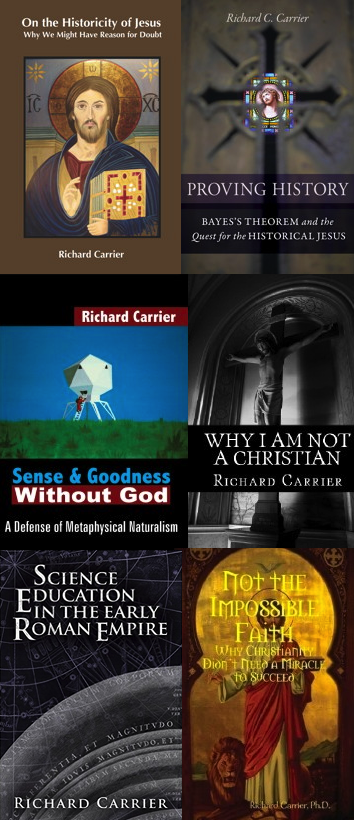
So, let’s not exaggerate (Christians did not “destroy” all ancient literature). But let’s not fig leaf what happened (Christians threw it all away). Leaving only the question of how much they tossed. What have we lost? I cover many examples of lost literature relevant to the origins of Christianity in chapter eight of On the Historicity of Jesus, and a great many examples relevant to ancient science in The Scientist in the Early Roman Empire, and I’ve written about more specific examples in Ancient Theories of Gravity: What Was Lost? and Twelve Books at Herculaneum That Could Change History and The Sociology of Ancient Scientists Cannot Be Based on Medieval Source Selection. But after dozens of pages of summarizing our losses, that barely even touches the subject. I’ve come nowhere near the whole gamut, of histories, biographies, commentaries, almanacs, memoirs, treatises, manuals, geographies, navigationals, oratories, apologies, plays, comedies, dialogues, epistolaries, florilegia, miscellanea, memorabilia, contraria, hagiographies, hymnals, paradoxographies, oracles, novels, satires, encyclopedias, dictionaries, mythographies, poetry, jurisprudence, philosophy, or even (what I’ve covered the most of) physical, medical, and other life sciences. “The quantity of literature produced in antiquity was vast, far beyond the minuscule fraction that we now have” (OHJ 299).
My Napkin Estimate
I ran a rough “back of napkin” calculation in Historicity (from 300n29):
[T]he actual number of authors in [even just] the first century would have been in the thousands. For example, if in the Roman Empire there were a hundred major cities with a literary elite (and there were at least that many, as [evidenced throughout Richard Carrier, Science Education in the Early Roman Empire], and the number of cities in which Christians had established congregations by the year 100 has likewise been estimated at seventy, which was by no means all the major cities in the empire; cf. Carrier, Not the Impossible Faith, pp. 420-25) and only ten authors published in each city every ten years (an enormous undercount, being only one book each year per city), then for any given century there would be 10,000 published authors in that century [10 authors × 10 decades × 100 cities], producing an average of some 100,000 titles [cycling through authors every few decades].
And that’s just for one century. If this scale of productivity spanned the immensely prosperous Hellenistic and early Roman eras (approximately 330 BC to 230 AD), and it likely did, that’s five and a half centuries. If we include the Classical era (which saw a lot of writing, yet a lower geographic scale of prosperity and education—so, far fewer than a hundred cities), we’d add two more centuries or so, for seven centuries altogether; and if we added the Archaic (which saw very little but some important writing), two more, totaling almost a thousand years. But let’s assume the most prosperous and productive five centuries. After 235 AD, a catastrophic contraction of the economy and corresponding decline in education and libraries would have reduced this rate. So we’ll just do the five centuries in between then and the Classical era.
That’s still an expectation that 500,000 books would have been in circulation or on shelves across the empire when Eusebius composed his history of the church. And that’s whole titles—which often came in multiple rolls or volumes, being what we more approximate as chapters today. If there were on average 3 volumes per title, a complete collection of them would require 1.5 million rolls by the end of the 3rd century, which is about three times what there is reported to have been in the Library of Alexandria in the 3rd century BC. But as that reported count will have contained only a third of literature (as the remaining two thirds had yet to be written), this actually corroborates my estimate: my napkin guess could be close to right.
But what does more direct evidence indicate? I’ll walk you through the least useful tests to the most.
✤
The Library Test
That 500,000 scroll-count comes from the late Byzantine author John Tzetzes (in his Prolegomena to the Comedies of Aristophes, §2.9), but his detail is precise enough to trust he is giving us what his stated source, the 3rd century BC librarian Callimachus, had recorded. Roman sources, Marcellinus and Gellius, state a higher number (700,000 scrolls) but with less precision and not citing their source (and both in Latin), and Marcellinus was provably lifting his data from Gellius, so any error in Gellius would have translated to Marcellinus. John is therefore probably giving us the most reliable information:
King Ptolemy, a most philosophical and divine soul, seeking the prizes of all that is good and spectacular, especially of deed and word, at the expense of Demetrius of Phalerum and other elites, collected scrolls from all over Alexandria, and deposited them in two libraries, of which the number outside [i.e. in the Serapeum] was 42,800, and the number inside the palace and royal quarters was 400,000 in multi-volume sets and 90,000 single-volume books [for a total of 532,800 scrolls], as the young Callimachus copied their catalogue after the court was renovated.
And yes, with a population in the vicinity of a hundred million by the end of our period, even given the great expense of bookmaking, the ancient economy could do this scale of publishing (see Imperial Roman Economics as an Example of an Overthrown Consensus and Yes, the Dark Ages Really Were a Thing). However, after studying all the converging data more acutely, I think this is closer to a limit, the most they could have produced. We can see from the TLG canon (which I’ll discuss below), of all the books we have at least one quoted line from we can determine the average number of books a single author wrote was three.. But the TLG doesn’t count books we know of yet don’t even have a line from. So, for example, we know Galen wrote some 300 books, because he told us; but we only have a line or chapter or more from 111 of them in Greek, and a handful more in Latin or Arabic.
So these numbers tell us any author could write dozens, even hundreds, of books in under half a century, but perhaps on average wrote at least three; or if we’ve lost on average half of what every author wrote (every author, that is, that we have anything from), then each author in antiquity wrote on average six. It’s possible medieval perfidy in preserving the corpus of authors (reflected at losing half an author’s work in the case of Galen) is skewing this number and the actual average was indeed closer to six. But if we assume the lowball of three, and an average literary career of thirty years (from completion of “grad school” to an average life expectancy of 48), we would get my estimate of each author producing one book per decade. That leaves the number of authors per city. I said ten at any given time. If if was five, then the 500,000 maximum drops to 250,000. If it was two or three, then it’s near 125,000 books, for a loss of over 98% (see below). And that’s surely near the minimum.
The absolute minimum books lost is of course what we directly know we have lost. First, we can count all books we have at least a quoted line from, which is in the ballpark of 4000 titles, 1600 of which survive only in fragments (and thus are most definitely lost). This is counting from the TLG canon (discussed below). Note that in the TLG there are a few dozen fragments miscategorized as extant, but as “testimonia,” which is just another word for fragment; so I am actually giving an undercount for how many texts survive only in fragments and thus overcounting how many books we actually have. So the resulting numbers are all lowballed from here on out. The TLG also lists about 400 authors we have no surviving quote from (or at least, none that can be connected to a specific book).
If the average number of books per author we have is that lowball of 3, that means we should add 400 × 3 = 1200 more lost titles, for 2800 books (1600 + 1200) that the TLG records are lost. But there will be a lot more, as the TLG’s list of unquoted authors is incomplete, and many books are lost from even the authors with works attested in the TLG, including the miscategorized fragments; and an average production of 3 books is, as noted, probably lower than actual. In addition to those lost books, we have about 2400 books (in all numbers here I am counting the Classical and Archaic periods; everything before the 4th century).
So where in the resulting range, between 2800 and just shy of 500,000 books is the actual loss? Is it closer to 100,000 lost? Or 10,000? Or 5,000? Because those 2800 books the TLG records as lost is an enormous undercount (as we’ll see below). We know a great many titles that existed but aren’t in the TLG because we have no quoted line from them (again, the example of Galen: the 111 titles in the TLG includes 4 we don’t have but have fragments from, and doesn’t include a scattered few that survive only in Latin or Arabic, but does not include the near 200 other books of his we have the names of but not lines from). So what there was has to be much higher.

For reference, Eusebius was relying almost exclusively on what was in Origen’s personal library in Caesarea—estimated by Andrew Carriker to contain at least 400 books or so (likely more, as Eusebius won’t have had use for most of what was there). But that’s in just one guy’s room, with a fetish for only what interested him. And yes, just one room: 400 books at an average of 3 rolls apiece for 1200 scrolls would take up (at 30 rolls per 5 square feet of wall) two hundred square feet of shelving space (less than just three walls of a 10×10 room with 8 ft. shelves), given an extant analog in Tibet (and Roman shelving may have been more efficient). So that sounds like a lot of scrolls, when in fact it’s dinky (for comparison, I own over a thousand books, more efficiently modern-bound, but all are shelved in a single room taking up maybe half its wall space). Neither Eusebius nor even six small rooms could have held all of ancient literature across nine centuries. Just think of all the titles we have, at around 2400 books in the TLG (average 3 rolls × 2400 titles = 7,200 rolls = 1200 square feet = 6 small rooms). If we add quoted but lost books, 2400 becomes 4,000, which would be ten small rooms (3 × 4000 titles = 12,000 = 2000 sq. ft. = 10 rooms), or just five large rooms (24 ft. × 24 ft.). That’s not a lot.
The 2nd century Library at Ephesus, whose structure we have almost intact, is rather small. It has a footprint of 2000 square feet and two levels (within a single main room), which has been estimated as once holding 12,000 scrolls (or, at two 40 ft. x 40 ft. interior rooms, 15,000 scrolls), which could be on average 4,000 books. But Ephesus will have already had libraries before that one was added (in the 2nd century AD). So the total number of books publicly available there was likely many times that. If we assume all the libraries across Ephesus together housed 5x that, there would be 20,000 books there. And that won’t have been “all” the books in the empire at the time, even after adding in all the books held in private estate libraries across Ephesus, similar to the one used by Eusebius.
So that doesn’t answer our question, because individual libraries were limited by wealth and space, and so larger collections could be expected in, for example, the famed libraries of Pergamum, Alexandria, and Rome, and other now-forgotten centers of learning at the time, like Rhodes and Marseille (ancient Massilia). And the total sum of books there will have been is the sum of all non-overlapping titles available in all the libraries of the time, not in any single one of them. For example, every library will have held far more local authors than libraries abroad would. Reading Galen, I get the definite impression that he knew authors in Rome were better represented in the libraries at Rome—and this would be even more so at less famed centers like Tyre or London, or in Carthage or Lyons, and especially the least famed cities with local authors, like Cologne or Gadara.
The Gadara Test
Gadara is instructive. Home of Philodemus (the Epicurean, who wrote at least 30 books, all lost), Meleager (who wrote at least one book of poetry that became renowned, yet the Christians threw away), Menippus (the Cynic, who wrote thirteen books, all lost), Thoedorus (wrote at least seven books, all lost), Philo (the mathematician, all of whose unknown number of books were valued, yet thrown away), Oenomaus (wrote five or ten books, all gone, apart from scattered quotes), and Apsines (who wrote several books, only one or two preserved). And these are just the authors we know about because their works became renowned enough to spread beyond Gadara—but there will necessarily have also been less popular or successful authors whose books only made it as far as local private and public collections. Yet for just this one city alone we have a prima facie loss rate of 60/2 ergo 30/1, about 97% just counting what we chance to hear about. If there were twice as many publications from Gadara as we chanced to get mentions of (as is surely a lowball; it would be very improbable if the preserved mentions were as thorough as that—anywhere, much less for Gadara of all places), it’s 60/1, or over 98%.
And that’s at minimum. Remember my napkin estimate would be for 100 books per century per city (averaged over all cities), expecting then over 500 books from Gadara across the last five century period of prosperity, and we’ve chanced to hear about only sixty. That would mean the “lost even to a mention” is close to ten times more than what we chance to have mention of. But even if we stick to the factor of two, which we can be sure is lowballing, we’re already over a 98% loss.
We can put a test on this. In Science Education in the Early Roman Empire (pp. 29–31) I and others estimate that in every generation under the Empire there could be some 3,000 writers (about 100 of whom published scientists), but that’s produced every twenty years or so (every cycle of education), which would amount to 15,000 per century and thus 75,000 across five centuries, which would make my top limit of 500,000 books just an average of 6 books written by each writer of the period. If the average was indeed closer to 3 as discussed earlier, that would suggest the real number of books produced was 250,000. That average, however, comes from what the TLG has, but it’s missing books from many authors, so we know that’s lower than actual. If, again, it’s missing on average half the books from each author, then average production would be 6 books per author, and my 500,000 books remains credible again—we are just lowballing at 250,000.
Likewise, 75,000 writers across five centuries would also entail an average of 300 students per generation per city across 100 cities. The ancient equivalent of “graduate school” averaged about 5 years, and professors for it could be found in every major city, so any given annual graduating class would total 75 students. But there were always many professors to study under in any given city. In fact, Roman law established an expectation of three to five professors of rhetoric receiving imperial exemptions in every city of the empire (p. 126), with three being most common; but this was for a privileged station, to ensure each city had the minimum number—many cities would have had more, who then vied for this special imperial status.
Moreover, the law established twice as many physicians, who typically split their time between providing fee-scaled state-subsidized healthcare and teaching in medical schools (which minted most of the biological scientists in antiquity), and would continue teaching and writing in retirement. We know engineers (the physical scientists of the era) did the same. We only don’t have imperially incentivized minimums for them because there was never a lack of top-level engineers in any city, so no subsidy was needed to attract them.
But forgetting that medical and engineering students become physicians, botanists, and zoologists, and physicists, mathematicians, and astronomers—who also write books—and just counting literature professors, at the state minimum each actual class being taught would consist of some 25 students (split across three professors). Which sounds about right for the time. Even if it was more like a dysmal 15 (actual or who went on to write), the remaining 10 could be expected to be studying under the doctors and engineers we forgot to count.
So 500,000 books is a realistic estimate. But again, this is a limit, the most there could have been. My second guess gets us closer to 250,000, which could be closer to actual. Both entail a loss of over 99%. And if we halved that middle estimate just out of spite, we’d still have 125,000 books, of which we only have 2400, giving us a loss of over 98% of ancient literature. So it looks like the loss is at least 98% and could easily exceed 99%. Just as the Gadara case signals. Is there any evidence to corroborate that estimate?
The Thesaurus Linguae Graecae
The Thesaurus Linguae Graecae is a modern digital database of all Greek literature from the Archaic to the end of the Byzantine eras (so not counting Latin and other languages). As I mentioned, ending with Galen in the 230s AD, it has about 2400 actual books (some missing parts but at least the bulk of each book survives) plus some 1600 fragments (usually quotations) of lost books, and knowledge of at least 2800 books lost altogether (counting the authors the TLG has listed but doesn’t have quotations of). But the problem is all the books never even quoted, from authors both listed and not listed. Many we do know existed (the list of Gadarene authors for example; the lost books of Galen not even counted in the TLG; and so on). There will be many more we don’t have record of. It’s extremely improbable that our chance accident snapshot of ancient literature to survive just “happened” to name the titles of every or even half of the books or even authors there then were. So that 2800 needs a multiple. Is it 2x, 5x, 10x, 100x?

Counting fragmentary texts, the TLG lists roughly 1600 authors for the period we are looking at (roughly 1200 of which with quoted books). That is a gross undercount, because the TLG only lists (and thus counts) authors from whom we have at least one quoted-and-attributed line, plus about 400 more authors the compilers of the TLG just happened to have hunted down. We actually have tons of names of authors in extant sources without any quotations of them, many of which the TLG compilers overlooked; and on top of that, we will not “by mere luck” have all the names of all the authors there were—remember, that a lost author or book gets mentioned at all in what we do have is a chance accident. So the total number of even known authors certainly exceeds the count in the TLG; and the total number of authors there were will exceed that.
To get my estimate of 50,000 authors for that whole period, there would need to be over thirty times more authors than chanced to gain mention in the TLG. Which is not implausible. The TLG contains about 50 million words in our period of interest, almost all of which are from extant books, not authors we don’t have, or surviving only in fragments and quotations (many of which are duplicates, the same quotation repeated across many books, but that won’t matter to the point here). I doubt more than 10% of the entire word-count is in these fragments. But that means that for the 45 million words comprising entire books (or nearly entire), the remaining 5 million are fragments of what used to be the same volume of literature.
The TLG has over 600 authors only in fragments, and under 600 with at least one whole book (or near enough). Let’s round that to half and half, 600 each. Then add the 400 authors it lists from which nothing survives. If the 600 we have produced 45 million words, the 600 we don’t have will also have produced 45 million words, and the 400 will have produced on average 30 million words, for a total of 120 million words, just given what is known from the TLG, which as noted is nowhere near complete. If we have half of what there was (at least a quotation from half the books there were, and half the names of the authors there were are listed in the TLG) then the total there had been would have been 240 million words, for a loss of over 81%. Having half, though, would be remarkably lucky. Imagine just a fraction of literature survived from the modern era (no databases or anything, just books and periodicals). How many books and authors would chance be mentioned in that snapshot? Would it be half? I extremely doubt it. If we have a fifth of what there was, there will have been 600 million more words, for a loss of over 92%. If we have a tenth, then 96%. If a twentieth, 98%.
And the evidence from Gadara suggests the latter. We were there counting books rather than words. And the loss of books may be greater given that most books are short, so preserving a few massive sets or prolific authors will have padded the surviving TLG word count (as I’ll demonstrate in a moment). But Gadara is also clearly exceptional in its survival of mentions. There is no similar author or count of books extant for most comparable cities of the era, yet they’ll have had as many as Gadara. So while we saw we may have a surviving mention of a tenth of what there was there, the loss rate must be greater for most other cities (by a lot). So having lost 20x what we have a surviving mention of overall is more than probable.
Another data point: we have 2.5 million words from Galen alone; and from just three other authors, over a million words each: Plutarch, Origen, Aristotle; making over 5.5 million words from just those four guys. Yet we have comparatively little from other medical scientists (Christians just “loved” Galen) or from the counterparts of the others. And yet we do not have all of even these authors’ books. Galen himself references many books he wrote that we don’t have, and we know entire rolls and titles are also missing from what we have of Origen, Plutarch, and Aristotle—likewise nearly all the authors we have anything from. There are over 125 million words in the TLG but most are from the Byzantine era. Counting only prior to the mid-3rd century, as noted, we have some 50 million words (counting fragments and whole books). Which means just the incomplete collection we have of just Galen, Plutarch, Origen, and Aristotle is over 10% of all surviving ancient literature. And they won’t have been that exceptional (see the conclusion below).
Remember, even the TLG records around 1600 authors for this period, which as noted is a gross undercount. Yet if only four authors comprise 10% of what we have, you get another insight into what’s been lost. If we assume the TLG’s listed 1600 authors were only 10% as productive as our top four guys, and average those guys’ surviving production down to 1.2 million words each (given what’s lost, it’s actually over 2 million), we should expect there to be over 120,000 average words (almost two average books today) × 1600 authors = 192 million words published in antiquity. But it will have been 2 million actual words from each of our four guys, so it’s 200,000 average words × 1600 authors = 320 million words published. We have 50. That measure predicts 84% of all published words are lost. But as we mentioned, the TLG is hugely undercounting authors—by well more than half. And 200,000 × 3200 authors = 640 million words, or 92% words lost. If there were five times as many authors as are listed in the TLG, it’s 200,000 × 8000 authors = 1.6 billion words, or 97% words lost. If ten times, then 200,000 × 16,000 authors = 3.2 billion words, over 98% words lost.
So from this measure we can say with confidence over 85% was lost; while it could yet be as high as 98%, fitting the estimated loss of 120,000 books (given that we have 2400, and 2400/0.02 = 120,000), as the Gadara sample suggests. The average words per author with books we have (not fragments) comes to something like 75,000 (45mil/600); and the books we have are missing chapters, and we are missing books from these authors as well. We can expect we have surely lost at least an average of twice what we have, just from the authors we do have books from (as in the case of Galen and even, by word count, authors like Diodorus, and so many others—we’ll see quite a lot below), which gets us an average word production per ancient author of 150,000 words. Which is close to the 200,000 estimate. That would require that we have lost at least 2.7x (two and two thirds) per author on average. Which fits observation (e.g. Galen, Apsines, etc.; see more to come).
It’s reasonable to expect at least the same ratios, if not worse, also come out for all the books published in Latin (the stats are comparable for the Brepols’ Library of Latin Texts, or LLT), which doubles these numbers, getting us near a quarter million books lost altogether. But even at the lowball estimate here of 85%, that means Christians threw away over sixteen thousand books in Greek, and another sixteen thousand in Latin, for a total of over thirty two thousand lost books (preserving less than 5,000). Which means, physically, hundreds of thousands of books, when counting all surviving copies of each title across a hundred or so libraries. At the highball estimate, they threw away over a hundred thousand books, which is physically millions of books (counting all copies). Either way, they binned almost all ancient literature. And what they binned was vast.
But can we narrow that range of certainty?
The Herculaneum Library
We’ve actually dug up a good chunk of a personal library, similar perhaps in size to Origen’s if Origen had way more books than Eusebius used. This is not a public library, which I document in Science Education were in every city, so any city would have had (across all its public libraries) 10x to 100x as many books as a private collection like this. As I mentioned earlier, probably any given city library had a good wing full of local authors whose books were not deemed interesting or useful enough to end up in many other libraries (or even special rooms filled to a patron’s liking—Suetonius reports Claudius added an entire section to the Library of Alexandria just to house his own books, although I assume that bequest included all the source texts he used for them). But every library system would share a pretty hefty core of the same “essential” 10,000 to 100,000 books (depending on the wealth and size of the city).

But from the private villa at Herculaneum we have recovered more than 1,800 scrolls, which is between 300 and 600 books (at a ballpark average of either three or six scrolls per book). These were mostly books in the villa’s atrium being evacuated at the time of the ashfall that eventually buried them, and thus does not count books already successfully hauled off, or books still sitting in other chambers of the villa yet to be excavated. I suspect we have less than half, probably less than a quarter (maybe even less than a tenth), of what was (or still is) there. Those estimates would put the size of this library at 600 to 1200 books owned by that one wealthy magnate alone (or even 2400, but no more than 6,000).
Unfortunately, even of these hundreds of books we do have from this site, we don’t have a complete list of their titles yet, as they are charred and difficult to read (while their title ribbons long ago burned away). A lot of new science and tech is being brought in to solve that problem, so stay tuned. But right now only about 960 of these 1800 or so scrolls have been identified, matching visible text to known TLG or TLL text (indicating a book we have), or not (indicating a lost work)—and of what we can read that doesn’t match what we have, for many a title line or enough text is available to ascertain what book it was or what author it’s from, even though that charred scroll is (so far) the only copy we have of it (and that only thanks to a volcano, not Christians). While this identified sample is small (not quite a thousand scrolls or four or five hundred books or so), it is effectively random (nothing about the process that selected them favors lost or known works—text is either visible enough or not), so we can draw some tentative conclusions from it.
Because very few of these scrolls have enough information yet gleaned, we cannot tell how many of them are additional volumes of the same book. About 655 of those 960 scrolls are from new works we don’t have, but we’ve yet to identify anything more specific about them (like author or title or which go together as chapters of the same book). The rest are authors we knew about but don’t have writings from (Chrysippus, Zeno of Sidon, Polystratus the Epicurean, Demetrius Lacon, Colotes of Lampsacus, Caecilius Statius, Polyaenus of Lampsacus) or didn’t have the writings found here (Epicurus, Philodemus of Gadara, Metrodorus of Lampsacus, Seneca the Elder, Ennius); and at least one author we are lucky enough to identify from the charred text that we had not known of before (Carneiscus), though this is only because known authors are far easier to make out from burned text.
Only one text found is one we already have: On the Nature of Things by Lucretius (in its original Latin)—and we found here only three of its six rolls, though the other three may be among the hundreds of scrolls unreadable or yet to be read (over 100 of the 1800 scrolls contain Latin texts; but over 800 are so badly burned we don’t even know what language they are in). On the other extreme we found here some 20 to 25 of the 37 books of the lost magnum opus of Epicurus, On Nature (though again, some may be among the unreadable scrolls). And we have five volumes of the otherwise lost text Against the Dialecticians by Metrodorus. And in fact most of what we have identified in this stack is Epicurean philosophy, including some thirty or so lost titles of just one guy, Philodemus, with multiple chapter-rolls for many of these. In fact over 200 rolls belong to books of Philodemus alone, and many of the unread rolls may be likewise, suggesting what we have was mainly just the shelf for this one author, plus a few shelves either side, of mostly “the Epicureans” in this magnate’s collection. Which means we have only a merest fraction of this entire library.
But notice: almost none are books we already have. In fact, of the 300-600 books we have some idea of what they are, only one is a book we already have. That gives us a loss rate of over 299/300, which is well over 99%. About 50 separate actual titles have been identified, which would get us a 98% loss (1/50 is a loss of 49/50), but there are many more unknown works here whose titles cannot be discerned, so the real result is probably closer to 99% or more. Which means the Herculaneum library corroborates our finding so far: at least 98% (and possibly over 99%) of ancient literature was lost. This is what we already saw from the Gadara sample, the Callimachus count of the early Alexandrian collection, and my own lowball napkin calculation; and it’s plausible on the TLG data.
Pliny’s Natural History
When Pliny the Elder composed his 37-volume encyclopedia of the natural world, he did something unusual among extant literature of the time: he devoted almost the entire first scroll to his bibliography, listing every single author he consulted for the content of the remaining 36 rolls. Which gives us another window into how much has been lost. Pliny is only listing authors useful for his subject (and that he had on hand, probably on his own estate), and he is choosing the most renowned authors when he could get the same information from several. So his list of books belongs to just a few niches of literature and is not a random sample. Indeed we can tell, from what we know elsewhere (see Scientist and Sociology of Ancient Scientists), that Pliny’s selection was not even close to complete even in its subject.
Which is expected, as Pliny would not need to consult all of a hundred books on botany when he could get all he needed from, say, five of them. Moreover, this list was compiled in the 70s AD, and another century-and-a-half of ancient publications were to follow. He also did not, for example, sail to Alexandria and consult its far more massive collection (or even to Rome to rifle the libraries there)—though he could have, as Domitian did, sending teams of copyists to Alexandria a couple decades later when the libraries at Rome burned, to copy up replacements for all their lost volumes. Which entails that even by the end of the 1st century AD the Library at Alexandria was known to be the largest library in the Western world (and it was not burned during the Alexandrian war under Caesar as oft misreported, but was in continuous operation in every century until the middle ages; it only vanishes under Muslim tenure).
So with all those caveats in mind, here is what we get: after an introduction of about ten pages in the Loeb edition, where Pliny tells us he perused “about 2000 volumes,” i.e. scrolls (we would say chapters), which in this case must be over 400 to 600 books, he goes on to list the authors he consulted (rather than titles, except occasionally when he felt he needed to specify), and what facts he got from them chapter-by-chapter, for about 70 more pages in English. He names at least 419 individual authors here. Of which we have works from only 33. Which is a loss of 92% of his own bibliography. The actual loss will be greater, for all the reasons noted, as his bibliography was already very selective.
But we can get a sense looking at that more closely:
First, in that 33 I am counting authors only if we have works Pliny might have meant he consulted; so, e.g., I am not counting his reference to an astronomical book by Julius Caesar, as we know we don’t have that, but only some of his histories; whereas I am counting his reference to Hippocrates, Archimedes, Euclid, Seneca, Xenophon, Aristotle, and Theophrastus, even though he likely consulted (or for all we know only consulted) what we know to be lost works from them. I think it’s quite clear he consulted lost volumes of, e.g., the encyclopedia of Celsus (we only have the medical section) or the historians Diodorus, Dionysius, and Livy, from whom we are missing a great many chapters Pliny would have used. He also would have used the missing half of the Fasti of Ovid, and the lost encyclopedias of Varro. That makes 13 we should probably not count as what we “have.” That gets us 20/419, which entails a loss of 95%.
A great many of the lost authors Pliny names we know wrote many—some, dozens—of pertinent books. Indeed, pretty much all ancient botany and zoology is lost: I have previously listed over twenty authors in that category alone that we know of (for example, Pliny never mentions Dioscorides, one of the most important botanical authors we even have a text from), and I, too, was undercounting. By contrast, when we look at the mere 20 authors from whom we “have” what Pliny likely consulted, many are mainstay school texts and thus not really significant examples of the actual genre his bibliography serves: Virgil, Homer, Hesiod, Horace, Sophocles, Euripedes, Aeschylus, and Plautus. These are just stock poetry and plays, the most popular in the world then and now, padding his volumes with pithy verse. They are not histories or scientific treatises (as almost everything else he cites is). And if we remove them, our actual loss in the genre of natural history is 12/419 which entails a loss of 97%.
This is an undercount, yet it still gets pretty close to where every other line of evidence is pointing. Since Pliny’s bibliography omits less popular and redundant works in the subject, any correction for that error gets us well above 98% of literature lost. For example, if there were even just twice as many books he could have cited (which is an incredible under-estimate), the loss becomes 12/838 or 98.6%, which rounds to a 99% loss. And we can be reasonably certain the actual loss was greater. Because all evidence we have indicates Pliny referencing even as much as half the published literature is an implausible assumption to adopt. Gadara suggests 10x to 20x is more likely. But that even the lowball of 2x gets us in the same place every other line of inquiry reaches is improbable unless we’re actually looking at an accurate measure of the minimum loss. And it’s above 98%.
Diogenes Laertius
We also have other things similar to Pliny’s bibliography. For example Diogenes Laertius, in his Lives of Famous Philosophers, writes bios on the most famous philosophers (a merest fraction of all the published philosophers there were) up to around only half of our period of interest, but lists their books—almost all of which are lost, again corroborating our result. I mostly rely on Diogenes here (otherwise linking when I have a better source), and when he cites volumes and not titles I will count them as individual titles (and when he cites titles but attributes them all to one scroll, I will count that as only one title). And whether a book is correctly attributed won’t matter here, as it still existed to be counted. But I may even have missed a few obscure examples of works he mentions that we don’t have, but often we know about more lost works for these authors than he lists (I tried to account for that but will have missed some), but most of all, we know many published philosophers he never mentions, and that there will have been many more than we chance to have mentions of anywhere, so this is all again an undercount:
- He tells us Xenophon wrote 14 books, all of which we have;
- but tells us Aristippus of Cyrene wrote 16 books, none of which we have;
- Speusippus the Athenian wrote over 30 books, none of which we have;
- Xenocrates wrote 75 books, none of which we have;
- Plato wrote about 36, and we have all 36;
- but Clitomachus, 400 rolls (probably 150 titles), none of which we have;
- Aristotle wrote around 200 books, we have only 31;
- Theophrastus wrote 226, we have 3;
- Strato of Lampsacus (the most important Aristotelian in history) wrote 46, we have none;
- Demetrius of Phalerum wrote 46, we have none;
- Heraclides of Pontus wrote 50, we have none;
- Antisthenes the Athenian wrote 10, we have none;
- Diogenes of Sinope wrote 31, we have none;
- Menippus of Gadara wrote 13, we have none;
- Zeno of Citium (the founder of Stoicism) wrote 21, we have none;
- His pupil Persaeus wrote 11 more, we have none;
- Ariston the Bald wrote 14, we have none;
- Herillus of Carthage wrote 13, we have none;
- Dionysius the Renegade wrote 9, we have none;
- Cleanthes of Assos wrote 50, we have none;
- Sphaerus of Bosporus wrote 31, we have none;
- Chrysippus (the most important Stoic in history) wrote 705, we have none;
- Democritus wrote 71, we have none;
- Protagoras wrote 11, we have none;
- Metrodorus the Epicurean wrote 12, Christians preserved none;
- Hermarchus the Epicurean wrote 4, we have none;
- Timon, more than 38, none of which we have;
- Epicurus wrote over 42, and we have 9 (the briefest and least detailed);
- and Sextus Empiricus, at least 8, of which we have 3;
Diogenes also mentions many minor authors, but still only if famous enough:
- Thales wrote 2 books, of which we have none;
- Empedocles wrote 2, neither of which we have;
- Pythagoras, 3, of which we have none;
- Solon, at least 3, of which we have none;
- Chilon, 1, which we don’t have;
- Pittacus, at least 3, of which we have none;
- Bias, 1, which we don’t have;
- Cleobulus, 1, which we don’t have;
- Anacharsis, 1, which we don’t have;
- Epimenides, at least 9, none of which we have;
- Pherecydes, 1, which we don’t have;
- Anaximander, at least 4, none of which we have;
- Aeschines, 7, none of which we have;
- Phaedo, at least 3, none of which we have;
- Euclides of Megara, 6, none of which we have;
- Eubulides of Miletus, 7, none of which we have;
- Euphantus of Olynthus, at least 5, none of which we have;
- Diodorus Cronus, 1, which we don’t have;
- Clinomachus of Thurii, at least 1, which we don’t have;
- Stilpo, 9, none of which we have;
- Crito of Athens, 1, which we don’t have;
- Simon of Athens, 1, which we don’t have;
- Simon Rhetor, 1, which we don’t have;
- Glaucon of Athens, 1, which we don’t have;
- Simmias of Thebes, 1, which we don’t have;
- Cebes of Thebes, 3, none of which we have;
- Alexamenus of Styra, at least 1, which we don’t have;
- Demetrius Lacon, at least 1, which Christians did not preserve;
- Zeno the Eleatic, at least 1, which we don’t have;
- Bion of Abdera, at least 2, neither of which we have;
- Bion of Proconnesus, 2, neither of which we have;
- Carneades, 1, which we don’t have;
- Heraclides of Bargylis, 1, which we don’t have;
- Diogenes of Apollonia, 1, which we don’t have;
- Monomus, 2, neither of which we have;
- Onesicritus, 2, neither of which we have;
- Crates, 1, which we don’t have;
- Hipparchia, at least 3, none of which we have;
- Ariston of Alexandria, at least 1, which we don’t have;
- Epicharmus, 1, which we don’t have;
- Archytas, at least 1, which we don’t have;
- Alcmaeon, at least 3, none of which we have;
- Philolaus of Croton, 1, which we don’t have;
- Eudoxus, at least 4, none of which we have;
- Heraclitus, 1, which we don’t have;
- Pausanias, at least 1, which we don’t have;
- Nicomedes, at least 1, which we don’t have;
- Xenophanes, at least 3, none of which we have;
- Parmenides, 1, which we don’t have;
- Diogenes of Apollonia, 1, which we don’t have;
- Aenesidemus of Cnossus, 8, none of which we have;
- Zeuxis, at least 1, which we don’t have;
- Apellas, at least 1, which we don’t have;
- Diogenes of Tarsus, at least 1, which we don’t have;
And these are just the most famous philosophers, over 80 writers in all. Countless more published, but we don’t have them either: even the TLG lists 187 published philosophers in our period of interest (more than twice as many) and we already saw that’s a gross undercount. just look at the incredible lists on Wikipedia alone for the 2nd century and from there every pertinent century before and after; I myself have noted the greatest losses include Xenarchus (Scientist 187), Quintus Sextius (395–96), Ptolemaïs (index), Nicolaus of Damascus (index), any of four philosophers named Aristocles (54n130), and Arria and Leontion (Science Ed, 15n21), none of whom Diogenese includes any book count for (most he doesn’t even mention). And Diogenes didn’t even include all the most famous philosophers, but just the ones he bothered to write up, who pretty much all dated before the Roman era. For example, literally the most famous philosopher in antiquity (second only to Socrates) was the Roman Stoic scientist, historian, and polymath Posidonius, who wrote around 30 books that we know of, none of which survive, yet Diogenes gives no list or bio for him (though cites him as a source).
And yet, just from the massive undercount in Diogenes we get a loss rate of 96/2109, or over 95%. The real number (when we put back in everything he left out, and the greater abundance of lost literature in other genres altogether) will certainly approach 99%. Just consider that it is not possible that the 80 plus philosophers Diogenes chose to even mention a book from are even 10% of all published philosophical writers across nearly a thousand years of antiquity (from the Presocratics of the 7th century BC to the end of Second Sophistic around 235 AD). Indeed he skipped the entirety of the Roman period altogether; and we have many examples of philosophical writers he didn’t include even in the period he spent time on. In Scientist I catalog fifty Presocratic philosophers alone (pp. 555–57), who, combined, will have written over a hundred books before we even get to the 4th century B.C., when literary and philosophical productivity rockets to many times that, and holds steam for seven hundred more years.
Diogenes mostly stops his interest at around 200 B.C. So he is ignoring the next four hundred years—and of course writing before the last century in our period, leaving 500 years unaccounted for. In those neglected 500 years the TLG signals that we have about 115 philosophical books, and in the previous 500 (the time covered by Diogenes), about 135. Both of which are pretty close to the number we get from his examples that summed to 96. So if we use the most disfavorable total of 250 extant texts (115 + 135) against a doubling of all his referenced books to about 4200 (because the fertility of publication did not slide after that), thus covering all 1,000 years of philosophical writing, we would have 250/4200, or over 94% lost.
That’s pretty close to our estimates so far. And yet we know that’s still an undercount, as it is only counting surviving mentions of authors and books. Remember, Diogenes is leaving out most of the philosophical writing even in the period he looks at, by not giving complete lists of books for all the philosophers he does name, and only giving complete lists (or at least counts) for the most famous ones. If he bothered to mention as many as half (as with Pliny, an overly optimistic estimate), we’d have 250/8400, for a loss of 97%. To get to 98% he’d only need to be ignoring 3x or just 2/3rds of the published works in philosophy there were (250/12,500), and at least that much is so likely here as to be effectively certain (given all the evidence surveyed so far). So the evidence in Diogenes confirms Christians threw away at least 98% of ancient books.
The Pinakes
The last line of evidence I’ll examine is the Pinakes. Christians threw it away at some point. But it was sort of a published edition of the library catalog of the Library of Alexandria as it was around the 3rd century BC. Really, it was a reference work written and published by one of its librarians, Callimachus, based on what was at the library when he was there, and is often presumed to be as of then complete, but in fact we know from later Byzantine encyclopedias that its title declared it only included exceptionally distinguished authors (διαλαμψάντων) and therefore was probably not complete. Yet we know from reports it spanned 120 volumes.
Various estimates have been made by papyrologists as to how many titles that would contain. In his oft-cited article “Library of Dreams” Roger Bagnall (whom I studied papyrology under at Columbia) runs some math and gets a result of 100,000 rolls. But his math actually sums titles: he is counting lines in the Pinakes, and most usually each line would have identified a book, not each roll of each book. And 100,000 titles actually signals 500,000 rolls, if there were five volumes on average per book. Which is in the ballpark of ancient claims to the actual size of the collection at Alexandria at the time, citing Callimaches himself (see discussion of Tzetzes above).
Bagnall works this out by reasoning that “if its books were standard rolls of 20 sheets, and if they used relatively narrow columns (yielding 27 columns to a roll) and were written in small letters (44 lines to a column),” then “they will still have contained no more than 142,560 lines.” And while in some cases Callimachus padded his discussion of distinct volumes, and also had lines devoted to a brief bio for each author and occasional comments on the authenticity of a work, and other notes, nevertheless “If two-thirds of the space was used for titles and on average each line represented a title,” then “the total would still not have reached 100,000 rolls.” In fact, he means titles, not rolls. The use of one line per roll is not commonly attested for this text, and he already accounted for that by subtracting a third of the lines across 120 rolls. But the number we are interested in is at least 100,000 books. Already by the 3rd century BC.
But that was not complete. It’s conceivable that the Library of Alexandria did at that time have every title in the West, or near to—Galen reports that ships on the docks were then always raided for books to copy, as a kind of docking fee. But Callimachus signals his 120 rolls were only of the most distinguished authors in the collection. Moreover, the pace of book production continued for five more centuries. Likewise, Latin, Hebrew, Aramaic, Egyptian, Babylonian, Persian, Syrian, and other works won’t likely have been included either. But lowballing everything, counting only the books Callimachus included in the Pinakes, the works in the library then represented four centuries of production (really only two at the full scale of publishing of the Hellenistic and Roman eras; but here we’ll assume it went all that way back). If there were then 100,000 books for Callimachus to record, that’s 25,000 books per century. Five more centuries would have added another 125,000 books, for 225,000 books. Pretty bang on to my middle estimate.
If we get all stodgy about it and insist Callimachus was a wordy birdy and blew half his lines on rigmarole rather than titles, and insist Callimachus listed every book that then existed in the Library (both implausible assumptions), leaving us with a catalog of then 70,000 books, at the resulting lowball rate of 17,500 per century, then five more centuries would have added 87,500 books, for a total in our period of interest of 157,500 books. That’s just over my lowest napkin estimate of 125,000. Given the 2400 books we have, the Pinakes data gets us a loss rate of over 98%. Which again corroborates every other line of inquiry.
Other Tests
All of this is, as I’ve mentioned in each case, undercounting the losses. And not just because of the much greater number of unmentioned authors and books. I’ve already noted how the authors we are counting as “having” them today is undercounting because in fact we are missing many books from most of the authors we “have” any work from. But we are also often missing whole chunks of the books we are counting as ones we “have,” too—for example, most of the histories of Livy and Diodorus, almost all of the encyclopedia of Celsus (we only have the medical volumes), many volumes of the Annals and History of Tacitus, a few volumes of the Natural Questions of Seneca, and so on. If we counted incompletely surviving books as “lost” rather than “extant,” we’d get a lot more “lost” than I have so far counted.
So with that and every other lowballing I did, the fact that all indicators point to Christians throwing away at least 98% of all ancient books leaves no sound argument that it was less. It was more likely more. There are many other indicators to check to confirm this. Wikipedia’s lists of ancient poets are huge, yet not even complete. You can get from that a pretty clear idea of how much poetry was lost. It’s in the same ballpark. You can do this with the other genres as well, though Wikipedia is less compete for the more obscure or technical genres. But take just one rare genre: Atthidography (historians of just one city: Athens). We know of at least fifty of these—and we have none of them. There will have been historians of many another city and region; we only know about these so well because Athens was a popular topic. But at 50:0 we’re looking at a loss rate, again, of over 98%.
In Historicity I list lost works pertinent to early Christianity. Just looking at the genre of history (including memoirs, biographies, chronologies, etc.) for only the first century, Wikipedia (as of May 2026) lists 26 (I’m not counting Tacitus who lived in the first century but wrote only in the second; or Thallus, who definitely did not write in the first century). Of those we have works (though not all the works) of only 6. Which would entail 6/26 or 77% are lost. But as I also show in Historicity (ch. 8.3, pp. 293ff.), Wikipedia is missing almost every historian to list here. It also adds some, because I was mainly only listing historians writing after the year 30; so we’ll put them all back in. I will also add ones in the TLG that we both missed (and I am adding only those not of uncertain date—so there are even more).
Here are the historians we don’t have from just that one century:
- Marcus Antonius Julianus
- Aufidius Bassus
- Caecilius of Calacte
- Dio Chrysostom (we have his speeches, not his histories)
- Marcus Cluvius Rufus
- Fabius Rusticus
- Fenestella
- Justus of Tiberias
- Titus Labienus
- Gaius Licinius Mucianus
- Memnon of Heraclea
- Nicias of Nicaea
- Nicolaus of Damascus
- Bruttedius Niger
- Pamphila of Epidaurus
- Quintus Asconius Pedianus
- Seneca the Elder
- Marcus Servilius Nonianus
- Pliny the Elder (we lack his histories)
- Julia Agrippina
- Petronius
- Juba of Mauretania
- Emperor Tiberius
- Emperor Claudius
- Emperor Vespasian
- Emperor Titus
- Pompeius Saturninus
- Aulus Persius Flaccus
- Lucillius the Satirist
- Turnus the Satirist
- Chaeremon of Alexandria
For a total of 31 known to be lost. While we have only some of:
- Strabo
- Philo of Alexandria
- Quintus Curtius Rufus
- Plutarch (we lack 2/3rds of what he wrote)
- Valerius Maximus
- Velleius Paterculus
For 6 partials. While we have the complete works of only one “historical” author from the first century, Juvenal the Satirist, who isn’t even a historian per se.
Giving us a ratio of 7:31 (for 7/38) if we ignore losses within authors, which would get us around 82% of “historians” lost. But we should not be counting historians we only have some of—their lost work counts as lost. If we count only writers we have every pertinent thing from, the ratio is 1/38, which is over 97%. But that’s based only on the ones known, because they just happen by chance to be mentioned somewhere. If, as we’ve seen is almost certain, we have less than half the names there were, the result exceeds 7/76 or 91% of authors; and if we count actual losses, 1/76, that’s a loss of 98.68%, or more than 98% of books (nearing 99%). If the loss was 10x more than surviving mentions (which all previous evidence indicates is not unreasonable to assume) or 20x (which all previous evidence indicates is not impossible), then the actual loss count exceeds 99%. Indeed even the lost historian count then exceeds 98% (7/360 is over 98%; 7/720, 99%).
Similarly, in my chapter on lost science in The Scientist in the Early Roman Empire I mention what amounts to around a thousand lost scientific treatises (in the physical, astronomical, and life sciences; adding logic and mathematics, it would be more), against the roughly 350 we have. And here the stats are skewed by Galen, just over 100 of whose books Christians preserved (out of some 300 or more that he wrote, so we have lost twice as many of Galen’s books as we have). Remove that outlier and the loss approaches 1000:250 or 80% (250/1250). And that’s just based on works we know about. What happens when we plug in the works we didn’t chance to hear about in surviving literature? If it’s twice what we know of (again, we cannot expect to have “accidentally” received mention of even that many), then we lost about 89%; if it’s 10x what we know of, it’s almost 98%. We’ve already seen evidence the scale of loss could be twice that.
Because there were many more Galens lost. For example, I point out (in Scientist, p. 124) “one Roman epitaph from the first century” that “honors an imperial physician Tiberius Claudius Menecrates as the founder of his own medical sect and author of 156 books in medical science, which earned him public honors from several major cities,” for around 150 titles in 350 volumes. Yet none of this is counted in the TLG or anywhere else because we only know of it from this inscription. Yet this is just one example of one author who wrote millions of words by his single self. And we only know about this by chance accident. There will have been a great many times more authors like that. It’s simply improbable that we chanced to have a surviving mention of even as many as half of them.
If there were even just ten such authors in the whole of antiquity (now counting Galen), we already have 2500:350 or almost 88% lost (because 10 authors × 150 books each = 1500, and added to the other 1000 or so, that’s 2500. Given a total production of 2850 books (those 2500 + 350 we have), of which 2500 were lost, we get 2500/2850, or 87.7%. But we have enough data on prolific scientists of the period to know that’s a definite undercount. And yet if there were ten Galens per century for just the five centuries of the Hellenistic and Roman periods (just one each decade, in whichever science, across the entire Empire of a hundred million people and a hundred major cities), which is still more likely an undercount, then we’re at 8500 lost science books (50 Galens × 150 books each, for 7500, + the 1000 others = 8500, for 8850 books, of which 8500 were lost), which lands us at 96% of all science literature lost (8500:350). If the other 1000 books we know about are the tip of an iceberg of yet more books we did not chance to hear of, there’d have to be 5x more lost books to get the rate to 97%; and 10x more (which we have seen evidence is quite probable) to get it to 98%.
Conclusion
But even a 96% loss-rate means medieval Christians threw away twenty five times more science than they kept. The data from Tzetzes, Gadara. Herculaneum, Pliny, Diogenes, the Pinakes, and everything else, all converge on the loss being worse than that, above 98%. And that result is consistent with all other data (from the TLG and beyond). Which would mean of all literature in all genres together, from the 600s B.C. to the late 200s A.D., medieval Christians threw away fifty times more than they kept, possibly a hundred times more. There is no way to reach any other conclusion except to forget whole piles of data—like that it is impossible that we have a complete list of all authors and books (much less in the TLG), when abundant data proves most authors and books will have escaped chance mention in our surviving materials. So we know (not speculate, but know) the actual numbers are greater than we have. And the data all signals, by multiple independent lines of evidence, over a 98% loss.
That’s over 100,000 books—10,000 per century. All tossed in the trash.
✤
There is a lot of counting and math in this article. So I could have erred here or there. If anyone checks my work and finds anything off, explain in comments below and I’ll update this article when warranted. It can then be increasingly vetted over time.
Discover more from Richard Carrier Blogs
Subscribe to get the latest posts sent to your email.






This is staggering.
Yes, lots of numbers and counting but well worth it Rick. It does give you insight on how the Christian faith worked with the “few books” that were available to them. Even so leaving out works like the Shepherd of Hermes, the Ascension of Isaiah, the epistles of Barnabas, etc., my question pertaining to the list of first century historians that included Nicholas of Damascus and justice of Tiberius, David Fitzgerald wrote about those guys in “Nailed”, I believe. The rest of the list as historians of the first century if that’s the way I’m reading it said nothing about the life of Christ. Is that correct?
thank you.
Correct. So far as we know, no historian wrote about Jesus. Had they done, we’d have heard of it, even if we didn’t have their book. I discuss this (and explain why it’s a sound conclusion) in Ch. 8 of OHJ.
This however does not entail Jesus didn’t exist; only that if he did, he cannot have been even a fraction as famous as the Gospels claim. I also discuss this there.
The effect is that historicists have to choose: either abandon every famous-making claim about Jesus, and make him smaller potatoes of less influence and impact than even the other fleeting Jesus Christs (Messianic Joshuas) that Josephus does record, for example, or indeed anyone else of note (so as to get the effect of this silence down to 1/1 and thus it makes no difference to the probability Jesus existed) or insist Jesus was famous and eat the bullet that results (that no one mentioned someone so famous and impactful, which then reduces the probability that that Jesus existed by exactly as much as the fame and impact you insist upon).
For that reason, I don’t even consider the famous Jesus hypothesis in OHJ. I only contrast mythicism with the obscure Jesus hypothesis because it’s the only one likely to be true on this evidence.
I sent you a few typos via email.
I think you would be better to consistently list all your fractions with “estimate of number lost” as the numerator and “estimate of the total number” as the denominator, so that there is a direct correlation between fraction and percentage lost. Instead you are generally listing the fraction of what *remains* from what probably originally existed, but then quoting the percentage as what has been lost. For instance, you say “a prima facie loss rate of 60/2 ergo 30/1, about 97%” whereas you really mean “a prima facie loss rate of 58/60, about 97%”.
As I review, I see that you have been quite inconsistent, which will be extra confusing for those who are less mathematically literate; in addition to the example above, you also have “of which 2500 were lost, we get 2500/2850, or 87.7%” and “which lands us at 96% of all science literature lost (8500:350)”.
I adjusted some of the text to suit, but everyone should realize these are entailment relations not arithmetical results. It’s obvious what is meant and how to get every result. It is not necessary to be pendantic about sentence structure when everyone can tell what’s meant and how to derive it.
Maybe, in addition to this splendid work, you should have made an attempt to calculate the “background loss rate” prior to Christian takeover? I mean, during the centuries of antiquity there can’t have been a perfect accumulating of all and every published work? At any point in time during the Hellenistic and Roman pagan rule I guess there would have been a lot of litterature unavailable for all kinds of reasons.
We have no indication of any background loss rate. No one references lost works until the middle ages. The ancient system appears to have successfully preserved everything. Which is to be expected. It was an extraordinary wealth engine and had an efficient and extensive library system and preserving knowledge was a core-value of the wealth-controlling elite.
One thing that might be true, I suppose, is that in say Britannia, which was one of the least developed provinces of the empire, you would have had more difficulty getting access to literature compared to anywhere in Gaul, and definitely compared to the Mediterranean area, though London likely did have a library (it hasn’t been found yet to my knowledge) and Eboracum may well have had one (now York). Out on the frontier on Hadrian’s wall it would have been much harder.
Even then it’s a lot better than the Anglo-Saxon era, as there’s evidence at least some people that far North were learning Greek (there are Greek exercise tablets that have been found and tuition was presumably available, there were educated Romans and ethnic Greeks living in Britannia). They probably would have had access to the core canon, as Richard has said.
In fact, the state of the preserved works in Medieval times was often hilariously bad. You often had cases where one part of a text was preserved in one monastery in France, and another section in another one in Spain, and nobody had joined the two together. We really have to thank Poggio Bracciolini, an Italian scholar in the Renaissance (1380-1459) who went around various monasteries in Europe, both discovering lost texts (Lucretius´s De Rerum natura) and piecing together ones that existed as fragments (lots of Cicero’s work) to reconstruct the text. He really did a marvellous job, considering what was available to him at the time.
By contrast, the medieval situation you describe reveals lone wolfs abandoned and unsupported by society struggling against post-apocalyptic conditions merely to retain scraps. While the elites around them flout massive and ostentatious wealth, blown all on vanity and wars of adventure. The change in values is the cause of the effect. And the loss of pertinent values here is a Christian thing (as I document in the anti-intellectualism sections of Scientist and Science Education).
That was always true. I give examples in the article itself: neither Pliny nor Eusebius traveled to other provinces to search libraries for reference materials. They relied on what was close to hand. In Pliny’s case, whatever Pliny himself bought. In Eusebius’s case, mostly whatever Origen had bought. But they had access to lists of what there was to find and knew there was more stuff to find if they felt the need (that’s how both those libraries built their acquisitions). That’s also why listicles always focused on the most renowned or famous materials, yet still acknowledged the existence of others.
This isn’t relevant to the present question, however. The question here is why we (now) don’t have a thing. We are not limited anymore to physical travel to have access to it all. So that factor is not relevant to the present question. That Christians had to throw away several or even dozens copies of every title across hundreds of libraries and three continents for us to not have a title now is the phenomenon to account for.
The weird case where each half of a book is on other ends of the world is precisely an effect of this Christian indifference. That never happened in antiquity because they cared far more about preserving knowledge and building and maintaining a whole infrastructure to do that with. Domitian repopulating the burned libraries of Rome by sending crews of copytists to the central library at Alexandria on the other side of the Roman world is a direct illustration of this.
I think you meant to add this onto your paragraph, rather than mine.
Yes, I think that is what it reveals, at least for the early Middle Ages that it was the result of indifference. You can compare it to how accessible the Christian canon was and the efforts that went into preserving works of the church fathers etc.
I guess I was saying to the poster here, that you would have had differences in accessibility, but it was nothing like the situation in the dark ages, where tonnes got lost or was badly catalogued.
The only places where you might have had an increase in literacy at that time were Germany (the bit not occupied by Romans) and Ireland, though that’s to some extent an accidental result of the diffusion of scraps of Roman and Greek learning.
True, yes, relative increases in literacy, e.g. the Pax Romana had good literacy (20% casual and 10% literary), and northern Europe almost none, then it all collapsed to “some,” which is more than “almost none” (thus, Germany went up) but still a lot less than “good” (thus, Germany didn’t even ascend to Roman levels; of course until the Renaissance).
It seems to me that you get more written graffiti in the Roman era (at least in Italy, from evidence on walls, and there’s plenty of pottery evidence elsewhere) than you do in medieval times.
I suppose it’s fair to say that in parts of Europe you might get some survivor bias there, i.e wattle and daub buildings not surviving as long as stone. Though the surviving graffiti often does seem to be in the form of marks. I guess again, it’s possibly for cultural reasons, though written graffiti does seem more common when you start entering the Renaissance.
In Tudor and Stuart England there is plenty of it and it makes sense as a lot more people are going to school then (well, from merchant and gentry families anyway, most people still had virtually no education).
I guess perhaps the first place in Europe to be comfortably ahead of Rome on literacy was Amsterdam in the 16th and 17th centuries, the Dutch have quite good record and it seems male literacy was over 50% and female literacy about 40%
The graffiti symptom: I think that’s true.
Literacy: yes, literacy levels above 20% (general, 10% literary) were only achieved with funded education of the general population (i.e. it doesn’t need to be state funded, but the students need to not have to pay for it). That only happened in the Late Renaissance (arguably causing the Enlightenment). The Romans experimented with that but crashed before the concept could spread (e.g. Pliny’s private educational foundation educated all children, or at least boys, in his home town, launched in the late-1st century, but was wiped out by the crisis of the mid-3rd, and Christians never rebuilt any of those foundations, despite pleas).
Yes, I’ll admit my thoughts about graffiti are impressionistic based on visiting museums, churches and various other monuments.
I have read studies of Roman graffiti when reading up on proto-romance and how Latin gradually became the modern Romance languages over time. There’s enough to have some really useful information about sound changes.
Scotland was one of the first societies where the State tried to actively push literacy, starting with the nobility (1496 education act) and later more grammar schools were created for people from lower classes, especially after Scotland became Protestant. They also had a lot more universities than England and the state really encouraged their creation quite a lot.
I think this is a good example as you say of the Enlightenment (and the Industrial revolution) being encouraged by this expansion of education. Generally by the end of the 17th century, Scotland seems to have had a higher literacy rate than England and it’s a reason why a disproportionate amount of inventors and philosophers came from Scotland. In 1696, they passed an act insisting that every single parish maintain a school.The Scottish actually insisted on their education system being preserved in the negotiations that led to the Act of Union in 1707
I have to say, Dark Age denialism is bizarre to me, as the Western European Dark Age of the best evidenced events in history and archaeology. Indeed, it’s the whole reason why the Renaissance was actually a thing (from the 12th century onwards).
In Spain, you can see plenty of evidence in the archaeology of people squatting in what were once grand public buildings, and whole cities being abandoned (Juliobriga). You can also see that the quality of pottery got a lot worse. In Britain the decline was even more dramatic, people just abandoned the cities alltogether and even basic masonry was lost as a technology, not to be brought back until about the time the Anglo-Saxons converted to Christianity (597).
I find one reason why some early medievalists hate the term “Dark age” is because they are very much in love with the period and I am really interested in it, I think the Anglo-Saxon invasion is fundamental for understanding how England formed and the Visigothic kingdom in Spain is also very interesting (I’ve read two excellent books Spanish readers might like by José Soto Chica, a Spanish military historian “Los Visigodos, Hijos de Un Dios Furioso” and El Aguila y los Cuervos, la Caída del Imperio Romano). I think that Anglo-Saxon and Visigothic art and architecture can be really beautiful, but there’s no doubt there was a decline in education and living standards and I think denying that it was overall a much darker period than the Roman era is simply ridiculous. You can’t claim that the level of interest in Anglo-Saxon England and Visigothic Spain in philosophy was anywhere near where it was in the Roman Empire in 200Ad.
I find that as well as some Christian apologists having their reasons for denying there was a real dark age, there are other motives. My experience with a lot of people in archaeology and history in the UK and Spain is that many from the post-60s generations are often the kind of people who don’t like empires and don’t want to admit that the collapse of the Western Empire may have been a disaster and lots of pretty good things were lost.
Another is that cultural relativism in the humanities sometimes goes far too far, it’s important not to portray peoples the Romans called Barbarians as simplistic primitive savages and at the end of the day the Romans themselves were to blame for the Empire collapsing. Indeed, leaders like Alaric were trying to claim Imperial offices for themselves, rather than actively trying to destroy the empire per se. As you have argued a few times, the successor states to Rome can be blamed for not preserving things, or recovering knowledge (in other words the various successor Frankish, Visigothic, Lombard kingdoms after they converted to Christianity) and it’s wrong in my view to say that societies cannot have superior values in some ways.
Indeed. See my article Yes, the Dark Ages Really Were a Thing.
I cover all those points and more.
In fairness to the Germanic pagans, they were technically behind the Romans but like the later Vikings, wanted to learn about the technology, something “Barbarian proponents” forget. But the skill was gone. There was nothing to teach. The truth is as the Papacy converted tribes between 500-1000 decline of skill is noted in all cultures. Some dark ages lasted longer than others
All because around 50ce A fairytale was constructed by Syrian Jews…….amazing.
Christians engaged in the mass murder of Germans to compel conversion to Christianity, then took over and maintained that stranglehold for a thousand years. Talent and independent thought are less likely to survive that.
As I replied to Richard elsewhere, it’s not quite true that everything was gone and Ireland and Germany and parts of Eastern Europe in some ways had better literacy than they did before the fall, because they were never under Roman rule, and bits and scraps of classical learning did reach them, the bits Christian missonaries liked, admittedly.
But the fall was definitely dramatic. There’s no doubt about that and what they were learning was a pale reflection of what had existed.
As I said earlier, they also probably weren’t actively trying to destroy the Empire as such and the Empire did a pretty good job of destroying itself (there are so many factors to mention, but one for sure is that as Empires/states expand, leaders start to think that they would prefer a lot of local power, rather than merely have a share of power in a bigger entity. Some leaders are making that political calculation today, i.e much of the far right in Europe).
The Frankish elite had (mostly) converted to Christianity about the time of the fall and there’s no doubt that they made their subordinates do the same. Clovis (one of their kings, founder of the Merovingians) converted in the 490s and there’s no doubt he got others to follow suit, by a variety of means, i.e institutional pressure. Indeed, the Franks then made the Saxons convert to Christianity under Charlemagne a couple of centuries later (8th and 9th centuries) and started to persecute pagans more severely.
I think it’s a fairly common view, that one reason the Frankish rulers ended up converting to Christianity was because there is a big advantage in having an organised church if you want to control your population. In much of the area they conquered (the bit of Germany under Roman control, where Cologne and Trier are today) and of course Gaul (what is now France) the population were Christian and you had a lot of the church structure in place and you could co-opt it to legitimise your rule.
Pursuing a single church to control as a feature of fascism is indeed a thing. The Romans already started trying that as the system was collapsing in the third century. Different emperors tried different gods to organize control around (Baal, Sol Invictus, the emperor himself) but usually died too soon to establish the idea, and/or chose poorly organized systems or to reinvent the wheel rather than appropriating (“buying out”) an already-successful corporate apparatus. Constantine just picked a good one, invested heavily in it, and avoided getting assassinated for thirty years. Otherwise Christianity likely would never have dominated society.
Likewise, yes, Christians weren’t accelerationists, they weren’t “trying” to destroy civilization. They were just failing to make any correct decision needed to save it, owing to delusions and ignorance about what would work. Constantine enslaving all free farmers “for freedom” (thereby creating the entire feudal system of serfdom) is a perfect example of that. They needed democracy, evidence-based reasoning, and the leveraging of freedom rather than draconian oppression.
The East suffered a similar string of failures to succeed based on similar bad ideas or lack of good ones, it just took longer. The Byzantine empire slowly deflated over centuries, eaten up by Islamic conquerors, which wasn’t inherently a bad thing until the anti-intellectualist purge of Islam started in the 11th century or so. But that meant when the empire fell in the 15th century it did not fall to anyone with any better ideas about how to rebuild a collapsed civilization or its knowledge infrastructure.
I guess there’s the question as to whether you could have made a democracy work back then over such a large territory,(though I guess under the Empire they failed anyway). I think the idea of making the Empire a federal state wouldn’t have even occured to Romans of that time.
I guess too that we can be fairly generous about what we call a democracy,i.e the Roman Republic or the early Dutch Republic or the British constitutional monarchy post the Bill of Rights, just anything where there is a reasonable amount of political pluralism and it’s possible to remove the government by constitutional means.
I think that one thing that is clear is that a lack of pluralism does a lot of damage to society in the long run. You need a reasonable amount of freedom to criticise government policies, otherwise blind spots don’t get checked, injustice prevails, etc.
I think societies tend to make more progress in precisely the areas where free discussion is allowed. Bourbon France was quite advanced scientifically, in part because they didn’t really care whether you actually believed in Church dogma or not, as long as you weren’t too direct about attacking it openly or attacking the church as an institution. By contrast, you couldn’t attack the monarchy or the privileges of the nobility very easily (although the philosophes did that) and we know how that ended.
It’s a shame these days that a lot of people don’t appreciate that democracy might not be utopia, but it’s a lot better than other systems we’ve tried. I actually think that rather than strongmen we need people who are willing to listen to different perspectives.
I think this can even be seen within liberal democracies, ones that are strongly majoritarian (like the UK and Canada) and ones where coalitions are almost inevitable, like the Netherlands, Germany, the Scandi countries. I was debating with a friend a while ago who likes the idea of majoritarian systems and he said “It gets ridiculous when you have to negotiate every last detail, we can probably plan projects better if there is a strong determined leader”. I responded that on the whole, the Netherlands, Denmark and Sweden are better run countries than the UK, precisely because you don’t get radical lurches and policies get questioned in cabinet much more.
In the UK too, although I don’t think the Tory-Libdem coalition was great, there was at least no question of a Brexit referendum because the Liberals blocked it. Likewise, I think the grand left coalition in Spain has done some good things, because I think they are checking each other’s biases to some extent and coming out with some decent policy compromises.
This was already well understood in antiquity. Polybius wrote an entire discourse on it. And that in fact was heavily inspiring of the American Founding Fathers. The US system of separation of powers and coequal branches of government was already standard then and well grounded in theory and practice. Its cooption and dissolution by Caesar and his descendants was not for lack of understanding that that was a bad idea—people literally fought and died to stop it and just lost.
The idea of large geographic democracies was already solved before Roman times by the Greek confederacies that formed to fight Alexander. Again, they just lost. But they, too, were cited explicitly by John Adams as others for inspiring their idea of federal vs. states rights and decentralization of power while maintaining a strong executive for cooperative warfare and trade.
The Roman imperialists actually came up with really good ideas for running an even larger territory, they just built it on sham democracy, but the only reason they maintained the sham was that they understood the system would have worked for real, and they needed to trick people into thinking that therefore their paper tiger version would work too.
In short, the Romans had a central executive with provincial governors, which were sham elected (in Italy, after completing a cursus honorum that was also supposed to be ascended by elections, but ensuring governors were experienced administrators); but would have worked even better if they were actually elected. But under the governors, who only ran things regionally, you had city states with locally elected city councils (some of which may even have been legitimate but one can rightly suspect they shammed their elections too in emulation of the “federal” system).
If Rome had united their original Republican system with their developed Imperial system along the same lines as the previous Greek Confederacies, they’d have had a perfectly functional democratic society on any scale. Precisely because it disperses power and thus doesn’t “lose track” of anything. City or tribal councils run local regions, which comprise provinces run by governors served by a staff of a Chinese-like bureaucracy of educated admins, and all interprovincial concerns are run by the sitting Consuls (replaced by the Emperor in the pseudodemocratic version) in Rome.
By the time of the 2nd century, the Senate was comprised of citizens from all provinces, not just Italy. And while the elected members of the Senate then representatively elected who would govern which province (again, in reality, this was shammed and it was just the will of the emperor to to bottom, but I’m describing what they would have known to do if any of the reported occasions of the Senate restoring the Republic had ever succeeded), by then those Senators were not solely Italians, so the provinces “had their representatives.” Although they never created a district system for elections, it would have been easy (along the Confederacy examples) to have simply instituted that, e.g. citizens elect their Senators, thus having a voice in the central system.
There is a reason this sounds a lot like the Republic in Star Wars. That was based on exactly these Roman-era models.
There are other reforms they’d need to remain stable over time, just as the US and every other modern democracy did (increasing who gets to vote, ensuring equal rights, etc.). But that would all be realized if the elites came to that mindset. And we do know that’s difficult (American elites are actively trying to degrade our democracy and produce an imperial system in its place even now).
Great examples. I guess it was less outside the imagination than I had thought to have a large democracy.
I think r.e your last point, it tends to be that a class excluded from power starts advocating for their fair share. I.e the American landowning and Merchant classes having no representation in the British parliament, the French bourgeoisie being tired of a system where the aristocrats and the king were running the show.
You see it in the UK where you have the upper middle classes gaining the vote in the 1830s, then the upper working classes in the 1860s, more working class people in the 1880s and then all men and some women in 1918, then everybody in 1927.
In Latin America, the people who led the independence revolutions tended to be people from the “Criollo” class, people who were from Spanish families, mostly Spanish descent (enough to qualify for the “purity of blood”) but who were excluded from the very top positions in colonial government, i.e being the Viceroy.
In turn, although in theory the qualifications to vote post-independence were not on “racial” grounds, in practice, like in the Southern US, things like literacy tests basically excluded them. Some states had property qualifications, etc too.
Yes. That’s the entire history of the 1st century BC and the Roman Social Wars. People often just read about Caesar’s coup when all free Italian men had the vote, even if they were born abroad by then. But that was only a recent thing. About half a century before the Italians fought a war for the franchise and won it. The history of how women got the vote often tracks a similar narrative: as soon as you need someone for fighting wars, it starts to become a pressing need to enfranchise them. Hence in the US, the fact that women were absolutely essential to mechanized warfare (already in WWI having to man the factories building the machines and munitions while the men fought) secured them the vote in a matter of years.
That’s not admirable (that shouldn’t be the calculation; every compus mentus adult should have the franchise) but it reflects the fact that those hoarding power are loathe to share it, and often have to be coerced to because of their selfish irrationality. That’s as true today as anciently. Which is why it requires people in power to realize this to do something about it. And even then they have to move stepwise. Hence the 1619 Project is right: the Founding Fathers capitulated on slavery for military power, because slaveholding states were so evil they would not help anyone win their freedom unless allowed to continue being evil. And all that resulted was an even more destructive and pointless war they would inevitably lose. Irrational. But typical.
“Wasn’t inherently a bad thing” except that all forms of conquest are bad things. (I got your point, just figured it’s good to make sure to put on our human hats sometimes even as we try to look at the broad sweep of history!)
Do you know any good estimate for the rate of loss of books in non-christian cultures of the time? If the rate of loss across all cultures is around the same, then it has nothing to do with christians being bad at preserving knowledge but more about humankind being uninterested in preservation. As we say in French « après moi, le déluge ».
There is no evidence of any loss rate in the Hellenistic-Roman era (see my other comment).
I don’t have the qualifications to assess what happened in other cultures (e.g. India and China). Islam, we know it’s the same thing (once they switched from the Islamic Renaissance that respected and thus even started preserving knowledge, to a ruthless anti-intellectualism that diminished all value for it, they stopped preserving anything, even more extensively than Christians did). China, might be (they underwent an anti-intellectual turn in their own middle ages; though I see many sources blame wars, foreign and civil, that doesn’t explain why restoring literature wasn’t one of the things rebuilt), but China also didn’t produce as much as the Greco-Romans did. India, I don’t know the history at all (even to know how much literature there was to lose).
Would this also include the “Greek Miracles”, the dozens of amazing engineering marvels? Were they purposely destroyed or simply ignored? It seems that Christians were always at war with knowledge.
The loss of scientific and technical knowledge was indeed tremendous. This is one of the things I spent about a hundred pages demonstrating with hundreds of examples in The Scientist in the Early Roman Empire.
To be fair, all it took to leave us without 99+% of ancient books was to fail to copy them onto new media each time they rotted. And, to fail to camel copies out to desert storage. Monastics copied the heretical De Rerum Natura by Lucretius just enough times, and kept them intact in monastic libraries long enough, for us to have a couple of complete 9th-c copies. It seems almost miraculous that those were preserved so long. This does not absolve anybody except the ones who did step up and make copies that subsequently rotted.
The Herculaneum 3d x-ray micro-scan transcription work seems to have slowed to a standstill. I was expecting a steady drumbeat of newly recovered pages released, but it has seemed very quiet for a long time, despite that you can download the post-processed scans and run your own code on them.
Apropos, a new Herculaneum scroll decipherment landed today: https://scrollprize.org/firstscroll
And the actual paper, in preprint: https://scrollprize.org/pdf/main.pdf
And I think they are right, that damaged and fragmentary scroll is probably one of the rolls of Chrysippus, other rolls of which were already found there.
Dr. Carrier, are all loses to blame on ‘christians'(=mainly monks & clergy?) or did the gradual decay of the Roman Empire from the Third Century onwards also play a role? I watched a video with you on Mythvision in which you state this and also that Christianity didn’t cause the decline in knowledge ‘directly’ though ‘it certainly didn’t help’.
And also almost any ancient text on papyrus would eventually be lost with out finding a steady succesion of copyist (exept perhaps in desert conditions like in Egypt.)
My remarks on the decline in knowledge referred to indifference—not only not preserving anything, also no longer pursuing anything (scientific and philosophical progress ended from indifference to it as well).
The economic situation cannot cover this. Though the West declined a lot, the East did not. So half the Empire had ample means. But even the other half had sufficient means. That’s why I linked here to discussions of the wealth available even to Western Dark Age kingdoms and the church itself (which was the wealthiest corporation in the world at the time). Even in the Dark Ages they had enough resources to preserve knowledge. They still chose not to. In neither East nor West.
Also, note that parchment (made from skin) widely replaced papyri by then. So access to papyri was not a problem. They had ample access to parchment in the West and even the East, and it was a far more renewable resource outside Egypt.
It’s a historical sci-fi, but what was the alternative without christianity? Would 99% of lost knowledge become 100% when barbarians took over the west? Or would the Eastern Empire be better equipped to preserve classics and we would have much more than we have today? Any other probable scenarios?
I discuss this some in Ch. 18 of Not the Impossible Faith.
The short answer is:
It depends on displacement effect. The nature of the collapse in the 3rd century was such as to drive people toward fascist, reactionary superstitions like Christianity (that’s why Christianity was plugged into that slot); so, remove Christianity, and they’d likely have run to something else just as bad (like theurgic neoplatonism or some religion married to it), possibly producing no net change.
What would have to happen differently is for science-minded elites to have taken the reigns and reacted to the collapse with some evidence-based, democratic ideology. The main philosophies (Aristotelianism or Stoicism especially, even Epicureanism) would have served. But in respect to religion they’d have taken the Ciceronian stance of tolerance and polytheism, and religious freedom would remain the norm and seconded to rationalist governance (as it did throughout the Pax Romana).
If that had happened, the values of curiosity, empiricism, and progress would have survived and steered the ship, producing effective reactions to the collapse, and thus preventing the Dark Ages. It would also have had the effect of maintaining or even expanding their knowledge infrastructure (books, libraries, schools). I argue this, with ample examples (e.g. Galen’s religion vs. Christianity), in The Scientist in the Early Roman Empire.
Your answer to Paul above is the answer I was hoping to get on my own reaction.
I’ve been able to get a suitable copy of Obsolete Paradigm through Dutch Amazon, and in the wake of it The Scientists in the Early Roman Empire as well, I now have five books by Richard Carrier.
Meanwhile, waiting for a suitable copy of Obsolete Paradigm I discovered the works of David Fitzgerald, so I now hope to have a fairly extensieve overview of the Mythicist argument. Raphael Lataster’s book is €237 with Brill Publishers even – even! – the ebook version, so that’s out of the question.
Yeah. I sympathize. I have railed against the predatory business model most academic publishers have turned to many times.