
Today I want to introduce you to three books about the Bible not written by PhDs yet are outstanding enough to be well worth reading. As always, I get a commission on anything you buy on Amazon after clicking any link on my website—in fact, on everything in your cart when you check out within 24 hours after following a link from my site, even if you don’t buy the item you clicked on but instead wander around Amazon and buy, say, a giant castle-fish rug or the actual D&D campaign in Stranger Things complete with cool retro playing components instead (those links might not convert outside the US; but follow a link that does—books usually do—and then find products to add).
Here are today’s recommendations:


-:-
Ken’s Guide to the Bible requires very little explanation. It’s own curt description is stupendously accurate: “An insider’s guide to the Bible with a focus on sex, gore and lunacy.” By the travel writer Ken Smith, it works like a travel book but of the Bible (mainly the Old Testament). This is a brief, funny, yet accurate introduction to what’s weird and fucked up about the Bible. It’s been decades and it still remains the single best intro book to give to anyone who hasn’t been clued in yet on what a bizarre cockup the Bible actually is. For example, it was Ken’s Guide that taught me that there is a full-on porno scene in Ezekiel, and you can tell how reliable a Bible translation is—or not—by how honestly they translate the “she loves donkey dicks” passage (I, really, just, cannot emphasize enough how much I am not kidding here). You simply won’t get that in any standard stodgy academic treatment of the Bible. And there’s so much more.
-:-
On The Origins of YHWH: The Gods | The Wars | The Messiahs by James David Schoelles advances a thesis that I think is largely correct, yet is rarely explored: that depictions and understanding of the god Yahweh (and the entire ensuing idea of holy wars and ravaging messiahs that never really existed before) evolved over time as a psychological reaction to collective trauma among a particular tribe of disastrously-led Canaanites we now call Israelites, and you can see this temporal development in the Bible itself, especially in light of the corresponding archaeology, which exposes where the Bible is fabricating. It is in that nexus where Schoelles finds an opportunity to detect why things were fabricated, not just whether they were (the point where most studies stop).
It’s actually quite timely, as it gives you the psychoreligious backstory for why the world ended up as I explained just this month in Let’s Be Honest about Why You Are a Christian or a Muslim: Your Forebears Murdered Their Way into Your Mind. It gives a credible explanation for why the Israelites wrote the genocidal fantasy novel of Joshua, for example, and everything else.
Schoelles gives you well-cited surveys of the scholarly findings on: where Yahweh came from, both concept and name, and how that god changes when you see it in its actual religio-historical context, and how everything in early Judaism is an adaptation of stuff already around at the time; discussions of ancient stele and inscriptions that focus on theological details usually underplayed that inform how all this was evolving; the role of failure and defeat in generating ever more ridiculous conceptions of the divine and divine plan, as a grinding output of cognitive dissonance; and he not only surveys the actual politico-historical context generating the books of the Old Testament but continues through intertestamental political history, the context that inevitably created Christianity, and then the politico-historical context generating the books of the New Testament.
Always the focus is on building factual context, and then showing the role of a response to failure in building subsequent transformations. This is a very illuminating way to survey this evidence, and it is rewarding to follow, and well cited for follow-up.
I can aver, this is no tinfoil hat or hack job. Schoelles’ study is methodologically careful and thoroughly based on established peer reviewed sources. It is clear about what is an argument and what a speculation. And its premises are pretty much all mainstream academic facts or positions. The rest you can then evaluate yourself as he lays it all out. It is, really, a model for how a lay researcher can accomplish something like this. For both the value of its probably correct thesis, which teaches us a lot about how we ended up with the religio-political world we now do (one of the very purposes of history as a field to explain), and for its being a model example of how to do this right, I highly recommend it.
-:-
The Savior Complex: How Jesus Became the World’s Ultimate Influencer by Be Scofield takes a remarkably different tack: she analyzes the Gospels to identify the profile they create of Jesus as one matching exactly that of abusive cult leaders across history. Scofield is an expert cult journalist and thus sees in the text what most don’t. And the effect is hard to dismiss. She nails numerous points of comparison without fudging any facts or leaping over any logic. I found the journey eye-opening and informative. And unique.
No one else has done this. Hector Avalos wrote smartly on the villainy of Jesus from a philosophical and theological perspective in Bad Jesus and I’ve summarized why the Gospel Jesus is actually an asshole in a single paragraph (in The Real War on Christmas: The Fact That Christmas Is Better Than Christ). But no one has run the analysis from the perspective of psychological cult tactics and the personality profile of sociopathic cult leaders. The Gospel Jesus is exactly the guy they would want to take cues from.
Scofield’s not entirely an amateur—she just doesn’t have a PhD, but does have a Masters in Divinity (from my own old stomping grounds at the Graduate Theological Union in Berkeley, whose library I mined for all my books on Christian origins) and an undergraduate degree in philosophy and psychology. And her conjunction of skills makes up for not being a doctorate in this subject. Scofield’s description of her book is correct: she “places Jesus back inside the world that made him: a world of prophets, emperors, miracle workers, messiahs, myths, cult leaders, sacred branding, and imperial spectacle,” and “rather than treating Jesus as a figure floating above history,” she “shows how he was shaped by the stories and power struggles of his time.”
Of course, I would say, his inventors were so shaped. Just as Valerie Tarico aptly argued in The End of Christianity that Yahweh is a reflection of actual ancient tyrants of the era, and thus exactly matches their personality profile—without actually existing (an observation well supported by Schoelles above)—I think the same has happened here to Jesus. The inventors of Yahweh were projecting their “ideal leader” onto their god and depicting him accordingly, based on their own observations of admired warlords and tyrants. The inventors of the Gospel Jesus were projecting their “ideal leader” onto their demigod and depicting him accordingly, based on their own observations of admired cult leaders and charismatic missionaries. I have long thought (and noted in several of my books) that one of the functions of the Gospels, certainly the Synoptics, was to provide a storytelling manual for traveling missionaries to sell their religion with, providing them with a pithy tale to tell in response to every generic challenge they faced. It is natural, then, that their “ideal missionary” should reflect the personality traits of their ideal “cult leader.”
And if we take the position instead that the Gospels record embellished legends originating in a real ministry of Jesus, Scofield’s results become even more damning, as then Jesus fits exactly the profile of a dangerous and abusive cult leader, not a peace loving moral genius who saved the Western world from whatever. Her result reminds us of “be careful what you wish for” when it comes to literalist and historicist “Jesus fans.” Because “Jesus and the God of the Bible reproduce familiar patterns of control: obedience, fear, submission, purity, sacrifice, group identity, and salvation through dependence.” And that’s how he became a “franchise. A story engine. The world’s ultimate influencer.”
This is another example of how to do this right, especially applying one’s own earned expertise to gain and communicate insights overlooked by others, and which we must reflect on and think about even if we aren’t convinced or don’t agree (though I found little to disagree with here myself). It’s now my go-to reference alongside Avalos. Highly recommended.
Discover more from Richard Carrier Blogs
Subscribe to get the latest posts sent to your email.




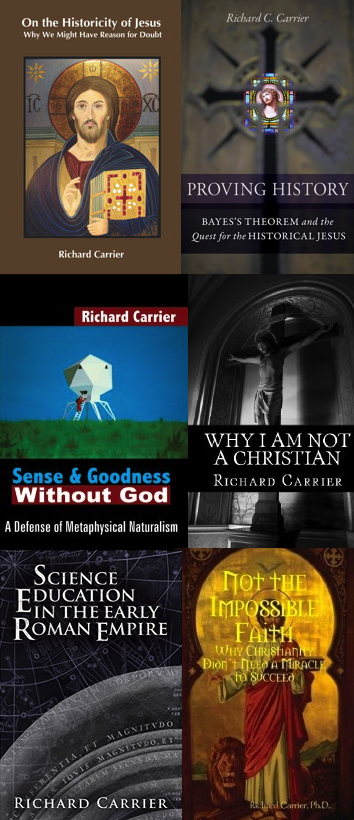


One you might add (although I do have a PhD) is my book, Bible Stories: Fact, Fiction & Fantasy in Scripture, which has just come out in paperback. It covers the history of the Abrahamic religions, and particularly Christianity, and argues that the patriarchs from Abraham to Moses and Joshua were not historical figures, there was no exodus from Egypt and that there is serious doubt about whether Jesus existed as an historical figure and if he did, we know very little about him. It also shows that some of the key doctrines of Christianity, including belief in the Holy Trinity and Hell, were late additions to theology. It ends with a chapter on atheism, arguing for it while also critiquing the evangelical atheism of Dawkins et al.
All sounds good.
I think r.e Richard Dawkins, the problem I have with him isn’t so much that he argues that people should be persuaded to be atheists (although I think persuading them to be humanists is better), I think that’s all fine, my biggest issue is more that he lacks nuance when it comes to how to criticise Islam in a constructive way and it’s clear he knows nothing about the Humanities and can be amazingly naive about some people.
He defended Geert Wilders saying “oh I didn’t see anything racist about that film”, a brief bio of Wilders would show that he´s a die hard racist, he even hates people from Curaçao, which actually legally is part of the Netherlands and all people there are recognised as Dutch citizens (I think you can guess why he doesn’t like them). That’s something I take very seriously, if you’re going to support someone, it´s best to check that they aren’t actually a fascist first.
The other thing is that although Dawkins isn’t a fascist himself, he´s taken up a lot of contemporary right wing talking points. For example, he´s fully behind Rowling´s loony level transphobia and in interviews I´ve seen him look bemused and say “but how can sex and gender be different”. Well, it seems he doesn’t give a shit for science when it disagrees with him as this is a super-well established finding in anthropology and sociology. Indeed, Germaine Greer who is probably the most famous TERF recognises that, it´s one of the biggest arguments of The Female Eunuch is we need to get rid of gender.
In fact, ironically Dawkins himself is a bit of an example of how not believing in God, isn’t enough in and of itself to get to rationality, if you don’t apply humanist standards consistently in your life. None of us do it perfectly, we all have biases, but throwing so much of modern social science out because it disagrees with your preconceptions is really bad.
Did Dawkins say that about Wilders recently? I’m sure Dawkins has said plenty of silly stuff, especially over the past decade for whatever reason, but you can hardly hold events more than a decade past Fitna against him.
I disagree, because it´s part of a pattern with Dawkins’s thinking. He´s done exactly the same with Douglas Murray, reviewing his book “the War on the West” positively.
I´ve read extracts of it and it’s rubbish, to say the least. It´s the typical right wing gripe “wah wah Western culture is constantly under attack”. Yeah, you can find very extreme postmodernists in academia and you can find intersectionality applied in a bad way (in fact, the cartoonish “privilege points” version of intersectionality, used by many people on the far left, and the far right as a strawman to attack it, is very very different from what Kimberly Krenshaw actually thought).
Above all, the book is a big tu quoque fallacy. The message of the book is “well, we did practise slavery, but so did the Arabs”, as if it actually somehow makes it better. He’s also very unfair in saying that “Western Civilisation is uniquely held to account for this”, I think pretty much all Sinologists would argue the Qin Empire was pretty oppressive, I don’t think there are many apologists for Japanese imperial atrocities (often mimicking Western colonialism, incidentally) and I don’t think anyone seriously disputes that the Ottomans were oppressive in important ways.
He also glosses over serious challenges to certain positions he holds. There are very serious challenges to the notion that slavery was abolished in the UK just because of moral outrage among the British public (which I think was a big factor). Like in the US, there were people who actually thought it was holding back the island’s economy and there is also the prestige argument, i.e it allowed the British to claim they were a more civilised empire than the Spanish or the Dutch. A massively important factor was that slave riots were becoming more common in the Carribbean, which Murray glosses over. It’s worth noting that like in the US, abolition didn´t lead to racial equality anywhere in the British empire
And despite what he says, a big issue is lots of people are utterly unaware of bad things their countries have done or are doing. Most people are pretty ignorant about history (and that has big consequences for our democracy), loads of Spanish people know absolutely nothing about the colonisation of South America or Morrocco, loads of British people know absolutely nothing about the plantations of Ireland or the colonisation of Australia.
Anyone who read that book critically, would have seen that Murray is basically overgeneralising about what people on the left (used broadly) actually think about the colonial legacy. Sure, you can find people who think that it means everything the West has done is bad, but they’re a minority. Anyone thinking remotely critically would think “but isn’t the problem that not enough people in our country actually know about these things”.
It´s not surprising because Douglas Murray is basically a fascist who is deluded enough to want to believe in “civilising imperialism” in the 21st century, he was a big cheerleader for Iraq and doesn’t even think we have any responsibility to take in refugees for a conflict the UK and US caused.
And Dawkins reviewed his book favourably because when it comes to the Humanities, he doesn’t know what he’s talking about. He just gives good reviews to anything that vaguely seems to conform to what he already thinks and he engages very badly with serious counterarguments (as with the Rowling case he just looks puzzled whenever anyone says sex and gender are different).
These are nice recommendations! The titles are provocative, but inside you DO have accessible info
Thanks so much for the recommendations. I got the Savior Complex through your link. I can’t find a kindle version of the James David Schoelles book. Are you able to set up a notice to you when that becomes available so that you can then post a purchase link?
I don’t think so. But I’ll find and poke him about it.
I really enjoyed The Savior Complex. It is a fun read and and makes a perfect companion piece AFTER having read your recent books. She doesn’t go into much detail or context on some things, but I knew the context already from your insights. Her seriousness with a sense of humor pairs well with your writing style.
I am working on getting that completed. Just some formatting to do. Give me a couple of weeks.
My problem is I have far too many interests and far too many books to finish!
The Savior Complex looks particularly interesting to me. In my case, I am not really an ex-Christian, beyond a brief childlike belief when I was 8 and I was introduced to the hippy liberal Anglican version of Jesus before anything else and I think lots of atheists and other non-Christians think “well, Jesus in the Gospels is an admirable figure, even if he wasn’t really divine”.
I think re-reading the Gospels as an adult changed that somewhat for me. Bertrand Russel pointed out flaws with Jesus very well, especially that he is only too keen to send people to hell merely for not believing in him and that’s not what a good person would do. I think hell is a problematic concept for any ominbenevolent being.
One of the biggest problems I have with Jesus as a moral guide, is that he seems utterly unconcerned with the evils of the social system around him. It makes sense, when you realise that the religion isn’t fundamentally about that and part of the early Christian message is “reform is hopeless, put your faith in Jesus” and they believed the end of the world is coming.
Right. The Sermon on the Mount is not about reforming society but the elect avoiding any accidental sin that would exclude them from the ranks come the end, which was doable because the end was soon so they wouldn’t have to sustain idiotic behaviors like submitting to thieves and slavers and murderers for very long.
Meanwhile, suppression of democracy, gender inequality, toxic superstitions, endemic diseases, famines, anti-intellectualism, slavery, things secular thinkers were well aware of as problems (however they proposed to solve them), Jesus never seems even aware of much less have any solution for (not even a bad one).
Yes to all, Jesus is a good literary hero, but as an actual moral guide, there are better people out there.
Some of his moral teachings were also ludicrous and reactionary for the time he was living in, i.e his teachings on divorce in Mark and Matthew are very at odds with the rather liberal Roman divorce laws and certainly not the product of any great moral thinker.
I also think his telling people to concede easily in lawsuits is not the best advice ever, especially if the lawsuit is not a just one. It makes sense if you see the Gospels as saying “don’t waste time with these things, you need to spread the word about Jesus and the Apocalypse is coming soon”.
What do you think about “Hunting Lucifer: One Reporter’s Search for Cults and Demons” (At Amazon I read “…As she hunts demons, she realizes she too is being hunted but is told angels are guiding her. Scofield discovers a profound truth along the way: the dark hides in the light.”)
I haven’t read that so have no opinion.
Note that she may have her own religious beliefs (trending woo perhaps), which may aid her ability to understand and infiltrate cults, though I find on her website she is generally skeptical of demonology and aliens talk, and doesn’t stump for any woo there.
I read ken’s guide and found it entertaining, even though he seems unaware that several NT epistles are forgeries. I’m reading Killing history by robert price and he says that Josephus wrote that pious jews would bury the body of crucified criminals so that they would not be put on a graveyard for the condemned. Is robert confusing it with secondary burial that you explained in the book the empty tomb?
Can you point me to the page number where Price says that?
The beginning of chapter 12: Trial and Error. ”Nor does Joseph’s desire to give the crucified Jesus a decent burial imply discipleship, since seeing to the burial of those dead who had no one to take care of it was a very important act of charitable piety in Judaism, as witness Tobit 1:16–19, 2:3–4, 7–8; Matt. 8:21. Matthew does not even hesitate to depict the villainous priests as being concerned for the burial of indigents (27:7). “Josephus the historian actually tells us that pious people undertook the task of burying crucified victims who otherwise would have been buried in a common grave for malefactors.”1 So Mark may well have pictured Joseph as having voted against Jesus and yet being concerned that the pathetic heretic receive a decent burial”. Because of Deut 21:22-23, it’s likely that in Judea the romans allowed the jews to bury the criminals to avoid rebbelion, especially during Passover, which has nationalistic implications. Why wouldn’t Joseph bury the other two criminals as well? If there was a historical Jesus crucified during Passover, he was probably buried with criminals.
Thank you. That gets us p. 174.
Okay.
First, that’s a quotation of Derrett, not Price’s own words. I checked, and the quote is correct. So the mistake is Derrett’s. Though Price missed it, so he still gets dinged here.
Josephus never says that. I think Derrett mistyped that sentence and meant to say something like usually rather than otherwise. Because Jos., War, 4.317 only says the executed were buried promptly, not that they were buried somewhere other than where the executed were supposed to be buried.
That there were graveyards set aside for the condemned (and the reason for this) is reported convincingly in the Mishnah, and in such a way as to entail this was indeed pre-war practice (but might no longer have been when the Mishnah was written). Mark does not say he is buried anywhere else than that yard (the idea that it was Joseph’s own tomb only enters in later embellishments, but Mark conspicuously does not say that and thus implies it wasn’t).
That Price agrees is implied in “If there was a historical Jesus crucified during Passover, he was probably buried with criminals.” So he just missed the awkard wording in Derrett’s quote.
Thank you. I appreciate the clarification. Killing History is a good book, even if Price frequently criticizes liberals, which is not only unnecessary but also counterproductive for him. Liberals and progressives are more likely to read his books, so to be so dismissive to a good part of his audience is not smart. I think he goes a bit far in thinking that Mark 13 is about the Simon bar Kokhba revolt instead of the first jewish-roman war and that all pauline epistles are second century forgeries. I think mark is late, but not that late and 1 thessalonians and 2 thessalonians contradict each other so incredibly that the idea that they were both invented in the second century is absurd to me.
If you read the intro, that was by design: the book is written to persuade conservatives (especially fans of O’Reilly), so digs at liberalism and outing his archconservatism is the opposite of counterproductive for his stated purpose. 🙂
Just FYI, a contrary letter could be forged within weeks much less years, so if 1 Thess was a 2nd century forgery, 2 Thess could as well be too.
I think the better case is that 1 Thess stylometrically matches the Paulines, not 2 Thess, which mimics Paul but not well enough to pass statistical muster. There are also theological congruences that don’t match the 2nd century for 1 Thess (or even post war contexts at all), whereas 2 Thess does.
But it’s not unusual now to argue they are all 2nd century forgeries. I’m not convinced but see my Livesey review and links therein.
Dear Dr. Carrier,
Have you heard of this channel? https://youtu.be/MALbRzRKCG8?is=1Bevj9HKUNFfFpI- . His name is CJ Cornthwaite. He’s a Canadian with a PhD in Christian Origins who started a channel relatively recently and has had many scholars on. Might not be a bad idea to get in touch to promote your new book and view. The video linked above released just an hour ago shows he’s open to the mythicist view but considers it an overreach. I think it would be a very interesting and productive interview (or debate if that’s what happens). The following video is also useful to know more about his views https://youtu.be/qQDXhfaEANg?is=Xgz1fNWftC2sPmVJ.
Yes. Thank you. But I was familiar. He’s in my List of Historians Who Take Mythicism Seriously. And he’s aware of my availability. But you could ask him to pursue something like that.
CJ’s channel pops up in my feed & from the few vids I have watched he is a thoughtful & competent interviewer and brings on top notch scholars. A recent vid though felt like he presented a false equivalence between historicists & mythicists too broadly as both claiming certainty & I immediately thought “he needs to interview Dr Carrier & read his latest book!” I am just a rando viewer, no connections, but I will put a note in the comments to that vid & any others that are relevant.
Richard, I know you don’t watch videos, so this is a recommendation for interested readers, which I think treads at least some similar ground to your recommendations here.
It’s a youtube channel called Centre Place, where a guy called John Hamer presents lectures on (among other things) biblical history.
As far as I can gather, Hamer is both a historian and a pastor in a very progressive Mormon-related movement, and his lectures (the biblical history ones at least, the only ones I’ve looked at) present a very secularist perspective. He’s also a mapmaker, so his presentations are full of well-made maps, charts, and timelines.
His treatment of the old testament and related writings goes into great depth about the known historical contexts and motivations in which it was all written and received, and it’s fascinating – and fills in so much that your own books build on but don’t elucidate in detail.
Similarly the new testament, where he seems to follow the secular mainstream – definitely a historicist regarding ‘a’ Jesus, but tending towards the politically and theologically motivated non-historicity of most of its narratives. He appears to credit some kind of Q source, talks about Gnosticism and Docetism, and (annoyingly) insists on referring to the pillar James as “Jesus’s brother” – but thankfully not as “James the Just”. But he’s unafraid to acknowledge how little Paul actually speaks of an earthly Jesus, the fabricated nature of much of the gospels, etc.
He also goes into the Dead Sea Scrolls, Hellenistic mystery cults, Melchizedek, Zoroastrianism, Sumerian and Babylonian history, seemingly countless side-subjects that all turn out to be profoundly relevant.
I think his own theology is very much of the God-is-(human)-love variety, and as such needs barely anything in these writings to be historically true. In fact I suspect he’s probably the type of Christian you have in mind who could accept the mythicist thesis and barely miss a step.
Anyway, as I say I think his channel could prove interesting to some readers here, so I thought I’d share.
Can’t vouch for any of that. There are thousands of channels like that. So I don’t see any utility to randomly plugging one of them here.
Fair point. Feel free to delete.
Long Form Dan McLellan?
(I heard John Hamer on Joseph Smith years ago, and he was pretty sharp on that, at least. He’s in the Church of Christ, what used to be called RLDS, the breakoff sect that Joseph Smith III started. But yeah, they’re very progressive, women prophets even.)
The Amazon blurb for J D Schoelles has ‘…before Christianity proclaimed him the Father of Jesus.’
Well, Christianity holds all the persons of the Trinity are Yahweh.
Is Schoelles not aware?
Surprisingly, Ehrman’s evinced astonishing ignorance of the same.
He thought Yahweh was exclusively the Father, and so calling Jesus ‘Yahweh’ was tantamount t calling Jesus the Father – a heresy.
That’s only a heresy post-Bible. The Trinity was invented by a political committee in 325 AD. No such concept exist anywhere in the Bible. It very clearly says Jesus is a created subordinate of God and adopted as his Firstborn Son. God is thus also the Father of all Christians, who in baptism also become his adopted sons (Jesus is thus “the firstborn of many brethren”).
Schoelles is only explaining the Bible. Not what happened centuries later.
How would mythicism respond to the assumption of the historicity of John the Baptist? McGrath’s new book is full of useless sh*t like taking the thankfully diminishing viewpoint that the gospels could be seen as being mainly historical accounts and taking the existence of Q for granted, but he does make some interesting points about the interest of the Didache text in living water and compares it to that of Mandaeism and says it must go back to the influence of John. It’s not 100% but it’s stronger than many parts of his book and struck me as plausible.
Even ignoring that, I think John was more likely to have existed than Jesus, simply because he was a prophet figure from the existing sources and thus doesn’t fit into the divine type that is more likely to be mythical. His historicity is also greatly aided by the Josephus mention which most scholars think is authentic, unlike those about Jesus, so that’s also independent confirmation. I think you at least you have to grant that there’s better evidence for the historical John than for the historical Jesus. Do you agree?
I agree, J the B is probably historical. We have an independent account.
He’s coopted by Mark to add a famous celebrity endorsement to Jesus and to have John himself argue Jesus is his superior and replacement, thus serving any propaganda war between the anti-temple factions of Christians and the Baptists. John thus gets refigured as Elijah to the Messiah of Jesus. It’s fiction, just like Jesus’s conversations with Pilate or Caiaphas.
I have a question Dr. Carrier. How did no one “call out” Mark (or whoever historicized Jesus) when he presented his gospel to the masses? Wasn’t there any elder in 70AD who must’ve said, hold on, the Jesus we worship wasn’t on this Earth, this is completely false? In Asia Minor or elsewhere? Even if we say the Jerusalem exodus destroyed the core community there were still other communities who weren’t affected. If we try to imagine how this would’ve happened it doesn’t make much sense. This is necessarily in the realm of speculation but I think a mythicist theory needs to answer how it could’ve realistically occurred. Also I didn’t find this article How Did Christianity Switch to a Historical Jesus? • Richard Carrier Blogs to answer the question I have in mind.
I already covered this in my original study: Historicity, Ch. 4, Element 22, pp. 148–52.
All Christian literature in which any such call-out would happen was destroyed (whether just casually lost or deliberately disappeared). So we don’t get to see what anyone was saying or thinking about Mark’s publication, con or pro. Christian literature about themselves between 1 Clement (60s AD) and Papias (130s–150s AD) is 100% gone. We have not even a scrap. Nor even a quote or paraphrase. Even Eusebius, when he wrote their history in the early 300s, could not find a single scrap of historical material about his own church in that gap, so thoroughly was it lost.
Papias, it is clear, also had no access to any, and thus was reduced to reporting contemporary urban legends, which by then were so divorced from anything that actually happened as to be utterly useless. We see this as well in what we know of Hegesippus: he only had contemporary apocrypha, new myths and propaganda texts, no actual historical material. Neither did Marcion, as all he could muster was an edited edition of Paul’s dossier and some recent forgeries. When Tertullian goes at Marcion for claiming the other Gospels were frauds (the apostles “distorting” the message requiring Marcion to publish his “pure” version) the discussion reveals quite clearly that Marcion had no one to cite in his favor, and Tertullian had no one to cite against him. They neither of them had access to anything at all about what anyone was saying, either way, about any Gospel—or any developments in the Church in that period besides. So if even they did not have it, neither will we.
This is why it matters that Christianity appears to have almost died out in the early 2nd century and the bottleneck resulted in a massive loss of institutional records and knowledge, leading to late 2nd century Christians having to make everything up. This is why the surviving commentators miss practically every literary allusion and device and message in the Gospels: they had to reinvent stories about what their authors were saying or doing, because they no longer knew by then (and if any did, the surviving orthodoxists declared it heretical and shunned and destroyed it all: I document that across the first part of chapter 8 of Historicity and with the example of docetism in chapter 7 of Paradigm; extensive support for this point is now in the latest monograph of Markus Vincent).
It’s only the worse that this was built and run like a mystery cult, and thus was actually a secret society (explicitly in Paul, Hebrews, and Mark: all refer to outsiders being kept from knowing the truth by insiders being inducted and sworn to secrecy). They were public in their evangelism and existence, of course; but like modern Scientology and Freemasons, their “true” doctrines and teachings were secrets. Consequently, there might not have even been anything in writing at all about what people thought of the Gospels as they came out—until Luke, who is the first to even mention that Gospels existed to comment on. And that’s already early-mid 2nd century. After the blackout and its loss of documents. Before that disputes could be kept secret and oral only, as otherwise would look like betrayal and thus fail at its purpose.
This is evident in Matthew, who rewrote Mark to try and win the propaganda war. Matthew (along with Revelation and James) is from the anti-Pauline sect and thus well knows they had to get ahead of the crisis started by Mark promoting the Pauline faction. And yet they did not write a screed or a debunking treatise (like Tertullian did against Marcion, for comparison). They didn’t even mention Mark at all. Their objective was to do it secretly: just compose an alternate mystery text that they hoped would eclipse the original and thus be believed the original and Mark’s the fake (and all the promo for this may well have been oral, not textual; but if any epistles were pushing it, we don’t have those because we don’t have any epistles from the blackout period, and neither did even Marcion or Tertullian have access to it—yet we know there must have been a ton of interchurch correspondence over that period).
So all Matthew’s critique about why Mark is wrong about everything is hidden behind rewrites of stories, added stories, and other symbolic rather than direct attacks. This is what it looked like to call Mark out. And that’s a behavior typical of secret societies. Later John did the same thing to Luke: rather than call Luke out directly, he just writes a contradictory Gospel to refute it by process rather than argument.
So, as such, Mark was called out. That’s what Matthew, Luke, and John are doing. That this doesn’t look like the analytic, “fourth wall” call outs of later practice (with the first heresy hunters like Tertullian and Irenaeus) is because the culture of the church had changed in the interim. Breaking secrecy, and basically denying there ever was any, claiming anyone preserving the oral lore of it a faker and heretic rather than a preserver of the original tradition, was the strategy that won the propaganda war. So like the Soviet state “version” of its own history, we don’t get to see the real history of the church.
Great answer and thanks a lot for the lengthy and detailed response. However I wanted to clarify something, that my main question wasn’t about the relevant evidence, which unfortunately is practically nonexistent. I was moreso asking about speculating how a gospel that historicized Jesus could’ve found widespread favor early on. What would the mechanics of that be? Christianity may well have been similar to mystery cults. Wouldn’t Mark or sections of it be still be read in churches? Wouldn’t new believers interact with older ones? Do you assume there were different congregations or one congregation and the older believers were clued in that this was going to be the new program?
Surely more attention in mysticist literature needs to be paid to this. I think enough evidence has been demonstrated to show the earliest texts are all compatible with and lean towards a celestial understanding. Speaking for myself the mechanics of the transition on the level of individual human interactions, the micro-level, is the only remaining holdup for me. I think speculation would be totally legitimate in a case like this, where sticking to the evidence isn’t an option because there is little to no evidence.
This hinges on what you mean by “widespread.”
You also might still be stuck in Christianity’s own fake history here. You have to purge their fantasy of how the church operated and grew before understanding the place of texts like Mark. I cover all this in Historicity and many modern scholars are already aware of it but don’t popularize it well. So you might need the following detailed reset before we can even answer your question intelligibly:
Christianity was a tiny fringe cult. It’s total membership across three continents when Mark wrote was likely under two thousand and may have been only several hundred.
By the time of Pliny it appears it was even worse—in decline, rather than growing. The competing movements of Marcion and (let’s call them, a la Trobisch) the Polycarpians led the revival under a big charismatic and publishing push, backed by gargantuan monetary investment (elite capture). Marcion was a functional billionaire at the time, thus analogous to Peter Thiel without any democracy to keep him in check—and it is evident Polycarp assembled even more billionaires to fight him, though we don’t know their names (the equivalent of Bezos and Soros, say), but we know they existed behind the scenes bankrolling it, because the manuscript record shows they flooded the market with their NT, completely swamping Marcion’s, which entails they had more billions, and that both sides were monetizing Christianity with a massive capex.
But Christianity had nothing at all like the scale implied by Acts until well into the second century. And it was split already into multiple competing factions. Paul mentions more than one, but only tells us about one competing faction, the Torah faction, which were his main nemesis throughout the letters, particularly as they were the most influential with the originators of the sect who were thus seen as its highest authorities by most—but clearly not all, as there were splinter sects Paul knew about that apparently didn’t even try to court the authorities as Paul eventually did (and that he was courting them meant the only competing sect he had to care about was the other one courting them).
So once you understand the actual situation, the sequence of events looks like this:
Peter launches the fringe sect. He had twelve henchmen to first recruit and maybe a few hundred “venture cap” members to sway into splintering from whatever sect he was advancing in at the time (it looks like something very similar to the Qumran sect but need not have been that exact one specifically). I suspect less (more likely only a few dozen), but that gets into a separate rabbit hole I’ll skip here. But a fortiori, we can say “five hundred” just for argument.
They go around preaching across three continents, and some split from the main faction, or inspire upstarts to muscle in (Paul is just the example we know of; Acts implies there were others), resulting in fragmentation within twenty years (when Paul is writing, there are already multiple splinter sects of this group). They maybe double or triple their numbers by that time and spread out across the Diaspora where they were more successful. Paul appears to have been multiple times more successful, because he made entry cheaper, and thus captured the godfearer market far faster. Think iphone over blackberry.
It is clear that the mission was not very successful generally as Paul has no competing churches in his targeted markets (meddlers are always outsiders touring in), he’s the one founding most of them (meaning the ones he mentions; we don’t know how many others there were, but he mentions Apollos as a successful competitor, it just appears in other urban markets than Paul was the first-mover in). And it seems evident his faction’s numbers soon swamped the original sect (hence the panic of the Judaizers trying to muscle in to control of his churches, necessitating Paul’s embassy to the pillars to arrange a detente).
At the brink of the Jewish War we have one more datum:
1 Clement tells us they still had very little hierarchy. Bishops were minor managers, not authorities; and there was no real established authority: the apostles were revered, local elders next, but Clement makes clear there is no central control, each city’s congregation ran itself. So Clement had to attempt diplomacy to get a fellow church in line, and could only appeal to surviving apostles, most by then dead, and local elders as authorities. Though writing from Rome, there was no special power there, so he couldn’t order them to do things; no authority existed at Rome the Corinthians would obey. So churches were essentially locally independent franchises, with no outside corporate control.
Also, IMO, it appears things had gotten pretty cutthroat by then, with wealthy members essentially sex trafficking their women with near impunity and rivals for power getting each other framed for crimes and thus killed to get them out of the way (see Interpreting 1 Clement’s Supposed Descriptions of Fabulous Murders).
Then the War.
It is not possible to under-emphasize how that changed everything.
Judaism was now super unpopular, no longer legally protected, and their Palestinian congregants and assets almost entirely wiped out. Moreover, by mid 70s all apocalyptic clocks had run out, so the idea that the War was just the opening of the apocalypse failed. This meant Judaism was left condemned by God, and the temple cult erased, forcing Diaspora Jews to completely reinvent their religion to accommodate atonement without a temple apparatus.
This was probably a fatal blow to the original Torah faction. It was just bleeding out after this. Though it had a good pivot plan (since they were already anti-temple), it had all the other defects hanging around its neck like an albatross. The Jewish faction thus just shrank after that. It appears to have survived into the Middle Ages as only a tiny (tiny) sect outside the Roman Empire (in the southwest Mesopotamian area). But was already well dying out by the third century within the Roman Empire. But had enough surviving congregations mid-second century to be necessary to recruit against Marcion by the Polycarpians (that’s why their literature was selected into the canon despite contradicting the rest: to get them on board; the rest could be solved with clever exegesis).
So the context of Matthew is a desperate attempt to staunch the bleeding caused by Mark, by a faction already on life support and panicked. Luke is an attempt to get the two factions back together (though with the Gentiles still on top and the Jewish Christians merely “integrated”). And the final redaction of John is the opposite: a final, coded, antisemitic divorce (the order “Matthew first, John last” thus reflects the real ideology of the Polycarpians: yes, we started Jewish, but now fuck those guys—but all in dogwhistles because they needed the Jewish faction’s remaining numbers, influence, legitimacy, and funding to tip the scales against Marcion’s campaign).
So when Mark wrote, he’s facing a completely open market, and no meaningful competition, and has the wind at his sails due to the War. In fact the War is the market jump for his entire project. He is capitalizing on the global paradigm shift that created, to sell the perfect solution: you don’t even have to be Jewish to get the Jewish god to save you.
Insofar as anyone would even dislike his project, that meant only the already shrinking and thus almost impotent minority of the remaining Jewish faction, who weren’t Mark’s audience anyway. He was writing a consolidating treatise for the Gentile mission, which no longer cared about Jewish recruits (they were fine, but there were far more customers to get in the Gentile market, and a lot more money and respectability to gain there), nor cared what the holdout Judaizing congregations thought (wherever they were—none exist in any of Paul’s cities, and he only mentions examples in Rome—and Jerusalem, which by the time Mark is writing no longer exists; it would remain a forcibly uninhabited ruin until mid-second century—although IMO I suspect there was a basecamp of them in Arabia, and that may have something to do with why Paul’s mission to Arabia failed, with him fleeing Arabian marshals for reasons he conveniently never explains—but there had to be enough in the Roman Empire to require courting in the market war against Marcion).
So when we get to your question “how a gospel that historicized Jesus could’ve found widespread favor” that’s the function of many of the Elements in chapter four and five of my original study (Historicity).
All Mark had to do was convince the already-sympathetic majority of congregations to adopt his project. Which they would be primed to do by its obvious in-the-moment utility, and the belief that this is what a sect had to do. Because it’s what every other successful mystery cult did: they all flourished after historicizing their saviors in the functional equivalent of gospels. Mark is simply replicating what was believed to be (and on good evidence at the time) the best business plan for that kind of cult; and he would be well received for exactly the same reason.
His only opposition would be the Jewish minority—who duly responded by accepting the paradigm (“marketing texts like this is how sects like this thrive”) and simply rewriting the text.
It’s important to recognize that at this point no one is actually trying to convince any congregation that Jesus was a historical Galilean preacher. They are all riding on Mark 4’s code: this is all facade; real meaning underneath, only told to insiders. So at this point anyone being convinced Jesus existed by this Gospel would be secretly snickered at as an ignorant outsider. Very much like the way in the era of early 20th century union busting, union workers would change the way they pronounced streets and towns so they could spot carpet bagging scabs.
This is still the game when Matthew composed.
And it matches exactly how Plutarch described Osiris cult operated.
The game changes sometime in the early second century. Luke seems intent on courting literalists rather than condemning them (he is now on to the theory of double truth as later explained by Origen, which other mystery cults had already embraced). While John is explicitly courting literalists and condemning anyone clinging to the original paradigm. This is all much clearer when you delete the false modern history of docetism and reset to what actually happened (hence chapter seven of Obsolete Paradigm, which quotes scholars also noticing this shift from the original mystics to the upstart literalists condemning them, which appears to have preceded and might even have spawned the Marcionite gambit).
So in that actual context (as opposed to the fake context invented by Christians centuries later and still clung to today), it’s self-evident why Mark’s euhemerism project was readily and widely embraced within the Gentile church (indeed it’s time was come and the iron was hot precisely then), and was only combated by the competing Jewish church, which we witness in the surviving text of Matthew as their hat in the same ring. Because in that era, they didn’t object to faux historicizing. They objected to its coded messaging. So they just needed to promote their own coded story.
Everything else happened decades or centuries later and thus isn’t relevant to this part of the story.
Dr. Carrier, I can’t thank you enough for taking the time to write this very detailed and comprehensive post. I have one (or two) more questions in light of your explanation: why do you assume c. 30 AD was around when Christianity started? I can understand why mainstream scholarship does, because there is a fear of being too critical or pushing too far on traditional Christian narratives.
But why would that be necessary for someone outside that fold?
Even though Christianity was undoubtedly a small sect in Paul’s time, it was still big enough to have different and competing sects a mere 20 years after its supposed starting date, and even though it was still fringe, people were apparently melting when they heard the gospel from Paul.
I know he talks about the 3+14 years in Galatians, but that is only dating from his conversion. So don’t you think we have reason to give a wider window for the start of Christianity based alone on the diversity of Christianity seen in Paul, to allow more time for that diversity? The Christian world Paul paints is too weird for a movement that’s been around for only 20 years and doesn’t have the backing of a state for its growth.
The early spread of Christianity is also very weird to me. We can usually explain people joining religions due to socioeconomic factors, such as a newly dominant state religion, or access to monetary resources, or as part of a nascent quasi-political faction demanding more rights/power. (Spiritual factors are of course valid, but they usually go hand in hand with the aforementioned factors, especially in the pre-modern world). Why on Earth would pagans in Anatolia and Greece join Paul’s new religion (Galatians, Thess., Corinthians)? At least with the Greek mysteries you could explain it was in the realm of something they knew about, and it did offer spiritual benefits and possibly material benefits, so it would be kind of like converting to a different sect of the same religion. Why would Pagans switch to a completely different religion upon hearing the gospel from Paul, even if it had some similarities to their previous religion? Is it probable/possible there was a rich benefactor early on in Christianity, maybe Peter himself, or Paul? Were the spiritual benefits of joining Christianity simply too great to resist…I don’t know if I would find that plausible.
Imo pushing back the start date is the only way to allow for a slower and therefore more plausible rate of spread and diversification while keeping the rest of the mainstream/traditional account of spread. If we want to maintain 30 AD, surely the story of early Christianity must be revised, and perhaps some doubt must be cast on the contents of Paul’s letters, either that he’s lying (but how could he lie to his addressees) or there’s been some editing going on to make it sound like he’s converting Pagans, which would be appealing for the purposes of evangelist Christians at a later time.
Even if we want to maintain 30 AD, why can’t we also use a plausible timeframe for the start of Christianity like we do with many other dating problems from that era (dating books, people, etc.)? If anything c. 30 AD seems to be the absolute latest Christianity could’ve started.
Thanks again for your response.
As it happens, I wrote a whole article on that:
How Do We Know the Apostle Paul Wrote His Epistles in the 50s A.D.?
But I think you will benefit on the methodological issues there that I discuss in Can We Doubt Paul Existed? (not directly on point but you’ll see the relevance when you’re in there).
Which question evokes me to answer your first question taking it a different way than you may have intended:
I explain in Historicity why I assume a lot of mainstream stuff there: methodologically, to argue a fortiori. Otherwise if you bog a thesis down with a hundred deviations from the consensus you will fail to persuade, both rationally and psychologically. Every “maybe it’s something else” premise reduces the probability of your thesis; and multiplying improbabilities compounds, such that a hundred together is massive geometric progression, trashing any probability you could have hoped for into effectively zero.
Hence the purpose, as stated, of chapters 4 and 5 (and 7), is to nail down what minimal set of premises can we be sure about, and then show what the results are on those premises. Yes, maybe many of those premises are false and we just don’t know it or haven’t proved it yet. But that doesn’t matter to the point, which is that, even on their own assumptions they should abandon historicity as a paradigm. That’s how you win arguments. You can’t throw a zillion wild claims at them and expect to get any traction. You need to do the opposite: keep any deviation to an absolute minimum, and then meticulously prove those. No other method is valid. Future scholars can then try to shift more. But you can’t shift a hundred things at once.
That’s explicitly stated as the study’s methodology and is consistently deployed throughout. The most conspicuous example is what I say about the dates of the Gospels. I have more to say on that in Ignatian Vexation (which is now in my book Hitler Homer).
Nevertheless, on this one point, I also happen to agree the mainstream view is more probably than not correct. While I am more sympathetic to the Marcionite Prioritists (who try to update the origins of Christianity to even after the Jewish War and/or its texts to the second century) and the High Chronologists (who argue for a c. 70 BC origin of Christainity), I remain unpersuaded by their arguments, and find just enough evidence against them to bolster the standard Low Chronology. It is at least > 50% the correct chronology, on evidence and logic. That doesn’t mean it’s > 99.99% the correct one, however. Hence I don’t consider the hypothesis ridiculous, just more or less false. But if I force-ranked these three chronologies, it’s probably: Low Chronology (the mainstream view), High Chronology (the pre-Roman view), Marcionite Priority (the post-War view).
What I see you falling victim to here is a common fallacy we need a name for. I’ve discussed it before with respect to arguments over the authenticity of Daniel: there is a tendency to see time differently the farther away something is. So, something that we readily recognize can happen in even a single year today, is somehow thought to require decades in antiquity.
Your “twenty years is not enough time” is an example of that. Why? Sectarian divisions can happen immediately, within days, certainly within years. They do not require even one decade, much less two—even less five or whatever. Mormonism officially began in 1830. On the death of Smith in 1844 it split immediately into several sects. So even just counting his somehow holding it together when alive (a thing less available to ancient operators, who will have completely lost control over anyone with new ideas a whole province or two away, or even another city or neighborhood away), that’s still a multisectarian split in under fifteen years. Where one sect existed, within days (not years), four did. The same happened to Scientology while Hubbard was still alive (they didn’t survive, but even the one surviving sect is barely still alive), likewise the Rajneesh movement. One could even say the explosion of UFO cults in the 1950s is an example, culminating in the most successful ones (the Raelians and Heavens Gate) which launched in the 1970s, less than 20 years from their forebears.
The readiness and speed with which new sects could form in antiquity is one of the reasons strongmen tried taking control of the Christian church in the 130s to 160s. A lot of what happened in that period is explicable as a struggle to control and limit the speed and divisiveness of schisms, by developing extreme slander and shunning campaigns and actual political moves to unify disparate sects into one loose affiliation to take over churches and get rivals killed or run out of town (and of course, deploying massive capex on the problem). This was why there was then a push to even have a canon and lock out access to authority claims by using historicity to lock in only those claiming apostolic pedigrees as legitimate (while denouncing anyone else claiming such to be faking it, when of course they probably all were), vs. several sects claiming a living voice of Jesus was still appointing apostles (this was the main reason Tertullian eventually turned on the Montanists to join the Pseudo-orthodoxists).
In short: things happen waaaaaaaaayyyyy faster than you inexplicably think they do. And your understanding of history must take that into account. What takes a few years now also took just a few years then. It didn’t get magically telescoped into a decades long trudge. Obviously anything could take that long. But it never had to. And it didn’t usually.
Indeed. Read Element 29 in Historicity. I show that Christianity exactly fits, item by item, the entire criteria set in anthropology for the phenomenon of revolution cults throughout history. And Elements across chapters 4 and 5 (especially Elements 5, 13, and 23–29) demonstrate how the political situation was so apt that one could have predicted the rise and spread of Christianity a hundred years before, if they knew what they were looking for. It’s exactly on point to existing sociopolitical theories of religions and new cult crazes.
Case in point: you have the history exactly wrong.
First:
The Romans complained of how quickly “new cults” spread like wildfire and became popular. They were all alien cults, completely unknown and foreign until they showed up.
How did they do this? By packaging themselves in familiar veneer. So Isis cult did not rage across Rome because it was familiar, but because it was packaged in familiar things. The base example is the politically integrated Eleusinian cult of the Athenians. Every subsequent mystery cult adopted its trappings to evangelize itself effectively in foreign markets. That’s literally how mystery cults acquired the plural “cults.” And notice: that’s exactly what Christianity did. Indeed, it was a late comer to the party. Every other major culture had a multicultural mystery cult success story. It was just a matter of time before the Jews would.
Second:
In an environment that does not punish sampling—in other words, before abusive exclusivist religion gained imperial support (which did not happen until 325 AD)—spread of new religions is so common it actually creates the thing we call polytheism. Because of a psychological effect known for the spread of superstitions: because superstitions aren’t real, their success is stochastic, and thus fail eventually, driving an operator to switch to something new (believing it must have juice or it can’t hurt to find out). So, pray to Athena, get boons, feel good, then something goes wrong, look for a god that hasn’t failed you yet—hey, a god that drives people to travel hundreds of miles promoting it must be pretty effective, why else would they (yadayada), so let’s try that one. And because you are never punished for this, you can keep them all. You can go on believing in Athena while still trying out Cybele, and maybe that weird new god from Ethiopia is worth a look, and so on.
Empires thus accumulate gods and religions like junk in the attic.
Until they start punishing this. Then people are coerced to hew to only one and condemn all others. Which forces the zero sum decision as to which one will hurt less to adopt, which is typically going to be the one the empire rewards you for.
But that didn’t happen for a while. In the meantime, Christianity’s growth was limited by its exclusiveness to people who were so desperate or so moved or so bound to friends and relatives joining that they could justify going all in to get the bennies (usually food and friends and feels). Except the rich who then saw in it a way to become a big fish in a small pond (hence, early elite capture), and weak adopters (who could pretend to obey the exclusivity for as long as they could get away with it, and then their choice would be controlled by the cost of exposure or leaving, standard cult stuff even today).
These are all standard dynamics in textbooks on the psychology of religion.
In this context, Christianity fits exactly in its context. Which is not to say it was as successful as apologists claim. It likely won barely a few percent of the population before its imperial takeover.
And in that respect it was comparable to (and in fact largely built itself out of) Godfearers: pagans who already liked the idea of exclusivist Judaism and hung around it but just couldn’t mutilate penises or give up pork. When Jews became the “Enemy of the State,” Christianity became the best way into what they already wanted. And Gentile Christians had already leaned into that by eliminating the barriers to entry. So it accelerated growth in a normal fashion. The data show Christianity grew at about the same rate as Mormonism did (I cover this in the last chapter of Not the Impossible Faith). Which was another alien, heretical cult in its own persecuting imperial context.
There is a lot more to the story of why people join culture-defying cults like Mormonism or Scientology or the Cargo Cults or Falun Gong or Rastafari or Sevians or Raelians or Moonies, which also exactly match what Christians were doing and the context they were in. But hopefully you see enough of the point here.
Thanks again for the detailed response, I’ll consider these points carefully. It’s been a minute since I read OHJ and I read it before I could properly digest it so I might have to reread it again. Regarding the high chronology point, I was more so thinking 10-30 AD, because I still believe Peter and the “twelve” played a primary role in starting Christianity, and I trust that Paul met Peter in person, so I’m not inclined to push it before the common era. Do you think that’s reasonable? If I had to guess, I would say c. 20 AD is the time that most makes sense to me and preserves the mainstream idea that Christianity had inherent competitive advantages that allowed to spread relatively quickly, even though it was still small by Paul’s time.
Also, what do you think about the idea of rich benefactors early on? Do you think that is probable or bordering on probable, or do you think it’s possible but not necessary as an explanatory method?
I also want to say I definitely agree with this point when it comes to arguing a point within a scholarly work (book/article etc.) “You need to do the opposite: keep any deviation to an absolute minimum, and then meticulously prove those. No other method is valid. Future scholars can then try to shift more. But you can’t shift a hundred things at once.” But as you can guess I was talking about a personal belief outside of books/articles where the issue of chronology isn’t the main topic being discussed.
Thank you. Your questions and followups have been good enough I might cobble this into a blog post with more links and citations.
As for the 20 AD thing: this conflicts with the Aretas datum. The only two dates that work for that are the 30s AD (for Paul writing in the 50s, getting the Aretas incident into the mid-30s) and the 70s BC (for Paul writing in the 50s BC, getting the Aretas incident into the 60s BC). I explain this in the linked discussion about the different arguments for standard high and low chrono. In short, high chrono has the advantage that it solves this, while low chrono complicates it but at least has the historical events of the Nabataean war, whereas changing the data decade up loses that advantage, so it becomes less probable than standard chrono. And so on. These are not conclusive. But it makes your thinking less probable than others, which have more evidence than you to point to. Since you already have to drop the Pilate framework, that leaves 70s BC more likely than 20s AD.
As for spread, there is no data that it spread any faster than any other religion in history. In fact its growth looks dead on standard for sociology of religion.
As for wealth, there clearly weren’t Peter Thiels in the early decades. There were some moneyed persons involved (Paul refers to them; congregations churched at their houses). But Paul being accused of graft constantly indicates that they had only small fish on the hook, no one with real juice; and Paul appears to have been the wealthiest member of the movement at the time, and even he had to hustle, so he wasn’t that rich.
Pliny the Younger’s trials also indicate no major players connected as of the 110s. The first time we see any evidence of serious big fish getting involved is Marcion, which is the 130s, a century after the cult began. And it appears his impact was precisely that this was the first time a Peter Thiel type moved in on the religion, sparking the panic: if there was going to be elite takeover, there were opinions about which elites that should be, just as there are camps today that side with Thiel or Musk against each other; and so the division between Marcionites and the consolidation of an anti-Marcionite league began, essentially originating modern orthodoxy as a reactionary political move. Likely on that side it moved up the ladder of client-patron relationships to recruit a group of big fish in exchange for power and influence in the movement. Selling their soul to win, as it were.
Footnote: I’ve guestimated Marcion at billionaire status but it might safer be said “tycoon status” at over a hundred million maybe over a billion. I calculate the dollar adjusted value of silver coins in Science Education, 52 n. 125, which is already out of date due to skyrocketing US inflation, but since minimum wage has not budged (even though it should be at least $15 it remains at just over $7), the math is still the same. But running for either value, Marcion’s 200,000 sesterce donation has a modern lowball value of almost six million now; but really, price adjusted, twelve million. That’s unlikely to have been even a twelfth of his net worth as a major shipping magnate (the standard annual interest rate then, so a minimum year’s passive income for him). So at minimum he was a mega-millionaire at over 144 million net worth. Would he give away a year’s income? Probably not. If his donation was 1% of his net worth, the latter would have been 1.2 billion. Either way he’s very big fish. Nothing like the few upper middle class donors Christians were tapping in the early days.
Thank you again for the response, however I wanted to clarify a point. In one of my replies I did acknowledge that Paul’s conversion happened in the early or mid-30’s, but I was talking about the start of Christianity with Peter when I was mentioning the 10-30 AD window and c. 20 AD. As far as I know, Paul’s letters don’t indicate that Jesus “died” or Cephas first started seeing visions shortly before Paul’s conversion, not to mention a specific number of years. Of course Acts does mention his conversion happened shortly after Jesus’s death, but I assume you would agree that is not a trustworthy source on that point. Unless there is other information I am not aware of, I don’t see why we can’t be freer in backdating the start of Christianity or at least giving a wider window for its start. And to reiterate, the reason for this argument is, it’s how almost every other event from that document-poor time gets treated or should be treated (window of time, not certain date that lines with tradition), and secondly, to allow more time for mainly the diversity and spread evident in Paul’s letters, although I understand you think 20 years is enough to explain that.
I greatly appreciate you taking the time to respond, and I will leave this to be my last comment as to not take more of your time, although there is of course much more to learn about this subject.
That’s what I mean.
Paul had to have converted by his own chronology within a few years of the religion, because Jesus remains the firstfruits of the general resurrection (so decades cannot have passed by then; in fact by Danielic logic, no more than seven years could have, and more likely it was less than three) when Paul’s revelation closed the loop, making him “last.” So his own chronology puts the Peter vision (starting the cult) in the 30s AD (or 70s BC on the only other viable model), because the letters then date to the 50s (AD or BC) by his own internal chronology (Acts is useless so its chronology should be ignored). Paul then started writing letters after the imminent end did not come and he had to pivot to keep his congregations together (this is why many conclude 1 Thessalonians was the first written, and Galatians close second).
It gets difficult and awkward to shift the chronology by decades either way, and that is going in the wrong direction on the probability curve.
Gonna against my word and reply but were you referring to the 70 weeks of years prophecy here: “in fact by Danielic logic, no more than seven years could have, and more likely it was less than three) when Paul’s revelation closed the loop, making him “last.””? One could argue this could be one of those things that is “discovered” after the fact to further justify the new movement instead of Peter waiting until this prophecy is fulfilled to start his visions. I’m not sure though.
At any rate, do you have any book/article suggestions for this topic, let’s call it the sociocultural context (encompassing demography among other things) of the first 40-50 years of Christianity? All the well-known ones I am aware of are too accepting of the traditional narrative to my taste and are all firmly historicist (which is to be expected).
Actually I present evidence in OHJ that the Daniel prophecy was the thing driving messianic fever exactly then. It’s even mentioned by Josephus. It is already being discussed at Qumran. It was not applied after the fact.
The expectation that a messiah would die, beginning a seven year end-times clock was so locked in it was a common Jewish belief by the time of Paul. My recent study confirms this across a wide range of scholarship.
This is what Paul is referring to when he says Jesus is the first part of the general resurrection: the death itself began the period of resurrection of all Israel (a concept found in only one place: Daniel 9 & 12), with only a brief pause to bring in the elect. Jesus is not an isolated special resurrection. His resurrection is the resurrection, beginning it.
That is not a belief that could be held decades after the fact. By then, Paul would need to come up with some other framing than that. The idea that the end was in progress required mere years of distance to actually say Jesus began the resurrection of everyone. Paul would only then be locked into repeating but reinterpreting it decades later.
But there are direct references in Paul: 1 Corinthians 6:2 references Daniel 7:18–22, 1 Thessalonians 4:17 references Daniel 7:13, and 1 Thessalonians 4:13–16 and 5:10 and 1 Corinthians 15:40–42, 51–52 and Philippians 2:15–16, etc. reference Daniel 12:1–3 and 7:13–14. Likewise Dan 2:21 is referenced in 1 Thess 5:1.
This is all in alignment with the Melchizedek Scroll, a pre-Christian pesher on Daniel 9, which originates many of the themes Paul takes for granted above (celestial messianism, imminent apocapyticism, describing the risen messiah as an archangel, the short timetable after the death, including placing the death seven years before the resurrection of all Israel, etc.).
So, no. This originated Christian thinking, right in line with pre-Christian Jewish sectarian thinking all around them, particularly among sects the Christians were most like and thus most likely originated from or were influenced by. It was not discovered after the fact. It was a cause of Christianity. Not an effect.
I sympathize. That we need the thing you are asking for is precisely what Obsolete Paradigm was written to explain and encourage. The field is ignoring it. So it won’t give you one. And I don’t have the time or resources to do it myself, unless it was with a team of scholars sharing the labor and dovetailing their specializations.
Vinzent also wrote a whole book arguing that we need the thing you are asking for. He is also being ignored.
So, that’s where things are. I don’t see it changing anytime soon.
The closest you’ll get is almost useless hodgepodges like The Next Quest, which fails because it simply assumes historicity and mostly traditional narratives, and produces no coherent comprehensive result but just a random candy bag of microtopics.
Thank you for all the replies and insights Dr. Carrier. This thread is full of quality information you’d be hard-pressed to find elsewhere for this topic.
Thanks again for your book recommendations! They are always interesting.
Money is tight for a lot of people. Anyone looking for a taste of “The Savior Complex” before shelling out for the book can check out Be Scofield’s Substack page. It has a few good articles:
https://thesaviorcomplex.substack.com/s/jesus-and-christianity
A friend of mine recommended your book Jesus From Outer Space a couple years back and I really enjoyed it. His name is Peter DiGangi and he has written his own book called Dying For The Faith. I understand you consulted with him on it. The way he depicted some of the events that led the mythological Jesus to be accepted as a historical person helped me visualize how a relatively implausible claim might be, in fact, what actually happened. The best examples would be his depiction of the tensions between Paul and Peter and James at the Jerusalem Council; and another was the chapter on Eusebius and his interpolation of the Testimonium Flavianum. I wonder if it might pick up where The Savior Complex leaves off?”
It’s a different project (fiction rather than history). But in a way.
Dr. Carrier, I ordered the YHWH book you suggested. I was quite disappointed in the print format. It is way too light & the lines are too closely spaced. Not easy to read. After just a few pages, the eye strain was intolerable. Returned it for a full refund to my Amazon acct. I am disappointed. Hope the publisher improves this unfortunate condition. Thank you.
I didn’t have that problem.
I guess user experiences will differ.