
While my Three Recommendations in Godless Epistemology were of books I added to my Recommendations in Philosophy list, I wanted to post three more recommendations that veer too far to be suited to that particular list for reasons I explained last time:
I don’t include philosophy of religion (“atheism,” “counter-apologetics,” and the like) on my Recommendations in Modern Philosophy page beyond the single catch-all gateway text of Murray’s Atheist’s Primer, because I don’t actually think philosophy of religion is all that serious (it’s mostly tinfoil hat) and the point of my list is to skill atheists in building their own philosophies, not let religious crazy colonize your mind. Religion, theism, supernaturalism can all just be ignored as stupid (and no, really, it could), allowing you to spend all your thought and time on real philosophy that actually matters and is evidence-based and logical. But, yes, it plagues our society. So you need at least some skilling up in dealing with it, so I put one token recommendation in my list to cover that niche.
Hence my only other such recommendation there, John Loftus’s The Outsider Test for Faith, I added more for its use in epistemology generally than as a philosophy of religion text. Which is ironic considering the three books I want to discuss today, which I do think are must-haves for anyone building a good Philosophy of Religion library. Because one of them is an extended argument for the same point—that philosophy of religion is mostly a stupid waste of time and we should have to spend way less time on it if we could. The others add crucial deep-dive material on the Argument from Miracles and the Argument from Evil, which essentially prove the same point: responding to Christian apologetics on these is always a process of just reminding people that all the modern arts and sciences and their methodologies rejected all the silly naive nonsense that apologetics depends on so long ago it’s exasperating that we still have to re-explain all this.
But alas, we do.
I already recommend another Loftus trilogy because I’m in them, the edited volumes full of expert analyses on diverse subjects, often the best brief in each topic you can find: The Christian Delusion, The End of Christianity, and Christianity Is Not Great (riffing on the three horsemen’s God Deluson, End of Fath, and God Is Not Great, which are 101 and thus actually much less intellectually useful).
As always, I get a commission on anything you buy on Amazon after clicking any link on my website—in fact, on everything in your cart when you check out within 24 hours after following a link from my site, even if you don’t buy the item you clicked on but instead wander around Amazon and buy, say, an actual dead bat or a Poe about teaching your cat about important MAGA issues like gun safety and Satanism instead (those links might not convert outside the US; but follow a link that does—books usually do—and then find products to add to your cart).
Here are today’s recommendations:


-:-
All three have abundant documented praise from a wide assortment of philosophers and historians and professional atheists. Although I have some mixed views of them, they remain very important books to have, use, or engage with, each for a different reason. And again two of them collect the excellent work of many scholars, not just their editor,
The Trouble with the Philosophy of Religion
The first is the most controversial: you can think of Unapologetic: Why Philosophy of Religion Must End as a companion piece to The End of Biblical Studies by Hector Avalos. Avalos argued, in magisterial fashion, that his entire job should be eliminated, that “biblical studies” should not exist as a field, and all the personnel and resources wasted on it should be disbursed to broader fields of more diverse cultural studies. They could instead be translating the backlog of Sumerian and Tibetan texts, say, rather than publishing tens of thousands of articles on Paul’s letter to the Galatians.
Avalos did not mean “entirely eliminate,” but subsumed as a mere specialty within other fields not devoted to “defending the Bible” or its religions; and with far fewer people in that specialty, so more could be moved over to other fields studying other cultures and subjects that are in desperate need of more personnel. Loftus makes the same argument for the corollary field of Philosophy of Religion, which has basically just become a false flag for Christian theology and apologetics, to steal respectability and secular funding. And indeed, Avalos endorsed this book. He shared its goals.
Loftus gives opposing views to his a fair shot and description, even from atheists who disagree with him, so you can evaluate both sides. Which is better than religious authors do. And you may well come down in the middle after this, not entirely siding with every conclusion Loftus advocates, but not siding either with their opposites. I myself am not persuaded of every point. But I have never seen the arguments on both sides so well laid out for examination and consideration. And what makes this an essential read precisely is that Loftus has some important points to make that are often overlooked, and where he is wrong, you do need to have better reasons to reject his case than most usually present. These are arguments that need serious thought. Your process of arguing against his conclusions is itself the value of reading them. And, as well, you may also find yourself agreeing with him a lot.
The overall gist is to document that PoR really is a sham discipline, and that when all the Christian apologists and theologians are removed as colonizers and exploiters of the field’s prestige to sell their wares, not enough remains to call a distinct field at all. What remains should be folded into other fields that haven’t been colonized and captured by Christian salesmen and propagandists, fields labeled more honestly like the Philosophy of the Paranormal or the Philosophy of Error. The topic might occasionally come up in other fields, too, like Ethics or Metaphysics. But a lot of PoR really doesn’t belong in philosophy at all, any more than astrology or magic or mythology, which have their own scientific and historical disciplines more honestly studying them, like Folklore Studies, Ancient History, Jewish Literature, and the Anthropology and Psychology of Religion.
Second to arguing for the dissolution of the field (and its journals), and the dispersion of its remaining subjects to more suited and objective secular academic fields (and their journals—along with their standards), Loftus argues at least that it should be taught differently, with skepticism and error theory the norm. Christian propaganda should not be a feature of it any more than astrologers should be allowed to teach astronomy courses. And hearing both goals you may already be thinking of several objections, but Loftus has anticipated them all. So you do need to hear out his case against all your objections (and everyone else’s) before coming to an opinion about this, or even a policy. You may find some of those objections survive, while others don’t. But seeing that out is necessary to have a well-informed opinion or policy here at all.
On the way you’ll find some things annoying but not so much so as to be a problem for the book’s point. For example Loftus uses a couple of arguments for god as examples at one point but only samples the available modes of their attack, e.g. against the Kalam Cosmological Argument he only mentions eternalism even though all four premises of the KCA are equally bogus. And he repeats some popular mythology about the difference between science and philosophy, e.g. lines like “Have any nonscientists settled a scientific dispute?” are obviously unaware of the science-changing accomplishments of, say, Pearl or Frege, or Turing or Church or Nash, or the strong dependence of Cognitive Science on findings in philosophy—see Philosophy in Science: Can Philosophers of Science Permeate through Science and Produce Scientific Knowledge? But these kinds of things don’t much affect the book’s arguments, and they can all be explained or steemanned. I’d say the only really misplaced content is Loftus’s unproductive screeds against Jeff Lowder, which is more a product of a personal grudge than objective logic. You could strike them all with no loss.
These aside, you will need to read this book to be able to better defend and justify any position you wish to take other than the ones advocated here—or even to take those positions, or any modified version of them. And it makes a lot of unflinchingly important points about the Philosophy of Religion that anyone who wants to delve into PoR needs to be aware of and have thought through. So Unapologetic is an important book to engage with, whatever you think of its thesis in the end. And being the metaphilosophy of PoR, it is an essential have for any PoR shelf or library.
The Trouble with the Problem of Evil
The other two are anthologies Loftus edited and contributed to, and of those, the best by far is God and Horrendous Suffering, which connects a lot to the work of James Sterba, Is a Good God Logically Possible? (2019), which I have written a review of before. Sterba’s is the best study of the Argument from Evil (and attempts to wriggle out of it) that I’ve yet seen, a must-read on that subject. But it makes points one might want to see even more thoroughly backed by an appendix, and that’s what this does well. In fact what Loftus has assembled is a huge and excellent series of unique and well-sourced essays by numerous experts that supplements any discussion of the AfE. You won’t find the brilliant takes and studies and analyses in here anywhere else in one place. And it’s so good and far-reaching, it’s definitely a must-have for any library or list that you expect to cover the AfE well.
It opens with a professional journal debate on the AfE between John Loftus and Don McIntosh. And then chaper-by-chapter covers every conceivable digression in solid form. After Sterba summarizes his case for the logical AfE after Loftus addresses the role of emotion in powering the AfE itself, we then get excellently informed and concise chapters by various experts on:
- animal suffering (by Loftus);
- child torture and abuse (by Darren Slade);
- World War I as a proof of concept (by David Madison);
- then of course the Holocaust (by Vitaly Malkin);
- a general take on “making excuses” to try and get the AfE to go away (by Loftus);
- followed by a brilliant chapter by William Patterson, a professor of international studies, on a “Rawlsian” AfE, applying the principles of original position and veil of ignorance to dismantle all possible apologetical attempts to make the AfE go away (which I now realize I also did in A Simple Thought Experiment That Destroys Plantinga’s Free WIll Defense of Evil, and Patterson gives takes like that a serious philosophical underpinning);
- there is a fascinating comparison by philosopher (and published expert on the AfE) N.N. Trakakis of Richard Swinburne the 18th century poet with Richard Swinburne the modern archconservative Christian apologist, exposing the latter’s distasteful politics and how they drive his (and, really, every Christian’s) disturbing attempts to escape the AfE;
- and then a chapter on why even skeptical theism (yes, that’s a thing, and increasingly popular of late) does not escape the AfE (by David Kyle Johnson);
- then chapters each on several specific religious traditions and their failure to solve the AfE: Calvinism (by Loftus), Thomism (by Gunther Laird, particularly in response to Ed Feser), Buddhism (by Mark Gura), and Islam (by Taner Edis);
- closing out are direct attacks on the evils of Christianity itself, all too improbable if a God existed to believe he does: that the Christian God cannot exist unless he is “incompetent, ignorant, and inept” is well proved by Loftus; that Christianity unjustifiably entails even supernatural evil, not just the evils we observe, is well argued by Dan Barker (including creating agents of evil, and God directly causing evil, even setting evil magical traps); and continuing that tack, “Biblical Horror Stories” are surveyed by David Madison, which he follows with another chapter on all the horrendous suffering allowed, even commanded, by God in the Bible;
- it then ends with real world evidence of the inexplicable—and indefensible–evils of Christianity: Elicka Sparks details the “criminogenic” properties of Christianity itself, meaning the actual scientific evidence that Christian belief increases criminality and thus evil in society (though all the citations you’d want are in her book, this chapter will at least introduce you to all the arguments); then Michael Paulkovich surveys the criminogenic history of Christianity, and its long and horrific saga of evils from antiquity to now; and finally Dale O’Neal closes the book out with an epilogue on his journey from toxic zealot to freethinker and what that alone tells us about the unavoidable strength of the AfE.
Overall, every chapter has use in boning up on why the AfE is actually a powerful argument with no credible defense yet, all from different angles of methodology and subject. All of it quite good. As with any book I can’t have vetted every fact claim in it, but at my reading, it’s generally solid, and its approaches so diverse and unique that I think God and Horrendous Suffering is an essential appendix to any fullgoing knowledge of the Argument from Evil. You will get valuable information and fresh perspective from every chapter.
The Trouble with Miracles
I have more trouble with the third item, The Case Against Miracles. But it gets in here because while it has flaws, it also contains immensely valuable content, in fact essential to its subject. It’s also a subject I’ve long been a specialist in, and I can vouch for the fact that there is nothing better in its category.
The last anthology defending miracles was thirty years ago, In Defense of Miracles, which I already debunked back then. Despite its Christian contributors being the best of the best, it was pretty naive and awful. If we look at Case Against Miracles in comparison, it’s vastly superior, and decisively wins the argument between them. Even the worst chapters in Case are better than the best chapters in Defense. The only other real defense of miracles since has been Craig Keener’s comprehensive two-volume set Miracles, which is just one guy’s face-palming gullibility and confusion droned on across over a thousand pages like a drunk uncle (I don’t consider Strobel’s foray into the subject even worth mention, other than to forestall anyone else bringing it up—it’s about as reliable as you could imagine a Tucker Carlson documentary would be on how lizard people stole his childhood baseball mitt). Case more than ably destroys Keener across several chapters, making this essentially the only one-stop-shop refutation of Keener in print that I know of. That alone makes it a required item in any library or list on the subject.
I’ll lead with what’s wrong with it, though, just to get that out of the way: it never really does a clean job of defining miracle well, or consistently, occasionally gets stuck in the weeds on convoluted analytical arguments, and repeatedly fails to comprehend Bayesian interpretations of Hume’s argument against miracles (or indeed any argument against miracles). The three chapters making extensive claims about math or “laws of nature” are so full of conceptual errors as to be almost unreadable. For correctives see Daniel Bonevac’s Bayesian Argument for Miracles and That Extraordinary Claims Require Extraordinary Evidence, and then my closing examples in Theism & Atheism: Miracles. But in general, the only definition anyone should use should be the simplest and most precise that is analytically possible, such as “any event that more probably has a supernatural than a natural cause,” then efficiently demarcating the natural from the supernatural, and correctly describing the logic of probability and evidence. But set those scant three chapters aside, and more than enough remains to justify—even demand—getting this book, especially if arguing against miracles is ever a thing you plan to do and want to do well.
Indeed, while I recommend not even reading the three chapters I don’t list below, I very strongly recommend reading the ones I do, which comprise nearly the whole of the book.
Overall its chapters come in three sections. The first applies to both kinds of Arguments from Miracle at once, arguments from biblical or ancient miracles and arguments from medieval or modern miracles:
- Michael Shermer’s “Foreword” and John Loftus’s “Introduction” (and “Epilogue”) are very good briefs of the subject, with the “Introduction” doubling as a survey of the contents and structure of the book as a whole.
- In “God Would Not Perform Miracles,” philosopher Matt McCormick well defends the thesis that miracle claims actually disprove the existence of God because they are too stupid or lame. Though those are my words, not his, they capture the gist. For example, “walking on water, turning water into wine, and raising the dead are underpowered, inelegant, clumsy solutions to the various goals that are typically attributed to God when we reflect on what an omni-being is capable of” (p. 75). And more.
- In “Properly Investigating Miracle Claims,” historian Darren Slade provides an actually competent outline of what a real legal investigation of a miracle claim would look like, appealing to actual standards and practices in the investigative and forensic sciences, including interrogation and witness evaluation. This provides a crucial corrective to the Bullshit Version of this that you usually get from Christians instead.
- In “Assessing Keener’s Miracles,” librarian Ed Babinski builds on Slade’s already ample takedown of Keener with more examples and more detail of why Keener’s study is so bogus and, ultimately for that very reason, self-refuting: because any position whose “best” defense has to be so gullible and incompetent is by that very fact already disproved.
- In “The Abject Failure of Christian Apologetics,” John Loftus (who studied under William Lane Craig and has graduate degrees in theological and religious studies) gives that very point a general philosophical defense, by quoting Christian apologists themselves on their own methodologies—what they insist upon and reject (and dance around)—and showing that that already demonstrates the point: miracles can only be defended by rhetoric and bullshit, not real, academic methodologies.
- In “Why Do Christians Believe in Miracles,” psychologist Valerie Tarico surveys the psychology of belief in the miraculous, from the context of ancient folk magic to modern urban legendry, and why this actually casts doubt on miracles generally: it always arises from sources of error, not methodologies designed to eliminate it. And that need not have happened. It just did. Which is the point.
The theme then turns to Biblical miracles:
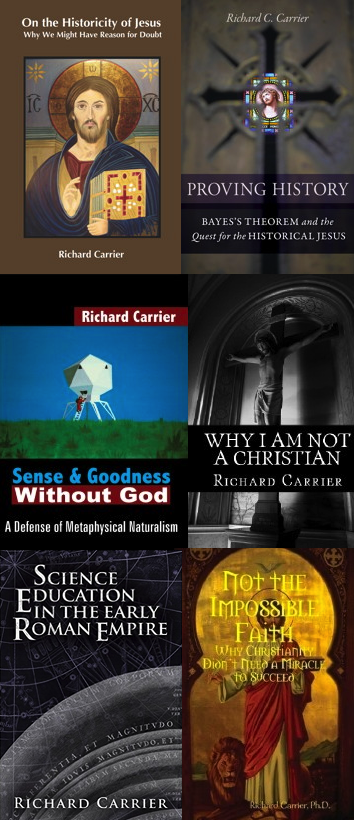
- In “Why the Romans Believed the Gospels,” R.G. Price (the other member of the Jesus seminar, not to be confused with R.M. Price) provides one of the most unique and interesting discussions of ancient epistemology, in particular the role of prophecy and its internal critique, to show that Christian miracle stories were designed to appeal to superstitious and fallacious epistemologies that were nevertheless stalwartly trusted at the time (in a way that are mostly mocked as childish today), and no Argument from Miracles can proceed in ignorance of this fact. (As such this chapter adds an important unit to my broader surveys of the same subject, which decided the difference between who really actually believed in Christianity and who didn’t even in its first centuries, in Not the Impossible Faith and the anti-intellectualism chapters of Scientist and Science Education).
- In “How New Testament Writers Helped Jesus Fulfill Prophecy,” professor of religious studies Robert Miller expands on that point by formally detailing what arguers on the internet take for granted: that the main miracle of Jesus is prophecy fulfillment (how he fulfilled prophecy and his own prophecies were fulfilled) by basically making it all up. This chapter gives a proper grounding of this fact.
- In “The Prophetic Failure of Christ’s Return,” historian Robert Conner zeroes in on the second aspect of that: how Jesus himself is necessarily a failed prophet and all attempts to deny or fix that are fallacious or specious.
- In “Five Inconvenient Truths That Falsify Biblical Revelation,” David Madison (with a doctorate in religious studies) documents several conceptual reasons (each backed with evidence) that the Bible fails to qualify as a miraculous book, and yet that failure alone argues against the reality of any of the miracles it describes, or any miracles at all.
- In “Evolution as Fact,” zoologist Abby Hafer explains the evidence for evolution and why science has settled that, and explains how all of that entails the miraculism of any creationism (young or old, biblical or speculative) is false, justifying a prior disposition to disbelieve all miraculism.
- In “Old Testament Miracle Genres as Folklore and Legend,” Old Testament historian Randall Heskett demonstrates why the evidence of the Bible fits the models of folklore and legend, not reliable truthtelling or objective reporting, and therefore should be treated like the former, not the latter. Includes good examples of comparative religion and form criticism.
- In “Science, Miracles, and Noah’s Flood,” journalist Clay Farris Naff illustrates the gist of all those chapters with a scientific analysis of one particular example: the Biblical myth of Noah’s Flood, usually avoided by modern apologists because it is so ridiculous. Yet it’s there.
- In “Jesus Christ: Docetic Demigod,” New Testament historian and ex-theologian Robert Price (R.M. Price) illustrates the gist of all those chapters with a properly contextualized historical analysis of incarnationalism and miraculous conception and glossolalia (speaking in tongues), as eruditely as ever.
The theme then shifts to reception history: how the miraculism of the Bible inspired subsequent quack miraculism of various kinds in later Christians that further demonstrates miracles aren’t a thing but only come to exist in fiction and fabrication.
- In “Miracles of the Christian Magicians,” Robert Conner returns to connect the depiction of apostolic miracle folklore in the Bible to subsequent Christian “magic shows” from the Middle Ages to now, and explains how what that looks like really (vs. what it would have were it real) is refutation enough of any Argument from Miracles, no matter what its referent.
- In “Credulity at Cana?” philosopher Evan Fales surveys all the different apologetical “interpretations” today of the “water to wine” story in the Gospel of John and what that tells us about the epistemic deficiency of Arguments from Miracles generally. As he concludes, the theory of authorial “creativity, love of narrative, and deep concern with both fundamental and quotidian” questions of “human existence” is always more probable on current evidence than “it happened.” And that ends every biblical Argument from Miracles. Fales includes a lot of interesting suggestions as to the meaning of this myth and how we can tell it is just a myth. Which teaches an approach we can bring to any other example (as Fales carries out in his excellent book, Reading Sacred Texts: Charity, Structure, Gospel).
- There are then two closing chapters that deal reasonably well with the specific miracle claim of the resurrection of Jesus: Loftus handles the creed and Gospels (with elegant efficiency), and Conner handles the specific case of the conversion of Paul (with a rather long treatment full of valuable observations). These chapters are useful and necessary for a book like this, and though for a complete treatment nothing beats the magnum opus, Pearce’s New Take-Down of Resurrection Apologetics, any PoR study of Arguments from Miracles in broad scope will benefit from Loftus and Conner’s additions to that.
Which is a lot of great analysis from a plethora of experts, all more than sufficient to make The Case Against Miracles also an essential addition to any PoR library. Indeed all three of these books get overlooked a lot, which is why I am bringing them back into view.
Conclusion
A complete up-to-date library or reading list in PoR would of course venture into advanced and technical works of great value, from Joseph Schmid and Dan Linford’s Existential Inertia and Classical Theistic Proofs (2022) to Paul Draper’s Atheism and the Problem of Evil (2025), and lesser known but superb studies like Richard Schoenig’s Where Christianity Errs (2024) and J.L. Schellenberg’s What God Would Have Known: How Human Intellectual and Moral Development Undermines Christian Doctrine (2024), among some two dozen other volumes I could recommend (including Sterba). But as I don’t research this subject so thoroughly as to know all the best lit on every subject in so vast a heap of tinfoil as PoR, and I think PoR is a really annoying distraction anyway, I won’t be building a recommendations list in it. But if you are interested in building one, these and the Loftus volumes I just discussed today, plus the two items that are on my Philosophy List (OTF and Primer), make a really good—and essential—start.
Discover more from Richard Carrier Blogs
Subscribe to get the latest posts sent to your email.






Interesting stuff, I couldn’t agree more that Biblical studies shouldn’t really be its own separate thing. I may well buy one of those books.
I have a recommendation too of an interesting author:
Professor Ronald Hutton of the University of Bristol.
He’s proof you can be an expert on lots of periods and different aspects of history, he’s an expert on Paganism in the British isles and on Neo-paganism, as well as the English Civil war and Oliver Cromwell (it’s impossible to study the politics of that era without knowing the religious disputes).
I can personally attest that “Pagan Britain” is an excellent book and he has a good lecture series on the Gresham college youtube site if anyone wants a taster. But don’t hesitate to buy any of his books.
Anyone who buys his civil war books should also read Christopher Hill’s work. Hutton tends to emphasise the religious aspects more, Hill more the class aspects, they have their disagreements, but they’re both excellent historians worth reading.
In the section “The Trouble with Miracles”, you have the sentence, “The last anthology defending miracles was thirty years ago, In Defense of Miracles, which I already debunked back then.”
Both links point to the Amazon page for the book. I think the second link was supposed to point to your Secular Web review of “In Defense of Miracles”
https://infidels.org/library/modern/richard-carrier-indef/
Thank you. You are right. Fixed.
Thanks for the reading recommendations! All of these look interesting, especially the Problem of Evil one. Unfortunately, my experience suggests that a disturbing number of Christians (at least the very Conservative ones) will either do mental jiu-jitsu like claiming that, actually, God is the only hope we have for a solution to Evil (let’s ignore the fact that it shouldn’t exist at all if He exists as described) or go with the Psychopath’s Response (“I don’t care” or even open mockery). I met one particularly strange one that acted in a way that would only be intellectually consistent if he were a (very unpleasant) atheist – he tried to act like it was absurd to complain about being dealt a bad hand by the universe, “that’s just the facts of life, kid” type justifications, and yet still claimed to be a Christian who believed in a good God. Maybe that’s just another example of the type of mental lapse mentioned above – they know the world is cruel and harsh, they believe God is loving, and they simply fail or refuse to connect the dots, as if they could simply take “the world is cruel” as a given without needing to reconcile that fact with their belief that it was created by a good God.
Oh, side-tangent, but have you ever heard of the case of St. Philomena? It seems like it would provide a challenge to the notion that a vivid and detailed “God Person” legend can’t arise without a historical basis, or in a short timespan. Basically, a skeleton was discovered in the Roman catacombs in 1802, with three tiles nearby inscribed with “pax tecum Filumena”. This person was completely unknown to both history and Catholic tradition until this point. There are absolutely zero references to a St Philomena prior to this point, not even daffy ones in a centuries-removed hagiography. Some people presumed that the grave was that of a martyr, but this was based on the flawed assumptions of people at the time. Then, in 1833, an Italian nun named Maria Luisa di Gesù claims to have spoken to Philomena in many visions, even recounting her life story. This story is filled with very obvious errors and anachronisms that prove it absolutely was just made up by an ignorant 19th century person with no knowledge of the time period it alleges to be from. “Philomena” claims to have been the daughter of a third-century “Greek King” who tried to marry her off to Diocletian in order to prevent him from making war upon his kingdom. I don’t think I need to explain to a historian of Rome how ludicrous this portrayal of the time is. There’s other bizarre details too, like Diocletian meeting them in the “Baths Palace” in Rome and immediately lusting for the 13-year old Philomena’s hand in marriage, which of course leads to refusal, torture, virgin martyrdom, all the usual. Where it gets really interesting is when St John Vianney starts having visions of her less than 10 years after this! He “corresponds” with her regularly, she has an entire fleshed-out personality, he attributes miracles and healings to her, and he generally spreads her cult far and wide. Vianney’s fame and popularity rub off on her and lots of people become devoted to her. So, in just a little over 40 years we go from literally just a name, a body, and a presumption of martyrdom to a fully-fleshed out mental person with a personality, backstory, relationships, and divine portfolio, believed in by thousands! Maybe I’m overestimating it, but that sure seems like it would be important data for the discussion about the prior plausibility of claims about the rise of Christianity, doesn’t it? It seems like that’d be evidence that Mythicism is plausible, wouldn’t it? OK, technically there was a body, but there was no prior historical memory of Philomena – every detail about her life is indisputably made up. The physical remains only provided seed ideas for the myth – they might as well not have existed.
Thank you Dr. Carrier. I find your research to be of tremendous importance to the world. I don’t have the discipline to gain the knowledge of ‘experts’ and scholars, so I’ve come to rely upon people who actually are. Escaping the desert death cult didn’t come easy, but your research and publications definitely made it reasonable – and necessary. The truth does matter, to me and hopefully many others. My growing library includes all of your work and several others that you’ve recommended. I’ve reread your books at least twice now, will do so again.
I realize this is off-topic for this post, but I also don’t want to post on an ancient thread, and I have a question about, well, Polycarp, specifically, in Polycarp’s Epistle to the Philippians 2:3, and what it implies about Polycarp’s knowledge of Luke (or lack thereof). And you strike me as one of the few people competent to answer this who might give me the time of day, and I will endeavor below to do as much of the work for you as I can.
(This passage is noteworthy as being the only place where the epistle supposedly references Luke).
I was reading the David Robert Palmer translation compilation (2022 edition of a 2010 original): https://bibletranslation.ws/down/Polycarp_Epistle_To_The_Philippians.pdf
2:3 μνημονεύοντες δὲ ὧν εἶπεν ὁ κύριος διδάσκων· Μὴ κρίνετε, ἵνα μὴ κριθῆτε· ᾧ μέτρῳ μετρεῖτε, ἀντιμετρηθήσεται ὑμῖν· καὶ ὅτι μακάριοι οἱ πτωχοὶ καὶ οἱ διωκόμενοι ἕνεκεν δικαιοσύνης, ὅτι αὐτῶν ἐστὶν ἡ βασιλεία τοῦ θεοῦ.
³but being mindful of what the Lord said in His teaching: “Judge not, that ye be not judged; forgive, and it shall be forgiven unto you; be merciful, that ye may obtain mercy; with what measure ye measure out, it shall be measured to you again; and once more, “Blessed are the poor, and those that are persecuted for righteousness’ sake, for theirs is the kingdom of God.”
I checked against Matthew, and the bold is from 7:1, while the underlined is from the end of 7:2. There’s no text between the two in the Greek Palmer gives. Yet his English translation gives the forgiveness and the merciful phrases with no Greek text?
So I checked another translation, which gives this Greek:
2:3 μνημονεύοντες δὲ ὧν εἶπεν ὁ κύριος διδάσκων· Μὴ κρίνετε, ἵνα μὴ κριθῆτε· ἀφίετε, καὶ ἀφεθήσεται ὑμῖν· ἐλεᾶτε, ἵνα ἐλεηθῆτε· ᾧ μέτρῳ μετρεῖτε, ἀντιμετρηθήσεται ὑμῖν· καὶ ὅτι μακάριοι οἱ πτωχοὶ καὶ οἱ διωκόμενοι ἕνεκεν δικαιοσύνης, ὅτι αὐτῶν ἐστὶν ἡ βασιλεία τοῦ θεοῦ.
Okay, now we have Greek text there, at least.
Here’s Luke’s forgiveness phrase (6:37): ἀπολύετε καὶ ἀπολυθήσεσθε
Here’s Luke’s merciful phrase (6:36): Γίνεσθε οἰκτίρμονες καθὼς καὶ ὁ Πατὴρ ὑμῶν οἰκτίρμων ἐστίν
Those are not direct references to Luke. And then I remembered I’d seen ἐλεᾶτε, ἵνα ἐλεηθῆτε before, in 1 Clement, which has “Ἐλεᾶτε, ἵνα ἐλεηθῆτε· ἀφίετε, ἵνα ἀφεθῇ ὑμῖν” in 13:2. Identical on the mercy phrase, and… that looks a lot closer to the forgiveness phrase as well.
So, why does this get annotated as a reference to Luke rather than 1 Clement? And is that Greek actually in Polycarp’s letter at all? (I’ve got two versions of the Greek, and they don’t agree… If Palmer’s is wrong, how has it not been corrected in >10 years? Surely someone far more competent than me in Greek would have noticed… and how does Palmer end up giving an English translation for Greek text he doesn’t present?)
Anyway, on to the interesting part, having disposed of those claimed Lukan references, we get to the last ‘quote’ in the passage, which largely looks like a blend of Matthew and Luke’s “Blessed are the poor” line. (Leaves out ‘in spirit’ from Matthew, follows Matthew on “αὐτῶν” but Luke on “τοῦ θεοῦ”). Except it also includes this entirely separate phrase: “καὶ οἱ διωκόμενοι ἕνεκεν δικαιοσύνης”, which is in neither Luke nor Matthew… And this is the last remaining reference to Luke in the epistle I’m aware of, so i have to wonder:
I can’t be the first person to notice this, just from casually looking into it as a lay person, right?
Sorry again for the off-topic post.
I haven’t looked into that, so I don’t have a specific opinion about it, but it’s not an unusual problem to find in the scholarship. See my Ignatian Vexation for a similar conundrum I gave up on solving because it’s too much work for too little gain, as I suspect is the case here—which only means gain in re: my own work; for someone else it may be worthwhile, and there may even be scholarship on this already, you’d have to look around.
To answer whether anyone has discussed the specific thing that interests you, start with judicious keyword searches in Google Scholar; likewise locating any editions of or commentaries on this epistle published in the last fifty years, as they may have notes on the point. It’s complicated by the fact that you first have to confirm a stable Greek text (are there manuscript variants here?); and set aside questions like whether Polycarp actually wrote this or whether it was assigned to him later; and whether the letter is a unity or has been interpolated; and so on. Wikipedia will give you a sense of these problems though.
But the reason I can’t spend time on it (unless I were hired to) is that it won’t matter what the outcome is to anything I argue. It can’t be established that this letter was written before publication of the fourfold Gospel against the Marcionite canon. And if it was after, then whether he quoted Luke in this letter or not makes no difference to that fact. And that’s the only fact relevant to my own work. This gets into the vexations of dating, e.g. the latest and best scholarship puts Ignatius much later than tradition, and Polycarp’s “edition” of them will have been later still, possibly decades later for all we know; there are also multiple redactions of the Ignatians, raising the problem of when this letter was edited: for which edition? And so on.
Long story short:
Once you realize how many fucking weeds and sandtraps this is buried in, you start to lose enthusiasm for even bothering to solve problems like yours. I explain this emotive effect in my article about Ignatius (where I end drinking gin straight from the bottle). And that is already obsolete because the field has even made everything more complicated about Ignatius since I wrote it!
Thanks for the response. Ug, what a mess.
BTW, I should add that Ignatius clearly knows the text of Luke (or at least Marcion’s version of Luke, though being an anti-Marcionite, it’s unlikely that’s the version Ignatius is referencing), so if Polycarp’s letter is taken as a reference to the letters of Ignatius, this would at least entail that Luke predates Polycarp. But there are many uncertainties to pick at even there (as I note in Ignatius Vexation).